The upper half-plane is the open setIt contains precisely the complex numbers with positive imaginary part: is inside, lies on its boundary, and belongs to the lower half-plane. In the complex plane its boundary is the real line; in the Riemann sphere the boundary also includes infinity. It is a convex set, hence a simply connected domain, and the Cayley transform between the half-plane and disk makes it biholomorphic to the unit disc.
With the hyperbolic metric , the same domain becomes the Poincaré half-plane model. Its hyperbolic geodesics are vertical lines and upper semicircles whose centres lie on the real line. Under the Cayley transform, these become arcs of circles orthogonal to the unit circle, with diameters as the straight-line cases. [ref]
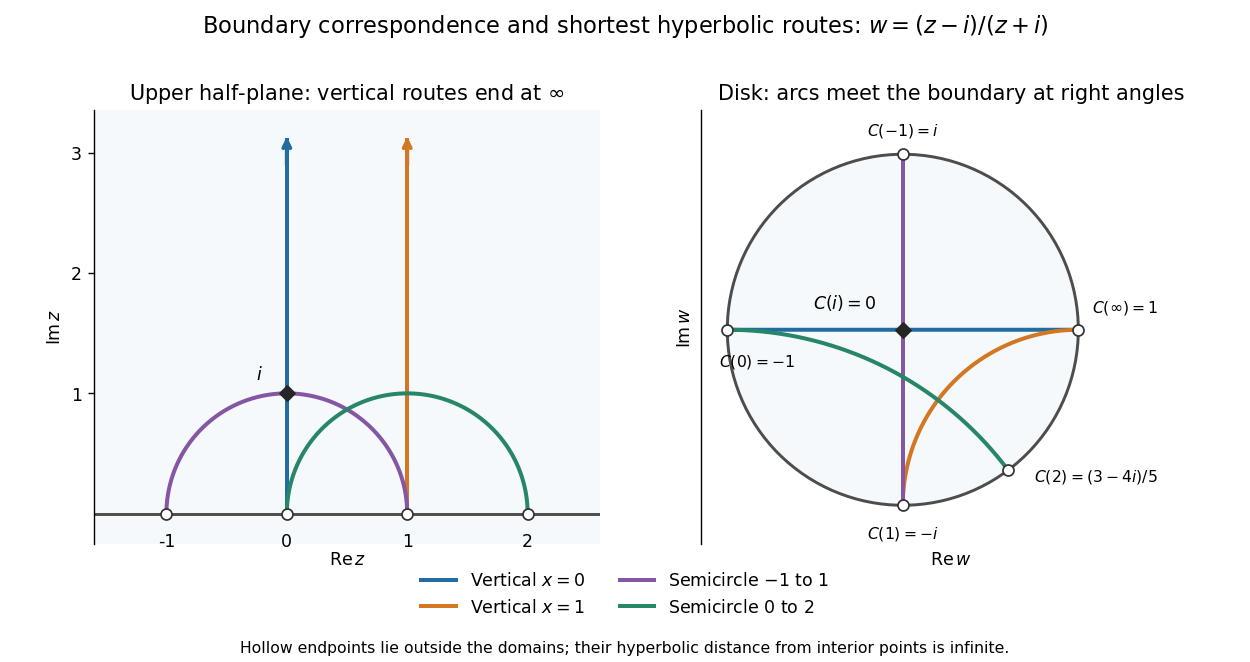
Boundary points and hyperbolic geodesics correspond under the Cayley transform from the upper half-plane to the unit disc
. Details. 
Matching colours identify each hyperbolic geodesic and its image. The vertical line through zero maps to a diameter; the vertical line through one maps to an arc ending at and . A semicircle from to also maps to a diameter, whereas the semicircle from to maps to a curved arc. Their endpoints lie on the boundary, outside the domains: the endpoints are infinitely far from interior points in hyperbolic distance.
The upper half-plane is useful because its straight boundary and explicit upper half-plane automorphisms make conformal maps and hyperbolic geometry calculable. The picture explains why shortest hyperbolic geodesic routes can look curved in Euclidean coordinates; their lengths are measured with the position-dependent hyperbolic metric.
For historical context, in his letter to Klein of 22 September 1882, Poincaré constructs a quadrilateral bounded by four circles orthogonal to a fundamental circle, and studies transformations generating repeated copies. In modern language, the sides inside that circle are hyperbolic geodesics in a disk model. The letter directly exhibits the connection between transformation groups, geometry and complex functions. [ref]
https://henripoincarepapers.univ-nantes.fr/chp/text/klein-en-1882-09-22.html. Poincaré to Klein, 22 September 1882, English translation, opening construction
Every conformal automorphism of the upper half-plane is a Möbius transformation with real coefficients and positive determinant, and conversely every such map is a conformal bijection of the upper half-plane to itself:The real-coefficient and sign conditions matter. The complex Möbius transformation sends to on the boundary, while the real Möbius transformation has negative determinant and sends to in the lower half-plane. [ref]
https://math.ucdavis.edu/~romik/data/uploads/teaching/math205a-2018/mat205a-2018-hw4.pdf. Romik, Complex Analysis, Homework 4, page 3, automorphism statement 5
For two concrete upper half-plane automorphisms, takeBoth matrices have determinant one. Here , , and . On the extended real line, fixes infinity and exchanges zero and infinity. On the unit disc, the same maps become and ; the second is simply .
Multiplying all four coefficients by a nonzero real scalar leaves unchanged. Dividing them by normalizes the determinant to one; the two remaining representatives and give the same map. Thus the group under function composition is the projective special linear groupwhere is the real special linear group of degree two. Composition of the Möbius transformations corresponds to multiplication of their matrices. [ref]
On the boundary,So preserves the cyclic boundary orientation of the extended real line; when , its pole at prevents treating it as a single increasing function across that point on the ordinary real line. Three distinct boundary images determine a Möbius transformation uniquely, but an upper half-plane automorphism can realize only triples with matching cyclic boundary orientation.
A brief proof outline starts with the identitiesThey show that and its inverse function preserve the upper half-plane. For completeness of the classification, conjugate an arbitrary conformal bijection by the Cayley transform. Normalize its image of zero with an automorphism of the unit disk, then apply the Schwarz lemma to the resulting map and its inverse function; both inequalities force a rotation. Conjugating back gives the real Möbius transformation above.
Finally, and the displayed imaginary part identity show that . Every upper half-plane automorphism is therefore also an isometry of the Poincaré half-plane model. The same formulas describe both holomorphic coordinate symmetries and motions of the hyperbolic plane.
Articles by others on the same topic
There are currently no matching articles.