A weak electrolyte yields only a fraction of ions from its dissolved substance under the specified conditions, as illustrated by acetic acid in water.
For a neutral weak acid, unconverted molecules coexist with hydronium and the conjugate base at chemical equilibrium. The weak acid dissociation fraction describes the partition of the dissolved inventory; the acid dissociation constant describes the chemical equilibrium at fixed solvent, temperature and standard states. A single fraction is not a permanent label for every concentration: dilution can increase that fraction while the acid dissociation constant stays fixed. Calling a substance a weak electrolyte does not mean its chemical solution must be dilute.[ref]
14.3 Relative Strengths of Acids and Bases. Chemistry 2e, §14.3, Acid and Base Ionization Constants, percent-ionization discussion preceding Example 14.7
The following ideal weak electrolyte dilution law makes the distinction quantitative for a monoprotic acid. Other weak electrolytes, mixed chemical solutions and additional proton-transfer steps require their own chemical equilibrium and inventory balances.
Consider a neutral monoprotic acid dissolved in water, with no added salts or other acids. Assume dilute ideal thermodynamic activities, fixed temperature, water thermodynamic activity one, and negligible self-ionization of water. Write for its analytical concentration, with , and for its weak acid dissociation fraction. Conservation of acid units and electric charge givesHere is the conjugate base, and is conventional shorthand for hydrated hydrogen ions, represented by hydronium in this model. Substitution into the dimensionless acid dissociation constant givesSolving this quadratic equation and rejecting its negative root of a polynomial gives an exact result within the stated model:The second form avoids subtracting nearly equal numbers. Unlike the approximation , it retains depletion of neutral weak acid and always satisfies for positive . The broader weak acid mass and charge balances restore self-ionization of water when that omitted contribution matters.
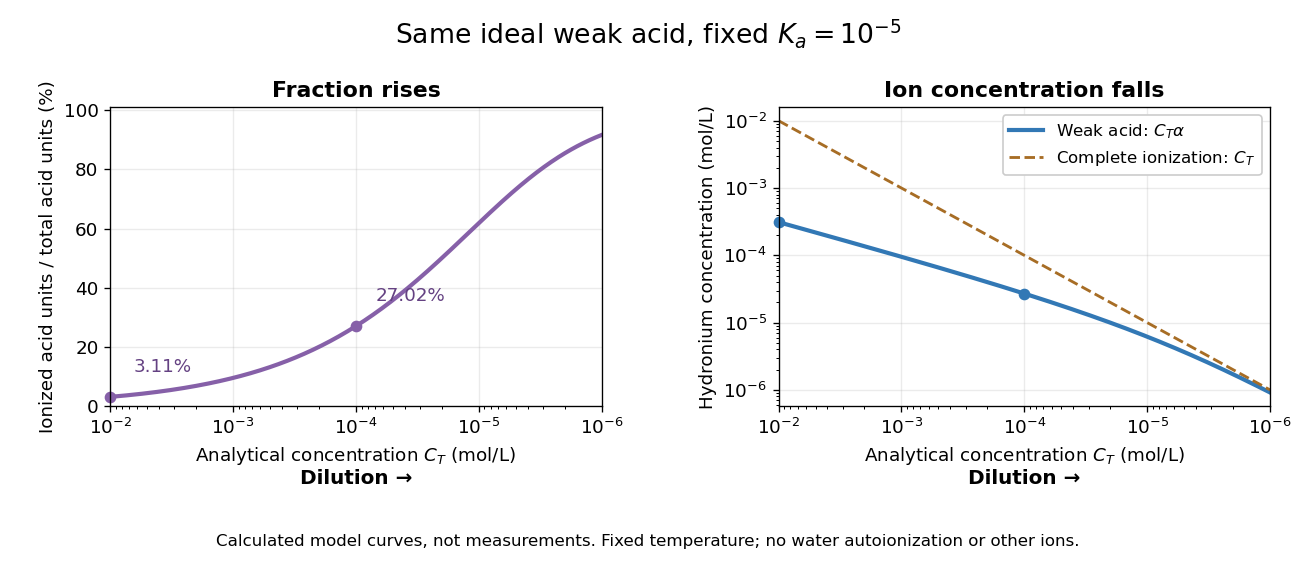
Dilution increases the ionized fraction while decreasing the absolute hydronium concentration in an ideal weak electrolyte model
. Original calculated curves for stipulated dimensionless acid dissociation constant at fixed temperature, not measurements of a named chemical acid. The shared horizontal analytical concentration axis decreases to the right. Separate panels show weak acid dissociation fraction and ; a dashed comparison shows a completely ionized monoprotic acid at the same . Both omit self-ionization of water, other ions and nonideal thermodynamic activities. Details.
For an original worked example, stipulate without identifying a real substance. At , the weak acid dissociation fraction is approximately , or , and . A hundredfold dilution to raises the fraction to , or , but lowers to . A completely ionized strong acid at would have : less than the more concentrated weak acid in the first calculation, despite its greater converted fraction.
The directions of both changes follow without relying on the plot. Put . Rearranging the chemical equilibrium relation givesThus smaller forces smaller , which in turn makes larger. The derivative proves that total hydronium concentration and converted fraction move in opposite directions during dilution. In this model, adding solvent also makes additional acid units ionize at fixed total acid amount of substance, even though their ions are spread over more volume. That distinction explains why “more ionized” alone does not predict greater electrical conductivity.
Do not extend the no-background model to unlimited dilution: its prediction omits water's own ions. The weak acid mass and charge balances include that background. Added salts, other acids or bases, and nonideal activity coefficients also change the relation between analytical concentration, converted fraction and hydronium concentration.
Articles by others on the same topic
There are currently no matching articles.