Put a contact thermometer in thermal contact with , wait for thermal equilibrium, and record response . Repeat with under the same operating constraints. If , and the calibrated response is an injective function of temperature on this range, occupies the same thermal reference state in both comparisons. The zeroth law of thermodynamics then predicts . Equality of raw numbers from different uncalibrated thermometers supplies no such premise.[ref]
University Physics Volume 2 by Samuel J. Ling and others. §1.1, Figure 1.2 and following paragraph: a thermometer measures its own temperature and transfers the equilibrium comparison
Use a probe whose participating heat capacity is small relative to each sample, or use maintained heat baths. Otherwise the matching readings describe the disturbed final states. Also hold the probe's immersion and mechanical conditions fixed: its response can depend on more than temperature. Matching readouts only tests agreement within resolution and repeatability, rather than proving exact equality of temperatures.
Agreement within a tolerance is not itself an equivalence relation. With a tolerance, readings and each agree with , yet disagree with each other. This is a limitation of the measurement rule, not a failure of the exact transitivity asserted by the zeroth law of thermodynamics.
Consider an original worked thermometer calibration, using the height of a liquid column responding through thermal expansion. Stipulate two equilibrated reference baths whose corrected thermometer readings are and , in degree Celsius units. Suppose the corresponding column heights are and . These are constructed inputs, not observed measurements. Assume the response is linear over this interval, with the same immersion and reading procedure throughout. Applying thermometer calibration givesFor , first subtract the zero-reference height, then divide by the full reference span: . Multiplying by the span gives , or in kelvin. Thus equal readings in separately equilibrated samples test equal temperatures, regardless of how much internal energy those samples contain. The Celsius offset and modern absolute-scale definition are described in degree Celsius and kelvin.
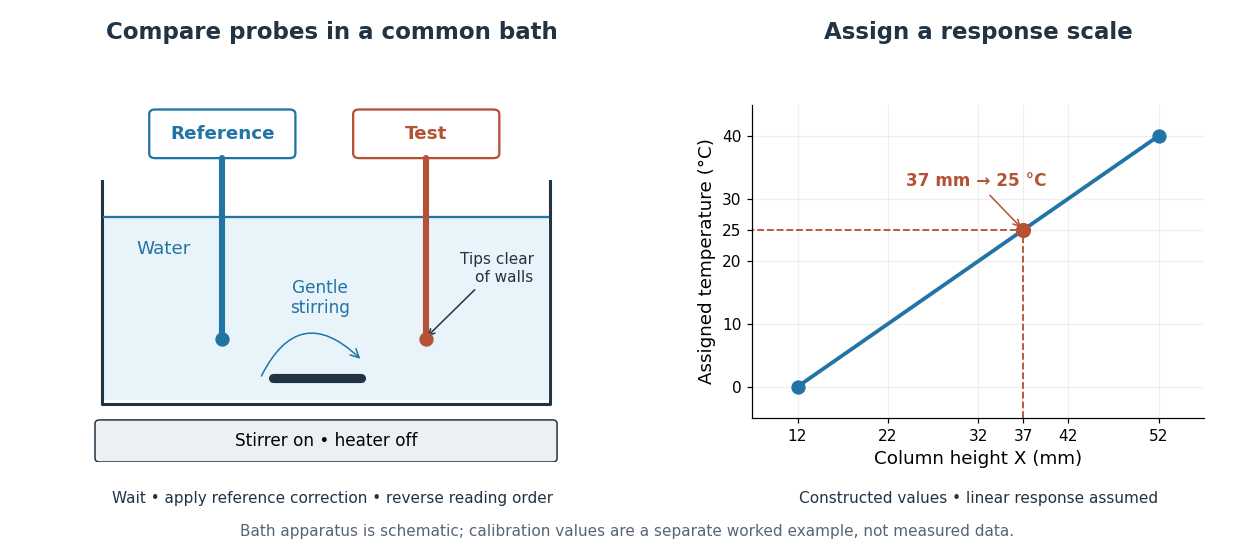

The two endpoints determine the assumed line, but do not establish linearity. An independent middle reference and a return to the initial bath can test curvature and drift. If the height has an error of while reference values and endpoints are held exact in this calculation, the inferred temperature error is ; that is only the height contribution, not a full measurement error budget. A boiling-water reference needs a measured atmospheric pressure correction, rather than an automatic assignment. The modern kelvin is not defined by either bath.
A motivating real procedure is NIST's ambient thermometer verification. Its apparatus is a deep beaker of water, a calibrated reference thermometer, a test thermometer, and a magnetic stirrer with any heater switched off. Let the water approach room temperature, stir gently, immerse both sensing tips well below the surface, and wait before reading. NIST specifies about of water, – immersion where possible, and an initial five-minute wait. Record test then reference, repeat in reverse order, and apply the reference's certificate correction. Subtract corrected reference from test: the difference estimates the test instrument's error at this bath temperature. Agreement between the two reading orders checks repeatability. [ref]
Mercury Thermometer Alternatives: Verification Methods for Alternative Thermometers by National Institute of Standards and Technology. “Comparison with another calibrated thermometer at ambient temperature”, apparatus and steps 1–10; “Measurement at the steam point”, pressure and elevation correction
For example, suppose a test reads , a reference reads , and its certificate says to add . The corrected reference is , so the test error is : it reads high. These are illustrative readings. This verification tests a previously calibrated instrument at one point; it does not establish the two-point response used in two-point thermometer calibration example.
Additional controls follow from the thermal equilibrium premise. Keep tips away from walls and bottom, interchange probe positions to test a temperature gradient, and check that longer waits and modest immersion changes leave agreement unchanged within the required tolerance. A flat trace alone can be a steady state maintained by competing heat transfer paths. Five minutes is a procedural starting point, not a universal equilibration time. Excessive stirring can supply work and warm the bath, while probe stems can exchange heat with the room. These controls test whether both probes sample the same state; neither one-point agreement nor this experiment proves the zeroth law of thermodynamics for every material and condition.
Articles by others on the same topic
There are currently no matching articles.