If two thermodynamic systems are each in thermal equilibrium with the same third system in the same equilibrium state, they are in thermal equilibrium with each other. Write for this relation. The zeroth law of thermodynamics supplies transitivity:Its symmetric relation property and self-equilibrium (reflexivity), together with transitivity, make thermal equilibrium an equivalence relation. Its equivalence classes can be labelled by a common empirical temperature; choosing an absolute numerical scale requires the further structure of thermodynamic temperature.[ref]
4 Classical Thermodynamics. §4.1, printed pp. 109–110: thermal contact, transitivity and temperature labels
The comparison assumes internally equilibrated macroscopic bodies, unchanged composition and mechanical constraints, and contact permitting only heat exchange. Use rigid, impermeable diathermal walls so that neither matter transfer nor boundary work spoils the test. The same state of matters: letting warm while measuring , then cool while measuring , does not supply the premise. Ordinary nonrelativistic laboratory thermodynamics is assumed; the Tolman temperature law treats gravitational qualifications. Equal temperatures establish the thermal condition, without requiring mechanical equilibrium or chemical equilibrium.
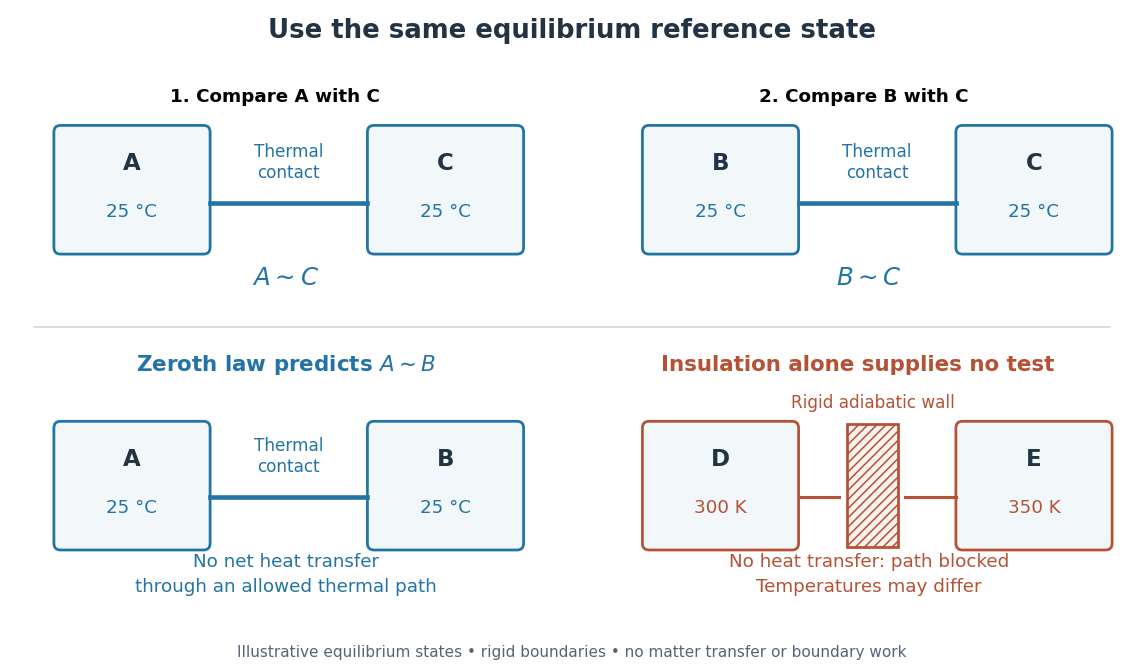
This explains why a thermometer can compare unlike materials: it supplies a reusable third system. A temperature is a property of an equilibrium state, while heat is energy transferred because of a temperature difference. Two bodies at the same temperature can have different internal energies and heat capacities. A thermometer therefore does not measure a body's stored amount of heat; the finite-body disturbance and waiting-time calculations in thermometer describe how making the comparison can change the state being measured.[ref]
The name “zeroth” reflects logical order rather than the date of the first thermometer: this premise about thermal equilibrium precedes the already numbered first law of thermodynamics, Second law of thermodynamics and Third law of thermodynamics. This is the naming explanation given in University Physics Volume 2 by Samuel J. Ling and others (§1.1, “Thermal Equilibrium”).[ref]
University Physics Volume 2 by Samuel J. Ling and others. §1.1, paragraph introducing the zeroth law: retrospective numbering; the textbook credits the name to Ralph Fowler in the 1930s
The corresponding Zeroth law of black-hole mechanics states constancy of surface gravity over an equilibrium horizon; Hawking radiation identifies that quantity with physical temperature up to its universal conversion factor.
Articles by others on the same topic


The Zeroth Law of Thermodynamics is a fundamental principle that establishes a basis for the measurement of temperature. It states that if two systems (let's call them A and B) are in thermal equilibrium with a third system (C), then A and B are also in thermal equilibrium with each other.