Articles by others on the same topic

Heat is energy transferred across a thermodynamic system's boundary because of a temperature difference. It is measured in joules, like work and internal energy. A hot cup transfers heat to cooler surroundings; its temperature describes its state, while the transferred heat describes a process. The cup stores internal energy, rather than a substance called heat. [ref]
https://openstax.org/books/university-physics-volume-2/pages/1-4-heat-transfer-specific-heat-and-calorimetry. Ling, Moebs and Sanny, OpenStax, University Physics Volume 2, section 1.4: heat and internal energy
For a closed system with unchanged bulk kinetic energy and potential energy, choose for heat entering and for work done by the system. The first law of thermodynamics givesHere is the stored internal energy. For example, a sealed piston cylinder receiving of heat and delivering of work gains of internal energy. A closed system retains its matter while exchanging energy; it need not be an isolated system. [ref]
https://openstax.org/books/university-physics-volume-2/pages/3-3-first-law-of-thermodynamics. Ling, Moebs and Sanny, OpenStax, First law of thermodynamics and sign conventions
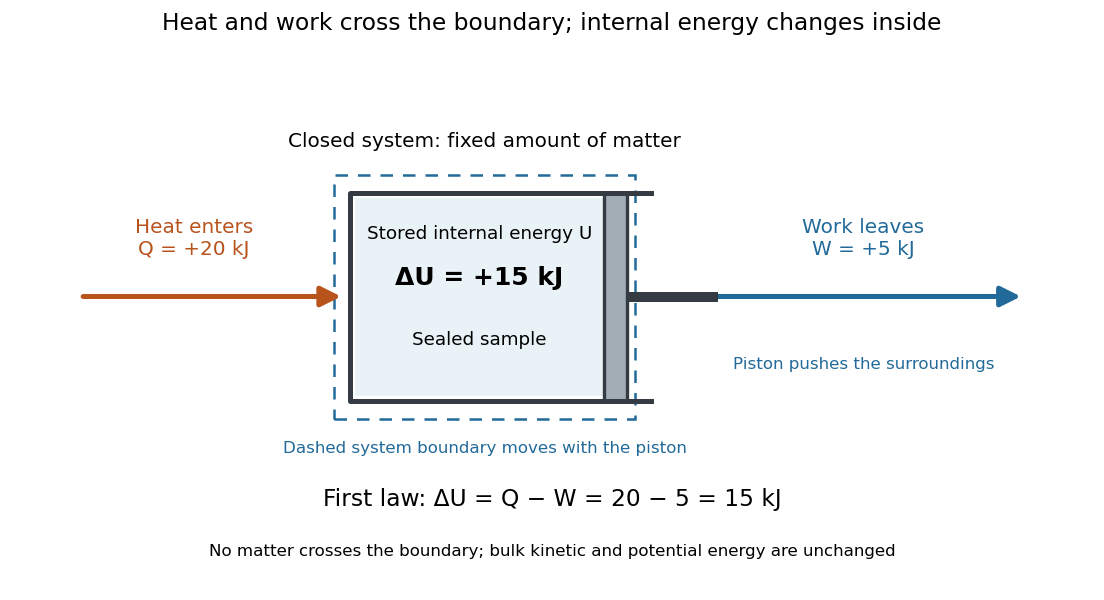

Unlike internal energy, heat is not a state function: different paths between the same equilibrium states can transfer different , with compensating differences in work. The symbol records this dependence on the path; there is no stored quantity whose difference is always . The two paths in first law of thermodynamics illustrate this directly. Supplied heat can raise temperature as sensible heat, change a phase fraction through latent heat, or help supply expansion work. Measuring temperature alone therefore does not determine transferred heat.
For a reversible thermodynamic process, , where is absolute temperature and is entropy. This identification requires reversibility: an irreversible adiabatic process has and can nevertheless increase entropy. Likewise , with enthalpy , requires the particular fixed-pressure conditions in enthalpy. These distinctions make heat useful as a precise boundary-transfer quantity in heat engines, refrigerators and heating calculations.
Historically, James Prescott Joule's paddle experiments showed that stirring water with input work could raise its temperature, helping establish conservation of energy. The lesson is still useful: a temperature rise can result from work even without incoming heat. [ref]
https://openstax.org/books/university-physics-volume-2/pages/1-4-heat-transfer-specific-heat-and-calorimetry. Ling, Moebs and Sanny, OpenStax, section 1.4: Joule's paddle experiment