Articles by others on the same topic

Simple harmonic motion is motion in which the acceleration is proportional to the displacement from equilibrium and points back towards it:Here is measured from equilibrium, and is the constant angular frequency. For a point mass attached to an ideal spring, Hooke's law gives the restoring force , with stiffness , and Newton's second law yields . The minus sign matters: for the force is negative, and for it is positive. A restoring force need not oppose velocity; on the return towards equilibrium it increases speed.
The general solution isThe amplitude and oscillation phase encode the initial conditions. We use for the oscillation period to distinguish it from kinetic energy . For , the oscillation period is independent of amplitude, the property of isochronous harmonic motion. At the body remains at equilibrium. [ref]
https://ocw.mit.edu/courses/8-01sc-classical-mechanics-fall-2016/mit8_01scs22_chapter23.pdf. MIT mechanics, Chapter 23, sections 23.2 and 23.3
Choose , , and release the mass from rest at displacement . Then , , and . Writing time in seconds,At the velocity vanishes, but the acceleration is : a turning point is not a state of rest that persists. At , the body crosses equilibrium with velocity and zero acceleration. At it reaches the opposite turning point, .
Taking potential energy zero at equilibrium, the same solution givesAt each turning point all mechanical energy is potential energy; at each equilibrium crossing it is kinetic energy. Both repeat twice during one complete position cycle because squaring removes the sign. At , for example, each contributes .
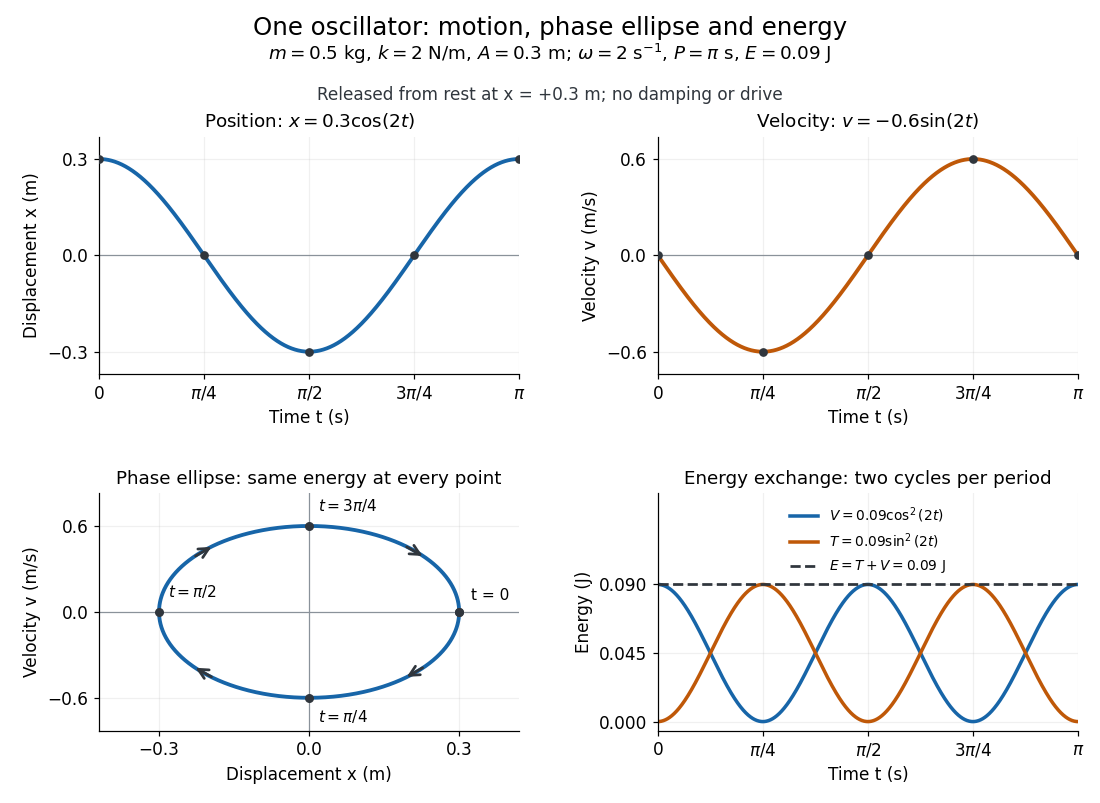
Position, velocity, phase ellipse and energy exchange for a mass of 0.5 kg on a spring of stiffness 2 N/m
. Details. 
The physical position trace covers a line segment, in metres. In the phase plane, the paired position and velocity instead trace the ellipseThis is precisely , rewritten: the single conserved mechanical energy fixes the amplitude and the whole ellipse. It does not fix the starting oscillation phase. At both and lie on it; position alone cannot distinguish them. Replacing by momentum gives the equivalent phase-space trajectory. The arrows show increasing time, clockwise in coordinates.
This closed ellipse assumes a time-independent spring and no damping or applied drive. Adding a resisting force , , gives and . An underdamped damped harmonic oscillator spirals inward in the phase plane, crossing successively smaller energy contours. The ideal harmonic oscillator is also useful beyond springs: near a smooth potential energy minimum with , its Taylor expansion begins with . For sufficiently small displacements, this gives the same restoring force to leading order, explaining why small oscillations share one solvable pattern.