Topics (384k) Articles (398k) Users (410) Discussions (242) Comments (383) Files (13k) New article
Supersymmetric covariant derivatives anticommute with the supersymmetry generators. Their antichiral member defines a chiral superfield through .
A characteristic coordinate is a function constant along one family of characteristics. For a second-order equation in two variables, two independent characteristic coordinates reduce the principal part to a mixed derivative.
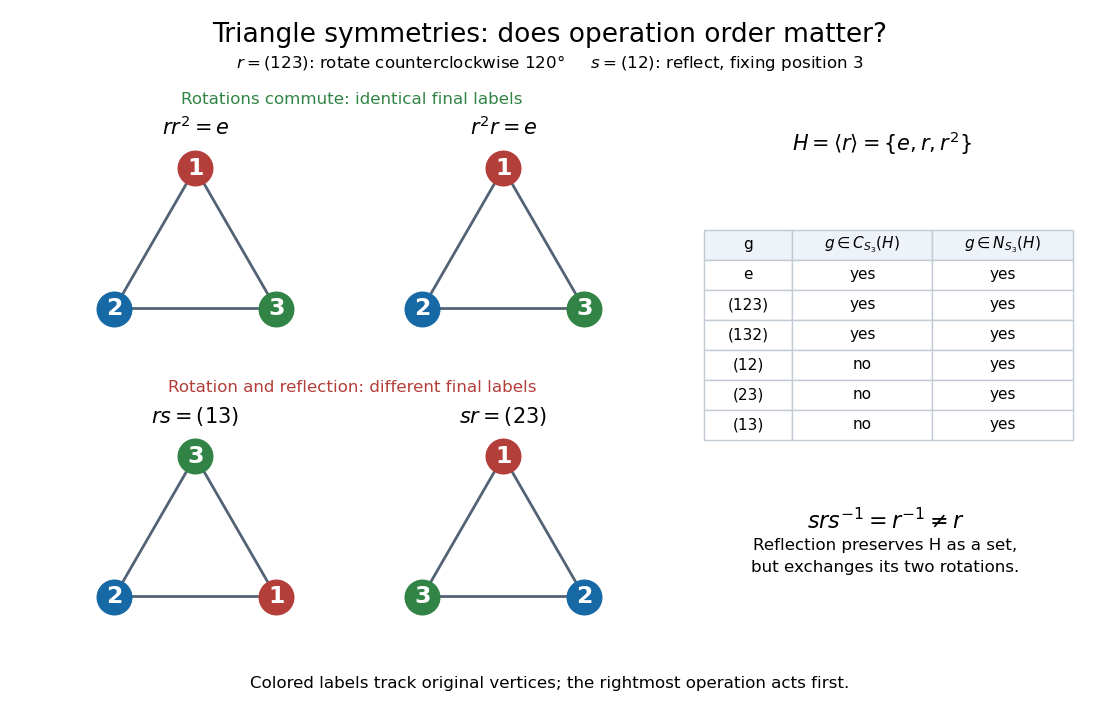
The centralizer of an element of a group consists of all elements that commute with :It is the stabilizer subgroup of under the conjugation action, hence a subgroup of . In conjugacy classes of the symmetric group on three letters, the three representative computations areFor the transposition , a commuting permutation must preserve the exchanged pair and fix ; only and do so. For , a commuting permutation is determined by where it sends : the equation forces the images of and , leaving exactly . For , every permutation commutes. These centralizer sizes give conjugacy class sizes .
The centralizer is useful because it measures how much freedom remains after fixing one operation. Its index of a subgroup counts the distinct results of conjugation, and the intersection of all element centralizers is the center of a group. A centralizer need not be an abelian group: even when is a nonabelian group. In an abelian group, all element centralizers equal . These observations also explain why the surrounding group matters: the centralizer of inside the alternating group is the whole , whereas its centralizer inside is a proper subgroup. See McKernan, the centralizer definition preceding lemma 23.6.
For an arbitrary subset , the centralizer of a subset fixes every element of individually under the conjugation action:This is a pointwise stabilizer of the elements of , not of the vertices of a polygon in a geometric realization. In particular, belongs to although its rotation moves every vertex of a polygon of the equilateral triangle. If generates a subgroup , commuting with every element of implies commuting with every product of those elements and their inverse elements; hence . For the triangle rotation subgroup , this gives .
To see the commutation test directly on the equilateral triangle, compare a rotation with the reflection . Their permutations satisfyThe two orders send vertex of a polygon to different places: , but . Thus . By contrast and commute, with . The reflection reverses the chosen rotation while preserving the subgroup of all triangle rotations, so . The distinction is visible before any counting: commuting preserves an operation itself; membership in the normalizer permits exchanging it with another operation in the same subgroup.
A causal null hypothesis states that an intervention has no effect on a specified potential-outcome contrast. A sharp causal null sets every unit's treated and untreated potential outcomes equal; an average causal null sets their population mean difference to zero.
The exponential in the category of posets is the poset of monotone maps ordered pointwise. Evaluation is monotone, and currying gives the cartesian-closed adjunction.
For a continuous semimartingale with local time of a semimartingale ,for every nonnegative measurable function .
Talagrand's one-sided bounded differences inequality by  Codex 0 Created 2026-09-24 Updated 2026-11-05
A useful precise version of Talagrand's one-sided bounded differences inequality assumes that independent random variables enter a measurable function for which there are nonnegative coordinate weights satisfying the global comparisonPut and . When and is integrable,The global comparison is stronger than bounding separate coordinate changes at one input. This distinction matters for a lower tail.[ref]
For a differentiable convex function on , the supporting-gradient inequality verifies the comparison with . Thus controls the lower tail. Applying the theorem to the negative of a concave function gives its upper tail. For example, has , giving as a valid, though conservative, lower-tail bound.
For , couple Bessel flows with the same Brownian motion and let . ThenIt is the probability that the SLE hull swallows the chosen point on the negative side before the point on the positive side.
At the integrable curvature scale on the Poincare disc, the vortex Taubes equation reduces to the Liouville equation. Holomorphic self-maps of the disc then generate explicit vortex solutions.
For a finite group presentation, the relator exponent-sum matrix records in row the total exponent of each generator in relator . It presents the abelianization of the group. For a balanced presentation of a perfect group, it is a unimodular matrix.
A slump test for yield stress probes a material by allowing a molded sample to deform under its own weight. Fill a known mold on a level support, remove the mold, and measure the decrease in height or the spread of the final deposit. Gravity supplies the driving stress; resistance associated with the yield stress can arrest the motion before the sample becomes a thin layer.
The measured distance is not itself a stress. Inferring yield stress requires a calibrated relation or a mechanical model using the initial geometry, final shape and density. The final slump alone generally cannot identify both yield stress and dynamic viscosity: a time-resolved measurement provides additional information. A modified concrete test, for example, records the time required for a specified fall as well as the final slump.[ref]
Modified Slump Test to Measure Rheological Parameters of Fresh Concrete. pp. 241–247, abstract and apparatus: final slump and additional time measurement for rheological parameter estimation
The procedure is useful as a simple field measurement, with interpretation dependent on sample history and geometry.Where the stress in a yield-stress fluid remains below the yield stress, the shear rate vanishes and the material moves as an undeformed plug bounded by yielded layers.
A Herschel–Bulkley fluid is unyielded for and obeys after yield. The parameters and are its consistency and power-law index.
The epsilon expansion computes critical quantities perturbatively in below an upper critical dimension . For scalar quartic theory, and the Wilson-Fisher fixed point coupling is of order .
An O(N) model has a real -component order parameter with symmetry under the orthogonal group . A standard Landau-Ginzburg theory free energy isThe gradient term penalizes spatial variation, tunes the transition, and the positive quartic term bounds the local free energy below. The case has a sign symmetry; for , rotations mix the components.
In , the standard short-range model's continuous critical transition is governed by a Wilson-Fisher fixed point for the corresponding -component order parameter. Near , the epsilon expansion treats the interaction perturbatively because its engineering dimension is . [ref]
Critical Exponents in 3.99 Dimensions by Kenneth Geddes Wilson and Michael Ellis Fisher. 1972 paper, small-epsilon interacting fixed-point construction; model normalization declared explicitly here
The dimension restriction matters. At and above the upper critical dimension , the Gaussian description controls the usual critical powers, with logarithmic qualifications at . Lower-dimensional continuous-symmetry models can have different transition behavior, including the Berezinskii–Kosterlitz–Thouless transition. Thus the fixed-point claim must be matched to dimension, symmetry and the range of interactions.
The Wien displacement constant is the constant of proportionality in . From the exact International System of Units values of the Planck constant, speed of light and Boltzmann constant,The units follow from : . The defining constants are exact; the displayed decimal is rounded. [ref]
Pinned article: Introduction to the OurBigBook Project
Welcome to the OurBigBook Project! Our goal is to create the perfect publishing platform for STEM subjects, and get university-level students to write the best free STEM tutorials ever.
Everyone is welcome to create an account and play with the site: ourbigbook.com/go/register. We belive that students themselves can write amazing tutorials, but teachers are welcome too. You can write about anything you want, it doesn't have to be STEM or even educational. Silly test content is very welcome and you won't be penalized in any way. Just keep it legal!
Intro to OurBigBook
. Source. We have two killer features:
- topics: topics group articles by different users with the same title, e.g. here is the topic for the "Fundamental Theorem of Calculus" ourbigbook.com/go/topic/fundamental-theorem-of-calculusArticles of different users are sorted by upvote within each article page. This feature is a bit like:
- a Wikipedia where each user can have their own version of each article
- a Q&A website like Stack Overflow, where multiple people can give their views on a given topic, and the best ones are sorted by upvote. Except you don't need to wait for someone to ask first, and any topic goes, no matter how narrow or broad
This feature makes it possible for readers to find better explanations of any topic created by other writers. And it allows writers to create an explanation in a place that readers might actually find it.
Figure 1. Screenshot of the "Derivative" topic page. View it live at: ourbigbook.com/go/topic/derivativeVideo 2. OurBigBook Web topics demo. Source. - local editing: you can store all your personal knowledge base content locally in a plaintext markup format that can be edited locally and published either:This way you can be sure that even if OurBigBook.com were to go down one day (which we have no plans to do as it is quite cheap to host!), your content will still be perfectly readable as a static site.
- to OurBigBook.com to get awesome multi-user features like topics and likes
- as HTML files to a static website, which you can host yourself for free on many external providers like GitHub Pages, and remain in full control

Figure 2. You can publish local OurBigBook lightweight markup files to either OurBigBook.com or as a static website.
Figure 3. Visual Studio Code extension installation.
Figure 5. . You can also edit articles on the Web editor without installing anything locally. Video 3. Edit locally and publish demo. Source. This shows editing OurBigBook Markup and publishing it using the Visual Studio Code extension. 
- Infinitely deep tables of contents:



All our software is open source and hosted at: github.com/ourbigbook/ourbigbook
Further documentation can be found at: docs.ourbigbook.com
Feel free to reach our to us for any help or suggestions: docs.ourbigbook.com/#contact