Topics (384k) Articles (398k) Users (410) Discussions (242) Comments (383) Files (13k) New article

Holographic mutual information is nonnegative because the disconnected union is an admissible surface for , whose minimizing surface can have no larger area.
A Hölder class bounds derivatives through order and requires the highest derivative to be Hölder continuous with exponent and constant .
The Hoeffding lemma controls the entire centered moment-generating function using only an interval width. For an essentially bounded real random variable with finite deterministic bounds almost surely, every real satisfiesEquivalently, . This single-random variable statement needs no independence assumption; independence enters when applying it to the factors for a sum in the Hoeffding inequality. Both signs of are allowed, and equality holds at or when .[ref]
In the convention for a centered sub-Gaussian random variable , the Hoeffding lemma supplies . This upper parameter need not equal the actual variance. For a Bernoulli random variable of success probability ,The actual variance is , whereas the supplied parameter is for every . This explains part of the conservatism visible in Hoeffding sample size for Bernoulli frequencies.
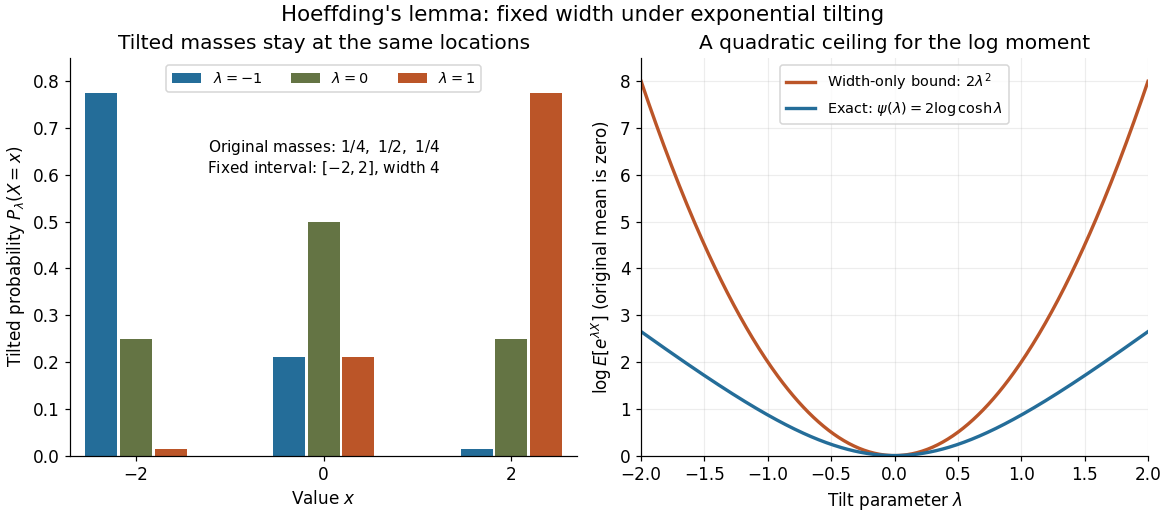
A short proof exposes why the constant is . Put and define exponential tilting byThe tilted probability measure has the same interval of possible values, and differentiating the cumulant-generating function gives . Boundedness justifies these derivatives for every finite . Under any such tilted law, Popoviciu's inequality on variances gives : the variance is no larger than the expected value of the squared distance from the interval midpoint, itself at most . Since , the integral form of Taylor's theorem yieldsThis expression handles either sign of without changing the argument.
The constant cannot be reduced uniformly over all essentially bounded real random variables. Equal endpoint probabilities at and give , a scaled Rademacher random variable, andThus the sharpness is already forced near zero by the variance; the bound need not be equality at nonzero parameters for a particular probability distribution.
Let be graded with positive degrees , and let be a finitely generated graded -module with finite-dimensional graded pieces. Thenfor a Laurent polynomial . For a standard grading, consequently agrees with a polynomial for all sufficiently large .
The proof is by induction on . For of degree , the exact sequence of graded modulesgivesBoth modules on the right are finitely generated over , so induction supplies the asserted denominator.
The Hilbert function of a graded module over a field is . Its generating function is the Hilbert series.
The Hilbert-Schmidt distance is .
Electroweak symmetry breaking is the Higgs-field breaking . It gives masses to the and bosons while leaving the photon massless.
With the hypercharge convention , the lower component of the Higgs doublet has and . Thus : the vacuum expectation value is electrically neutral. This is why one combination of the neutral gauge fields remains the massless photon, as the electroweak doublet gauge-boson mass matrix shows.
Continue the chosen Higgs field potential example with and . The tree-level electroweak gauge-boson masses are , and . In the basis,Its orthonormal eigenvectors and have eigenvalues zero and . Thus . This is an exact model check, not a fit to measured electroweak interaction parameters.
A diagonal charged-fermion Yukawa coupling expands asThe Yukawa coupling remains a free parameter: the mechanism relates a fermion mass to its scalar interaction but does not predict the numerical mass. This example concerns charged fermions; the minimal Standard Model has no right-handed neutrino and does not account for neutrino oscillations without an extension.
The real Heisenberg group consists of upper-unitriangular real matrices. In coordinates its multiplication is .
For the heat equation on with the Neumann boundary condition , the method of images givesThus . This is also the transition kernel of Reflected Brownian motion.
Harris' inequality states that two increasing events under an independent Bernoulli product measure are positively correlated.
For , if has zero trace at zero, thenIndeed, the one-dimensional Sobolev representative satisfies , so the claim is the Hardy averaging inequality applied to .
A Hamiltonian isotopy is a smooth path of symplectomorphisms , with , generated by a smooth time-dependent Hamiltonian function. In the convention , it satisfiesThe flow must exist throughout the chosen time interval. This is automatic on a closed symplectic manifold; on an open one, uniformly compactly supported Hamiltonians also suffice. The Hamiltonian flow preserves the symplectic form by Cartan's magic formula.
Its time-one map is a Hamiltonian diffeomorphism, an element of the group of Hamiltonian diffeomorphisms. A path and its endpoint are different data: a full rotation of the symplectic plane gives a nonconstant Hamiltonian path whose endpoint is the identity. Distinct paths can therefore represent the same Hamiltonian diffeomorphism.
A Hamiltonian function is a smooth function whose differential determines a Hamiltonian vector field.
A shelfy stream is a grounded, rapidly sliding ice stream whose internal resistance is dominated by longitudinal extension, as in an ice shelf, but which retains a basal drag. It is described by the shallow-shelf approximation.
Velocity memory is a persistent change in the relative velocity of freely falling bodies after a gravitational-wave pulse.
Displacement memory is a persistent change in the separation of freely falling bodies after a gravitational-wave pulse.
The infectious disease renewal equation expresses current incidence as a convolution of past incidence with an infectivity profile, multiplied by a time-varying transmission level.
A Bayesian inverse problem combines a prior measure on an unknown with a likelihood for observed data . When the likelihood is proportional to , Bayes' formula gives
Pinned article: Introduction to the OurBigBook Project
Welcome to the OurBigBook Project! Our goal is to create the perfect publishing platform for STEM subjects, and get university-level students to write the best free STEM tutorials ever.
Everyone is welcome to create an account and play with the site: ourbigbook.com/go/register. We belive that students themselves can write amazing tutorials, but teachers are welcome too. You can write about anything you want, it doesn't have to be STEM or even educational. Silly test content is very welcome and you won't be penalized in any way. Just keep it legal!
Intro to OurBigBook
. Source. We have two killer features:
- topics: topics group articles by different users with the same title, e.g. here is the topic for the "Fundamental Theorem of Calculus" ourbigbook.com/go/topic/fundamental-theorem-of-calculusArticles of different users are sorted by upvote within each article page. This feature is a bit like:
- a Wikipedia where each user can have their own version of each article
- a Q&A website like Stack Overflow, where multiple people can give their views on a given topic, and the best ones are sorted by upvote. Except you don't need to wait for someone to ask first, and any topic goes, no matter how narrow or broad
This feature makes it possible for readers to find better explanations of any topic created by other writers. And it allows writers to create an explanation in a place that readers might actually find it.
Figure 1. Screenshot of the "Derivative" topic page. View it live at: ourbigbook.com/go/topic/derivativeVideo 2. OurBigBook Web topics demo. Source. - local editing: you can store all your personal knowledge base content locally in a plaintext markup format that can be edited locally and published either:This way you can be sure that even if OurBigBook.com were to go down one day (which we have no plans to do as it is quite cheap to host!), your content will still be perfectly readable as a static site.
- to OurBigBook.com to get awesome multi-user features like topics and likes
- as HTML files to a static website, which you can host yourself for free on many external providers like GitHub Pages, and remain in full control

Figure 2. You can publish local OurBigBook lightweight markup files to either OurBigBook.com or as a static website.
Figure 3. Visual Studio Code extension installation.
Figure 5. . You can also edit articles on the Web editor without installing anything locally. Video 3. Edit locally and publish demo. Source. This shows editing OurBigBook Markup and publishing it using the Visual Studio Code extension. 
- Infinitely deep tables of contents:



All our software is open source and hosted at: github.com/ourbigbook/ourbigbook
Further documentation can be found at: docs.ourbigbook.com
Feel free to reach our to us for any help or suggestions: docs.ourbigbook.com/#contact