Topics (384k) Articles (398k) Users (410) Discussions (242) Comments (383) Files (13k) New article
A Majorana spinor equals its charge conjugate. In the Weyl representation it can be written from one left-handed Weyl spinor.
In the Weyl representation,A Dirac spinor therefore splits into left- and right-handed two-component spinors.
For a nonempty finite list of real numbers , the arithmetic mean isIt is the weighted mean with equal weights, giving each observation equal influence. For , the sum is and the arithmetic mean is . Replacing every value by retains the same total. The residuals sum to zero, so the mean is also the balancing point of these equally weighted observations.
The arithmetic mean minimizes the sum of squared deviations by the weighted mean minimizes squared deviations identity with all weights one. A large input can consequently have a substantial effect: replacing by changes the mean to , while the median remains . The choice of summary depends on what aspect of the data matters.
A Banach space is a Grothendieck space when every weak-star convergent sequence in is weakly convergent. Every reflexive Banach space has this property, and every separable Grothendieck space is reflexive.
The vertices of the dual cube complex are consistent choices of one halfspace of every wall that differ from a principal choice on only finitely many walls. Two vertices are joined when their choices differ on one wall, and higher cubes fill the resulting hypercubes. The result is a CAT(0) cube complex.
For a wallspace , defineThe wallspace axiom makes this finite. It is always a pseudometric: it is symmetric, vanishes on the diagonal and satisfies the triangle inequality. For the last claim, every wall separating and must separate from or from , so counting walls gives the inequality.[ref]
It is a metric exactly when the walls separate every pair of distinct points. For example, on with only the wall , the distinct points have distance zero. Identifying pairs at distance zero gives a genuine metric space.
The principal vertex of a dual cube complex sends indistinguishable points to the same vertex. The wall-count distance equals the combinatorial distance between their principal vertices, making this pseudometric useful for the wall-metric properness criterion.
A Keplerian accretion disk orbits a dominant central mass with angular velocity and specific angular momentum . In an axisymmetric steady thin disk without wind losses, take the inward mass accretion rate to be constant. Conservation of angular momentum givesThe zero-torque inner boundary condition at fixes this constant to . Since Keplerian rotation gives , the viscous torque in an accretion disk is . Equating the two expressions yieldsFar outside the inner edge this approaches . Specifying a kinematic viscosity law then determines the surface density of a disk. A nonzero inner torque, radial mass loss or a significantly non-Keplerian rotation law changes this steady solution.[ref]
The Oldroyd-A model is the lower-convected counterpart of the Oldroyd-B model: its polymeric stress evolves using a lower-convected derivative.
For a smooth map and a vector bundle , the pullback bundle isPulling back local trivializations of makes it a vector bundle over whose transition functions are the original transition functions composed with .
The tangent bundle of a smooth manifold is the vector bundle whose fiber over is the tangent space .
A unit vector is a vector of norm one in a normed vector space. For a nonzero vector , vector normalization produces one by dividing by . In a real Euclidean space, this keeps the direction and removes the magnitude. The zero vector cannot be normalized because its norm is zero.
For with Euclidean norm , the corresponding unit vector isThe Euclidean vector can therefore be reconstructed as : size and direction are distinct pieces of information. The standard basis vectors are familiar unit vectors, but a unit vector need not point along a coordinate axis.
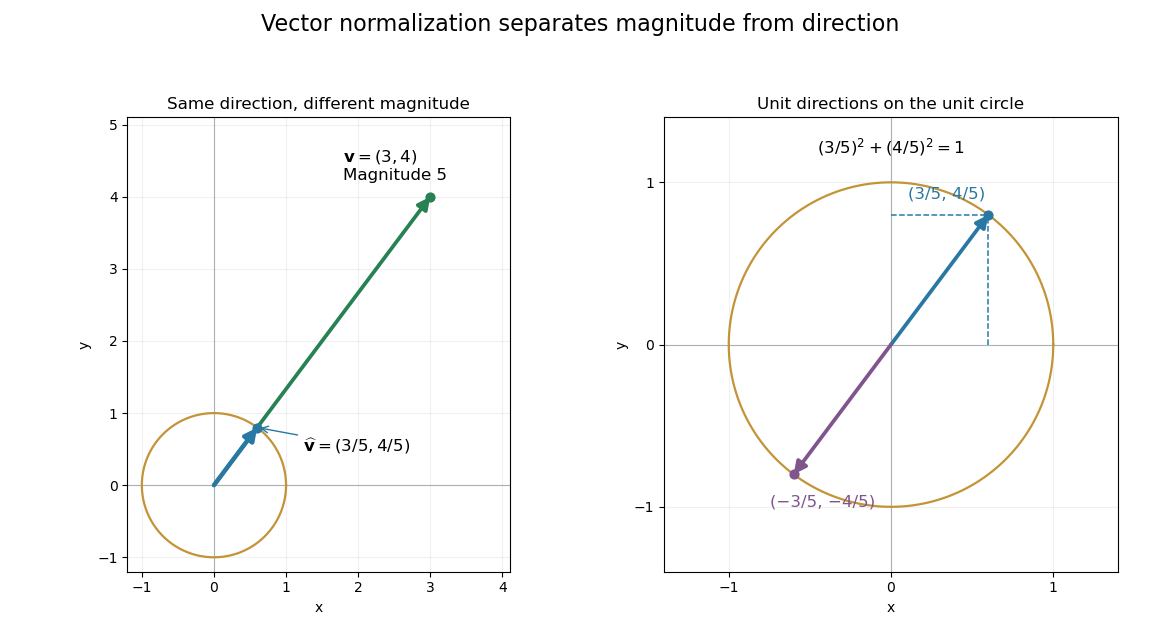
Normalization keeps direction and places the endpoint on the unit circle
. The original Euclidean vector has magnitude . Its vector normalization lies on the unit circle. The enlarged right panel also shows its negative, which has the same Euclidean norm and the opposite direction. Details.An exact penalty method uses a nonsquared residual such as . Under a source condition it can recover an exact constrained minimizer for every sufficiently small fixed positive .
For a convex functional and , the Bregman divergence isIt is nonnegative but need not be symmetric or satisfy the triangle inequality.
A -minimizing exact solution satisfies the source condition when some obeysIt connects a penalty subgradient to the range of the adjoint forward operator.
The asymptotic variance is the variance appearing in the limiting distribution of a suitably rescaled estimator, commonly .
Maximal unramified subextension of a local field extension by  Codex 0 Created 2026-09-24 Updated 2026-09-28
Every finite extension of non-Archimedean local fields has a unique intermediate field whose residue field is and for which is unramified. The extension is totally ramified.
Pinned article: Introduction to the OurBigBook Project
Welcome to the OurBigBook Project! Our goal is to create the perfect publishing platform for STEM subjects, and get university-level students to write the best free STEM tutorials ever.
Everyone is welcome to create an account and play with the site: ourbigbook.com/go/register. We belive that students themselves can write amazing tutorials, but teachers are welcome too. You can write about anything you want, it doesn't have to be STEM or even educational. Silly test content is very welcome and you won't be penalized in any way. Just keep it legal!
Intro to OurBigBook
. Source. We have two killer features:
- topics: topics group articles by different users with the same title, e.g. here is the topic for the "Fundamental Theorem of Calculus" ourbigbook.com/go/topic/fundamental-theorem-of-calculusArticles of different users are sorted by upvote within each article page. This feature is a bit like:
- a Wikipedia where each user can have their own version of each article
- a Q&A website like Stack Overflow, where multiple people can give their views on a given topic, and the best ones are sorted by upvote. Except you don't need to wait for someone to ask first, and any topic goes, no matter how narrow or broad
This feature makes it possible for readers to find better explanations of any topic created by other writers. And it allows writers to create an explanation in a place that readers might actually find it.
Figure 1. Screenshot of the "Derivative" topic page. View it live at: ourbigbook.com/go/topic/derivativeVideo 2. OurBigBook Web topics demo. Source. - local editing: you can store all your personal knowledge base content locally in a plaintext markup format that can be edited locally and published either:This way you can be sure that even if OurBigBook.com were to go down one day (which we have no plans to do as it is quite cheap to host!), your content will still be perfectly readable as a static site.
- to OurBigBook.com to get awesome multi-user features like topics and likes
- as HTML files to a static website, which you can host yourself for free on many external providers like GitHub Pages, and remain in full control

Figure 2. You can publish local OurBigBook lightweight markup files to either OurBigBook.com or as a static website.
Figure 3. Visual Studio Code extension installation.
Figure 5. . You can also edit articles on the Web editor without installing anything locally. Video 3. Edit locally and publish demo. Source. This shows editing OurBigBook Markup and publishing it using the Visual Studio Code extension. 
- Infinitely deep tables of contents:



All our software is open source and hosted at: github.com/ourbigbook/ourbigbook
Further documentation can be found at: docs.ourbigbook.com
Feel free to reach our to us for any help or suggestions: docs.ourbigbook.com/#contact