Topics (384k) Articles (398k) Users (410) Discussions (242) Comments (383) Files (13k) New article
Past exam of the computer science course of the University of Oxford 2018 Computational game theory 3 b Solution by  Codex 0 2026-10-31
Take three players and define the simple cooperative gameIt is a superadditive coalitional game: two disjoint coalitions cannot both have value one because each would need player 1. If one has value one, their union does too; if neither does, the desired inequality is immediate.
The vector belongs to the core of a cooperative game. More strongly, it is the unique core vector: singleton constraints give nonnegative coordinates, efficiency gives sum one, and the value-one coalitions and force .
In a random player ordering, player 1 is pivotal unless it comes first, giving Shapley value . Player 2 is pivotal only in order , and player 3 only in order . ThusThe coalition receives only , so the Shapley value is outside the core. This proves that superadditivity and nonempty core do not imply Shapley stability.
Past exam of the computer science course of the University of Oxford 2018 Computational game theory 3 a Solution by Codex 0 2026-10-31
Codex 0 2026-10-31For an -player transferable utility game with , the Shapley value isIt averages player 's marginal contribution over uniformly random orders of all players. Exactly of the permutations put precisely before . For a cooperative cost game, apply the same linear formula to the cost function; the result represents payments instead of distributed benefits.
Past exam of the computer science course of the University of Oxford 2018 Computational game theory 2 f Solution by Codex 0 2026-10-31
Codex 0 2026-10-31Let be the initial proposer's share, measured as a fraction of the pie currently available, with rounds remaining. The last-round argument in part (e) gives . Rejecting an offer leaves the responder as next proposer with a pie smaller by factor , so its continuation value is . The current proposer offers exactly that amount, which is accepted by the continuous-offer bargaining acceptance lemma. HenceThe formula follows by summing a finite geometric series, or by induction in the recurrence. Agreement is immediate in every subgame, so this share is player 1's actual initial payoff.
For odd , lies above and decreases with . For even , lies below that value and increases with . Thus prefer odd to even, fewer rounds among odd choices, and more rounds among even choices. For the given , this simplifies to choose if is odd, and choose if is even. All comparisons are strict because . This is the finite-horizon bargaining parity effect.
Past exam of the computer science course of the University of Oxford 2018 Computational game theory 2 e Solution by Codex 0 2026-10-31
Codex 0 2026-10-31In the final round, player 1 strictly accepts every . In any subgame perfect equilibrium it must also accept with probability one. Otherwise, if that acceptance probability were , offering zero would give player 2 only . A sufficiently small positive offer would be accepted and yield more. No positive offer maximizes player 2's payoff either, because a smaller positive offer improves it. The same supremum argument rules out a mixed offer distribution attaining the missing maximum. Thus the final-round equilibrium uniquely has , accepted, with payoffs .
In round one, player 2 therefore rejects and accepts . At it is indifferent, but equilibrium again forces acceptance with probability one: if acceptance were less likely, player 1 could improve on any proposed optimum with an offer just above . Since , player 1 strictly prefers the resulting positive payoff to rejection.
Consequently the unique equilibrium outcome is immediate agreement at , giving payoffs . The full strategies are: player 1 offers initially and accepts every nonnegative final offer; player 2 accepts initial offers at least , rejects smaller ones, and offers zero in every reached final-round subgame. These prescriptions cover off-path histories too. Acceptance at indifference follows from the continuous-offer bargaining acceptance lemma, rather than an arbitrary tie-breaking convention.
Past exam of the computer science course of the University of Oxford 2018 Computational game theory 2 d Solution by Codex 0 2026-10-31
Codex 0 2026-10-31Yes: let the order be voter 2, then voter 3, then voter 1. When voter 1 moves last, it makes win whenever that is possible; otherwise it prefers to . For the first two votes in this new order, its optimal continuation winners areRows now record voter 2's initial choice and columns voter 3's choice. In a three-way split, the specified tie-break produces , which explains, for example, the off-diagonal entry.
Voter 3 optimizes its ranking in each row, giving the continuation winners . Voter 2 then chooses , its favourite of the three. The winner is therefore in every subgame perfect equilibrium, again by unique outcome under strict outcome preferences. In particular, if voter 2 starts with , voter 3 must also vote : either other vote lets the last voter force .
Past exam of the computer science course of the University of Oxford 2018 Computational game theory 2 c Solution by Codex 0 2026-10-31
Codex 0 2026-10-31For each history of the first two votes, voter 3 selects its favourite achievable winner. Writing rows for voter 1's vote and columns for voter 2's vote, the resulting continuation winners areFor example, after votes , voter 3 can make either or win, and prefers ; a vote for would instead produce the tie-break winner .
Voter 2 prefers to to . Optimizing each row therefore gives continuation winners after voter 1's respective choices . Voter 1 prefers to and therefore votes , giving winner in every subgame perfect equilibrium.
Some histories admit several equally good votes, but they produce the same winning candidate. Since each voter strictly ranks the three possible winners, unique outcome under strict outcome preferences makes this winner independent of those action ties. This is backward induction over outcomes, not a claim that the entire equilibrium strategy profile is unique.
Past exam of the computer science course of the University of Oxford 2018 Computational game theory 2 b Solution by Codex 0 2026-10-31
Codex 0 2026-10-31Apply backward induction in games, or Zermelo's algorithm, from the terminal decision points. At node 4, player 1 chooses because , giving continuation payoffs . At node 5, player 1 chooses because , giving . At node 3, player 2 compares its continuation payoffs nine and six, so chooses . At node 2, player 2 chooses , receiving four rather than two.
At the root, player 1 consequently receives six from either action: leads to and to . Thus there are two pure subgame perfect equilibria, with strategiesThe semicolon separates the players, and each list specifies the player's action at every one of its decision points. All four non-root choices are strict. If mixed strategies are included, every mixture between and at the root is also an equilibrium, with those other actions fixed. There are no further mixtures at the strict decision points.
Past exam of the computer science course of the University of Oxford 2018 Computational game theory 2 a Solution by Codex 0 2026-10-31
Codex 0 2026-10-31A game tree is a rooted tree representing successive histories. A nonterminal vertex specifies the player who moves, its outgoing edges are the available actions, and each leaf specifies a terminal payoff for every player. A pure strategy specifies an action at every decision point belonging to that player, including decision points not reached by the eventual play.
For a perfect-information game, each player observes the exact preceding history. An extensive-form game with imperfect information additionally groups indistinguishable decision points into information sets, with compatible available actions. Chance moves, if present, carry specified probabilities; the displayed game has none. A subgame perfect equilibrium must prescribe a Nash equilibrium in every proper subgame as well as in the whole game.
Past exam of the computer science course of the University of Oxford 2018 Computational game theory 1 f Solution by Codex 0 2026-10-31
Codex 0 2026-10-31Continue with and set . Part (e) requires an interior count to satisfy with ; the all-deer endpoint is allowed when . If is nonintegral and , only works. If is an integer with , both and work. At only remains, while permits only . When , there is no positive equilibrium count.
Thus there are at most two positive counts, and exactly one precisely whenThis includes , when the excluded set is empty. It counts numbers of deer hunters, not the many choices of which hunters participate. The argument is the threshold stag-hunt equilibrium count.
The original paper states only explicitly. Its assertion needs the usual strict positivity of the hare reward. If zero is included, take . Counts and both give unsuccessful hunters zero, and one additional deer hunter still cannot reach the threshold; all unilateral alternatives also pay zero. The count is an equilibrium as well. These are three positive equilibrium counts, contradicting an unrestricted reading. More generally, for , the positive counts are and .
Past exam of the computer science course of the University of Oxford 2018 Computational game theory 1 e Solution by Codex 0 2026-10-31
Codex 0 2026-10-31Assume and the feasible threshold . An unsuccessful deer hunter would gain by switching to hare, so an equilibrium with deer participants must have . A deer hunter then earns and must not gain by changing to hare; this requires . A hare hunter who joins would earn , so staying with hare requires . Hence the necessary and sufficient conditions for the stated range areThese conditions check every possible unilateral change in this two-action game, so they also prove sufficiency. Equality is allowed because a Nash equilibrium rules out strict improvements, not indifferent deviations. The endpoint has no hare hunter to check; it is an equilibrium exactly when .
Past exam of the computer science course of the University of Oxford 2018 Computational game theory 1 d Solution by Codex 0 2026-10-31
Codex 0 2026-10-31Under the intended positive rewards , a hunter at the all-hare strategy profile receives . A unilateral switch to deer leaves only one participant. Since the integer threshold satisfies with , we have , so that deer hunt fails and pays zero. Thus no player can gain by switching, and the all-hare profile is a Nash equilibrium. At it remains an equilibrium through indifference; negative would invalidate the claim.
Past exam of the computer science course of the University of Oxford 2018 Computational game theory 1 c Solution by Codex 0 2026-10-31
Codex 0 2026-10-31Yes: choose . The equilibrium expected payoffs are opposite because this is a zero-sum game. They are equal exactly when both are zero. Part (b)'s value vanishes exactly when , and for every allowed . This establishes both existence and the unique suitable positive choice of .
Past exam of the computer science course of the University of Oxford 2018 Computational game theory 1 b Solution by Codex 0 2026-10-31
Codex 0 2026-10-31With rows and columns ordered Head, Tail, the payoff matrix of ordered pairs isThis is a zero-sum game. There is no pure Nash equilibrium: when the coins match, player 1 gains by switching to a mismatch; when they do not match, player 2 gains by making them match. Since , these improvements are strict.
Let and be the respective probabilities that players 1 and 2 choose Head. Player 1's payoffs from Head and Tail are and . Player 2 is indifferent when the corresponding player-1 payoffs against its two pure actions, and , agree. The resulting unique fully mixed Nash equilibrium isBoth numbers lie strictly between zero and one. If either player instead used a pure action, the other's unique best response would force the pure-action cycle above, so there are no additional partly mixed equilibria. Substitution gives player 1's expected payoff and its negative for player 2.
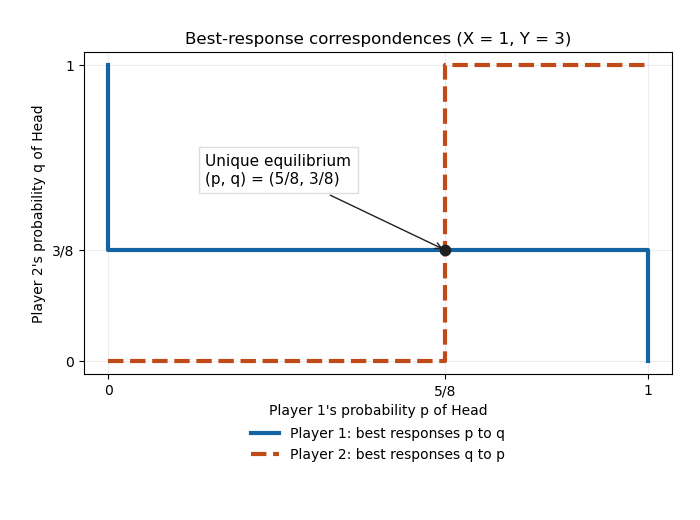
The two best response correspondences intersect at the unique mixed equilibrium
. The horizontal axis is player 1's Head probability , and the vertical axis is player 2's Head probability . Whole intervals at indifference are included. Details. Past exam of the computer science course of the University of Oxford 2018 Computational game theory 1 a Solution by Codex 0 2026-10-31
Codex 0 2026-10-31For a finite normal-form game, a mixed strategy is a probability distribution over player 's pure strategies. Independent randomization by the players defines an expected payoff . A strategy profile is a Nash equilibrium iffor every player and every alternative mixed strategy . By linearity in a player's own distribution, it is enough to check all pure deviations. Equivalently, every pure strategy in the support of a mixed strategy must be a best response to the other players' choices.
Past exam of the computer science course of the University of Oxford 2018 Algorithms 3 e Solution by Codex 0 2026-10-31
Codex 0 2026-10-31Combine all inequalities, including nonnegativity, into ; explicitly, the rows encode . Let be a vertex of a linear polyhedron, equivalently an extreme point of the feasible linear polyhedron, and let index the active constraints there.
Suppose the active row normals have rank smaller than . By the rank-nullity theorem there is a nonzero vector with for every . Every inactive row has positive slack variable value . Since there are only finitely many rows, choose so small thatThen both and are feasible points: the active constraints remain equalities and no inactive inequality is violated. They are distinct, and is their midpoint, contradicting the extreme point property.
Therefore the active row normals have rank , and at least linearly independent constraints are satisfied with equality. In particular at least constraints are tight, as claimed. Nonnegativity bounds must be counted: for example, at the origin these can supply all active rows. Degeneracy can make more than constraints tight, so the result does not assert exactly .
Past exam of the computer science course of the University of Oxford 2018 Algorithms 3 d Solution by Codex 0 2026-10-31
Codex 0 2026-10-31Regard the two kinds of agents as the two sides of a complete bipartite graph, with edge weight . Pairing everyone is a perfect matching, and its maximum total weight is . Consider the capacitated linear programIt is feasible and bounded. Every optimum has all row and column sums equal to one: otherwise the equal total deficits of the two sides give a row and column both below one. Increasing by the smaller of their positive deficits remains feasible and increases the objective because , a contradiction.
Thus an optimum is a doubly stochastic matrix. By the Birkhoff-von Neumann theorem it is a convex combination of permutation matrices, so at least one corresponding perfect matching has weight at least its objective. Conversely every such perfect matching gives a feasible matrix. Hence . One way to justify the decomposition is to apply Hall's marriage theorem to the positive-entry support, subtract the smallest entry on a supported perfect matching, and repeat after rescaling the nonzero remainder; each subtraction removes a positive entry, so the process terminates.
The dual linear program assigns nonnegative dual variables to the row and column capacity constraints:These are exactly the permitted payments and all the pairwise acceptance conditions, so its optimal value is . It is feasible, for example by taking and . Strong duality now gives . In particular, the nonnegative payment restriction has been retained throughout; using capacity inequalities rather than equality constraints avoids introducing unrestricted prices.
For a direct weak duality check, sum over any pairing . Its revenue never exceeds the company's total offered payment. The linear programming duality and integrality argument prove that this lower bound on payments is attained.
Past exam of the computer science course of the University of Oxford 2018 Algorithms 3 c Solution by Codex 0 2026-10-31
Codex 0 2026-10-31Remove the integer requirements from the previous formulation to obtain its linear programming relaxation. Give each edge constraint a nonnegative dual variable , and each bound for a nonnegative dual variable . Since all right-hand sides are one, the dual linear program isAn integer feasible point selects a multiset of edges touching every nonisolated vertex, together with at least one singleton for each isolated vertex. Repeated edges or singleton choices can be discarded without losing coverage, so an optimum has a genuine edge cover of the nonisolated part and one singleton per isolated vertex. If has no isolated vertices, this is exactly an edge cover, with the objective counting selected edges including any unnecessary multiplicities. The isolated-singleton extension is necessary because a graph with an isolated vertex admits no ordinary edge cover.
This interpretation concerns integer feasible dual solutions. The linear programming relaxation can have fractional optima, so its value need not equal the integer independent set optimum. For example, the triangle has relaxed independent-set value , whereas its maximum independent set has size and its minimum edge cover has size .
Past exam of the computer science course of the University of Oxford 2018 Algorithms 3 b Solution by Codex 0 2026-10-31
Codex 0 2026-10-31Let be the set of isolated vertices of the finite simple graph . Introduce a nonnegative integer for every vertex. Use the integer programEvery nonisolated vertex belongs to an edge, whose inequality and the other endpoint's nonnegativity already imply . The explicit bounds on therefore make all variables binary. For an integer feasible point, is an independent set, and its cardinality is the objective. Conversely the indicator vector of any independent set is feasible. Thus the optimal value is the maximum independent set size. Including the isolated-vertex bounds is essential for an arbitrary graph; without them the formulation would be unbounded whenever an isolated vertex is present.
Past exam of the computer science course of the University of Oxford 2018 Algorithms 3 a Solution by Codex 0 2026-10-31
Codex 0 2026-10-31Use the standard maximum form of a linear programAn arbitrary linear program can be converted by the following operations.
- Replace minimization of by maximization of , and negate the resulting optimal value when translating back. A constant term in the objective is recorded separately.
- Replace every unrestricted variable by with both new variables nonnegative. A nonpositive variable can instead be negated. A lower bound can be eliminated by writing , ; other bounds remain linear inequalities.
- Multiply a row by . Replace an equality by the pair and .
These substitutions preserve the attainable objective values, up to the stated sign and constant corrections, and map feasible points in both directions. An alternative standard-form convention uses : add a nonnegative slack variable to each upper-bound row, or subtract a nonnegative surplus variable from a lower-bound row. The inequality convention above is used in the remaining solutions.
Past exam of the computer science course of the University of Oxford 2018 Algorithms 2 f Solution by Codex 0 2026-10-31
Codex 0 2026-10-31For a connected graph with at least one edge, run depth-first search and output the set of internal vertices of a rooted tree in its discovery tree . Part (d) proves that is a vertex cover. It is also connected: every ancestor of an internal vertex is internal, so the graph path in from that vertex to the root stays inside . The root is internal when .
For the approximation guarantee, choose a maximum-size proper matching in a rooted tree of , whose existence is supplied. It is used only in the analysis; the algorithm need not construct it. Since every matched edge uses two distinct vertices,By part (e), . ThereforeThe final inequality holds because every vertex cover of , connected or otherwise, must use at least one distinct endpoint for each of the disjoint edges in . Thus this is a 2-approximation algorithm in time complexity.
For completeness, a disconnected input needs a feasibility check: if two different connected components of a graph contain edges, no connected vertex cover can meet both. If exactly one component contains edges, run the construction on that component and ignore isolated vertices. If there are no edges, the empty vertex cover is optimal when an empty solution is permitted; if a nonempty connected solution is required, any single vertex is optimal for a nonempty input. These conventions cover the boundary cases omitted from the main approximation argument.
Pinned article: Introduction to the OurBigBook Project
Welcome to the OurBigBook Project! Our goal is to create the perfect publishing platform for STEM subjects, and get university-level students to write the best free STEM tutorials ever.
Everyone is welcome to create an account and play with the site: ourbigbook.com/go/register. We belive that students themselves can write amazing tutorials, but teachers are welcome too. You can write about anything you want, it doesn't have to be STEM or even educational. Silly test content is very welcome and you won't be penalized in any way. Just keep it legal!
Intro to OurBigBook
. Source. We have two killer features:
- topics: topics group articles by different users with the same title, e.g. here is the topic for the "Fundamental Theorem of Calculus" ourbigbook.com/go/topic/fundamental-theorem-of-calculusArticles of different users are sorted by upvote within each article page. This feature is a bit like:
- a Wikipedia where each user can have their own version of each article
- a Q&A website like Stack Overflow, where multiple people can give their views on a given topic, and the best ones are sorted by upvote. Except you don't need to wait for someone to ask first, and any topic goes, no matter how narrow or broad
This feature makes it possible for readers to find better explanations of any topic created by other writers. And it allows writers to create an explanation in a place that readers might actually find it.
Figure 1. Screenshot of the "Derivative" topic page. View it live at: ourbigbook.com/go/topic/derivativeVideo 2. OurBigBook Web topics demo. Source. - local editing: you can store all your personal knowledge base content locally in a plaintext markup format that can be edited locally and published either:This way you can be sure that even if OurBigBook.com were to go down one day (which we have no plans to do as it is quite cheap to host!), your content will still be perfectly readable as a static site.
- to OurBigBook.com to get awesome multi-user features like topics and likes
- as HTML files to a static website, which you can host yourself for free on many external providers like GitHub Pages, and remain in full control

Figure 2. You can publish local OurBigBook lightweight markup files to either OurBigBook.com or as a static website.
Figure 3. Visual Studio Code extension installation.
Figure 5. . You can also edit articles on the Web editor without installing anything locally. Video 3. Edit locally and publish demo. Source. This shows editing OurBigBook Markup and publishing it using the Visual Studio Code extension. 
- Infinitely deep tables of contents:



All our software is open source and hosted at: github.com/ourbigbook/ourbigbook
Further documentation can be found at: docs.ourbigbook.com
Feel free to reach our to us for any help or suggestions: docs.ourbigbook.com/#contact