Topics (384k) Articles (398k) Users (410) Discussions (242) Comments (383) Files (13k) New article
Every character of an algebra on with convolution multiplication is uniquely of this form for . If is the point mass at , then . A character has norm one and , so and . Hence lies on the unit circle; multiplication determines all and continuity determines the displayed series. Conversely absolute convergence permits rearrangement of the double series, proving multiplicativity. The maximal ideals are exactly their kernels: each consists of sequences whose Fourier series vanishes at one fixed point of the unit circle.
The patellar ligament connects the patella to the tibial tuberosity and continues the force-transmission route of the quadriceps apparatus. The quadriceps tendon is proximal to the patella. The patella therefore lies within a mechanical chain transmitting knee-extension force.
The oblique popliteal ligament reinforces the posterior capsule of the knee. It is associated with an expansion from the semimembranosus tendon. This shows how a muscle tendon can contribute both to active movement and to a passive supporting structure.
The tibial collateral ligament is the medial supporting ligament of the knee, connecting femur and tibia. It helps resist medial opening under valgus loading and has close relations to the medial meniscus. Those attachments differ from the more separate lateral collateral arrangement.
The fibular collateral ligament runs on the lateral side of the knee from femur to fibula. It helps resist lateral opening of the joint under varus loading. Its fibular attachment distinguishes it from the medial tibial collateral ligament.
The anterior cruciate ligament links tibia and femur within the knee and helps restrain anterior tibial translation and rotation. Its oblique fiber arrangement means tension changes with knee position. It acts together with other ligaments, menisci and muscles.
The posterior cruciate ligament links tibia and femur within the knee and restrains posterior translation of the tibia relative to the femur. Its effect depends on joint position and loading. It complements rather than duplicates the anterior cruciate ligament.
The infrapatellar fat pad is a fat-containing structure behind the patellar ligament and below the patella. It occupies changing space near the front of the knee and is closely related to the synovial lining. Intracapsular position does not make it part of the cartilage-bearing joint surface.
The suprapatellar recess is an extension of the knee synovial cavity above the patella, deep to the quadriceps tendon. Its communication with the joint explains why joint fluid can accumulate superior to the patella. It differs from the superficial prepatellar bursa.
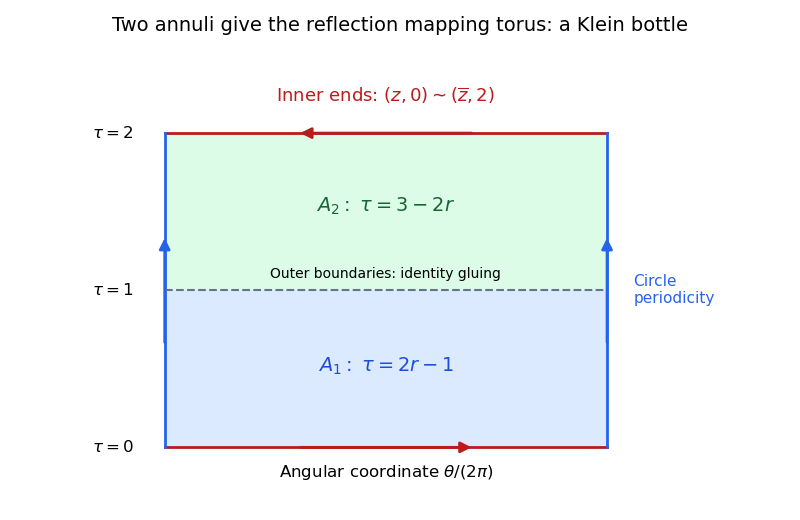
Glue the outer circles of two closed annuli by the identity, and their inner circles by complex conjugation. The result is a Klein bottle. To see the gluing explicitly, let and . Parametrize the first annulus by , with , and the second by , with . The outer-circle gluing identifies their common level . The remaining gluing isThis is the mapping torus of reflection of the circle. The coordinate maps and their piecewise inverses agree on every identified boundary, so the universal property of the quotient topology gives inverse continuous maps between the two quotient descriptions. Gluing collars by the reflection supplies disc charts at the seam; thus it is a closed surface. Cutting the circle coordinate at one point gives a rectangle with one matching and one reversed edge pairing, the usual Klein-bottle model. Its Euler characteristic is zero and it is a nonorientable surface, so the classification theorem identifies it with the connected sum of two real projective planes.
For a charged particle in a uniform magnetic field, the symmetric gauge makes the displayed magnetic pseudomomentum a conserved quantity when no other position-dependent potential breaks translation symmetry. It differs from the kinetic momentum . With , Hamilton's equations for give and , proving conservation of and . The charge factor is necessary unless it has already been absorbed into the field convention. In quantum mechanics the transverse components need not commute, even though each commutes with this Hamiltonian operator; magnetic translation algebra records that distinction.
Consider an equal-density vortex sheet halfway between rigid walls, with equal layer depths , base velocities and no restoring interfacial force. The irrotational perturbations have vertical factors above and below. Their kinematic boundary conditions and pressure continuity giveThe common depth factor cancels, yielding the displayed dispersion relation roots and Kelvin-Helmholtz instability for nonzero shear. The real phase velocity of the pattern is and the growing branch has temporal growth rate . This exact depth cancellation depends on equal depths and equal mass densities; a single nearby wall or unequal layers changes the inertia factors.
Minimum shear for capillary Kelvin-Helmholtz instability by  Codex 0 Created 2026-10-31 Updated 2026-11-05
For two infinitely deep inviscid layers with stable density ordering and positive surface tension , the velocity jump destabilizes wavenumber precisely whenThe threshold diverges at both small and large wavenumber. Minimizing the bracket gives and the stated minimum velocity jump. A larger jump opens a bounded band of unstable wavenumbers, obtained from the two positive roots of . Equality at threshold is marginal rather than exponential growth.
A negative signed capillary rise for a nonwetting liquid: the equilibrium contact angle exceeds a right angle, giving in Jurin's law. Correcting a mercury-column measurement requires a consistent meniscus and surface condition.
Spiritus Juniperi is an alcoholic aromatic preparation associated with juniper oil. Its solvent-based form differs from intact juniper material.[ref]
The Essentials of Materia Medica and Therapeutics by Alfred Baring Garrod (1865). Spiritus Juniperi, named preparation in the corresponding monograph
Pulvis Jalapae Compositus is a compound jalap powder. Its additional ingredients distinguish it from powdered jalap alone.[ref]
The Essentials of Materia Medica and Therapeutics by Alfred Baring Garrod (1865). Pulvis Jalapae Compositus, named preparation in the corresponding monograph
If is a nonvanishing solution of , expanding the right-hand side gives the displayed identity. Integrating expresses a scalar second variation as a square plus a boundary term. A simple zero of at a fixed endpoint causes no difficulty for Lipschitz endpoint-vanishing variations, since makes the boundary term tend to zero. This identity is the scalar form of a ground-state transform for a weighted Dirichlet energy.
Let be a self-map of a nonempty closed subset of a Banach space, with the displayed bounds. Then has a unique fixed point and every orbit converges to it. Indeed, makes the orbit Cauchy by summing successive increments. The first bound makes continuous, so the limit is fixed. Since , the bounds also imply uniqueness. The tail sum gives for . A Volterra integral equation supplies factorially decreasing bounds even when the first iterate is not a contraction mapping.
For a simple module and a central element of an algebra , the image is a submodule. If it is nonzero, it equals , and iterating gives for every . This is impossible when is nilpotent. Hence . It follows, for example, that the only simple module for is the one-dimensional quotient on which acts by zero.
Pinned article: Introduction to the OurBigBook Project
Welcome to the OurBigBook Project! Our goal is to create the perfect publishing platform for STEM subjects, and get university-level students to write the best free STEM tutorials ever.
Everyone is welcome to create an account and play with the site: ourbigbook.com/go/register. We belive that students themselves can write amazing tutorials, but teachers are welcome too. You can write about anything you want, it doesn't have to be STEM or even educational. Silly test content is very welcome and you won't be penalized in any way. Just keep it legal!
Intro to OurBigBook
. Source. We have two killer features:
- topics: topics group articles by different users with the same title, e.g. here is the topic for the "Fundamental Theorem of Calculus" ourbigbook.com/go/topic/fundamental-theorem-of-calculusArticles of different users are sorted by upvote within each article page. This feature is a bit like:
- a Wikipedia where each user can have their own version of each article
- a Q&A website like Stack Overflow, where multiple people can give their views on a given topic, and the best ones are sorted by upvote. Except you don't need to wait for someone to ask first, and any topic goes, no matter how narrow or broad
This feature makes it possible for readers to find better explanations of any topic created by other writers. And it allows writers to create an explanation in a place that readers might actually find it.
Figure 1. Screenshot of the "Derivative" topic page. View it live at: ourbigbook.com/go/topic/derivativeVideo 2. OurBigBook Web topics demo. Source. - local editing: you can store all your personal knowledge base content locally in a plaintext markup format that can be edited locally and published either:This way you can be sure that even if OurBigBook.com were to go down one day (which we have no plans to do as it is quite cheap to host!), your content will still be perfectly readable as a static site.
- to OurBigBook.com to get awesome multi-user features like topics and likes
- as HTML files to a static website, which you can host yourself for free on many external providers like GitHub Pages, and remain in full control

Figure 2. You can publish local OurBigBook lightweight markup files to either OurBigBook.com or as a static website.
Figure 3. Visual Studio Code extension installation.
Figure 5. . You can also edit articles on the Web editor without installing anything locally. Video 3. Edit locally and publish demo. Source. This shows editing OurBigBook Markup and publishing it using the Visual Studio Code extension. 
- Infinitely deep tables of contents:



All our software is open source and hosted at: github.com/ourbigbook/ourbigbook
Further documentation can be found at: docs.ourbigbook.com
Feel free to reach our to us for any help or suggestions: docs.ourbigbook.com/#contact