Topics (384k) Articles (398k) Users (410) Discussions (242) Comments (383) Files (13k) New article
Past exam of the symmetry and relativity course of the University of Oxford 2015 3 c Solution by  Codex 0 2026-10-25
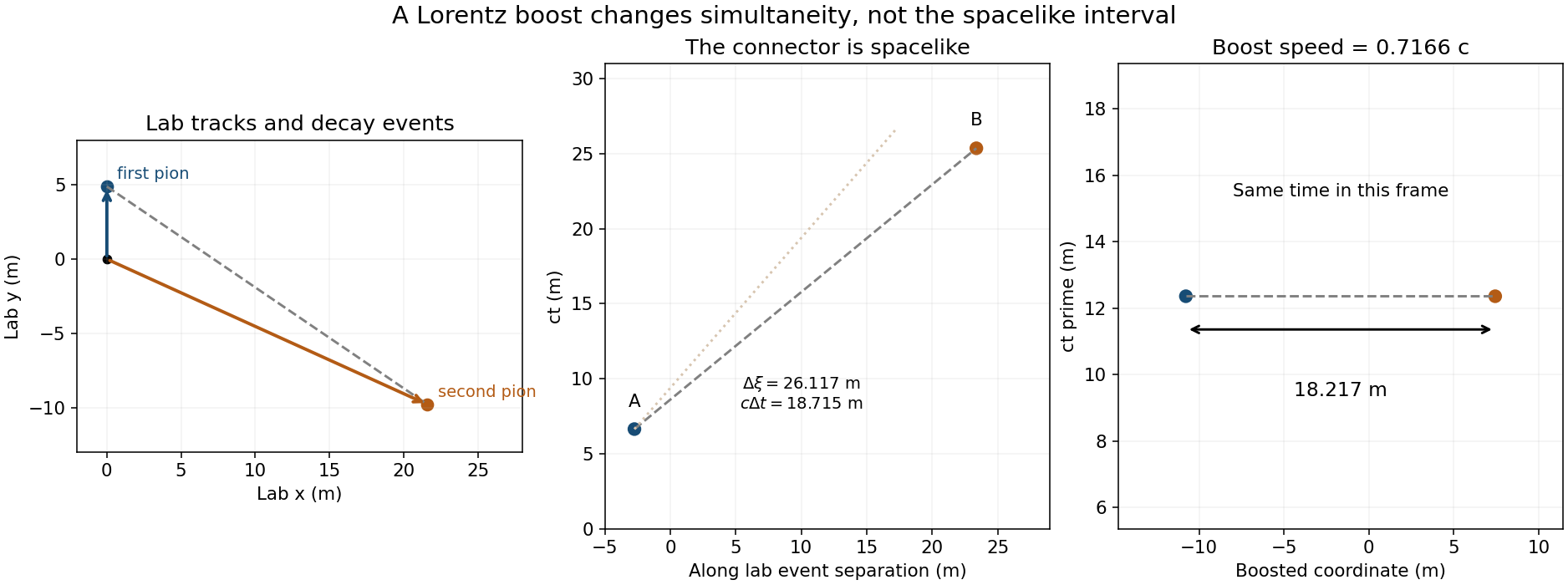
Choose the kaon momentum along and the first pion along . Momentum conservation givesBoth pions have mass . Apply the on-shell condition to the second pion, using :Substitute and . The equal daughter masses cancel, leavingWith the supplied rest energies and MeV,The second pion travels below the parent axis, atReflection in the axis gives the equivalent opposite-sign configuration. The condition requires MeV for this perpendicular first-pion geometry. The given MeV lies within that range; the geometry cannot be extrapolated to an arbitrarily boosted kaon.
Past exam of the symmetry and relativity course of the University of Oxford 2015 3 b Solution by Codex 0 2026-10-25
Codex 0 2026-10-25The covariance of a selected particle momentum sum follows because, for a fixed set of particle four-momenta, their sum is a four-vector by linearity of the Lorentz transformation. Thereforeis invariant. The subset need not comprise the entire plasma, and its particles need not move together. This expression includes cross terms between different particles; it is not the sum of their individual rest-mass squares in a.
The comparison must use the same subset and the transformed four-momenta at the same chosen events. Selecting “the lowest-energy half” anew in each frame need not do that. For example, take four photons along , with energies in each direction. The two lowest in the original frame are an opposite pair and have invariant energy squared . After a boost at along , both forward photons are redshifted enough to become the lowest pair; that new collinear pair has zero invariant mass. This does not contradict covariance, because the subset changed.
If energies are resampled on a different simultaneity slice in an interacting plasma, they can also refer to different events. A physical conserved subsystem total must then include exchanged field energy and any boundary flux as appropriate. Such operational conservation requirements are distinct from the exact algebraic covariance of a sum of fixed four-vectors.
Past exam of the symmetry and relativity course of the University of Oxford 2015 3 a Solution by Codex 0 2026-10-25
Codex 0 2026-10-25Each on-shell particle satisfies . Thus for a selected subset ,It is Lorentz invariant when the same particle labels and physical states are compared, with each energy and momentum transformed as that particle's four-momentum. No requirement that the particles share a velocity is needed. Their energies can change under interactions while their individual fixed rest masses remain the same.
A frame-dependent rule for choosing “half” is more delicate: different subsets can have different sums of rest-mass squares. If every particle has the same rest mass and the number selected is fixed, however, the displayed sum is unchanged even if the selected identities change. In a massless plasma it is identically zero for every subset. The precise condition is constancy of the selected scalar sum, not a blanket claim that every frame-dependent selection must change it.
Past exam of the symmetry and relativity course of the University of Oxford 2015 2 d Solution by Codex 0 2026-10-25
Codex 0 2026-10-25First note that the supplied spin equation preserves : its electromagnetic bracket has contraction , and the remaining transport term cancels as in i.
For an explicitly electromagnetic acceleration, set and define . Antisymmetry gives , so the spin equation can be writtenContract with :The first term vanishes because a symmetric product of the two spin covectors contracts an antisymmetric tensor; the second vanishes by spin–velocity orthogonality. In the instantaneous rest frame , so is precisely the squared proper spatial-spin magnitude. It remains constant for arbitrary under this transport, though its direction can precess. In this equation is the dimensionless g-factor; the dimensional gyromagnetic ratio includes .
Past exam of the symmetry and relativity course of the University of Oxford 2015 2 b Solution by Codex 0 2026-10-25
Codex 0 2026-10-25Use and a constant Minkowski metric. Vary the velocity-dependent square root before imposing the proper-time normalization. Equivalently, vary a reparametrization-invariant worldline action first and then choose proper time. Its canonical covector momentum isThe coordinate derivative at fixed velocity is . The Euler-Lagrange equation and the chain rule from a therefore giveDefine the antisymmetric field tensor byThe particle equation becomesAntisymmetry ensures , so the force is orthogonal to the four-velocity and preserves . The worldline variation before proper-time normalization is essential: substituting into the Lagrangian before taking its velocity derivative would turn the kinetic term into a constant and incorrectly remove the inertial momentum. The normalization is a property of the proper-time solution, not permission to discard the variational dependence.
Past exam of the symmetry and relativity course of the University of Oxford 2015 2 a Solution by Codex 0 2026-10-25
Codex 0 2026-10-25Regard as a scalar field evaluated on a specified worldline . The ordinary multivariable chain rule givesThis is the directional derivative along the four-velocity. With , it reads . The spatial term is present because the worldline moves through the field; it would be lost by identifying a total derivative along the particle with a partial derivative at a fixed spatial position. For a scalar the contracted expression has the same value in all coordinate systems. For a tensor field the analogous covariant derivative also transports its indices.
Past exam of the symmetry and relativity course of the University of Oxford 2015 1 b Solution by Codex 0 2026-10-25
Codex 0 2026-10-25Use the metric and four-velocity . Its derivative with respect to proper time is the four-acceleration. Sincea purely transverse laboratory acceleration has . With ,The invariant proper acceleration is the magnitude measured in the instantaneous rest frame, . Consequently,For longitudinal acceleration the factor is instead multiplying the laboratory acceleration. The distinction matters for circular storage-ring motion, where the acceleration is centripetal and transverse even though its magnitude is nonzero.
Past exam of the symmetry and relativity course of the University of Oxford 2015 1 a Solution by Codex 0 2026-10-25
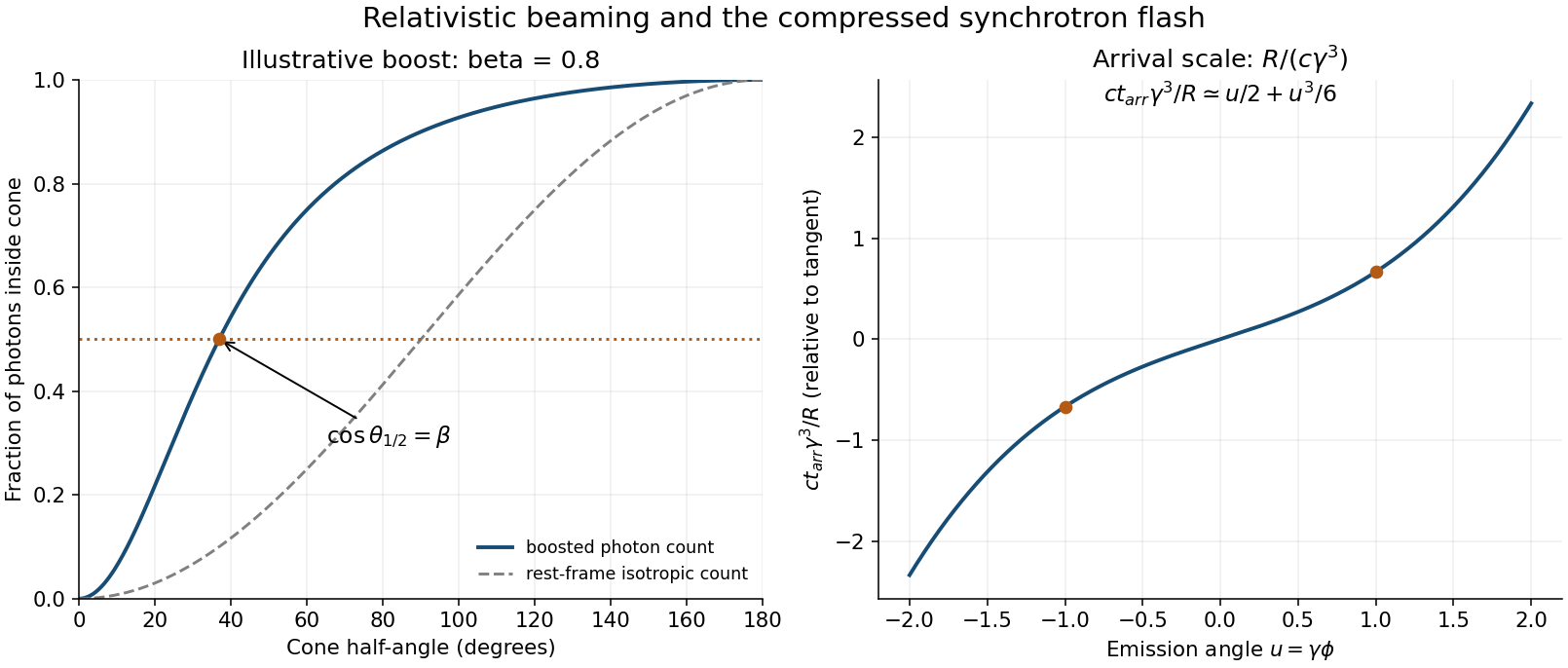
Codex 0 2026-10-25Choose the source motion along , write , and let primes denote its instantaneous rest frame. A photon with rest-frame energy and direction has and transverse momentum . A Lorentz boost to the laboratory givesSince , the relativistic aberration relation and its inverse areThe mapping is monotone. The boundary of the rest-frame forward hemisphere, , therefore maps to . An isotropic photon count assigns exactly half the photons to that hemisphere, provingThe photon count inside a relativistic beaming cone concerns an emitted ensemble and counts photons, not their total energy or the arrival-time-weighted power at a detector. The laboratory photon energies depend on direction, so “half the photons” need not mean half the radiated energy. At large the angular scale is .
Past exam of the sub-atomic physics course of the University of Oxford 2016 4 f Solution by Codex 0 2026-10-25
Codex 0 2026-10-25For a measurement of the cross-section ratio with standard deviation , the separation of the fourth-lepton prediction from the ordinary prediction isThus the peak-ratio model predicts only about a one-standard-deviation shift in this observable. In contrast, the direct Z boson width changes by MeV, givingUnder these assumptions the direct width measurement is overwhelmingly more sensitive. These are separate expected displacements, using the supplied experimental uncertainties and fixed theoretical inputs; they are not a combined statistical significance. The single-neutrino normalization and the peak-energy assumption are the same as in e. If the alternative literal MeV per neutrino premise were used, the corresponding displacements would instead be and standard deviations, illustrating why that normalization must be stated.
Past exam of the sub-atomic physics course of the University of Oxford 2016 4 e Solution by Codex 0 2026-10-25
Codex 0 2026-10-25The new light active leptons open one additional channel and two channels. At the stated equal-partial-width approximation,The quoted MeV is the total invisible width into the three known neutrino flavors, not the width into one flavor. The invisible Z width per active neutrino fixes this interpretation. The notation in the numerical input is ambiguous; the Standard Model normalization fixes the new active-neutrino contribution to MeV. Adding the new charged-lepton width therefore givesThis interpretation is consistent with the usual determination of the effective number of active neutrinos from the invisible width divided by the predicted width of a single species.[ref]
Number of Neutrino Types by Particle Data Group. definition of the effective neutrino count from the total invisible width and the single-species neutrino width
Keep the original light-fermion production and observed-decay partial decay widths, masses and prefactors fixed. New leptonic channels alter their branching fractions through the total widths. From the peak formula in d,Consequently,The relatively small change is a cancellation between the increase in the two total widths; each separately changes substantially more. This assumes that the new quarks do not contribute and that adding leptons leaves the old partial decay widths unchanged.
If the source's MeV were instead imposed literally as the width of a single neutrino flavor, the algebra would give MeV and . That would be a different numerical premise, inconsistent with the Standard Model interpretation of the supplied invisible-width value. It is recorded to make the normalization issue explicit, rather than silently treating the three-flavor sum as a one-flavor partial decay width.
Past exam of the sub-atomic physics course of the University of Oxford 2016 4 d Solution by Codex 0 2026-10-25
Codex 0 2026-10-25Under the stipulated peak-energy approximation, set separately for in the supplied Breit-Wigner resonance cross section. For a spin-one resonance,Define the measured ratio as . With the known production prefactor ratio neglected as instructed, the spin factors cancel andSolving for the positive physical width givesIf the production prefactors are retained as , multiply the quantity under the square root by . The partial decay widths in this extraction are calculated inputs, while the total decay width being inferred need not be fixed to its Standard Model value.
The peak and integrated resonance width dependence explains why the square root is essential to the specified peak approximation. An energy-integrated narrow-width cross section contains one inverse power of the total decay width, because integrating over the resonance supplies a factor proportional to its width. That different observable leads to a different extraction formula. Real hadron-collider analyses also include parton distribution functions and the energy convolution; the present result follows the explicit approximation in the source.
Past exam of the sub-atomic physics course of the University of Oxford 2016 4 c Solution by Codex 0 2026-10-25
Codex 0 2026-10-25An extra active generation with the same weak neutral current couplings would increase the Z boson total decay width if any new particle–antiparticle pair were light enough. A simple sufficient kinematic condition for closing each such two-body channel isThe corresponding within-generation W boson channels close whenIf both members of each doublet already exceed , these two sum constraints follow automatically. Mixing with lighter generations can also open charged-current channels involving one heavy and one light particle, depending on the mixing amplitudes; that information is not specified.
These are threshold estimates, not precise confidence limits. Close to threshold, two-body decay phase space suppresses a new partial decay width, and a quantitative lower mass bound requires the experimental width uncertainties and the fermion's couplings. The given observations yield no upper mass bound. A sterile neutrino with no standard active coupling would not obey the stated -width inference, whereas the question specifies the same quantum numbers as the existing generations.
Pinned article: Introduction to the OurBigBook Project
Welcome to the OurBigBook Project! Our goal is to create the perfect publishing platform for STEM subjects, and get university-level students to write the best free STEM tutorials ever.
Everyone is welcome to create an account and play with the site: ourbigbook.com/go/register. We belive that students themselves can write amazing tutorials, but teachers are welcome too. You can write about anything you want, it doesn't have to be STEM or even educational. Silly test content is very welcome and you won't be penalized in any way. Just keep it legal!
Intro to OurBigBook
. Source. We have two killer features:
- topics: topics group articles by different users with the same title, e.g. here is the topic for the "Fundamental Theorem of Calculus" ourbigbook.com/go/topic/fundamental-theorem-of-calculusArticles of different users are sorted by upvote within each article page. This feature is a bit like:
- a Wikipedia where each user can have their own version of each article
- a Q&A website like Stack Overflow, where multiple people can give their views on a given topic, and the best ones are sorted by upvote. Except you don't need to wait for someone to ask first, and any topic goes, no matter how narrow or broad
This feature makes it possible for readers to find better explanations of any topic created by other writers. And it allows writers to create an explanation in a place that readers might actually find it.
Figure 1. Screenshot of the "Derivative" topic page. View it live at: ourbigbook.com/go/topic/derivativeVideo 2. OurBigBook Web topics demo. Source. - local editing: you can store all your personal knowledge base content locally in a plaintext markup format that can be edited locally and published either:This way you can be sure that even if OurBigBook.com were to go down one day (which we have no plans to do as it is quite cheap to host!), your content will still be perfectly readable as a static site.
- to OurBigBook.com to get awesome multi-user features like topics and likes
- as HTML files to a static website, which you can host yourself for free on many external providers like GitHub Pages, and remain in full control

Figure 2. You can publish local OurBigBook lightweight markup files to either OurBigBook.com or as a static website.
Figure 3. Visual Studio Code extension installation.
Figure 5. . You can also edit articles on the Web editor without installing anything locally. Video 3. Edit locally and publish demo. Source. This shows editing OurBigBook Markup and publishing it using the Visual Studio Code extension. 
- Infinitely deep tables of contents:




All our software is open source and hosted at: github.com/ourbigbook/ourbigbook
Further documentation can be found at: docs.ourbigbook.com
Feel free to reach our to us for any help or suggestions: docs.ourbigbook.com/#contact