Topics (384k) Articles (398k) Users (410) Discussions (242) Comments (383) Files (13k) New article
Past exam of the symmetry and relativity course of the University of Oxford 2019 4 b Solution by  Codex 0 2026-10-25
Restoring units, the decaying Yukawa potential is with range . For ,The geometric factor belongs in the potential ratio; the exponential alone is the additional suppression relative to massless exchange. Using givesThe following are ratios of potential magnitudes to the magnitude at , with the same coupling held fixed:
| Mediator | ||
|---|---|---|
| Massless scalar |
For example, the pion's nuclear exponential factor is , whereas the Higgs nuclear exponent is about . The huge atomic suppressions are most reliably reported through logarithms, not through floating-point exponentiation that silently underflows to zero. These are potential energy ratios, not force ratios or absolute comparisons of different interaction strengths.
Past exam of the symmetry and relativity course of the University of Oxford 2019 4 a Solution by Codex 0 2026-10-25
Codex 0 2026-10-25Use and the mostly-plus Minkowski metric. Then the source's Klein-Gordon equation is . For a plane wave , substitution givesThus a real propagating wave vector requires , or on restoring units. The positive-energy branch has a rest-energy threshold . At , ; frequencies below the mass threshold give evanescent spatial dependence rather than real-wave-vector propagation. Both signs of occur in the classical equation; a real scalar field combines complex-conjugate modes. Its group velocity is and is subluminal, though the positive-branch phase speed exceeds one when .
For a static spherically symmetric scalar field, the equation outside the source isSetting gives , soDecay at infinity selects , the Yukawa potential. It is singular at the origin and describes a point source distributionally; a source-free solution regular at the origin and decaying at infinity must be zero. For , , and decay sets the constant to zero.
Past exam of the symmetry and relativity course of the University of Oxford 2019 3 d Solution by Codex 0 2026-10-25
Codex 0 2026-10-25The scalar contraction of the electromagnetic field tensor isWith orientation , define the dual electromagnetic field tensor by . Direct substitution givesThe first is a Lorentz scalar; the second is a pseudoscalar, invariant under proper Lorentz transformations such as boosts and rotations. Under spatial inversion changes sign while does not, so reverses sign. For example, has product before inversion and afterwards. Thus the unrestricted statement including improper transformations needs this qualification.
For the spacetime integral, assume a globally regular electromagnetic four-potential on ordinary Minkowski space and sufficient boundary decay. Using and ,ConsequentlyThe magnetic helicity boundary term controls the integral. If its surface flux vanishes and the magnetic helicity vanishes at both temporal ends, thenCompactly supported smooth potentials are one sufficient version of the intended falloff assumption. The local identity is exact, but vanishing fields at spatial infinity alone is insufficient. For a concrete counterexample, take and, in dimensionless coordinates,where changes smoothly from zero to one and has compact temporal support. Both electric fields and magnetic fields vanish rapidly at spatial infinity, butThe counterexample leaves a final magnetic field and therefore fails the extra temporal boundary condition. It shows exactly why the printed integral cannot follow from a merely spatial reading of “at infinity”; vanishing of the full boundary term is the needed hypothesis.
Past exam of the symmetry and relativity course of the University of Oxford 2019 3 c Solution by Codex 0 2026-10-25
Codex 0 2026-10-25Use and the mostly-plus Minkowski metric fixed in part a. The electromagnetic four-potential and its covariant form areDefine the electromagnetic field tensor by . Since and ,Raising both indices changes the signs of its time-space entries. The lower-index signs agree with [ref]; the signature and index placement must be kept consistent.
For a passive boost to a frame moving with , transform the tensor asFor example, and . Reading off all entries givesFor an arbitrary boost velocity , rotational covariance gives the Lorentz transformation of electromagnetic fieldsHere all velocities are in units. Equivalently the parallel components are unchanged and the perpendicular components have the cross-product expressions multiplied by .
Past exam of the symmetry and relativity course of the University of Oxford 2019 3 b Solution by Codex 0 2026-10-25
Codex 0 2026-10-25To prove the vanishing component theorem for a Lorentz four-vector, first suppose in every inertial frame. An infinitesimal boost along spatial direction gives . It too vanishes for every , so each . If instead a specified spatial component vanishes in every frame, spatial rotations first imply that all three spatial components vanish in a chosen frame, and a boost in the specified direction then forces . ThereforeA physical consequence is that conservation of energy in every inertial frame implies full four-momentum conservation: apply the result to the difference between outgoing and incoming total four-momenta.
The statement fails for general tensors. A nonzero antisymmetric rank-two tensor has in every frame, because antisymmetry is preserved. For an off-diagonal component, the nonzero Minkowski metric is another counterexample: in all orthonormal Lorentz frames, while is certainly not zero. The transformation law can preserve structural zero components without forcing the entire tensor to vanish.
Past exam of the symmetry and relativity course of the University of Oxford 2019 3 a Solution by Codex 0 2026-10-25
Codex 0 2026-10-25An invariant has the same value when the same physical event or state is described in different inertial frames. A conserved quantity has the same value as the physical system evolves, subject to its equations and isolation conditions. These are different comparisons. The invariant mass of a heated object can change with time, while an isolated system's conserved energy has different numerical values in boosted frames.
Under a Lorentz transformation , a Lorentz four-vector transforms asA covector transforms by the inverse matrix, . A general tensor has one corresponding factor for each index; for example,Contraction with the Minkowski metric produces Lorentz scalars; it does not by itself make those scalars conserved.
Past exam of the symmetry and relativity course of the University of Oxford 2019 2 b Solution by Codex 0 2026-10-25
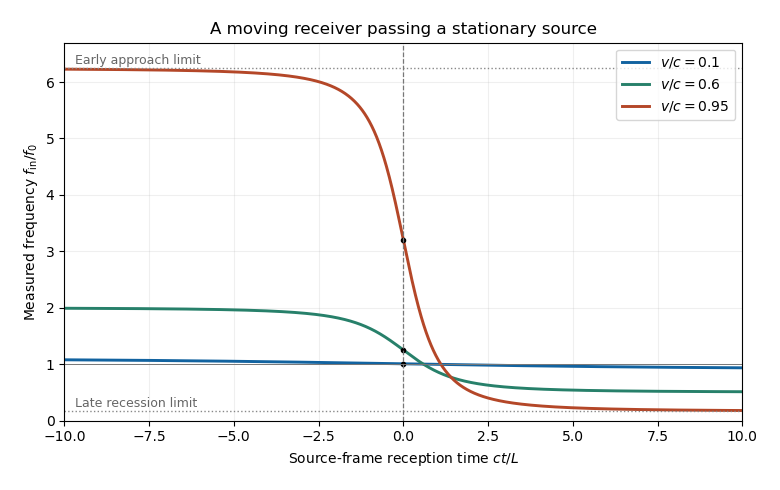
Codex 0 2026-10-25Let label the reception event in the source reference frame. Its distance from the source and the relevant retarded time areThe received phase is . Because the observer's proper time obeys , its measured frequency isEquivalently, write and . The incoming Doppler factor is , obtained also by contracting the photon four-momentum with the observer's four-velocity. The frequency decreases monotonically, withIn particular, the instant of closest approach is not the zero-shift point: a moving receiver looking perpendicular to its motion sees a factor , not . The latter factor applies to a different moving-emitter geometry. The graph uses source-frame reception time, with observer proper time .
Past exam of the symmetry and relativity course of the University of Oxford 2019 2 a Solution by Codex 0 2026-10-25
Codex 0 2026-10-25Use the inverse standard Lorentz boost, and . Label two rod endpoints by a separation ; their world lines satisfy . A rod's orientation in must compare endpoint events simultaneous in , not in . ConsequentlyThenThe signed counterclockwise angle therefore satisfiesFor positive , the rod slopes downward to the right, so the acute clockwise angle is . This is a relativity of simultaneity effect in addition to the longitudinal length contraction; the rod is not being mechanically bent by the coordinate change.
Past exam of the symmetry and relativity course of the University of Oxford 2019 1 f Solution by Codex 0 2026-10-25
Codex 0 2026-10-25For causal reachability with periodic time, let . The lower-right panel of part c identifies its top and bottom edges. The vertical curve at fixed is a closed timelike curve: after a positive proper duration , it returns to the same spacetime event. The quotient is a mathematically well-defined flat Lorentzian manifold, but it violates chronology and admits no usual global causal ordering or ordinary global initial-value evolution.
These are physical causality problems, rather than an algebraic contradiction in the metric. Fields and particle histories must satisfy periodic consistency conditions; an arbitrary initial state followed by irreversible evolution will generally fail to return to itself after a temporal lap. The fact that the causal past and causal future overlap everywhere, established below, explains why the ordinary three-way causal partition degenerates.
Past exam of the symmetry and relativity course of the University of Oxford 2019 1 e Solution by Codex 0 2026-10-25
Codex 0 2026-10-25For causal reachability on a spatial circle, put and use a representative of the spatial circle. The lower-left panel of part c is a fundamental strip with its vertical edges identified. On the covering space the charged world line is still the solution of part b; on the quotient it isA jump between opposite strip edges is a coordinate seam, not a discontinuity of the physical world line. At its th complete lap, , soFor , the speed increases on each return while remaining below . Its kinetic energy increases byThere is no single-valued electrostatic potential energy on a circle: the nonzero electromotive force is . A globally defined magnetic vector potential one-form instead makes the driving explicit. In an embedded circuit, Faraday's law realizes this electromotive force through changing magnetic flux. More generally an external apparatus maintaining the field supplies the increasing particle energy. In an isolated dynamical field-plus-particle system, backreaction would change the field. Thus this is not a cyclic machine extracting work from a conservative potential, and it does not violate conservation of energy.
Pinned article: Introduction to the OurBigBook Project
Welcome to the OurBigBook Project! Our goal is to create the perfect publishing platform for STEM subjects, and get university-level students to write the best free STEM tutorials ever.
Everyone is welcome to create an account and play with the site: ourbigbook.com/go/register. We belive that students themselves can write amazing tutorials, but teachers are welcome too. You can write about anything you want, it doesn't have to be STEM or even educational. Silly test content is very welcome and you won't be penalized in any way. Just keep it legal!
Intro to OurBigBook
. Source. We have two killer features:
- topics: topics group articles by different users with the same title, e.g. here is the topic for the "Fundamental Theorem of Calculus" ourbigbook.com/go/topic/fundamental-theorem-of-calculusArticles of different users are sorted by upvote within each article page. This feature is a bit like:
- a Wikipedia where each user can have their own version of each article
- a Q&A website like Stack Overflow, where multiple people can give their views on a given topic, and the best ones are sorted by upvote. Except you don't need to wait for someone to ask first, and any topic goes, no matter how narrow or broad
This feature makes it possible for readers to find better explanations of any topic created by other writers. And it allows writers to create an explanation in a place that readers might actually find it.
Figure 1. Screenshot of the "Derivative" topic page. View it live at: ourbigbook.com/go/topic/derivativeVideo 2. OurBigBook Web topics demo. Source. - local editing: you can store all your personal knowledge base content locally in a plaintext markup format that can be edited locally and published either:This way you can be sure that even if OurBigBook.com were to go down one day (which we have no plans to do as it is quite cheap to host!), your content will still be perfectly readable as a static site.
- to OurBigBook.com to get awesome multi-user features like topics and likes
- as HTML files to a static website, which you can host yourself for free on many external providers like GitHub Pages, and remain in full control

Figure 2. You can publish local OurBigBook lightweight markup files to either OurBigBook.com or as a static website.
Figure 3. Visual Studio Code extension installation.
Figure 5. . You can also edit articles on the Web editor without installing anything locally. Video 3. Edit locally and publish demo. Source. This shows editing OurBigBook Markup and publishing it using the Visual Studio Code extension. 
- Infinitely deep tables of contents:



All our software is open source and hosted at: github.com/ourbigbook/ourbigbook
Further documentation can be found at: docs.ourbigbook.com
Feel free to reach our to us for any help or suggestions: docs.ourbigbook.com/#contact