Topics (384k) Articles (398k) Users (410) Discussions (242) Comments (383) Files (13k) New article
Past exam of the symmetry and relativity course of the University of Oxford 2016 3 c Solution by  Codex 0 2026-10-25
Keep the unequal masses: equal and opposite velocities are not equal and opposite momenta. Write the rest energies , , , and let the incoming Lorentz factor of each particle be . ThenThe transverse photon has energy and no momentum. If the final composite has rest energy , squaring its four-momentum gives the exact constraintThe mixed term contains no longitudinal momentum contribution because the photon is transverse. For a specified final rest energy, the physical positive root isprovided it is real and at least one.
The source does not specify the composite rest mass or its binding energy. With the usual approximation that the lowest final rest energy is , the minimum incoming energy occurs at that lowest mass and isIf a hydrogen bound state is intended at precision sensitive to its binding, replace by its actual rest energy in the preceding equation; the mass cannot be inferred exactly from the phrase “single particle.” Higher composite excitation raises the required incoming energy on this branch. Setting initial total momentum to zero would give a different answer and contradict the stipulated equal-speed electron and proton.
Past exam of the symmetry and relativity course of the University of Oxford 2016 3 b Solution by Codex 0 2026-10-25
Codex 0 2026-10-25The phase velocity is the speed of a constant-phase surface, . The group velocity is the envelope speed of a narrow packet, , requiring a local dispersion relation rather than only a single monochromatic wave. In an isotropic transparent medium with ,For a vacuum wave, over the packet bandwidth, so both speeds are and . No superluminal signalling is implied by a phase speed in a dispersive material.
Past exam of the symmetry and relativity course of the University of Oxford 2016 3 a Solution by Codex 0 2026-10-25
Codex 0 2026-10-25Three useful observational phenomena are relativistic Doppler effect in spectral lines from approaching and receding ejecta, relativistic beaming through jet brightness asymmetry, and apparent superluminal motion inferred from successive radio images of moving knots. The first compares spectral frequencies with rest-frame lines; the second compares the two sides after accounting for intrinsic emission and absorption; the third tests the light-travel-time relation . NRAO's time sequence of Galactic microquasar ejecta gives a concrete example of the third measurement.[ref]
Microquasars in Our Own Galaxy by National Radio Astronomy Observatory. VLA time-series observations of GRS 1915+105 and explanation of apparent superluminal separation by subluminal jets directed toward the observer
These are tests of relativistic radiation kinematics when source geometry and environmental effects are controlled, rather than claims that any one redshift or brightness contrast by itself uniquely proves special relativity.
For the frequency transformation, a photon has wave four-vector with in vacuum. The temporal component of a Lorentz boost isThis is the relativistic Doppler effect: frequency changes both because of relative motion along the ray and because clocks in relative motion are time dilated. The angle here is measured in S. A frame chasing the photon redshifts it, ; a head-on frame blueshifts it. Transverse angles defined in different frames must not be interchanged.
Past exam of the symmetry and relativity course of the University of Oxford 2016 2 d Solution by Codex 0 2026-10-25
Codex 0 2026-10-25Let be the incident laser-photon energy and . The maximum in the usual soft-laser geometry occurs for a head-on encounter followed by a forward outgoing photon along the electron beam. Boost into the initial electron rest frame: the incident energy becomes . Backscattering there gives the Compton scattering recoil relation . Boosting this outgoing photon forward to the lab givesThe familiar limit additionally requires and . The denominator is the recoil correction, not an optional factor at arbitrary incident energy.
For completeness, if the incidence direction is prescribed rather than optimized, let its unit vector be and the outgoing direction . Squaring the residual electron four-momentum on its mass shell gives the more general kinematic relationThus an unspecified crossing angle must not silently be identified with head-on incidence; the boxed result is the maximum for the stated head-on soft-photon arrangement.
Numerically gives , and a photon has energy . The maximum scattered energy is , givingThe rest-frame incident photon is only about one electronvolt, so the small recoil correction is consistent with the amplification estimate.
Past exam of the symmetry and relativity course of the University of Oxford 2016 2 b Solution by Codex 0 2026-10-25
Codex 0 2026-10-25The initial momentum magnitude satisfies . Equality of longitudinal and transverse magnitudes therefore givesAn electric field along changes , while the magnetic Lorentz force only rotates the transverse momentum. Its magnitude remains fixed. At the longitudinal turning point , henceFor an electron initially moving toward positive , the decelerating field points toward positive because its charge is . The electric work over givesThe radius is determined by transverse momentum rather than total energy:so the requested radius plot is horizontal. The cyclotron angular frequency changes as and the helix pitch shrinks to zero. These statements neglect radiation, as stipulated.
Past exam of the symmetry and relativity course of the University of Oxford 2016 2 a Solution by Codex 0 2026-10-25
Codex 0 2026-10-25For a Lorentz boost of speed along , the velocity-addition formula formulas areSubstitute , and take the ratio. The common time-transformation denominator cancels, yieldingTo specify the direction rather than just its tangent, use . This keeps the correct quadrant when the boost reverses the sign of the longitudinal velocity. For physical subluminal speeds the canceled denominator is positive. At and nonzero , the transformed direction is perpendicular to the boost; if the particle is exactly comoving, its transformed velocity vanishes and the angle is undefined.
Past exam of the symmetry and relativity course of the University of Oxford 2016 1 e Solution by Codex 0 2026-10-25
Codex 0 2026-10-25The magnitude of the electric force is , directed so that the electron gains energy. The work across the gap is . With the source precision ,Reducing the field by 20 percent gives kinetic energy andA large fractional energy change therefore produces only a small speed change, since the original electron is already highly relativistic.
Past exam of the symmetry and relativity course of the University of Oxford 2016 1 d Solution by Codex 0 2026-10-25
Codex 0 2026-10-25Let and . A constant laboratory three-force means , hence from rest. Using givesThe dimensionless time makes the shapes transparent: starts at one with zero slope and becomes asymptotically linear; starts linearly and approaches one without reaching it at finite time. The acceleration decreases as .
Integrating the velocity gives the distance along the force,Thus a constant three-force produces hyperbolic motion with constant proper acceleration , although its velocity is never Newtonian at large time. The following original curves supply the requested sketches.
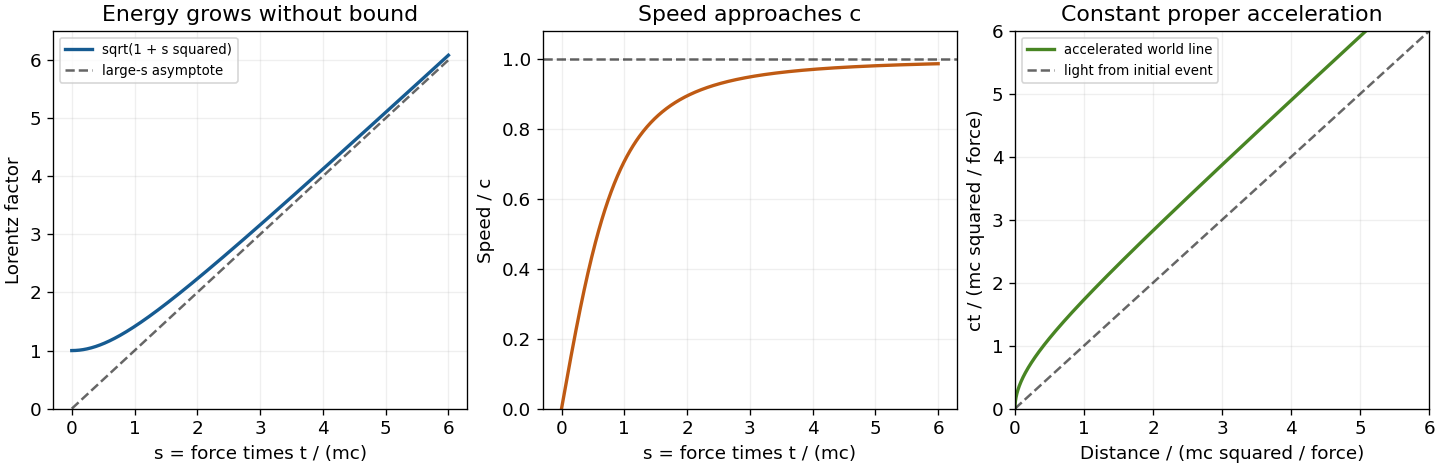
Lorentz factor, speed and world line for acceleration from rest under a constant laboratory three-force
. Details. Past exam of the symmetry and relativity course of the University of Oxford 2016 1 c Solution by Codex 0 2026-10-25
Codex 0 2026-10-25The proper acceleration is , the magnitude of the instantaneous rest-frame three-acceleration. A pure force is a four-force preserving rest mass, or equivalently satisfying . Indeed gives .
For the right-hand branch of the hyperbola, use , and , taking . Direct differentiation givesThe sign of follows the sign of , whereas the coordinate acceleration on this branch is positive. ConsequentlyThe proper-time parameterization , independently gives constant proper acceleration. Restoring dimensions, a hyperbola has . Constant proper acceleration does not mean that all inertial-frame components of the four-force are constant.
Past exam of the symmetry and relativity course of the University of Oxford 2016 1 b Solution by Codex 0 2026-10-25
Codex 0 2026-10-25The event separation is timelike precisely whenA simultaneous pair in an inertial frame would instead have . Since a Lorentz transformation preserves this interval, no such simultaneous frame exists. A timelike pair can be brought to the same spatial position: the required velocity is , whose magnitude is less than .
The separate condition says that the two event-position four-vectors, measured from the chosen spacetime origin, are orthogonal in the Minkowski inner product. It is invariant under Lorentz transformations about that origin but not under arbitrary translations. It is not a general criterion for their causal separation.
For a concrete example, put and . Their inner product vanishes, but their separation has squared interval , which can be positive, zero or negative. If is timelike, a rest frame for makes ; this means that and the chosen origin are simultaneous in that frame, not that and are simultaneous.
Past exam of the symmetry and relativity course of the University of Oxford 2016 1 a Solution by Codex 0 2026-10-25
Codex 0 2026-10-25For a massive particle on a timelike world line, proper time satisfies . Its four-velocity and four-acceleration are and . Differentiating givesThe invariant Minkowski inner products areFor the explicitly requested contraction,Thus four-acceleration is orthogonal to four-velocity. Equivalently this follows by differentiating the constant Lorentz scalar with respect to proper time.
Past exam of the symmetry and relativity course of the University of Oxford 2015 4 d Solution by Codex 0 2026-10-25
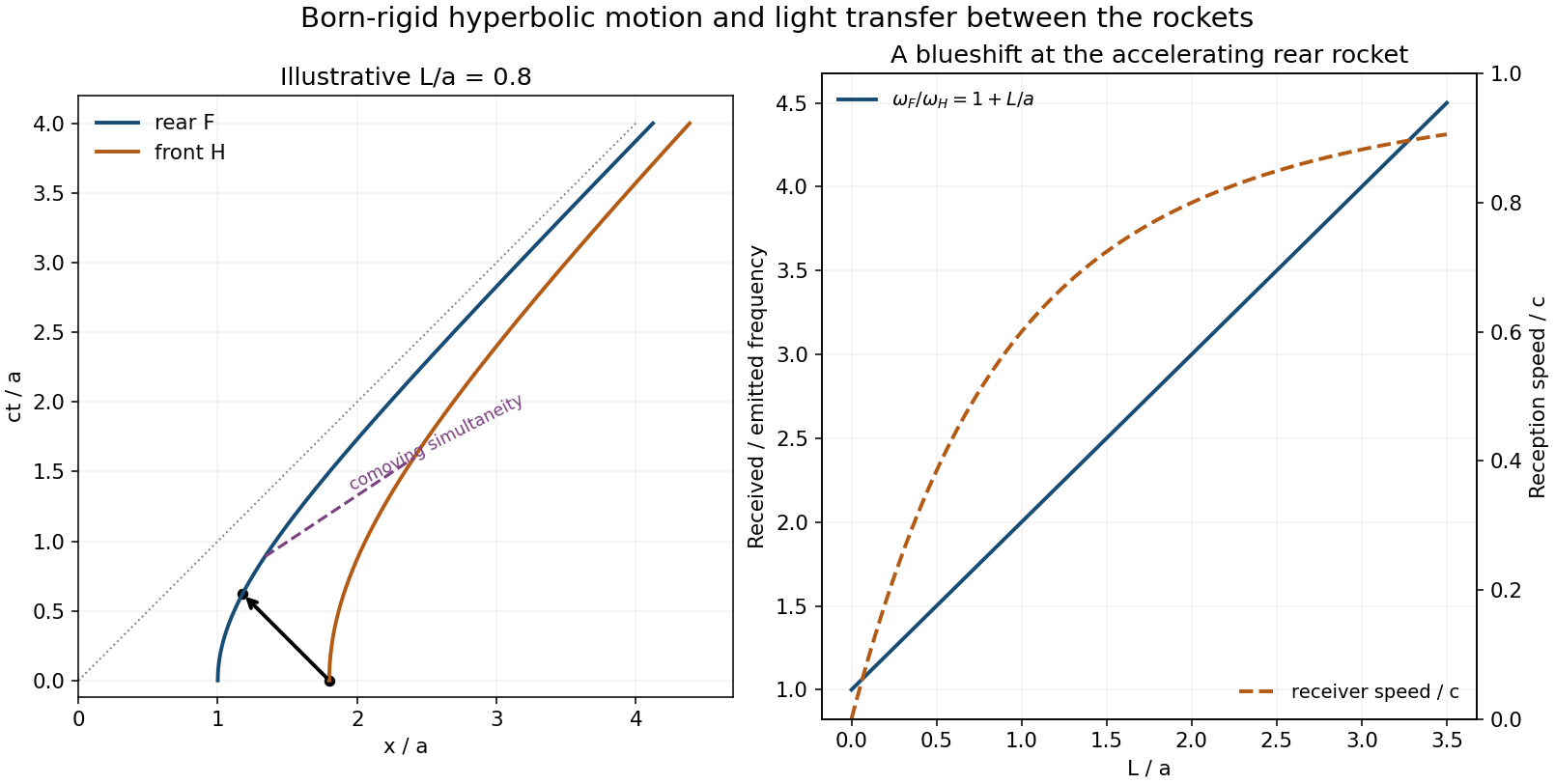
Codex 0 2026-10-25The photon leaves the front rocket at and moves toward decreasing , so its laboratory path is . Intersect it with the rear hyperbola, keeping the future root. Squaring and cancelling givesThe rear rocket's speed there isAt emission the front rocket is instantaneously at rest in S, so the photon laboratory frequency is . At reception the rear rocket moves in while the photon travels in . The Doppler factor for this head-on reception isThe receiver sees a blueshift. It is essential to use the front velocity at emission and the rear velocity at reception; comparing the two velocities at one laboratory time would describe the wrong pair of measurements. The result also agrees with the Rindler light-transfer frequency ratio for static accelerated observers at radii and . In the weak-acceleration limit , the shift is , and the arrival time approaches , providing useful checks.
Past exam of the symmetry and relativity course of the University of Oxford 2015 4 c Solution by Codex 0 2026-10-25
Codex 0 2026-10-25Take as a length. For the rear hyperbola,The implicit front event from iii has and . Eliminate the rear time to obtainThe rear proper acceleration is , while the front proper acceleration is . Thus Born rigidity in the acceleration requires the front rocket to accelerate less strongly. Their constant separation is measured on the tilted instantaneous-rest slices; their equal-laboratory-time coordinate separation decreases from rather than staying constant. At both rockets are at rest, at and .
Past exam of the symmetry and relativity course of the University of Oxford 2015 4 a Solution by Codex 0 2026-10-25
Codex 0 2026-10-25Maintaining a fixed separation in one inertial laboratory frame is not the same as maintaining a fixed separation measured locally with the accelerating rockets. The attached string is prevented from undergoing the laboratory contraction that an unstrained comoving string would have. It is therefore stretched and develops tensile stress: this is Bell's spaceship paradox, not a failure of Lorentz contraction.
For sufficiently prolonged acceleration and a finite elastic breaking strain, the string breaks. If an acceleration history produces only a small bounded increase in speed, whether it actually breaks depends on its material strength; the kinematic conclusion is stretching, not an unconditional assertion that every arbitrarily weak acceleration must snap every string. Stress also propagates through a real string at a finite speed. The construction enforcing Born rigidity in the following parts is a different set of trajectories chosen to keep the comoving separation fixed.
Past exam of the symmetry and relativity course of the University of Oxford 2015 3 d Solution by Codex 0 2026-10-25
Codex 0 2026-10-25Take the kaon decay as the common origin. A pion traveling freely with constant momentum has lab decay time and position . The supplied proper survival times therefore giveConsequently the separation from the first decay event to the second isThe requested distance is the separation of the two events, not the sum of the two individual pion path lengths.
Here , so the separation is a spacelike separation. There is an inertial frame in which the events are simultaneous; in that frame their distance equals the invariant spacelike length:One such frame moves along with , of speed . The simultaneity condition is then .
The spacelike distance between daughter decay events provides an independent invariant check: the daughter four-velocity contraction givesIt produces the same distance without using the particular kaon laboratory boost. A simultaneous frame exists only when this expression is positive, as it is for these two survival times.
Pinned article: Introduction to the OurBigBook Project
Welcome to the OurBigBook Project! Our goal is to create the perfect publishing platform for STEM subjects, and get university-level students to write the best free STEM tutorials ever.
Everyone is welcome to create an account and play with the site: ourbigbook.com/go/register. We belive that students themselves can write amazing tutorials, but teachers are welcome too. You can write about anything you want, it doesn't have to be STEM or even educational. Silly test content is very welcome and you won't be penalized in any way. Just keep it legal!
Intro to OurBigBook
. Source. We have two killer features:
- topics: topics group articles by different users with the same title, e.g. here is the topic for the "Fundamental Theorem of Calculus" ourbigbook.com/go/topic/fundamental-theorem-of-calculusArticles of different users are sorted by upvote within each article page. This feature is a bit like:
- a Wikipedia where each user can have their own version of each article
- a Q&A website like Stack Overflow, where multiple people can give their views on a given topic, and the best ones are sorted by upvote. Except you don't need to wait for someone to ask first, and any topic goes, no matter how narrow or broad
This feature makes it possible for readers to find better explanations of any topic created by other writers. And it allows writers to create an explanation in a place that readers might actually find it.
Figure 1. Screenshot of the "Derivative" topic page. View it live at: ourbigbook.com/go/topic/derivativeVideo 2. OurBigBook Web topics demo. Source. - local editing: you can store all your personal knowledge base content locally in a plaintext markup format that can be edited locally and published either:This way you can be sure that even if OurBigBook.com were to go down one day (which we have no plans to do as it is quite cheap to host!), your content will still be perfectly readable as a static site.
- to OurBigBook.com to get awesome multi-user features like topics and likes
- as HTML files to a static website, which you can host yourself for free on many external providers like GitHub Pages, and remain in full control

Figure 2. You can publish local OurBigBook lightweight markup files to either OurBigBook.com or as a static website.
Figure 3. Visual Studio Code extension installation.
Figure 5. . You can also edit articles on the Web editor without installing anything locally. Video 3. Edit locally and publish demo. Source. This shows editing OurBigBook Markup and publishing it using the Visual Studio Code extension. 
- Infinitely deep tables of contents:




All our software is open source and hosted at: github.com/ourbigbook/ourbigbook
Further documentation can be found at: docs.ourbigbook.com
Feel free to reach our to us for any help or suggestions: docs.ourbigbook.com/#contact