Topics (384k) Articles (398k) Users (410) Discussions (242) Comments (383) Files (13k) New article
Past exam of the symmetry and relativity course of the University of Oxford 2017 2 e Solution by  Codex 0 2026-10-25
With , the total four-momentum is . A sum of Lorentz four-vectors transforms as a four-vector, sois a Lorentz invariant. Its value is the squared invariant mass of the complete system, irrespective of whether its constituents interact. Isolation makes the total four-momentum constant in time.
For a photon gas, write with . Its individual null norms do not make the total norm vanish:For an isotropic gas in its momentum rest frame, and . Zero is possible only when all nonzero photons propagate in the same direction. Two equal-energy photons at right angles, for example, give , rather than zero. Without an angular distribution, the pairwise expression is the general answer; isotropy is an additional assumption.
Past exam of the symmetry and relativity course of the University of Oxford 2017 2 b Solution by Codex 0 2026-10-25
Codex 0 2026-10-25Let and . A spacelike separation obeysUnder a boost with velocity , the time separation is . ChooseThen , while follows from the spacelike inequality. Therefore an inertial simultaneity frame exists. This choice has no transverse boost component and is not claimed to be the unique such frame. If the events are already simultaneous, suffices.
Past exam of the symmetry and relativity course of the University of Oxford 2017 2 a Solution by Codex 0 2026-10-25
Codex 0 2026-10-25For a vacuum electromagnetic wave, the four-wavevector is with and . Its phase can be writtenBecause and transform as Lorentz four-vectors, their contraction is a Lorentz scalar. This proves phase invariance, with the same phase convention in both frames.
For a hypothetical free emission , four-momentum conservation gives . The initial and final electrons have , and . Squaring gives . In the final electron's rest frame, however, for a nonzero future-directed photon. ThusAn external field, another body or a medium can exchange momentum and change this conclusion; those are different systems.
Past exam of the symmetry and relativity course of the University of Oxford 2017 1 e Solution by Codex 0 2026-10-25
Codex 0 2026-10-25The electron moves in the direction for which the electric field does positive work. Its kinetic energy gain is the magnitude . HenceThis uses the relativistic energy-momentum relation, rather than the nonrelativistic kinetic-energy formula. Acceleration is opposite the field direction for a negatively charged electron, although the energy gain is positive along its actual displacement.
Past exam of the symmetry and relativity course of the University of Oxford 2017 1 d Solution by Codex 0 2026-10-25
Codex 0 2026-10-25The equal and opposite incoming momenta make the laboratory the centre-of-mass frame. The initial total four-momentum is timelike. One outgoing photon would have null four-momentum, so an isolated two-body annihilation cannot produce exactly one photon. Two photons are kinematically possible and must have opposite momenta and equal energies:The quoted is the rest energy , not a mass in SI units. The energy balance includes both rest energies as well as the total kinetic energy.
Past exam of the symmetry and relativity course of the University of Oxford 2017 1 c Solution by Codex 0 2026-10-25
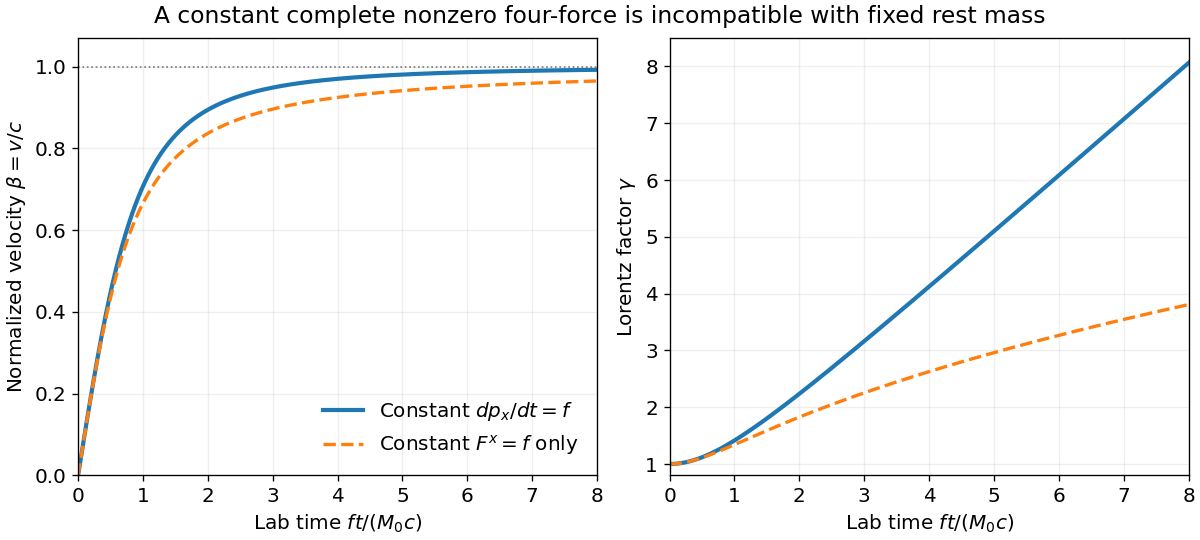
Codex 0 2026-10-25There is no nonzero, literally constant four-force that is a pure force throughout this motion. Initially , so purity forces . If the full four-vector were constant, ; its square would be , which cannot remain for a nonzero initially spatial . This is a genuine ambiguity in the source wording.
The usual consistent interpretation is constant laboratory relativistic force , equivalently constant one-dimensional proper acceleration . Take and let . Integrating momentum conservation with the applied impulse gives , soThe corresponding four-force has components , which are not constant, although its invariant magnitude is . Its temporal component is indeed . The speed rises from zero and approaches asymptotically; starts at one, initially rises quadratically and becomes linear in at late times.
If instead only the spatial four-force component is held constant, the distinct consistent answer is most simply parametrized by :This follows by integrating and . The temporal component must still vary. These two interpretations must not be conflated with a constant four-vector.
Past exam of the symmetry and relativity course of the University of Oxford 2017 1 b Solution by Codex 0 2026-10-25
Codex 0 2026-10-25Along a massive particle's world line, proper time satisfies . A pure force preserves its rest mass. Differentiating and givesso for a pure force. This is a restriction on rest-mass transfer, not a statement that its work in every frame vanishes.
Write . Since , the four-acceleration isIf , this reduces to , whenceHere is the proper acceleration. The positive expression printed in the source is in the opposite metric signature, or the squared acceleration magnitude in ours. For example, at rest with nonzero acceleration, has in our convention. Thus one must not combine the printed positive sign with a mostly-minus norm.
Past exam of the symmetry and relativity course of the University of Oxford 2017 1 a Solution by Codex 0 2026-10-25
Codex 0 2026-10-25For a massive particle on a timelike world line, the four-velocity is , with . Its four-momentum is and its four-force is . Here is proper time. A massless trajectory does not admit this massive-particle proper-time parametrization.
The asserted classification of arbitrary orthogonal vectors is false. With the chosen Minkowski metric, and are nonzero, orthogonal and both spacelike vectors. Also and are orthogonal null vectors. The valid statement is that a nonzero vector orthogonal to a timelike vector is spacelike. To prove it, choose the rest frame of the timelike vector, ; then forces , so .
The relativistic energy-momentum relation givesTherefore . A photon is an example: . A collection of photons need not itself have zero invariant mass.
Past exam of the symmetry and relativity course of the University of Oxford 2016 4 b Solution by Codex 0 2026-10-25
Codex 0 2026-10-25In the massive particle's rest frame, and the physical Pauli-Lubanski pseudovector is , up to a common overall sign. Their Minkowski inner product is therefore zero. Since it is a Lorentz scalar,in every inertial frame, for any nonzero scalar normalization of . This proves the requested orthogonality without a boosted component calculation.
The printed assertion that its particular normalization is always a unit vector needs qualification. For the displayed components ,Thus dividing by is unit spacelike only when , or when in that denominator is explicitly replaced by the proper rest-spin magnitude with correctly boosted components of . As a counterexample to the literal displayed normalization, choose with nonzero momentum: it gives , not . Orthogonality remains true, but it does not establish normalization.
Past exam of the symmetry and relativity course of the University of Oxford 2016 4 a Solution by Codex 0 2026-10-25
Codex 0 2026-10-25Take , and . ThenExpanding the cyclic derivative of produces six second derivatives, which cancel in pairs because partial derivatives commute. HenceThis Bianchi identity contains and . The inhomogeneous Maxwell equations areThe temporal component is , since ; the spatial components give . The source suppresses the coupling factor, as in units with or a rescaled current.
For the physical Lorentz force density on matter, the consistent tensor formula isIts temporal component is power transferred to matter per unit volume divided by . The printed expression has the opposite sign for the stated definition of in this convention. A stationary positive charge in a positive electric field is a concrete check: the physical upper spatial force is , whereas the printed expression, raised to an upper index, gives . It can represent the opposite momentum transfer to the electromagnetic field, but must not be identified with the force on the charge without changing a convention.
Past exam of the symmetry and relativity course of the University of Oxford 2016 3 d Solution by Codex 0 2026-10-25
Codex 0 2026-10-25For a forward wave, the Faraday's law of induction fixes the relative amplitudes and signs:Thus the two scalar amplitudes in the source cannot both be positive when the stated propagation direction and axes are used. The supplied product magnitude fixes only an overall amplitude in the chosen field units.
One convenient potential representative isIndeed gives the electric field and gives the signed magnetic field above. Moreover , the Lorenz gauge condition. The potentials are not unique because residual gauge transformations may preserve this condition.
Since , the electromagnetic electromagnetic field invariants satisfy and away from field nodes. A boost along positive with speed givesHere and . The wave becomes a static spatially varying magnetic pattern in this frame. This is possible because its medium wave four-vector is spacelike, ; it is not a vacuum-photon rest frame. The medium moves in the new frame, so its original rest-frame constitutive relation must not be reused there unchanged.
No inertial frame makes the magnetic field vanish throughout a nontrivial wave: that would turn the positive invariant into a nonpositive one. Both fields vanish at isolated nodes already, which is distinct from removing a field everywhere.
Pinned article: Introduction to the OurBigBook Project
Welcome to the OurBigBook Project! Our goal is to create the perfect publishing platform for STEM subjects, and get university-level students to write the best free STEM tutorials ever.
Everyone is welcome to create an account and play with the site: ourbigbook.com/go/register. We belive that students themselves can write amazing tutorials, but teachers are welcome too. You can write about anything you want, it doesn't have to be STEM or even educational. Silly test content is very welcome and you won't be penalized in any way. Just keep it legal!
Intro to OurBigBook
. Source. We have two killer features:
- topics: topics group articles by different users with the same title, e.g. here is the topic for the "Fundamental Theorem of Calculus" ourbigbook.com/go/topic/fundamental-theorem-of-calculusArticles of different users are sorted by upvote within each article page. This feature is a bit like:
- a Wikipedia where each user can have their own version of each article
- a Q&A website like Stack Overflow, where multiple people can give their views on a given topic, and the best ones are sorted by upvote. Except you don't need to wait for someone to ask first, and any topic goes, no matter how narrow or broad
This feature makes it possible for readers to find better explanations of any topic created by other writers. And it allows writers to create an explanation in a place that readers might actually find it.
Figure 1. Screenshot of the "Derivative" topic page. View it live at: ourbigbook.com/go/topic/derivativeVideo 2. OurBigBook Web topics demo. Source. - local editing: you can store all your personal knowledge base content locally in a plaintext markup format that can be edited locally and published either:This way you can be sure that even if OurBigBook.com were to go down one day (which we have no plans to do as it is quite cheap to host!), your content will still be perfectly readable as a static site.
- to OurBigBook.com to get awesome multi-user features like topics and likes
- as HTML files to a static website, which you can host yourself for free on many external providers like GitHub Pages, and remain in full control

Figure 2. You can publish local OurBigBook lightweight markup files to either OurBigBook.com or as a static website.
Figure 3. Visual Studio Code extension installation.
Figure 5. . You can also edit articles on the Web editor without installing anything locally. Video 3. Edit locally and publish demo. Source. This shows editing OurBigBook Markup and publishing it using the Visual Studio Code extension. 
- Infinitely deep tables of contents:



All our software is open source and hosted at: github.com/ourbigbook/ourbigbook
Further documentation can be found at: docs.ourbigbook.com
Feel free to reach our to us for any help or suggestions: docs.ourbigbook.com/#contact