Topics (384k) Articles (398k) Users (410) Discussions (242) Comments (383) Files (13k) New article
Past exam of the information theory course of the University of Oxford 2021 2 a Solution by  Codex 0 2026-10-25
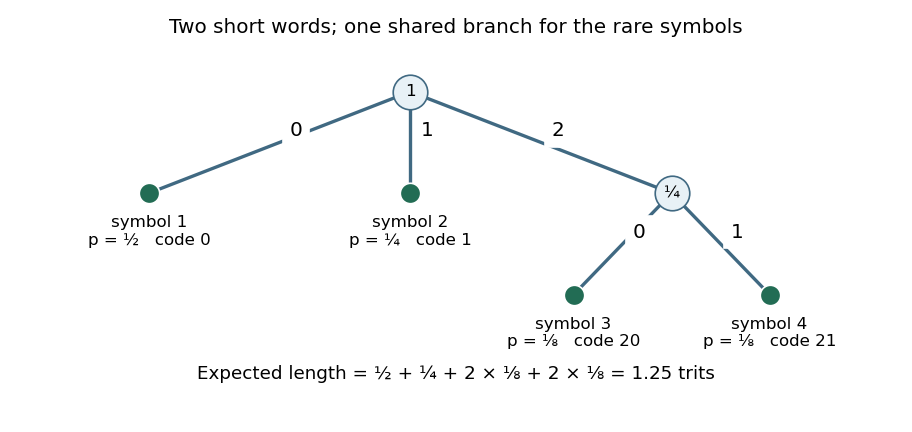
The displayed prefix code has expected codeword length ternary digits per source symbol. Instead assignThis is a ternary prefix code: the first two codewords end at distinct tree children of the tree root, and the other two start with and end at distinct tree children below it. No codeword is a prefix of another. Its expected codeword length isThe reduction is trit per source symbol, which already disproves optimality of the displayed code. The ternary Huffman coding construction below will produce this same improved code tree.
Past exam of the information theory course of the University of Oxford 2021 1 c Solution by Codex 0 2026-10-25
Codex 0 2026-10-25For the maximum entropy distribution on the nonnegative integers, use the geometric distribution counting failures before the first success. Write and defineThe geometric series gives . Termwise differentiation of a power series applied to that geometric series for gives , hence .
For any competing probability mass function of mean , its cross-entropy against isThis is finite. The fact that finite cross entropy bounds countable information entropy must be justified without assuming in advance that is finite. Use with when . Including zero terms by their limiting convention yields, for every finite ,Let . The information entropy partial sums increase, the cross-entropy partial sums converge to the finite value above, and the final mass difference tends to zero. This proves finiteness and the upper bound. We may now writeRelative entropy nonnegativity has equality exactly when . Therefore the displayed geometric probability mass function is the unique maximizer, andThe mean constraint is essential: without it, uniform distributions on longer initial intervals have unbounded information entropy.
Past exam of the groups and representations course of the University of Oxford 2025 4 d Solution by Codex 0 2026-10-25
Codex 0 2026-10-25One generation of left-handed Standard Model fermions fits into of an SU(5) grand unified theory. With hypercharge defined by , their restriction of a representation to isHere in the multiplet list denotes the left-handed quark doublet, and the superscript labels left-handed charge-conjugate fields of the corresponding right-handed fermions.
The results of c therefore giveThus the required matter representations are present. The extra singlet has Standard Model representation and can describe the left-handed charge-conjugate field of a right-handed neutrino. Its gauge singlet character permits a Majorana mass term; a Yukawa interaction with a lepton doublet and a suitable Higgs field can then supply neutrino masses. The branching alone does not fix those interactions or their scales.
The extra hasIf it describes Weyl fermions, these are additional coloured and electroweak fermions in the conjugate Standard Model representations to the ordinary . With an additional , they can form a vectorlike gauge spectrum and acquire invariant masses. Pairing them with the only ordinary would also remove that generation's fields, so a realistic heavy pairing needs extra matter. If the instead describes a scalar field, it has the quantum numbers of the usual Higgs field: a weak doublet and a coloured triplet. A single fermionic does not turn its extra fermions into a scalar Higgs field merely by branching.
There is a further consistency condition if these are the entire chiral matter content of an gauge theory. Normalize the cubic anomaly coefficient by . The dual representation has , and the two-index antisymmetric representation has . Thus one copy of each has nonzero gauge anomaly, . Their inclusion of the desired multiplets is therefore not, by itself, a complete consistent chiral unified theory.
For example, anomaly cancellation holds for , whose restriction of a representation isThis leaves one ordinary generation, a potentially massive vectorlike gauge spectrum, and two possible singlet neutrinos. This anomaly-free matter choice is also used in explicit model constructions.[ref]
Number of fermion generations from a novel grand unified model by Pritibhajan Byakti and others. Section 3, equations (14)–(16) and following discussion: the fifteen-dimensional antisymmetric representation has anomaly coefficient 2, and the conjugate fundamental has coefficient −1
These interpretations require additional choices of matter statistics, spontaneous symmetry breaking, and interactions; the weight systems determine the multiplet content. Past exam of the groups and representations course of the University of Oxford 2025 4 c Solution by Codex 0 2026-10-25
Codex 0 2026-10-25For the standard A4 root system inside the A5 root system, let delete the fifth Dynkin label. Put for . These are precisely the five weights of the defining fundamental representation:Since , the six projected weights of are . The first five form the dual representation , with highest weight ; the last is a singlet. ThusFor , split the fifteen weights in b into the ten pairs with and the five pairs . The former project to , the complete weight decomposition of , with highest weight . The latter project to , the complete weight decomposition of . ThereforeThis restriction of a representation can also be checked without a table: , so its dual representation is , while its exterior square is . The dimensions match and .
Past exam of the groups and representations course of the University of Oxford 2025 4 b Solution by Codex 0 2026-10-25
Codex 0 2026-10-25Let be the defining fundamental representation of . Its weights are . Pairing with the simple coroots gives Dynkin labels . Thus the complete list isSuccessive lowering operators subtract the corresponding rows of the Cartan matrix in a. Each weight multiplicity is one.
The complex-conjugate representation is the dual representation and has the negatives of these weights. Its highest weight is , and its entire weight decomposition isEvery entry has weight multiplicity one.
The two-index antisymmetric representation is , of dimension and highest weight . A weight basis is for , carrying weight . The fifteen sums, all distinct and all of weight multiplicity one, areThe exclusion of comes from the exterior square, where .
Past exam of the groups and representations course of the University of Oxford 2025 4 a Solution by Codex 0 2026-10-25
Codex 0 2026-10-25For the A5 root system, take simple roots , , in the hyperplane . Their squared lengths are two, adjacent simple roots have inner product , and all other pairs are orthogonal. Hence the An Dynkin diagram is the five-node single-edge chainIts Cartan matrix isThe complex Lie algebra is ; the corresponding compact special unitary group is , whose Lie algebra is its compact real form.
Past exam of the groups and representations course of the University of Oxford 2025 3 d Solution by Codex 0 2026-10-25
Codex 0 2026-10-25Because the present is anti-Hermitian, choose the Dirac adjoint with Hermitian intertwining matrix :This convention makes the Dirac scalar bilinear Hermitian. For real , a Lorentz invariant mass term isTo check infinitesimal Lorentz invariance, put . Then and . Using a,Equivalently, , and similarly for its complex conjugate. Exponentiation gives and therefore .
At fixed coordinates has only the orbital variation of a Lorentz scalar; the spacetime measure is invariant under the connected Lorentz group, so the integrated action is invariant. The mass term pairs the two opposite chiralities; retaining only one Weyl spinor removes this Dirac mass. An equivalent spinor phase convention gives a real multiple of instead.
Past exam of the groups and representations course of the University of Oxford 2025 3 c Solution by Codex 0 2026-10-25
Codex 0 2026-10-25All gamma matrices in this basis are real, and the Lorentz transformation is real. Therefore complex conjugation commutes with the connected Spinor representation of the Lorentz group. With a suitable phase convention, charge conjugation is simply . The Majorana spinor condition becomesThe reality constraint is preserved by Lorentz transformations because . For fermion fields, real components mean self-conjugate Grassmann variables or self-adjoint field components, rather than ordinary commuting real numbers.
Moreover, is real, so charge conjugation commutes with the chiral projectors. The Majorana spinor and Weyl spinor conditions can therefore be imposed simultaneously. The Majorana-Weyl spinors areThe independent real component counts areThese are component counts before imposing an equation of motion. In particular the simultaneous reality and chirality constraints are compatible in this spacetime dimension, unlike the familiar four-dimensional case.
Past exam of the groups and representations course of the University of Oxford 2025 3 b Solution by Codex 0 2026-10-25
Codex 0 2026-10-25Choose the chirality operatorA Weyl spinor is a Dirac spinor restricted to one eigenspace of . The chiral projectors are and . ConsequentlyThe two independent Weyl spinors each contain one complex component. Since , each chirality is preserved by every connected Lorentz transformation, with and . A spatial reflection exchanges the two chiralities.
The left/right names depend on the sign convention for . Choosing as the chirality operator exchanges the labels and ; the two invariant one-component representations are the same.
Past exam of the groups and representations course of the University of Oxford 2025 3 a Solution by Codex 0 2026-10-25
Codex 0 2026-10-25Adopt the Minkowski metric and the Clifford algebra convention . The source's Pauli matrices giveThey satisfy , and , which verifies the required Clifford algebra. Raising the indices gives and .
Fix the sign of the rapidity by taking the Lorentz boostThe corresponding Spinor representation of the Lorentz group isFor example and , establishing Lorentz covariance by .
Thus the Dirac spinor transforms as , with infinitesimal lawThese variations compare the fields at corresponding spacetime points. At a fixed coordinate one adds the usual orbital term . Reversing the rapidity convention reverses both boost signs consistently. Infinitesimal transformations describe the proper orthochronous Lorentz group.
Pinned article: Introduction to the OurBigBook Project
Welcome to the OurBigBook Project! Our goal is to create the perfect publishing platform for STEM subjects, and get university-level students to write the best free STEM tutorials ever.
Everyone is welcome to create an account and play with the site: ourbigbook.com/go/register. We belive that students themselves can write amazing tutorials, but teachers are welcome too. You can write about anything you want, it doesn't have to be STEM or even educational. Silly test content is very welcome and you won't be penalized in any way. Just keep it legal!
Intro to OurBigBook
. Source. We have two killer features:
- topics: topics group articles by different users with the same title, e.g. here is the topic for the "Fundamental Theorem of Calculus" ourbigbook.com/go/topic/fundamental-theorem-of-calculusArticles of different users are sorted by upvote within each article page. This feature is a bit like:
- a Wikipedia where each user can have their own version of each article
- a Q&A website like Stack Overflow, where multiple people can give their views on a given topic, and the best ones are sorted by upvote. Except you don't need to wait for someone to ask first, and any topic goes, no matter how narrow or broad
This feature makes it possible for readers to find better explanations of any topic created by other writers. And it allows writers to create an explanation in a place that readers might actually find it.
Figure 1. Screenshot of the "Derivative" topic page. View it live at: ourbigbook.com/go/topic/derivativeVideo 2. OurBigBook Web topics demo. Source. - local editing: you can store all your personal knowledge base content locally in a plaintext markup format that can be edited locally and published either:This way you can be sure that even if OurBigBook.com were to go down one day (which we have no plans to do as it is quite cheap to host!), your content will still be perfectly readable as a static site.
- to OurBigBook.com to get awesome multi-user features like topics and likes
- as HTML files to a static website, which you can host yourself for free on many external providers like GitHub Pages, and remain in full control

Figure 2. You can publish local OurBigBook lightweight markup files to either OurBigBook.com or as a static website.
Figure 3. Visual Studio Code extension installation.
Figure 5. . You can also edit articles on the Web editor without installing anything locally. Video 3. Edit locally and publish demo. Source. This shows editing OurBigBook Markup and publishing it using the Visual Studio Code extension. 
- Infinitely deep tables of contents:



All our software is open source and hosted at: github.com/ourbigbook/ourbigbook
Further documentation can be found at: docs.ourbigbook.com
Feel free to reach our to us for any help or suggestions: docs.ourbigbook.com/#contact