Topics (384k) Articles (398k) Users (410) Discussions (242) Comments (383) Files (13k) New article
Past exam of the groups and representations course of the University of Oxford 2024 2 d Solution by  Codex 0 2026-10-25
The embedded acts on the first three coordinates and fixes the fourth. This immediately gives the branching rulesDistribute the tensor product of group representations over these direct sums and split by taking the trace:One can locate every summand using the block matrixThe traceless part of is , is , is , and are independent trivial representations. Removing the overall trace instead gives . The dimension check is .
Past exam of the groups and representations course of the University of Oxford 2024 2 c Solution by Codex 0 2026-10-25
Codex 0 2026-10-25Write for a Young diagram with row lengths , and depict an empty box by . Appending the box of the fundamental representation to another single box gives a row or a column:The corresponding symmetric tensors and antisymmetric tensors have dimensions and , soFor the conjugate representation, the invariant volume tensor identifies , represented by a column of three boxes. Adding one box givesA column of four boxes is the determinant representation, which is trivial on . The remaining Young diagram has Dynkin labels and dimension fifteen. For example the hook-content formula givesEquivalently, a mixed tensor transforms by and splits into its trace and traceless matrix parts. Thereforewhere is the Adjoint representation.
Past exam of the groups and representations course of the University of Oxford 2024 2 b Solution by Codex 0 2026-10-25
Codex 0 2026-10-25Use the Hermitian from a to record real weight coordinates: . Reading off the diagonal entries givesThese are weights in the simple-coroot coordinate system, not coordinates in an orthonormal basis. In the skew-Hermitian convention they mean . Intrinsically, the weight on is the functional , with .
The conjugate representation acts by , so a diagonal transformation with entries becomes one with entries . Thus its four weights areAll have multiplicity one. In both representations the sum of the weights is zero, consistent with the vanishing trace of every Lie algebra generator.
Past exam of the groups and representations course of the University of Oxford 2024 2 a Solution by Codex 0 2026-10-25
Codex 0 2026-10-25Use the mathematical Lie algebra convention . Differentiating and at gives and . Conversely, for such an , the matrix exponential is unitary and has determinant . ThusThe four diagonal entries are purely imaginary, and the six entries above the diagonal are arbitrary complex numbers determining the entries below it. This gives real parameters before imposing the one real trace constraint, so .
A Cartan subalgebra of this compact Lie algebra is a maximal commuting Lie subalgebra; chooseA simple basis is , whereAny matrix commuting with every diagonal element is itself diagonal, which proves maximality. Commuting skew-Hermitian matrices can also be simultaneously diagonalized, so no larger commuting Lie subalgebra is possible. ConsequentlyThe Hermitian quantum generator convention instead uses the Hermitian and . The two conventions describe the same Lie algebra.
Past exam of the groups and representations course of the University of Oxford 2024 1 e Solution by Codex 0 2026-10-25
Codex 0 2026-10-25The scalar fields commute, so a degree- expression in one doublet belongs to a symmetric power, rather than an arbitrary tensor product. Put , . The generators of a group and act byA monomial is fixed by precisely when is divisible by three. Imposing then pairs the exponents. Through degree four the resulting holomorphic polynomial invariants areIn particular, two explicit invariant terms are and . Their invariance follows directly from and the interchange of the two components. A quartic example is .
For a physical real scalar potential, complex conjugate fields are allowed as well. The Hermitian inner product and its square are also invariant, while a holomorphic term can enter with its complex conjugate, for example . There is still no invariant linear term, because neither the doublet nor its conjugate representation contains a trivial representation. Thus the possible nonconstant total degrees areThe constant term is unrestricted.
For the fundamental representation of the special unitary group , its central element sends and . Every odd-degree polynomial changes sign, excluding degrees one and three. Further, acts transitively on the unit sphere in : a unit vector is the first column ofAn invariant polynomial must therefore depend only on . Through quartic order the general real scalar potential isHence the possible nonconstant degrees are ; the cubic term permitted by is excluded by .
If the notation is instead read as restricting to holomorphic polynomials alone, the distinction matters: a single commuting doublet has no nonconstant holomorphic polynomial invariant. The candidate contraction vanishes identically. The quadratic and quartic terms above require complex conjugate fields. This also explains why counting a trivial representation in alone would give an incorrect holomorphic answer.
Past exam of the groups and representations course of the University of Oxford 2024 1 d Solution by Codex 0 2026-10-25
Codex 0 2026-10-25All three displayed transposition matrices have trace zero. Multiplying two of them givessince . Their traces are , whereas . ThereforeBy character orthogonality, is the irreducible representation from c.
There is also a direct invariant subspace argument. The two distinct eigenvalues of force any invariant line to be one of the two coordinate lines. But exchanges those lines. Neither is invariant under the whole group, so this two-dimensional representation is irreducible.
Past exam of the groups and representations course of the University of Oxford 2024 1 c Solution by Codex 0 2026-10-25
Codex 0 2026-10-25There is one complex irreducible representation for each conjugacy class, hence three. The trivial representation and sign representation are distinct and one-dimensional. The sum of squares of irreducible representation dimensions leavesCall the remaining irreducible representation . The permutation representation on has character equal to the number of fixed objects, namely on the ordered conjugacy classes . Removing its constant-vector trivial representation gives , whose character inner product with itself is one. This constructs and gives the character tableTo obtain every Clebsch-Gordan decomposition of group representations, multiply the characters pointwise. In particular, , andThus all ordered pairs of irreducible representations are covered by
Past exam of the groups and representations course of the University of Oxford 2024 1 b Solution by Codex 0 2026-10-25
Codex 0 2026-10-25Compose permutations from right to left. The three transpositions are , and . In cycle notation, direct composition givesThe complete symmetric group is thereforeConjugation relabels the entries of a cycle, so the conjugacy classes are preciselyTheir sizes are , respectively. The differing orders of group elements also show that these three sets cannot merge under conjugation.
Past exam of the groups and representations course of the University of Oxford 2024 1 a Solution by Codex 0 2026-10-25
Codex 0 2026-10-25A group representation on a vector space is a group homomorphism : and . A reducible representation has a nonzero proper invariant subspace , meaning for every . Over the complex numbers, a finite-dimensional representation of a finite group is a direct sum of irreducible representations, by Maschke's theorem.
The character of a representation is . The cyclic property of the trace makes it a class function:Thus a character is specified by one number per conjugacy class, much less information than all the representation matrices. Moreover,Here character orthogonality says that is the multiplicity of the irreducible representation . Consequently characters determine finite-dimensional complex representations up to equivalence of group representations and compute tensor product of group representations decompositions without constructing a new basis explicitly.
Past exam of the groups and representations course of the University of Oxford 2023 4 d Solution by Codex 0 2026-10-25
Codex 0 2026-10-25Choose the first as and embed in the upper-left three-by-three block of . The fundamental representations then restrict as and . Thus the representation in solution, forgetting hypercharge, restricts toThis contains every required representation, with one extra singlet.
For the hypercharge embedding, let in the fundamental representation, and in the second . These commute with . The integer normalization in the paper isExplicitly, this circle group embeds in the covering group byBoth nontrivial blocks have determinant one, and the map is injective since the first three entries of the block recover .
On , , so the branching of a representation gives . On , the U(1) charges under are on and on , while takes values . HenceCombining the two summands givesThis is the Pati-Salam charge embedding, with . In terms of the common Standard Model convention , the paper's integer hypercharge is .
The extra neutral singlet can be interpreted as the left-handed charge conjugate of a right-handed neutrino. It is a sterile neutrino under the Standard Model gauge group, and completes the sixteen Weyl fermions of one family in this half-spin representation. Its neutrality permits a Majorana mass term without violating the remaining Standard Model gauge group.
Past exam of the groups and representations course of the University of Oxford 2023 4 c Solution by Codex 0 2026-10-25
Codex 0 2026-10-25The highest root of the D5 root system in our numbering is . Adjoin . The Extended Dynkin diagram has an extra bond . Deleting node leaves the two isolated nodes and the chain , hence the root subsystem .
This is a maximal Lie subalgebra, not merely a full-rank Lie subalgebra. In the orthogonal realization it is , acting on a decomposition. The remaining off-diagonal part transforms as the irreducible tensor product representation of dimension . Any intermediate Lie subalgebra containing one nonzero vector in that complement must contain the entire complement, because this representation is irreducible, and hence all dimensions. This proves maximality.
To apply the supplied projection, write a D5 root system weight as the column of Dynkin labels. ThenFor example, the highest weight maps to , and maps to . Applying the same expression to all sixteen weights in solution gives exactlywhere and are the four-element weight systems in solution. Each set has eight distinct weights, each of multiplicity one. Since an doublet has weights and an singlet has weight zero, the branching of a representation isThe highest weights of these two summands are and , and checks the dimensions. Here is the convenient covering group; its image inside has a common central identification. Both summands are trivial on .
Past exam of the groups and representations course of the University of Oxford 2023 4 b Solution by Codex 0 2026-10-25
Codex 0 2026-10-25For the D5 root system, take an orthonormal basis and simple roots for , together with . The Dynkin diagram has single bonds , , , , with the fork at node . Thus its Cartan matrix isThe fundamental weight has Dynkin labels . Its pairing with every positive coroot , , is zero or one. Hence its half-spin representation is a minuscule representation, so its weight system is a single Weyl group orbit with multiplicity one. The Weyl group of the D5 root system permutes coordinates and changes an even number of signs. Consequently its complete weight system isThere are such weights. Their Dynkin labels are , explicitlyHere the Lie algebra is , or its compact real form when discussing compact groups. Globally the half-spin representation is a representation of , and does not descend to ; the question only specifies the Lie algebra.
Past exam of the groups and representations course of the University of Oxford 2023 4 a Solution by Codex 0 2026-10-25
Codex 0 2026-10-25For the A3 root system, take simple roots for in the hyperplane of an orthonormal . Its Dynkin diagram is the single-bond chain . The Cartan matrix has entries , givingFor a weight , use Dynkin labels . The four weights of the defining representation have labelsThey form the weight system with highest weight . Equivalently, subtract successive rows of from that highest weight. The dual representation negates every weight, so the weight system with highest weight isAll these weights have multiplicity one. The numbered Dynkin diagrams used in this solution and in solution are shown below.
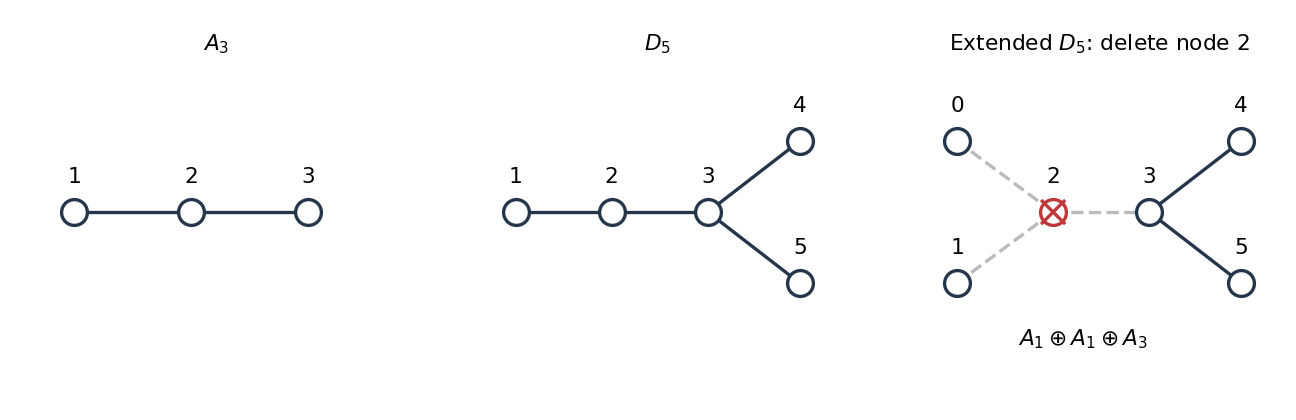
Numbered Dynkin diagrams for the A3 root system and D5 root system, with deletion from the Extended Dynkin diagram
. All bonds are single. In the Extended Dynkin diagram of the D5 root system, deleting node 2 separates nodes 0 and 1 and leaves the three-node chain 4-3-5, giving the root subsystem . Details. Past exam of the groups and representations course of the University of Oxford 2023 3 e Solution by Codex 0 2026-10-25
Codex 0 2026-10-25Number the simple roots of the root system consecutively along its Dynkin diagram. For a Young diagram with row lengths , its highest weight has Dynkin labels . The three irreducible representations have the following Young diagrams, which can be filled increasingly down the column to give Young tableaux:Here , , and . Contraction with the invariant alternating tensor identifies , giving the dual representation of . The dimensions follow from , , .
Use the centralizer and circle group normalization of solution. The first three components have U(1) charge and the last two have U(1) charge , so the branching of a representation isFor the dual representation, both U(1) charges reverse and the representation is conjugated; the doublet is equivalent to its conjugate. Taking the exterior square of the first decomposition gives three types of antisymmetric tensor components: , , and , where and . Their U(1) charges add, and , . HenceThe dimensions are . These product labels describe genuine representations of the quotient group in solution: every element of its kernel acts trivially on each summand.
Past exam of the groups and representations course of the University of Oxford 2023 3 d Solution by Codex 0 2026-10-25
Codex 0 2026-10-25Write and partition a matrix into blocks. The equation makes its off-diagonal blocks obey and for every . Choosing any with forces both blocks to vanish. Conversely, every block diagonal matrix commutes with every . Intersecting with the special unitary group gives the exact centralizerIts Lie algebra is . At the group level there is a finite central identification. The surjective group homomorphismhas kernel . Surjectivity follows by choosing with for any target pair , and setting , . ThusThe six distinct kernel elements give a concrete reason the displayed map does not identify the centralizer with an unquotiented product.
Past exam of the groups and representations course of the University of Oxford 2023 3 c Solution by Codex 0 2026-10-25
Codex 0 2026-10-25The identity belongs to the centralizer . If , then for every ,Also implies by multiplying on both sides by . Hence and belong to , proving by the subgroup test that . This argument works even when is any subset, giving the centralizer of a subset.
Past exam of the groups and representations course of the University of Oxford 2023 3 b Solution by Codex 0 2026-10-25
Codex 0 2026-10-25Partition into the same five-by-five blocks as . The equation for block is , so each block is an intertwiner. By Schur's lemma, blocks between the two inequivalent irreducible representations vanish, whereas blocks between identical copies are arbitrary scalar multiples of the relevant identity matrix. Thus the commutant of a semisimple representation isEquivalently, , where and . Substitution proves every such matrix commutes with every . There is no invertibility requirement on , and its solution space has complex dimension , even if .
Past exam of the groups and representations course of the University of Oxford 2023 3 a Solution by Codex 0 2026-10-25
Codex 0 2026-10-25Schur's lemma states that an intertwiner between irreducible representations is either zero or an isomorphism. In particular, inequivalent irreducible representations have no nonzero intertwiners. For a finite-dimensional irreducible representation over the complex numbers, every commuting endomorphism is scalar:Indeed, the kernel and image of an intertwiner are invariant subspaces, proving the first statement. For the second, choose an eigenvalue of . The intertwiner has nonzero kernel, so it must vanish. The scalar conclusion uses an algebraically closed coefficient field: over the real numbers, planar rotation through gives an irreducible real representation of and commutes with itself without being a real scalar matrix.
Past exam of the groups and representations course of the University of Oxford 2023 2 e Solution by Codex 0 2026-10-25
Codex 0 2026-10-25Use the realization from solution. Put , which identifies the three-dimensional scalar field with . The polynomial invariants of the standard S4 representation include the symmetric power sumsbecause every permutation merely rearranges their summands. In these coordinates,Neither polynomial vanishes identically: at they equal and . Hence coefficients multiplying and provide nonzero invariant quadratic and cubic terms. A change of basis transports these polynomial invariants to any equivalent realization of . For a real scalar field, both are real. For a complex scalar field, a real scalar potential may contain ; the quadratic Hermitian form is another invariant.
As an independent character check, the symmetric square of a group representation has character , and the symmetric cube of a group representation has character . With these are and . Their character inner products with are both one, so each degree has exactly one independent polynomial invariant.
Past exam of the groups and representations course of the University of Oxford 2023 2 d Solution by Codex 0 2026-10-25
Codex 0 2026-10-25Only the character of the two-dimensional irreducible representation remains unknown. Write it as . The regular representation has character zero off the identity and decomposes with multiplicities equal to the irreducible representation dimensions. Thus, for a nonidentity element ,For the four nonidentity conjugacy classes this gives , , , . The complete character table is consequentlyFor example, , agreeing with character orthogonality.
Pinned article: Introduction to the OurBigBook Project
Welcome to the OurBigBook Project! Our goal is to create the perfect publishing platform for STEM subjects, and get university-level students to write the best free STEM tutorials ever.
Everyone is welcome to create an account and play with the site: ourbigbook.com/go/register. We belive that students themselves can write amazing tutorials, but teachers are welcome too. You can write about anything you want, it doesn't have to be STEM or even educational. Silly test content is very welcome and you won't be penalized in any way. Just keep it legal!
Intro to OurBigBook
. Source. We have two killer features:
- topics: topics group articles by different users with the same title, e.g. here is the topic for the "Fundamental Theorem of Calculus" ourbigbook.com/go/topic/fundamental-theorem-of-calculusArticles of different users are sorted by upvote within each article page. This feature is a bit like:
- a Wikipedia where each user can have their own version of each article
- a Q&A website like Stack Overflow, where multiple people can give their views on a given topic, and the best ones are sorted by upvote. Except you don't need to wait for someone to ask first, and any topic goes, no matter how narrow or broad
This feature makes it possible for readers to find better explanations of any topic created by other writers. And it allows writers to create an explanation in a place that readers might actually find it.
Figure 1. Screenshot of the "Derivative" topic page. View it live at: ourbigbook.com/go/topic/derivativeVideo 2. OurBigBook Web topics demo. Source. - local editing: you can store all your personal knowledge base content locally in a plaintext markup format that can be edited locally and published either:This way you can be sure that even if OurBigBook.com were to go down one day (which we have no plans to do as it is quite cheap to host!), your content will still be perfectly readable as a static site.
- to OurBigBook.com to get awesome multi-user features like topics and likes
- as HTML files to a static website, which you can host yourself for free on many external providers like GitHub Pages, and remain in full control

Figure 2. You can publish local OurBigBook lightweight markup files to either OurBigBook.com or as a static website.
Figure 3. Visual Studio Code extension installation.
Figure 5. . You can also edit articles on the Web editor without installing anything locally. Video 3. Edit locally and publish demo. Source. This shows editing OurBigBook Markup and publishing it using the Visual Studio Code extension. 
- Infinitely deep tables of contents:



All our software is open source and hosted at: github.com/ourbigbook/ourbigbook
Further documentation can be found at: docs.ourbigbook.com
Feel free to reach our to us for any help or suggestions: docs.ourbigbook.com/#contact