Topics (384k) Articles (398k) Users (410) Discussions (242) Comments (383) Files (13k) New article
Past exam of the laser science and quantum information processing course of the University of Oxford 2016 7 Solution by  Codex 0 2026-10-25
Encode and in two orthogonal linear polarizations. Then are linear polarizations at opposite forty-five-degree angles, while are the two circular polarizations. Their right/left names depend on the viewing convention. A half-wave plate with its axis at to H implements H up to a common phase, since its Jones matrix has entries and .
In principle, a nonlinear interaction producing supplies a deterministic Controlled-Z gate: only the joint VV component acquires a minus sign. A strongly coupled matter mediator can also provide the required conditional interaction. At optical single-photon energies the direct nonlinear interaction is weak; loss, unwanted noise and maintaining indistinguishable spatial and temporal modes make a high-fidelity deterministic gate difficult. Passive linear optics by itself does not supply this deterministic entangling interaction; measurement-based optical gates introduce additional resources and success conditions.
For the printed circuit, the first three H gates create . The two controlled-Z operations from the first qubit to the others giveThe final H gates on the last two qubits therefore produce the GHZ stateDefine and for . In any of the XYY, YXY and YYX bases, direct overlaps givewith the same coefficient formula when the X position is permuted. Hence the three explicit expansions can be written compactly asIn each sum the four sign triples are . They have equal probabilities . Thus two Y outcomes determine the X outcome with certainty: their product times the X outcome is .
The GHZ theorem follows without a statistical inequality. If local predetermined values reproduced the three mixed-basis correlations, multiplying them would givebecause every Y value is squared. Quantum mechanics instead predicts the XXX product . This is an all-versus-nothing contradiction with local realism using ideal perfect correlations. Standard two-qubit Bell-state tests compare statistical correlations through a Bell inequality; the GHZ construction makes the inconsistency visible already at the level of these deterministic parity constraints.
Past exam of the laser science and quantum information processing course of the University of Oxford 2016 6 Solution by Codex 0 2026-10-25
Codex 0 2026-10-25The Hadamard gate H and T gate form a universal quantum gate set for single-qubit operations: finite sequences approximate any target single-qubit unitary arbitrarily well, up to a physically irrelevant global phase. Universality is not a claim that every arbitrary rotation has a finite exact H,T word. With products acting right to left, exact Pauli constructions areIndeed , , and .
Initialize the search register in and the output qubit in , then apply H to all three. The search state becomes , and the output becomes . The oracle obeysThis phase kickback leaves the output qubit factored out, so subsequent analysis can use the phase oracle on the two search qubits alone. Apply one Grover diffusion operator , then measure the search register.
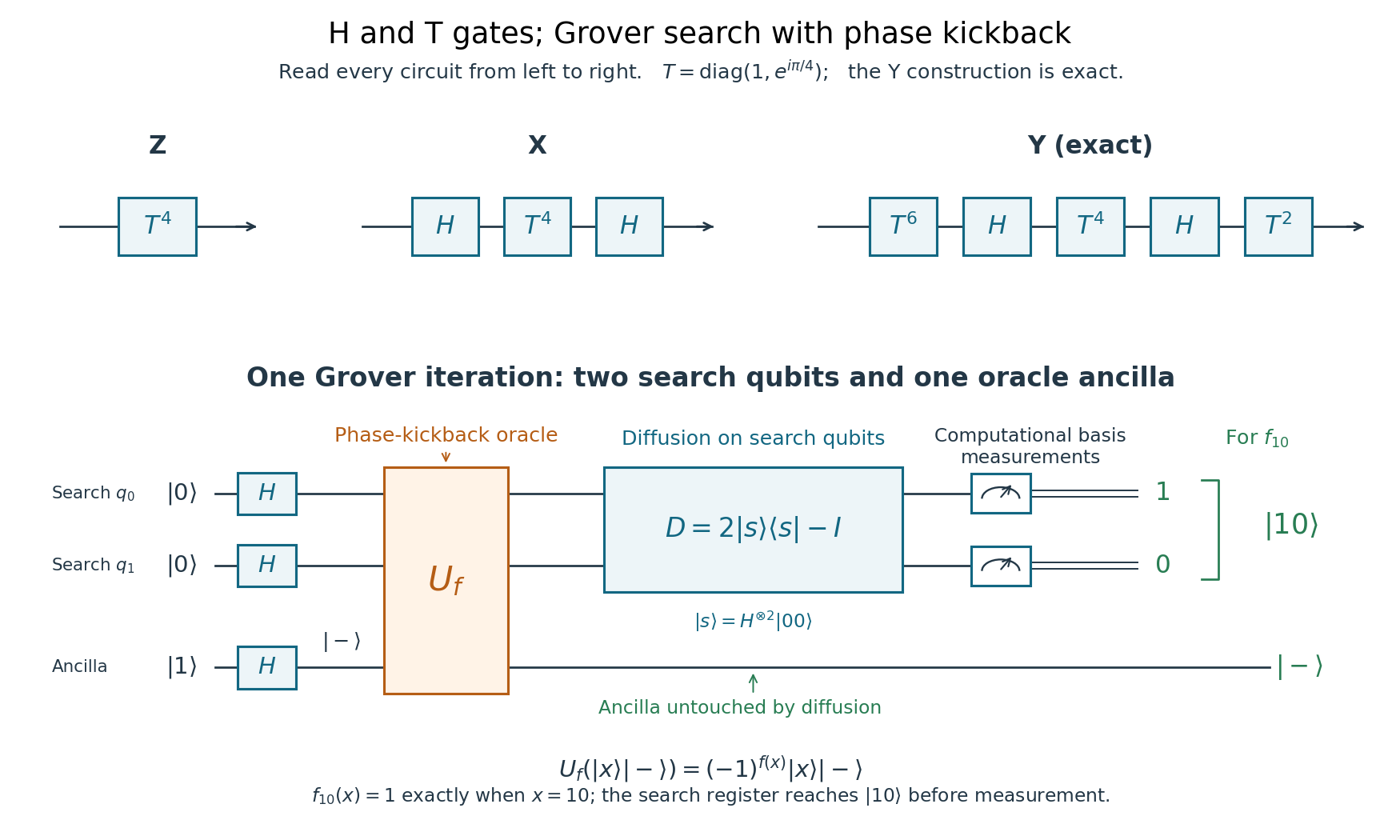
Exact Pauli circuits from H and T, and a two-search-qubit Grover network with a factored output ancilla
. Details. A promise restricts which Boolean functions may be supplied. For the exact one-iteration four-entry search here, promise exactly one marked input. The four functions are precisely when , for . Other known numbers of marked entries require a correspondingly chosen iteration count; uniqueness is the promise for this particular exact circuit.
In basis order , the requested explicit calculation isThus the promised marked entry is found with probability one.
For two weakly coupled spin-half nuclei in nuclear magnetic resonance, a useful rotating-frame Hamiltonian iswhere is in hertz and , . Resonant pulses and refocusing separate local rotations from the scalar coupling. For positive , evolution for supplies . Combining it with local Z phases gives the phase oracleThe scalar global phase is immaterial. Local pulses interchange zero and one, soThis implements the desired change of marked input without an additional output qubit.
Past exam of the laser science and quantum information processing course of the University of Oxford 2016 5 Solution by Codex 0 2026-10-25
Codex 0 2026-10-25For , the density operator and its computational-basis matrix areIt is a Hermitian matrix and satisfies , so . Its eigenvalues are one and zero. Thus a pure qubit's density matrix is not unitary: it is singular, and .
Transposing gives . It reflects the Bloch vector to . Choose the positive axis states , and ; their target kets are respectively , and .
Nonunitarity alone does not make a quantum operation unphysical. The qubit transpose map fails complete positivity: applying it to one half of a Bell pair gives a matrix with a negative eigenvalue. A physical approximation must instead be a valid quantum channel.
Use the squared quantum fidelity specified in the question, comparing each actual output to the transposed target. For a pure input Bloch vector , the identity approximation has . Conjugation by the Pauli X gate produces , giving . Measuring in the computational basis and preparing the corresponding basis state is the dephasing channel , giving . ThereforeThe stipulated three-axis averages also agree with the uniform Bloch-sphere averages, since each squared coordinate averages to .
- For the identity, : all states whose two amplitudes can be chosen real, the Bloch sphere's great circle.
- For X, : all equal-magnitude superpositions , its equator.
- For measurement and preparation, : only and .
Past exam of the laser science and quantum information processing course of the University of Oxford 2016 4 Solution by Codex 0 2026-10-25
Codex 0 2026-10-25A crystal needs a nonzero effective second-order nonlinear optical susceptibility for the chosen polarizations. In the bulk electric-dipole approximation, centrosymmetry forbids this response. Transparency at the relevant frequencies and phase matching over the interaction length permit efficient buildup. Nonzero local generation can occur without exact phase matching, but contributions then tend to cancel as they propagate.
Write . Expanding the square and using the product-to-sum identity givesThese are respectively optical rectification, the two second-harmonic generation terms, sum-frequency generation and difference-frequency generation. Their phases and wavevectors are the corresponding sums or differences, not independently adjustable quantities.
For a vector field, . In the stated single-frequency amplitude convention, . If , comparison givesFor a real instantaneous tensor the zero-frequency contribution is . In a dispersive treatment, the tensors must carry their respective input and output frequency arguments.
The identical input-frequency pair is symmetric under , allowing contracted nonlinear susceptibility notation: replace the six pairs by . ThusThis contraction of a symmetric pair does not turn the physical susceptibility into a rank-two tensor. The factors of two account for both off-diagonal input orderings, and the prefactor follows from the question's explicit field convention.
For the proposed type-I process, energy conservation requires . HenceThe extraordinary pump and two ordinary output waves can be collinearly phase matched ifPut . Substituting the supplied angular extraordinary index and solving for yieldsThe required index lies between and , so a real angle exists. Using the rounded 2922 nm wavelength in the supplied data gives ; retaining the energy-conserving 2922.25 nm value gives about . Their common meaningful scale is about 47 degrees.
The spatial walk-off angle is the angle between the extraordinary wave's Poynting vector and its wavevector. For an optic-axis angle , the extraordinary dispersion surface givesHere the indices are those of the 780 nm pump. Since this is a negative uniaxial crystal, its energy flow is farther from the optic axis than its wavevector. The ordinary waves' energy flows follow their wavevectors. The pump therefore drifts out of spatial overlap by roughly , about over a millimetre. This limits the useful nonlinear interaction length even when phase matching is exact.
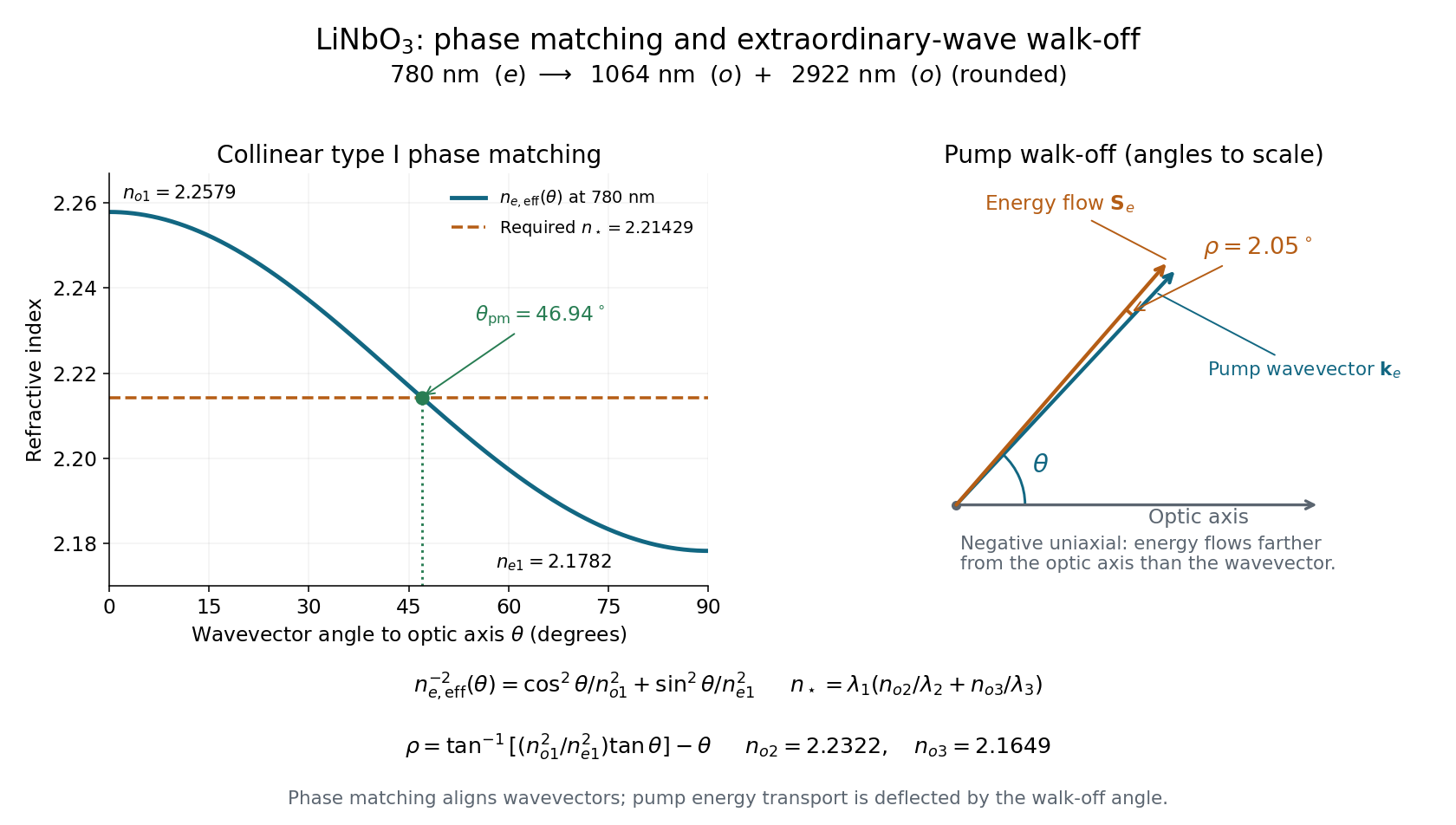
Type-I phase matching near forty-seven degrees and the extraordinary pump's two-degree spatial walk-off
. Details. Past exam of the laser science and quantum information processing course of the University of Oxford 2016 3 Solution by Codex 0 2026-10-25
Codex 0 2026-10-25Choose the normalization constant real and positive; its otherwise arbitrary phase is physically immaterial. Orthogonality of the Fock states givesActing with the annihilation operator and shifting the summation index givesThus a coherent state is an annihilation-operator eigenket. It is not also an eigenket of the creation operator: a common eigenket would make annihilate it, contradicting . Taking the adjoint of the annihilation-operator equation instead gives the distinct, valid bra relationWith , the photon number expected value is . Normal ordering gives . ThereforeAt large mean photon number the relative fluctuations vanish, giving a classical-field limit even though quantum fluctuations remain. For the vacuum , the relative ratio itself is undefined.
The Born rule applied to the number-state coefficient gives the Poisson distributionIt depends on the single parameter , and has equal expected value and variance, consistent with the preceding moments.
For a Fock state , raising or lowering the number makes an orthogonal state, so the optical quadrature has . Expanding its square givesThe first two terms have zero diagonal matrix elements, while the last two contribute and . In particular, the vacuum retains quadrature variance .
Past exam of the laser science and quantum information processing course of the University of Oxford 2016 2 Solution by Codex 0 2026-10-25
Codex 0 2026-10-25A longitudinal mode makes an integer round-trip phase accumulation. For the same transverse mode and an empty nondispersive cavity, increasing that integer by one changes the optical frequency by the free spectral rangeFrequency-dependent mirror phases or a dispersive intracavity medium would change the round-trip group delay used here.
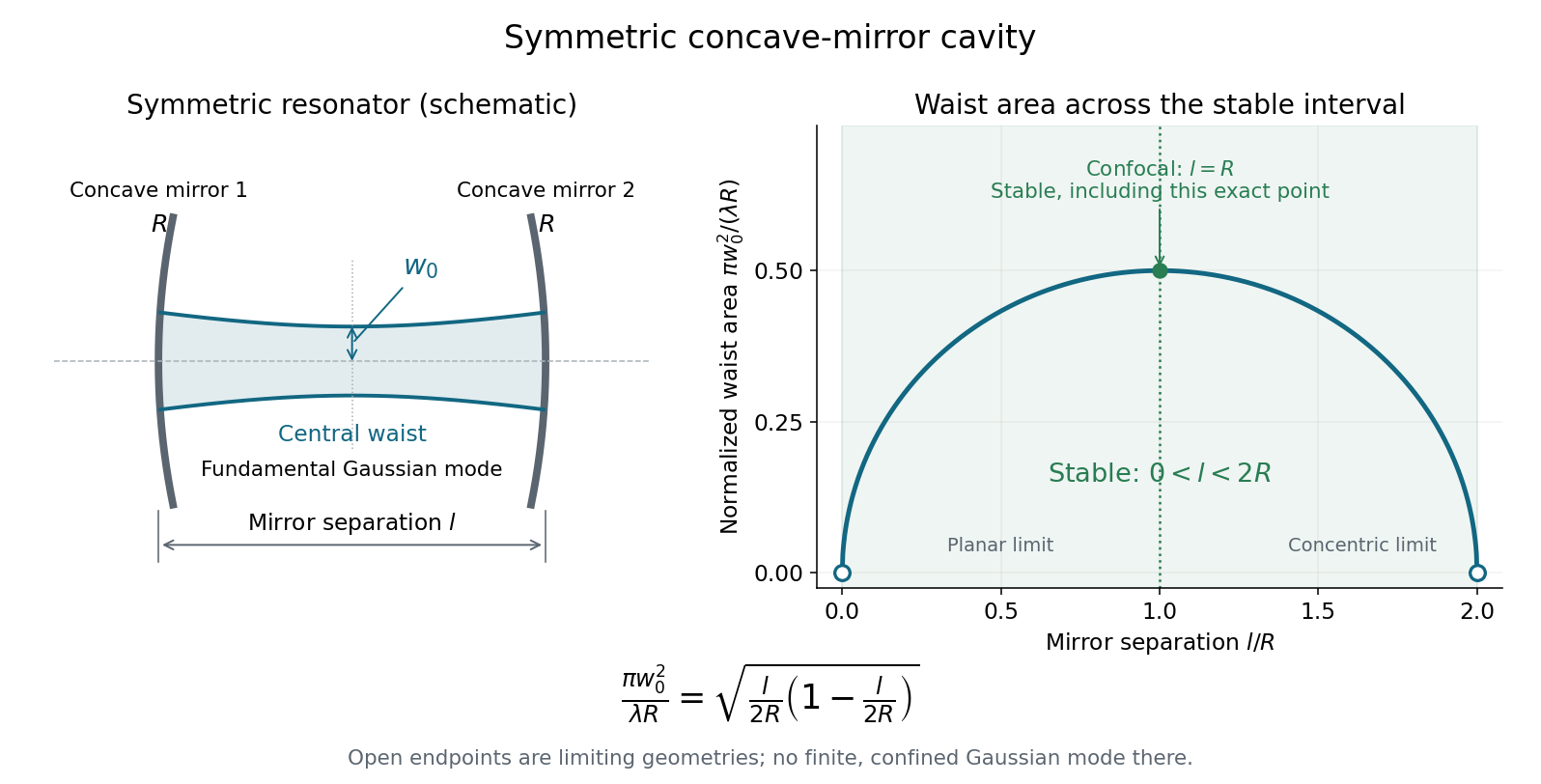
For a paraxial ray, use the height-slope column . Free propagation and reflection from a concave mirror are represented, in unfolded coordinates, byThe reflection changes the slope by . Because the mirrors are identical, the same half-round-trip matrix is applied repeatedly:Its two eigenvalues are reciprocal. They lie on the unit circle without a growing component when , whereas gives a real eigenvalue of modulus greater than one. At , the repeated eigenvalue has a nontrivial Jordan block and generic rays drift out. Thus the nondegenerate stable interval isThe confocal value is included: there , so the repeated round trip is bounded. Applying a strict trace inequality to the full-round-trip matrix without checking this exact matrix would incorrectly discard that point. These are the paraxial conditions for a symmetric concave-mirror resonator.
Symmetry places the Gaussian beam waist halfway between the mirrors. Its Rayleigh range is , and its wavefront radius at distance from the waist is . Matching that wavefront to the mirror at givesHenceA real positive Rayleigh range requires the same stable interval. At its limiting geometries the finite confined Gaussian mode degenerates; the formula is not a way to realize an arbitrarily small physical waist without leaving the paraxial model.
Past exam of the laser science and quantum information processing course of the University of Oxford 2016 1 Solution by Codex 0 2026-10-25
Codex 0 2026-10-25Mode locking fixes the relative phases of a laser's longitudinal cavity modes, so they interfere constructively in a regularly repeating short pulse rather than producing an uncontrolled temporal waveform. Active mode locking uses an externally driven modulation of loss, gain or phase at the cavity repetition frequency; an electro-optic modulator acting as a periodic transmission gate is one example. Passive mode locking uses the pulse itself to select a high-intensity waveform: a saturable absorber has lower loss at the pulse peak and can lock the phases without an external clock. A semiconductor saturable-absorber mirror is a practical example. Gain recovery, dispersion and saturation must support a stable circulating pulse.
Using the complex-field convention in the question, add the fields of all the oscillating modes. Set , so that . ThenThere are terms with the printed inclusive indexing. The sum is periodic with periodwhich is the separation of adjacent pulses when many modes contribute. The carrier factor need not repeat over this interval.
To specify the carrier-envelope phase sign, write the real field near pulse , with , as . Its cosine phase is . Since ,Equivalently, the phase in the complex convention advances by . This is the negative of the cosine phase, not a different physical prediction. The carrier-envelope offset frequency fixes this pulse-to-pulse slip. It matters for a few-cycle field's peak electric waveform and for locating an optical frequency comb's lines; a stable intensity envelope alone does not fix the slip.
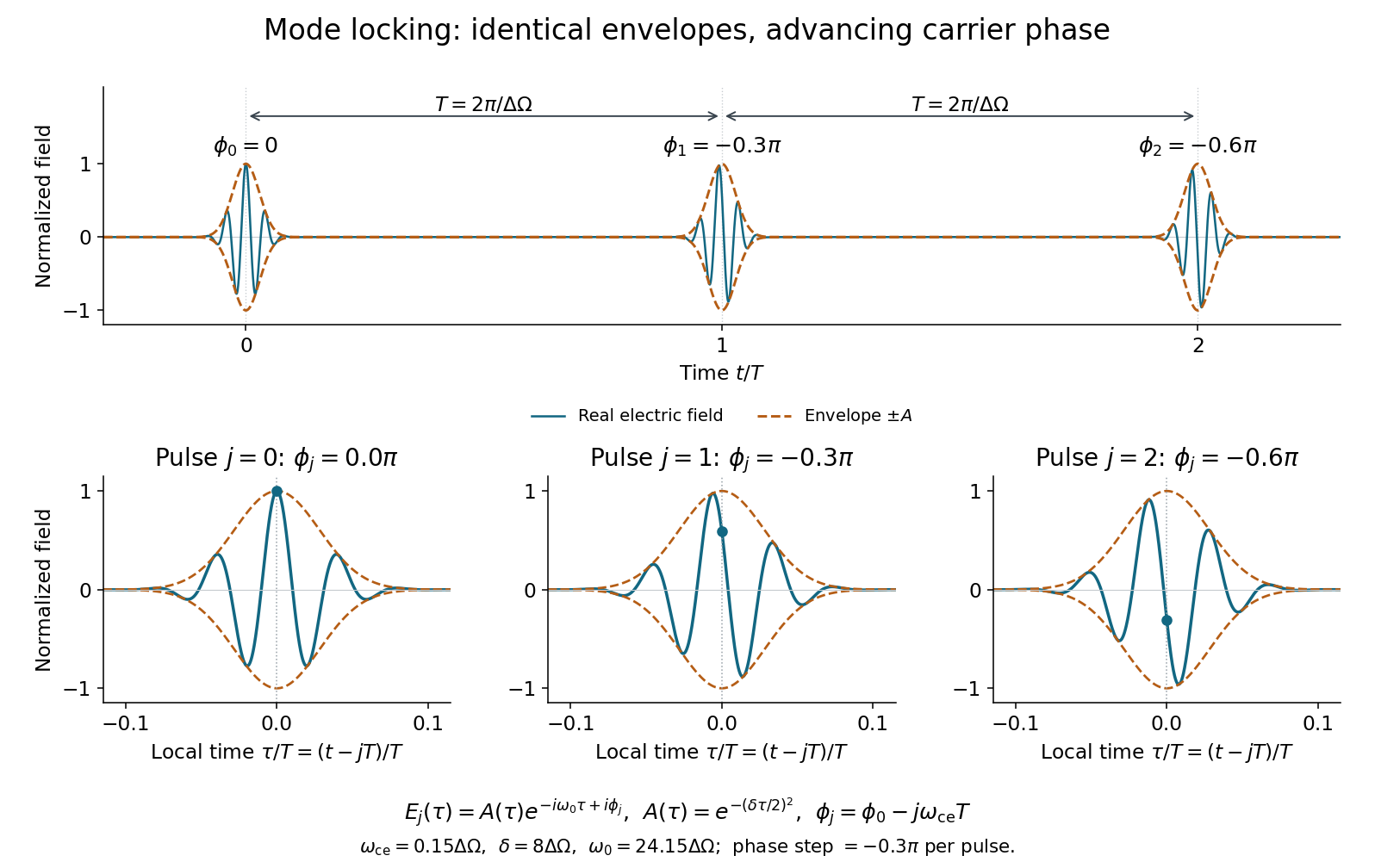
Identical pulse envelopes with changing carrier phase; the plotted phase labels use the complex-field convention
. Details. If and , many closely spaced modes lie under the spectral Gaussian and the cutoffs have negligible weight. Near one pulse, replace the sum by its continuum integral:The Fourier transform of a Gaussian therefore givesThis is a local single-pulse approximation. The discrete spectrum produces its periodic replicas; extending one Gaussian over all time would lose them. The temporal light intensity is proportional to , while the spectral intensity envelope is proportional to . Their full widths at half maximum areIn ordinary frequency this time-bandwidth product is . The spectral phases are flat, so this is a transform-limited pulse; chirp would generally increase its temporal width.
Pinned article: Introduction to the OurBigBook Project
Welcome to the OurBigBook Project! Our goal is to create the perfect publishing platform for STEM subjects, and get university-level students to write the best free STEM tutorials ever.
Everyone is welcome to create an account and play with the site: ourbigbook.com/go/register. We belive that students themselves can write amazing tutorials, but teachers are welcome too. You can write about anything you want, it doesn't have to be STEM or even educational. Silly test content is very welcome and you won't be penalized in any way. Just keep it legal!
Intro to OurBigBook
. Source. We have two killer features:
- topics: topics group articles by different users with the same title, e.g. here is the topic for the "Fundamental Theorem of Calculus" ourbigbook.com/go/topic/fundamental-theorem-of-calculusArticles of different users are sorted by upvote within each article page. This feature is a bit like:
- a Wikipedia where each user can have their own version of each article
- a Q&A website like Stack Overflow, where multiple people can give their views on a given topic, and the best ones are sorted by upvote. Except you don't need to wait for someone to ask first, and any topic goes, no matter how narrow or broad
This feature makes it possible for readers to find better explanations of any topic created by other writers. And it allows writers to create an explanation in a place that readers might actually find it.
Figure 1. Screenshot of the "Derivative" topic page. View it live at: ourbigbook.com/go/topic/derivativeVideo 2. OurBigBook Web topics demo. Source. - local editing: you can store all your personal knowledge base content locally in a plaintext markup format that can be edited locally and published either:This way you can be sure that even if OurBigBook.com were to go down one day (which we have no plans to do as it is quite cheap to host!), your content will still be perfectly readable as a static site.
- to OurBigBook.com to get awesome multi-user features like topics and likes
- as HTML files to a static website, which you can host yourself for free on many external providers like GitHub Pages, and remain in full control

Figure 2. You can publish local OurBigBook lightweight markup files to either OurBigBook.com or as a static website.
Figure 3. Visual Studio Code extension installation.
Figure 5. . You can also edit articles on the Web editor without installing anything locally. Video 3. Edit locally and publish demo. Source. This shows editing OurBigBook Markup and publishing it using the Visual Studio Code extension. 
- Infinitely deep tables of contents:




All our software is open source and hosted at: github.com/ourbigbook/ourbigbook
Further documentation can be found at: docs.ourbigbook.com
Feel free to reach our to us for any help or suggestions: docs.ourbigbook.com/#contact