Topics (384k) Articles (398k) Users (410) Discussions (242) Comments (383) Files (13k) New article

If a matrix with orthonormal columns is divided into two row blocks, each having at least as many rows as there are columns, it admits simultaneous thin factorizations , , with orthonormal , an orthogonal matrix , and nonnegative diagonal matrices satisfying . To prove this, apply the spectral theorem to ; the same orthonormal eigenbasis diagonalizes . Normalize the nonzero columns of and complete the zero columns to orthonormal sets. The entries of can be written as cosines and sines of angles in .
For any Lebesgue measurable set , the singular support of its indicator function, viewed as a regular distribution, is the intersection of the two essential closures in the displayed formula. Outside this intersection the indicator function is constant almost everywhere on a ball and hence represents a smooth function. At a point in the intersection, each sufficiently small ball has positive Lebesgue measure in both sets. Any continuous representative on that ball must take only the values zero and one everywhere: every other value would persist in a smaller ball and violate equality almost everywhere. By connectedness of the ball it would then be constant, a contradiction.
If is open, its essential closure is its relative closure. Its singular support can still be smaller than its topological boundary: represents the constant one and has empty singular support.
Target: Support and singular support rules for convolution. Parent: Convolution of distributions with a compactly supported factor. Intended file: fourier-analysis.bigb.In singly ionized calcium, resonance doublets, doublets and three-component groups approach the same ionization continuum from different lower terms. A three-line group need not have spin multiplicity three. The electric-dipole rule excludes .[ref]
Energy Levels of Singly Ionized Calcium (Ca II) by National Institute of Standards and Technology. 4s,3d,4p and5s assignments
The sine function extends to an entire function on the complex plane by the displayed exponential formula. Substituting and grouping the real and imaginary terms gives , for real . Thus its values grow exponentially in imaginary directions, even though the real sine is bounded.
An offset at which events are judged most simultaneous under a specified measurement procedure. A fitted peak in simultaneity reports need not coincide with the equal-response point of an order task or with equal neural onset latencies.
Let internal timing difference be with , and report simultaneous when . Standardizing the two interval bounds gives . For positive and symmetric noise, this function peaks at . Its width reflects both noise and acceptance bounds, so it cannot identify a sensory window without additional assumptions.
An edge path in a simplicial complex is a finite sequence of vertices of a simplicial complex such that is a simplex for each consecutive pair. Repeated consecutive vertices are allowed. Its geometric realization is a continuous path formed by traversing the corresponding line segments, with constant pieces for repetitions.
A connected geometric realization has an edge path between any two vertices. For a fixed vertex, the reachable vertices form a union of whole simplexes: all vertices of a simplex are pairwise joined by edges. The reachable and unreachable geometric parts therefore intersect each simplex in either the whole simplex or the empty set. Both parts are closed in the realization topology and are complements, so both are open. Connectedness forces the unreachable part to be empty. Conversely, edge paths between vertices and straight segments inside simplexes join arbitrary points, so the realization is path-connected.
For a simplex in a simplicial complex , its link consists of the simplexes disjoint from whose union with is a simplex of :This is a simplicial subcomplex, because taking a nonempty face preserves both conditions. At a vertex of a closed combinatorial surface its link is a cycle graph; at a boundary vertex in a triangulated surface with boundary it is a graph path. Geometrically, the incident triangles form a cyclic fan or a fan with two ends. Deleting one incident triangular face from a cyclic fan changes the vertex link into a path.
The performance difference between spatially incompatible and compatible trials in a Simon task. A group difference in overall reaction time is distinct from a group difference in this conflict cost.
A rule or boundary converting internal evidence into a response, such as reporting a signal when . Changing the criterion can change hits and false alarms without changing the separation of the underlying evidence distributions. A measured response threshold is therefore not automatically a pure measure of sensory sensitivity.
Under an equal-variance Gaussian evidence model, is separation of signal and noise means in units of their common standard deviation. A yes/no task gives , where and are hit and false-alarm probabilities. This formula assumes the model; it does not define every possible sensory-discrimination measure.
The ability to discriminate stimulus classes, conceptually distinct from the decision criterion determining which response is selected. A higher frequency of fear judgments can reflect a criterion shift without better discrimination.
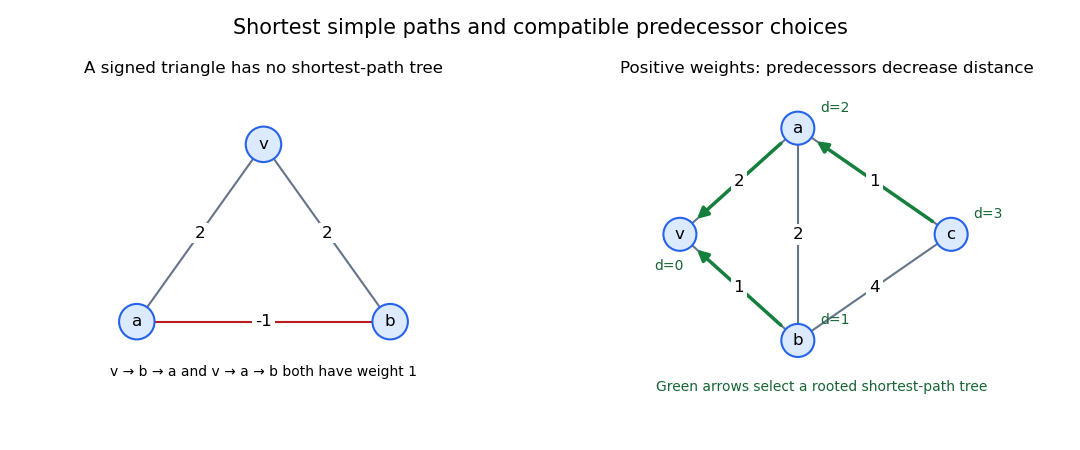
A shortest-path tree rooted at a source vertex is a spanning tree whose unique tree route from the source to every vertex solves the shortest path problem in the original weighted graph. Dijkstra's algorithm constructs one for a finite connected graph with nonnegative edge lengths, recording a predecessor whenever a distance improves. It need not be a minimum spanning tree: one minimizes each source-route length, the other the total weight of the tree's edges.
Unlike the sum in the usual shortest path problem, the bottleneck cost of a nonempty graph path is its largest edge weight. The optimum is the smallest threshold at which the endpoints become connected by edges of weight at most that threshold. For a finite undirected graph, sorting edges and increasing the threshold, with a disjoint-set data structure maintaining components, finds this value. In the same undirected setting, the minimax path property of a minimum spanning tree provides a single tree representing such optimal routes for every pair of vertices.
Suppose two pieces occupy a common connected component of a graph in an unweighted undirected graph. For integers , in each round an evader moves at most edges, then a pursuer moves up to edges along a shortest path to the new evader position, stopping upon capture. Let be their finite graph distance at a surviving round boundary.
The triangle inequality bounds the separation after the evader moves by . If that separation is at most , the pursuer captures it. Otherwise the pursuer reduces it by exactly , givingHence every surviving history has at most rounds. With a finite branching factor, the surviving search tree is finite and depth-first tree search becomes a complete search algorithm. This does not make its first goal optimal for arbitrary rewards. Initial reachability is essential: an infinite graph distance supplies no decreasing finite bound.
For a graph on vertices with all edge weights in , every minimum-weight shortest path has the smallest possible number of edges. Indeed, positivity permits a simple optimum, and a simple -edge path weighs at most for , while any path with more edges weighs at least . A breadth-first search followed by weighted dynamic programming along increasing-hop edges therefore solves the single-source problem in time. Choosing an arbitrary breadth-first tree alone is insufficient: equal-hop routes may still have different weights.
In a finite graph with positive integral edge weights, replacing by makes every transformed shortest path minimise original weight first and edge count second. Positive weights imply that an optimal route is simple, with at most edges. Original integral path weights that differ have a gap of at least one; multiplication by outweighs every possible difference in simple-path edge counts. Among equal-weight paths, only the added edge count differs. Thus a single ordinary shortest path computation solves lexicographic weight-and-hop minimisation.
Let be the minimum weight of a route from a fixed source to using at most edges; repeated vertices are permitted. Initialise to zero at the source and infinity elsewhere. Every feasible route either already uses at most edges or appends one edge to such a route, proving the displayed dynamic programming recurrence. Reading exclusively from the previous row enforces the edge budget. Negative cycles cause no unbounded objective because the budget is finite. Each round scans all edges, costing when only edge-incident vertices and the specified endpoints are processed. With nonnegative weights, cycle removal gives an equally good or better simple path within the budget.
Pinned article: Introduction to the OurBigBook Project
Welcome to the OurBigBook Project! Our goal is to create the perfect publishing platform for STEM subjects, and get university-level students to write the best free STEM tutorials ever.
Everyone is welcome to create an account and play with the site: ourbigbook.com/go/register. We belive that students themselves can write amazing tutorials, but teachers are welcome too. You can write about anything you want, it doesn't have to be STEM or even educational. Silly test content is very welcome and you won't be penalized in any way. Just keep it legal!
Intro to OurBigBook
. Source. We have two killer features:
- topics: topics group articles by different users with the same title, e.g. here is the topic for the "Fundamental Theorem of Calculus" ourbigbook.com/go/topic/fundamental-theorem-of-calculusArticles of different users are sorted by upvote within each article page. This feature is a bit like:
- a Wikipedia where each user can have their own version of each article
- a Q&A website like Stack Overflow, where multiple people can give their views on a given topic, and the best ones are sorted by upvote. Except you don't need to wait for someone to ask first, and any topic goes, no matter how narrow or broad
This feature makes it possible for readers to find better explanations of any topic created by other writers. And it allows writers to create an explanation in a place that readers might actually find it.
Figure 1. Screenshot of the "Derivative" topic page. View it live at: ourbigbook.com/go/topic/derivativeVideo 2. OurBigBook Web topics demo. Source. - local editing: you can store all your personal knowledge base content locally in a plaintext markup format that can be edited locally and published either:This way you can be sure that even if OurBigBook.com were to go down one day (which we have no plans to do as it is quite cheap to host!), your content will still be perfectly readable as a static site.
- to OurBigBook.com to get awesome multi-user features like topics and likes
- as HTML files to a static website, which you can host yourself for free on many external providers like GitHub Pages, and remain in full control

Figure 2. You can publish local OurBigBook lightweight markup files to either OurBigBook.com or as a static website.
Figure 3. Visual Studio Code extension installation.
Figure 5. . You can also edit articles on the Web editor without installing anything locally. Video 3. Edit locally and publish demo. Source. This shows editing OurBigBook Markup and publishing it using the Visual Studio Code extension. 
- Infinitely deep tables of contents:



All our software is open source and hosted at: github.com/ourbigbook/ourbigbook
Further documentation can be found at: docs.ourbigbook.com
Feel free to reach our to us for any help or suggestions: docs.ourbigbook.com/#contact