A psychologist studies behavior and mental processes using psychological research methods, or applies that knowledge in an appropriate professional setting. Research can concern learning, human memory, emotion or interactions between people. A cognitive psychologist might design a controlled task to distinguish explanations of remembering; a clinical psychologist might combine psychological assessment and clinical formulation to guide an intervention. These are different activities within a shared discipline, so the title alone does not identify one research method or clinical specialization. [ref]
Anne G. E. Collins studies learning, decision making and executive function using behavioural experiments and computational models. With Robert C. Wilson, she coauthored a 2019 methods paper explaining how to build, simulate, fit and test models of behavior.[ref]
Ten simple rules for the computational modeling of behavioral data by Robert C. Wilson and Anne G. E. Collins. Introduction and model-development rules
An illustrative reinforcement learning rule updates a prediction after outcome by , where is a learning rate. Starting at with , gives , whereas gives . This arithmetic shows what a model parameter does; it does not establish that an experimental participant uses that exact rule.
The joint paper emphasizes testing models through computer simulation and parameter recovery, so a fitted parameter is interpreted in light of what the task can actually identify.[ref]
Institutional research profile: vcresearch.berkeley.edu/faculty/anne-collins .
Robert C. Wilson investigates computational accounts of learning and decision making. His 2019 methods paper with Anne G. E. Collins presents practical ways to test whether a behavioural model and its fitting procedure support the intended scientific inference.[ref]
Ten simple rules for the computational modeling of behavioral data by Robert C. Wilson and Anne G. E. Collins. Introduction and rules for simulation, fitting and validation
A central check is parameter recovery: generate synthetic observations using known settings, then fit the model and compare estimated settings with their known values. Model recovery asks a different question: when synthetic data come from one candidate model, does the comparison procedure select that model over its competitors?[ref]
Ten simple rules for the computational modeling of behavioral data by Robert C. Wilson and Anne G. E. Collins. Parameter-recovery section, Box4 and model-recovery section
For an invented example, a program given data generated with learning rate might repeatedly estimate values near . That failure could indicate a coding problem, insufficient task information or confounding between parameters. A numerical optimizer returning an answer is therefore not enough to establish a useful psychological measurement. The example illustrates the methodological contribution without assigning an observed human difference to a parameter by name alone.
A comparative psychologist investigates behavior and cognition by studying different species or populations. Comparisons can test whether a capacity depends on a particular sensory system, ecological problem or evolutionary history. For example, Nicky Clayton studied what, where and when information in scrub jay cache recovery. Similar task performance does not automatically establish an identical mechanism or subjective experience across species. [ref]
Episodic-like memory during cache recovery by scrub jays by Nicky Clayton and others. 1998, cache identity, location and elapsed-time experiment
A comparative psychologist who, with Anthony Dickinson, tested episodic-like memory in scrub jays. Birds recovered different cached foods according to where they had hidden them and how long ago, including whether a perishable food would have spoiled. The design tests integrated what–where–when information without assuming that birds report autonoetic consciousness.[ref]
Episodic-like memory during cache recovery by scrub jays by Nicky Clayton and others. 1998, cache-recovery experiments, pp. 272–274

Portrait of Nicky Clayton
. VPRO; crop by Victuallers; CC BY-SA 4.0. Source.A social psychologist studies how social information and interactions influence cognition, emotion and behavior. Controlled experiments can vary a social cue while measuring another person’s response. Negotiation studies, for example, separate the emotion communicated by a partner from the observer’s own feeling and subsequent concession. This makes social influence an empirically testable relation rather than an explanation inferred merely because two people behaved similarly. [ref]
The interpersonal effects of anger and happiness in negotiations by Gerben A. van Kleef and others. 2004, emotion information and negotiation responses
A social psychologist who investigates how another person’s emotion influences judgment and behavior. In computer-mediated negotiation experiments, information about an opponent’s anger or happiness changed participants’ concessions. The experiments distinguish using emotion as information about an opponent’s limits from simply experiencing the same emotion.[ref]
The interpersonal effects of anger and happiness in negotiations by Gerben A. van Kleef and others. 2004, experiments on emotional information and concessions, pp. 57–76
A researcher in facial mimicry and emotion recognition. Her experiments with dynamic facial expressions measured observers’ facial responses and their judgments of the displayed emotion, allowing the relationship between mimicry and decoding to be tested rather than assumed. The cited author record identifies the psychology researcher.[ref]
Facial mimicry and emotional contagion to dynamic emotional facial expressions and their influence on decoding accuracy by Ursula Hess and others. 2001, dynamic expressions, mimicry and decoding analyses, pp. 129–141
A researcher in social appraisal and interpersonal emotion transfer. A three-week diary study examined how one person’s changing emotion related to another’s appraisals and emotion. Such work separates responding to another person’s interpretation of an event from treating emotional contagion as an automatic copying process.[ref]
Affecting others by Brian Parkinson and others. 2009, diary design and appraisal analyses, pp. 1071–1084
A social psychologist whose research includes the mere-exposure effect and relationships between evaluation and recognition memory.

Portrait of Robert Zajonc
. External portrait hosted by Stanford University, Bing Nursery School. Source.A social psychologist whose research includes experimental tests of the facial feedback hypothesis.[ref]
Inhibiting and facilitating conditions of the human smile by Fritz Strack and others. Author identity and research contribution

Portrait of Fritz Strack
. Franconius (file summary; EXIF credits Darius Endlich); CC BY-SA 4.0. 2015. Source.A researcher in emotion who coauthored a meta-analysis of experimental tests of the facial feedback hypothesis with Nicholas A. Coles and Jeff T. Larsen. The synthesis found small average changes in reported emotion after facial manipulations, with differences across tasks and outcome measures.[ref]
A researcher in emotion who coauthored a meta-analysis of the facial feedback hypothesis with Nicholas A. Coles and Heather C. Lench. Their analysis distinguishes reported emotional experience from evaluations of emotional stimuli, helping explain why the apparent size of facial-feedback effects depends on what an experiment measures.[ref]
A meta-analysis of the facial feedback literature by Nicholas A. Coles and others. 2019, abstract and outcome-type moderator analyses
A researcher who tested the facial feedback hypothesis by synthesizing experiments that manipulated facial movement and measured reported emotion. His 2019 meta-analysis with Jeff T. Larsen and Heather C. Lench found a small average effect whose size varied across experimental conditions. It distinguishes a pooled effect from the reliability of any one facial manipulation.[ref]
A meta-analysis of the facial feedback literature by Nicholas A. Coles and others. 2019, abstract and moderator analyses, 138 studies
A researcher who studied the relationship between facial expression, emotion and social interaction. Field studies of bowlers and soccer fans combined observations of smiling with participants’ reports of happiness. Happy participants smiled much more often during social interaction than when alone, showing why a smile cannot be read as an unqualified measure of happiness.[ref]
Spontaneous facial expressions of happy bowlers and soccer fans by María-Ángeles Ruiz-Belda and others. 2003, two field studies and abstract, pp. 315–326
A social psychologist who investigated smiling through naturalistic observation. Studies of bowlers, sports spectators and pedestrians compared social engagement with circumstances expected to evoke happiness. Smiling tracked interaction more consistently than favorable events, motivating a communicative account of facial expression alongside accounts based on felt emotion.[ref]
Social and emotional messages of smiling by Robert E. Kraut and others. 1979, four observational studies, pp. 1539–1553

Portrait of Robert E. Kraut
. Robert Kraut; CC BY-SA 2.0. 2010 file record describes the subject circa 2003. Source.A social psychologist who investigated nonmonotonic associations between lifetime adversity and later functioning.[ref]
Timothy D. Wilson is a social psychologist whose research includes limits of introspection about the causes of judgment. With Richard E. Nisbett, he examined whether verbal explanations reveal the processes that produced a response or instead draw on plausible causal accounts. The distinction motivates experiments comparing reported reasons with independently manipulated influences. It concerns access to causal processes, rather than implying that every report of a feeling or experience is false. [ref]
Telling More Than We Can Know: Verbal Reports on Mental Processes by Richard E. Nisbett and Timothy D. Wilson. 1977, review of process reports and causal attribution
A social psychologist who, with Timothy D. Wilson, examined limits on people’s reports of their own cognitive processes. Their analysis argued that explanations of judgments can draw on plausible causal beliefs rather than direct access to the processes producing a judgment. This distinguishes a sincere verbal explanation from independent evidence of a cognitive mechanism.[ref]
Telling More Than We Can Know: Verbal Reports on Mental Processes by Richard E. Nisbett and Timothy D. Wilson. 1977, argument and reviewed experiments, pp. 231–259

Portrait of Richard E. Nisbett
. UQx Think101, frame from an interview with Richard Nisbett. CC BY 3.0, via Wikimedia Commons. Source.Justin Kruger is a social psychologist who coauthored the original study associated with the Dunning-Kruger effect. Participants completed tasks and estimated their performance, allowing actual scores and self-assessments to be compared. Interpreting a grouped confidence-accuracy pattern requires separating an account about metacognition from effects of noisy measurement and selection on observed scores; the published pattern alone does not identify one exclusive mechanism. [ref]
Unskilled and Unaware of It by Justin Kruger and David Dunning. 1999, four studies comparing task performance and self-assessment
David Dunning studies social judgment and self-evaluation. With Justin Kruger, he compared actual task scores with people’s estimates of their own performance in the original Dunning-Kruger effect study. The comparison separates measured ability, confidence and relative-rank judgments, making calibration a question for evidence rather than a conclusion from confidence alone. [ref]
Unskilled and Unaware of It by Justin Kruger and David Dunning. 1999, performance and self-assessment studies

Portrait of David Dunning
. External portrait hosted by University of Michigan, Department of Psychology. Source.Thomas F. Pettigrew studied intergroup contact and prejudice. His meta-analysis compared evidence across studies rather than relying on one contact setting. Examining conditions and generalization helps distinguish an average association from a claim that every possible encounter reduces prejudice. [ref]
A meta-analytic test of intergroup contact theory by Thomas F. Pettigrew and others. 2006, meta-analysis of 515 studies and contact conditions
A social psychologist who compared approaches to reducing prejudice through group identity. Experiments manipulated the salience of subgroup differences and an overarching common identity. This allows tests of whether recognizing distinct subgroup identities within a shared group changes intergroup bias, rather than assuming that all subgroup distinctions must disappear.[ref]
John F. Dovidio studied how recategorization changes responses to members of another group. Experiments varied whether participants represented two small groups as a more inclusive group and measured evaluations, disclosure and helping. Comparing several outcomes tests whether a change in verbal evaluation also extends to behavior. [ref]
Extending the benefits of recategorization: evaluations, self-disclosure, and helping by John F. Dovidio and others. 1997, inclusive-group manipulation and behavioral outcomes
Samuel L. Gaertner studied intergroup bias and the common ingroup identity model. Comparing representations of one group, two groups or separate individuals tests how group boundaries influence evaluation. The manipulation concerns how people categorize a situation, rather than assuming that changing a group label removes every source of prejudice. [ref]
A researcher who examined claims connecting violent video games with later aggression. A 2020 meta-analysis of longitudinal studies evaluated pooled associations alongside study quality. This approach asks how methodological choices affect the estimated relationship and distinguishes longitudinal prediction from a demonstrated causal effect.[ref]
A researcher who synthesized longitudinal studies of violent video game play and subsequent physical aggression. The 2018 meta-analysis combined 24 prospective studies and compared models adjusting for initial aggression and additional covariates. The work illustrates how conclusions about change depend on baseline adjustment and remaining confounding.[ref]
Metaanalysis of the relationship between violent video game play and physical aggression over time by Anna T. Prescott and others. 2018, prospective-study selection and adjusted models
A researcher who tested associations between violent video game engagement and adolescent aggression using a registered report. The study paired adolescents’ game reports with carers’ reports of behavior and specified confirmatory analyses in advance. Its null result concerns the sampled association and measures, rather than establishing that every possible gaming effect is absent.[ref]

Portrait of Andrew K. Przybylski
. Marinna; CC BY-SA 4.0. Source.A researcher who investigated how childhood viewing of television violence predicts later aggression. A longitudinal study followed childhood measures into young adulthood and examined alternative explanatory covariates. Such a design establishes temporal ordering, while interpretation of the relationship still requires attention to confounding and how viewing and behavior were measured.[ref]
Rachael E. Jack studied facial expression and cross-cultural emotion recognition using generated facial movements and reverse correlation. Reconstructing which visual features observers use tests the assumed correspondence between an emotion label and a face. Cross-cultural differences challenge a universal mapping without implying that no facial information is shared. [ref]
Facial expressions of emotion are not culturally universal by Rachael E. Jack and others. 2012, Figures 1–3, generated stimuli and reverse correlation
A researcher in facial expression who compared spontaneous expressions of blind and sighted athletes. Including people blind from birth tests whether visually observing other people’s faces is necessary for the expressions studied. Similarities across groups inform the role of visual learning without implying that social context never modifies emotional displays.[ref]
Spontaneous facial expressions of emotion of congenitally and noncongenitally blind individuals by David Matsumoto and others. 2009, methods and results, blind and sighted athletes

Portrait of David Matsumoto
. External portrait hosted by San Francisco State University. Source.A researcher who investigated cross-cultural recognition of facial expressions. His 1971 study tested how participants in New Guinea matched photographs to emotion-eliciting stories. Agreement across populations supports some shared expression–situation mappings, while the story and photograph choices define what the task can establish about everyday emotion recognition.[ref]
Constants across cultures in the face and emotion by Paul Ekman and others. 1971, story-to-photograph task

Portrait of Paul Ekman
. Paul Ekman Group, LLC; CC BY-SA 3.0. Source.A researcher who studied cultural variation in social attribution. Comparisons of American and Chinese explanations used both animated physical events and accounts of social events. The work asks how explanatory habits favor properties of an individual or features of a situation, rather than attributing every judgment to a fixed personal disposition.[ref]
A social psychologist who tested how cognitive load affects social attribution. Experiments required observers to judge another person while occupied with an additional task. Their results motivated a distinction between forming an initial characterization and correcting it for situational constraints: an explanation may depend on the processing resources available to the observer.[ref]

Portrait of Daniel T. Gilbert
. Daniel Gilbert; CC BY-SA 4.0. Source.Edward E. Jones studied social attribution, including how observers infer a writer’s attitudes from an essay. Comparing assigned and freely chosen positions tests whether observers account for constraints on the writer. The design separates information about the expressed position from information about the freedom to select it. [ref]
The attribution of attitudes by Edward E. Jones and others. 1967, assigned versus chosen essay conditions
A clinical psychologist studies or applies psychological knowledge concerning distress, psychopathology and functional impairment. Clinical work can integrate psychological assessment, clinical formulation and evaluation of an intervention; research tests how difficulties arise and how treatments work. A diagnostic category describes a pattern of difficulties, whereas a formulation proposes processes that can be tested in an individual case. These levels should be distinguished when evaluating treatment outcomes. [ref]
Philipp Kanske studies social-affective and social-cognitive processes. His EmpaToM study independently varied emotional content and the need to infer a speaker’s mental state, combining behavioral measures with neuroimaging. The design helps separate empathy from theory of mind rather than assuming that a response to an emotional story measures both. [ref]
Dissecting the social brain: Introducing the EmpaToM to reveal distinct neural networks and brain-behavior relations for empathy and Theory of Mind by Philipp Kanske and others. 2015, task construction, independent manipulations and neural comparisons
A researcher who tested observational conditioning of fear in rhesus monkeys. Edited videos paired a demonstrator’s fear behavior with different objects, allowing acquired avoidance of fear-relevant and fear-irrelevant objects to be compared. The 1989 author record anchors this identity; the experiment tests selective social learning rather than mere exposure to an object.[ref]
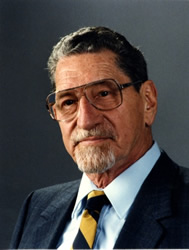
Portrait of Richard Lazarus
. External portrait hosted by University of California Academic Senate. Source.A clinical psychologist whose research investigated anxiety and obsessive-compulsive problems. [ref]
https://www.wits.ac.za/alumni/obituaries/obituary-content-by-year/. Wits obituary: Stanley Jack Rachman
[ref]Reducing contamination by exposure plus safety behaviour by Stanley Rachman and others. Journal of Behavior Therapy and Experimental Psychiatry 42, 397–404; 80 undergraduates, exposure with or without hygienic wipes, two-session analogue
A clinical psychologist who tested whether changing reasoning processes can reduce paranoia. Her SlowMo trial evaluated a blended digital intervention against usual care, with a prespecified GPTS endpoint and additional outcomes. The study connects a cognitive account of persistent threat beliefs to an intervention whose clinical effects can be measured.[ref]
Effects of SlowMo, a Blended Digital Therapy Targeting Reasoning, on Paranoia Among People With Psychosis: A Randomized Clinical Trial by Philippa Garety and others. 2021, randomized trial, primary 24-week GPTS endpoint and secondary outcomes

Portrait of Philippa Garety
. King's College London profile portrait. Source.A researcher who tested feedback-informed treatment for depression and anxiety. In a trial assigning therapists to different treatment conditions, progress feedback identified patients whose outcomes were off track. This design evaluates whether giving clinicians systematic outcome information improves treatment, while accounting for patients being clustered within therapists.[ref]
Feedback-informed treatment versus usual psychological treatment for depression and anxiety: a multisite, open-label, cluster randomised controlled trial by Jaime Delgadillo and others. 2018, cluster allocation, 77 therapists and 2233 patients

Portrait of Jaime Delgadillo
. King's College London profile portrait. Source.A researcher who tested how a visuospatial task influences later intrusive recollections. Participants watched a distressing film and, after a delay, either played Tetris or entered a control condition; subsequent intrusions and deliberate recognition memory were measured separately. The analogue experiment tests a cognitive mechanism and does not by itself establish treatment effectiveness after real-world psychological trauma.[ref]
Can Playing the Computer Game Tetris Reduce the Build-Up of Flashbacks for Trauma? A Proposal from Cognitive Science by Emily A. Holmes and others. 2009, trauma-film experiment, one-week intrusions and recognition

Portrait of Emily A. Holmes
. Katie Chan. CC BY-SA 3.0, via Wikimedia Commons. Source.A clinical psychologist who used virtual reality to test mechanisms maintaining persecutory delusions. A randomized experiment compared entering simulated social situations while retaining safety behaviors with entering them while dropping those behaviors. Measuring changes in conviction connects the manipulation to a proposed mechanism, beyond simply exposing participants to a social setting.[ref]
Virtual reality in the treatment of persecutory delusions: randomised controlled experimental study testing how to reduce delusional conviction by Daniel Freeman and others. 2016, 30-participant experimental study and real-world assessment

Portrait of Daniel Freeman
. University of Oxford profile portrait. Source.- Comparison of a theoretically driven cognitive therapy (the Feeling Safe Programme) with befriending for the treatment of persistent persecutory delusions: a parallel, single-blind, randomised controlled trial by Daniel Freeman and others
- Effects of cognitive behaviour therapy for worry on persecutory delusions in patients with psychosis (WIT): a parallel, single-blind, randomised controlled trial with a mediation analysis by Daniel Freeman and others
- The effects of improving sleep on mental health (OASIS): a randomised controlled trial with mediation analysis by Daniel Freeman and others
- Virtual reality in the treatment of persecutory delusions: randomised controlled experimental study testing how to reduce delusional conviction by Daniel Freeman and others
A clinical and cognitive psychologist at the University of Western Australia whose work investigates anxiety-linked information processing. [ref][ref]
Selective attention and emotional vulnerability: assessing the causal basis of their association through the experimental manipulation of attentional bias by Colin MacLeod and others. Journal of Abnormal Psychology 111, 107–123; modified dot-probe training and responses to a standardised stress task
Portrait of Colin MacLeod
. University of Western Australia profile portrait. Source.A clinical psychologist who coauthored the original dual representation theory of post-traumatic stress disorder. The account distinguishes verbally accessible recollections from representations activated by situational cues. This proposed difference explains how deliberately describing an event can diverge from involuntary reliving; it is a theoretical account of human memory, not a demonstration of two isolated anatomical stores.[ref]
A dual representation theory of posttraumatic stress disorder by Chris R. Brewin and others. 1996, original theoretical distinction, pp. 670–686

Portrait of Chris R. Brewin
. British Academy profile portrait. Source.A clinical psychologist who, with David M. Clark, proposed a cognitive model of persistent post-traumatic stress disorder. Negative interpretations and poorly contextualized autobiographical memory can generate a sense of current threat even though the event is past. The account links continuing symptoms to cognitive and behavioral strategies that prevent those interpretations from changing.[ref]
A cognitive model of posttraumatic stress disorder by Anke Ehlers and David M. Clark. 2000, proposed current-threat mechanism and maintaining strategies

Portrait of Anke Ehlers
. British Academy profile portrait. Source.
Photograph by Cfonagy, released into the public domain. Source: Wikimedia Commons.
Charles M. Borduin studied multisystemic therapy for serious juvenile offending. The treatment is evaluated through outcomes that extend beyond immediate symptom reports, including later offending. Distinguishing a controlled treatment comparison from a simple before-and-after change is essential when attributing long-term outcomes to an intervention. [ref]
Multisystemic treatment of serious juvenile offenders: long-term prevention of criminality and violence by Charles M. Borduin and others. 1995, long-term intervention comparison
A researcher who compared people with persistent psychotic experiences who did and did not need clinical care. The 2016 study also included a control group without such experiences. Differences in distress, functioning and psychological characteristics help distinguish having an unusual experience from developing a clinical difficulty requiring support.[ref]
- Clinical relevance of appraisals of persistent psychotic experiences in people with and without a need for care: an experimental study by Emmanuelle Peters and others
- Clinical, socio-demographic and psychological characteristics in individuals with persistent psychotic experiences with and without a need for care by Emmanuelle Peters and others
Erik Hedman studied internet-delivered cognitive behavioral therapy for severe health anxiety. A randomized trial compared therapist-guided internet treatment with an attention-control condition. The comparison tests that delivery arrangement and treatment package, rather than showing that an online format alone is sufficient or that every form of health concern has the same mechanism. [ref]
Internet-based cognitive-behavioural therapy for severe health anxiety: randomised controlled trial by Erik Hedman and others. 2011, randomized therapist-guided internet-CBT comparison
Articles were limited to the first 100 out of 439 total.



