Topics (384k) Articles (398k) Users (410) Discussions (242) Comments (383) Files (13k) New article

A typesetting penalty expresses how desirable a candidate break is. In the Knuth-Plass line-breaking algorithm's paragraph representation, a penalty item can also have a width that is included only if that break is taken. This lets the model account for a hyphen introduced by hyphenation without printing it in the unbroken word.[ref]
Breaking paragraphs into lines by Donald E. Knuth and Michael F. Plass. pp.1123–1125: penalty values, widths and flags
For example, suppose the material before an optional break uses 29 units and taking the break introduces a hyphen of width 2. At a typesetting line width of 30, the broken line needs units before any permitted adjustment of typesetting glue. Testing only the pre-hyphen width would wrongly declare it a fit. A finite penalty can discourage a break while still leaving it available when other choices are worse.
In TeX, values prohibit a penalty break and force it. Intermediate positive values discourage and negative values encourage it. These are control conventions of the implementation, not physical lengths.[ref]
TeX source code by Donald E. Knuth. penalty_node definition: inf_penalty and eject_penalty thresholds
The penalty value is an input to the typesetting demerit calculation. It is not the entire paragraph cost: typesetting badness, line-breaking fitness classes and consecutive hyphenated breaks can contribute too. Comparing two penalties alone therefore cannot choose the best text paragraph layout.
A line-breaking fitness class is a coarse description of how tightly or loosely a line is spaced. The Knuth-Plass line-breaking algorithm distinguishes tight, normal, loose and very loose lines. A transition between sufficiently different classes adds typesetting demerits, even when each line's own spacing is individually acceptable.[ref]
Breaking paragraphs into lines by Donald E. Knuth and Michael F. Plass. p.1155: four fitness classes and penalties for contrasting adjacent lines
For example, imagine one feasible line has line adjustment ratio and the next has . One compresses its spaces substantially, while the other expands them. That contrast can be more conspicuous than two lines with similar spacing. A paragraph objective can express this using an added termwhere indexes the classes. The indicator function adds the charge only for a sufficiently large class change.
Consequently, the dynamic programming state needs the previous fitness information. Suppose two routes to the same break cost 10 and 12, but the cheaper route's class would add a transition charge of 5 to the next line while the other adds none. Their relevant totals become 15 and 12: discarding the second route solely because would be premature. The principle of optimality applies to states that retain the information the future cost needs.
TeX computes its categories using integer typesetting badness thresholds and handles special glue cases explicitly. Its implementation should therefore be consulted for exact boundary behaviour rather than inferring it from rounded decimal adjustment ratios.[ref]
TeX source code by Donald E. Knuth. try_break: fit_class, badness thresholds 12 and 99, and adj_demerits
The line adjustment ratio measures the stretch or shrink required to make a candidate line fit. In the finite-glue model, let be its natural line width, its target typesetting line width, and and the total stretch and shrink coefficients of its typesetting glue. DefineIt is a dimensionless quantity: numerator and denominator are widths measured in the same units. Each glue item uses the same , scaled by its own appropriate coefficient.[ref]
Breaking paragraphs into lines by Donald E. Knuth and Michael F. Plass. pp.1125–1127: adjustment ratio and feasible stretching/shrinking
For , and , targets 32 and 28 give and respectively. If a nonzero width difference requires a coefficient total of zero, this model cannot make the adjustment. With ordinary bounded shrinkage, asks the glue to shrink beyond its total allowance and is infeasible. Positive stretch is usually limited by an acceptable-quality threshold rather than by treating as an absolute geometric limit.
The typesetting badness scores spacing quality from the required adjustment, while a line-breaking fitness class records a coarser category for comparison with neighbouring lines. Neither measure alone incorporates every typesetting penalty.
Typesetting badness scores the spacing strain needed to fit a line. For ordinary finite stretch or permitted finite shrink, a useful smooth guide iswhere is the line adjustment ratio. Doubling the required ratio multiplies this guide by eight, so it strongly penalizes large adjustments. The convex function on nonnegative ratios rewards more evenly distributed spacing strain.
TeX computes an integer approximation with saturation rather than evaluating that real-valued expression exactly. With stretch coefficient in the routine's internal units, excess widths give ratios and routine outputs . In particular, the first differs from the smooth guide value 12.5.[ref]
TeX source code by Donald E. Knuth. badness(t,s): fixed-point approximation, rounding constants and inf_bad; chosen input values evaluated directly
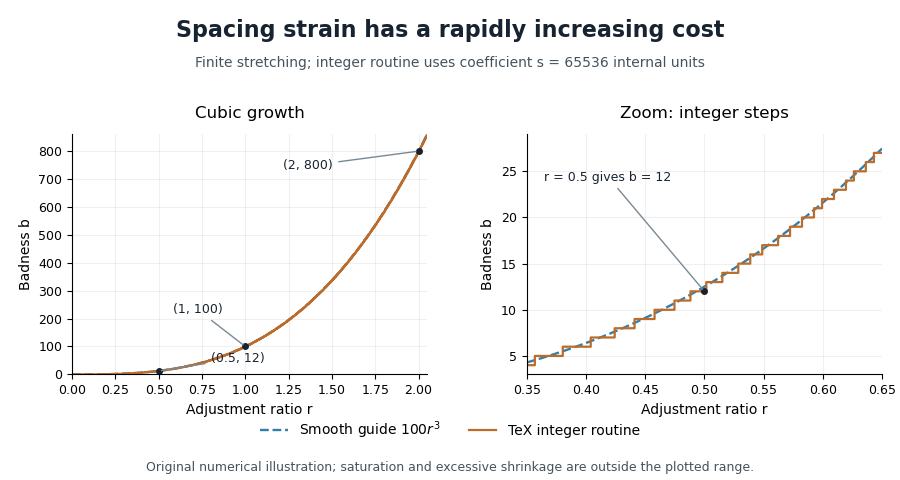
Cubic spacing cost and integer typesetting badness
. Original calculation comparing the smooth guide with TeX's badness routine at chosen finite stretch coefficients. The right panel enlarges the integer steps near r=0.5. All plotted ratios describe stretching. Details.The sentinel 10000 represents saturated badness in the routine. Excessive shrinking is tested separately in paragraph breaking; higher-order stretch has its own treatment. A paragraph's typesetting demerits also include typesetting penalties and possible neighbour-dependent charges, so choosing solely by badness can miss the best layout.
A typesetting demerit is a contribution to the paragraph cost minimized by the Knuth-Plass line-breaking algorithm. It combines spacing quality with break preferences and, when applicable, costs involving neighbouring lines. Thus typesetting badness is one input to the cost rather than the entire objective.[ref]
TeX source code by Donald E. Knuth. try_break: line_penalty, badness, break penalties and adjacent/hyphen demerits
Consider the ordinary finite-penalty case in TeX, away from its integer saturation and recovery cases. Let be the TeX line penalty, the typesetting badness and the typesetting penalty, with and . The base contribution isCharges for incompatible line-breaking fitness classes or consecutive hyphenated lines can then be added.
For an illustrative choice , and , the base is . Changing only to gives . If an adjacency charge of 100 applies, those become 1025 and 975. These are chosen example parameters, not asserted defaults.
Dynamic programming compares accumulated costs while retaining the dynamic programming state needed by future charges. The lowest-cost break considered alone need not produce the lowest-cost complete text paragraph.
A ureter is a muscular tube carrying urine from a kidney's collecting region to the urinary bladder. Coordinated contractions of its smooth muscle propel urine along the tube, so transport is not simply a consequence of gravity.[ref]
It should be distinguished from the urethra, which carries urine outward from the bladder. The distinction separates two different transport segments and explains why a description of blockage or flow must specify its location. Urine production in the kidney, passage through the ureter and storage in the bladder are different stages of the urinary system.
A nephron is a microscopic functional unit of a kidney, combining a filtration apparatus with a tubule that modifies the resulting fluid. The glomerulus filters fluid from the blood into the initial urinary space; the tubule selectively returns substances toward the circulation and secretes others into its lumen.[ref]
Your Kidneys and How They Work by NIDDK. How do my kidneys work?: glomerular filtration and tubular processing
For a specified substance, an accounting relation iswhen all terms refer to the same interval and other gains or losses are absent. Filtering 100 arbitrary units, reabsorbing 95 and secreting another 2 gives excretion of 7 units. Filtration alone therefore does not determine urine composition. The anatomical separation of blood and tubular lumen supplies the geometry for this controlled exchange.
The renal medulla is the inner region of the kidney, lying beneath the renal cortex and organized into renal pyramids. It contains portions of the Loop of Henle, collecting ducts and the renal vasa recta. The arrangement supports the production of urine more concentrated than blood plasma.[ref]
Anatomy and Physiology 2e by J. Gordon Betts and others. Section25.3, Internal Anatomy and renal circulation
Along the renal medulla, the surrounding fluid generally becomes more concentrated toward the renal papilla. Countercurrent multiplication involving the Loop of Henle helps establish this gradient; exchange in the renal vasa recta helps preserve it. A water-permeable collecting duct can then lose water by osmosis while passing through the concentrated surroundings.
In 1959, Carl W. Gottschalk and Margaret Mylle measured osmolality in tiny fluid samples collected by renal micropuncture. Oil-filled glass micropipettes sampled particular locations; freezing-point depression supplied a concentration measurement. Fluid from loop bends, collecting ducts and renal vasa recta at the same medullary level was similarly hyperosmotic. This supported a shared local concentrating environment and a countercurrent interpretation, rather than concentration occurring only inside one isolated tube.[ref]
The experiment connects location to function: a diagram showing a Loop of Henle merely bending back is incomplete without the measured concentration differences along the surrounding tissue.
The collecting duct system is the converging network of collecting ducts that receives fluid from many nephrons, modifies its composition, and conducts the remaining urine toward the outlet of the kidney. Collecting ducts run from the renal cortex through the renal medulla, joining into larger passages that empty at a renal papilla into a renal calyx.[ref]
Anatomy and Physiology 2e by J. Gordon Betts and others. Sections25.3–25.4: renal pyramids/papillae and collecting ducts
The network arrangement matters: a single downstream collecting duct can receive output from several upstream nephrons. Consequently the shared collecting duct system is not a separate terminal tube assigned exclusively to each nephron. Flow is pooled while further exchange across the lining epithelium adjusts the final urine.[ref]
A shared outlet can still regulate its water loss. In isolated rat collecting ducts, vasopressin increased water permeability while aquaporin-2 labelling shifted toward the apical membrane. Withdrawal reversed both changes. This supplies a molecular mechanism for regulating the network's epithelial water pathway; a surrounding osmotic pressure difference supplies the driving force for osmosis.[ref]
The renal cortex is the outer region of functional kidney tissue, surrounding the renal medulla. It contains the renal corpuscles, each with a glomerulus, and many convoluted portions of the renal tubules. Cortical extensions between neighboring renal pyramids form renal columns. The cortex is thus a substantial region containing multiple structures, not merely the kidney's thin external covering.[ref]
A practical histology comparison uses a section containing both regions. Look for the rounded renal corpuscle profiles among the tubular profiles: their occurrence identifies cortical tissue. In contrast, the medullary field emphasizes more parallel passages and lacks these corpuscles. Straight tubular segments can also extend through cortical tissue, so one straight tube is insufficient to classify the entire region as medulla.[ref]
Kidney histology laboratory by Columbia University. slide50: cortical labyrinth, corpuscles and medullary rays
This example separates a region from a functional unit. A nephron has its renal corpuscle in the renal cortex, while its Loop of Henle extends to a depth that varies among nephrons. Following one nephron therefore crosses anatomical regions; drawing a cortex–medulla boundary does not divide the organ into two independent sets of complete nephrons.
A renal papilla is the tip of a renal pyramid, projecting into the receiving space of a renal calyx. The converging collecting duct system opens at this surface, allowing urine to leave the medullary tissue and enter the collecting passages. A papilla is a region of the kidney itself; the surrounding calyx is part of its drainage route.[ref]
Longitudinal section through Kidney by the Manipal Museum of Anatomy and Pathology. voiceover and labeled specimen: pyramid apex opening into minor calyx
Trace a drop of tubular fluid toward this boundary. Before it exits the collecting duct, exchange across the lining epithelium can still modify its composition. After it enters the renal calyx, it has left that microscopic tubular pathway and moves into a larger collecting passage. This spatial distinction prevents confusion between making urine and routing the already collected output.
The renal papilla also marks the deep end of the renal medulla's concentrating environment. A section through the kidney connects the broad base of a renal pyramid, facing the renal cortex, to its narrower papillary outlet. The shape helps organize many converging passages, but shape alone does not explain the membrane transport that concentrates their contents.[ref]
Anatomy and Physiology 2e by J. Gordon Betts and others. Section25.3: internal anatomy and renal pyramids
A renal calyx is a cup-like collecting passage within the kidney that receives urine leaving a renal papilla. A minor calyx lies around a papillary outlet; these passages join into a major calyx, which drains toward the renal pelvis and then the ureter. The calyx is therefore part of the outflow route, downstream of the collecting duct system, rather than a site where the glomerulus first filters blood.[ref]
Kidneys by the National Cancer Institute. internal anatomy: minor/major calyces and renal-pelvis drainage
The branching arrangement supplies a simple mass balance. Suppose three upstream minor calyx passages deliver steady volumetric flow rates of , and to one outlet. With no storage or side flow, that outlet carries . These illustrative values describe how branches combine; they are not normal human flow measurements.
A longitudinal anatomical section makes the distinction visible: locate the pointed renal papilla first, then the hollow receiving space around it. The projecting tissue and its receiving passage are adjacent structures with different roles.[ref]
Longitudinal section through Kidney by the Manipal Museum of Anatomy and Pathology. specimenEXC002: papilla, minor calyx, major calyx and pelvis
The renal vasa recta are straight, hairpin-arranged blood vessels supplying the renal medulla, especially alongside the long loops of a juxtamedullary nephron. They carry blood, whereas the neighboring Loop of Henle and collecting ducts carry tubular fluid. Keeping these compartments separate is essential to understanding how the kidney returns reabsorbed water to the circulation.[ref]
Anatomy and Physiology 2e by J. Gordon Betts and others. Sections25.3–25.4: medullary circulation and vasa recta
Their geometry supports countercurrent exchange. As blood descends into increasingly concentrated surroundings, it can gain solute and lose water; on its return toward the renal cortex, the local differences favor exchange in the opposite directions. Much of the solute taken up on descent can therefore be returned to the medulla instead of being carried away. Exchange helps preserve a gradient; it is distinct from the active transport that helps generate it.
For an idealized accounting example, if descending blood gains 10 units of a solute and returning blood gives 9 units back, its net removal is only 1 unit. These are hypothetical amounts, illustrating retention through exchange rather than a measured percentage in every vessel.
Direct renal micropuncture supplied an important spatial test in 1959: fluid sampled from loop bends, adjacent collecting ducts and renal vasa recta at the same deep medullary level was similarly hyperosmotic. The vascular route thus shared the concentrated environment even though its contents were distinct from tubular fluid.[ref]
Micropuncture study of the mammalian urinary concentrating mechanism: evidence for the countercurrent hypothesis by Carl W. Gottschalk and Margaret Mylle. Abstract: corresponding medullary sampling sites
The renal pelvis is the expanded collecting region of the kidney that receives urine from the major calyx passages and continues into the ureter. It lies downstream of the collecting duct system and the renal calyx network. Its function is to collect and route their combined output, rather than to carry out glomerular filtration.[ref]
Kidneys by the National Cancer Institute. internal anatomy: calyces, pelvis and continuity with ureter
Trace the drainage sequence from a single renal pyramid: its collecting ducts open at a renal papilla, the receiving minor calyx joins a larger major calyx, and the latter drains toward the renal pelvis. A longitudinal anatomical specimen exposes these nested connections directly. The surrounding kidney tissue and the space receiving its output are different structures.[ref]
Longitudinal section through Kidney by the Manipal Museum of Anatomy and Pathology. specimenEXC002: minor/major calyces, renal pelvis and ureter
For a steady illustrative mass balance, suppose two incoming passages supply and . If pelvic storage is unchanged and there is no other inflow or loss, the ureter must carry . Sampling there measures pooled output: it cannot, by itself, reveal which upstream nephron produced a particular change in urine composition.
A renal column is an inward extension of the renal cortex between neighboring renal pyramids. It is part of the kidney's living tissue, continuous with the outer cortex, rather than an empty drainage passage. The renal medulla is organized into pyramids, with cortical tissue extending between them.[ref]
A longitudinal section provides a useful identification exercise. First locate two adjacent renal pyramids by following their striations toward their renal papilla outlets. Then trace the intervening tissue outward into the renal cortex. That continuity identifies a renal column; the hollow receiving spaces beside the papillary tips belong instead to the renal calyx system.[ref]
Longitudinal section through Kidney by the Manipal Museum of Anatomy and Pathology. specimenEXC002: columns between pyramids
This distinction explains why location alone can mislead: tissue lying deep between two pyramids is not necessarily medulla. The term describes how cortical tissue is arranged in three dimensions. A section's apparently separate cortical islands may simply be different cuts through one connected anatomical region.
HKDF is an HMAC-based key derivation function with extraction and expansion stages. Extraction combines initial material with a cryptographic salt to produce an intermediate key . Expansion uses that key, context
info and an output length . RFC 5869 specifies the construction as an Informational RFC.[ref]HMAC-based Extract-and-Expand Key Derivation Function (HKDF) by Hugo Krawczyk and Pasi Eronen. Status of This Memo; §§2.2–2.3
Writing for concatenation, its equations areThe output is the first bytes of , where and is the digest length in bytes. The counter occupies one byte, giving . The first HMAC argument is the key; swapping its two arguments changes the construction.[ref]
HMAC-based Extract-and-Expand Key Derivation Function (HKDF) by Hugo Krawczyk and Pasi Eronen. §2.1, HMAC argument convention; §§2.2–2.3, extraction and expansion
For SHA-256, . Requesting therefore requires two expansion blocks, using all 32 bytes of the first and ten of the second. The maximum specified length is bytes. Requesting a longer output under that one-byte counter rule is not an additional iteration of the same specification.
RFC 5869 Appendix A.1 supplies a reproducible example: 22 input bytes each equal to hexadecimal
0b, salt bytes 00 through 0c, and info bytes f0 through f9, with . The resulting output, written as hexadecimal, is3cb25f25faacd57a90434f64d0362f2a2d2d0a90cf1a5a4c5db02d56ecc4c5bf34007208d5b887185865.That is 84 hexadecimal digits representing 42 bytes. Each expansion block depends on its predecessor as well as the context and counter; independently hashing the counter would describe a different function.[ref]
A salt need not be secret, while the derived key material must receive the protection required by its role. Context can distinguish protocol uses through cryptographic domain separation. Neither changing a label nor asking for more bytes supplies additional secret entropy to a weak input.
Pinned article: Introduction to the OurBigBook Project
Welcome to the OurBigBook Project! Our goal is to create the perfect publishing platform for STEM subjects, and get university-level students to write the best free STEM tutorials ever.
Everyone is welcome to create an account and play with the site: ourbigbook.com/go/register. We belive that students themselves can write amazing tutorials, but teachers are welcome too. You can write about anything you want, it doesn't have to be STEM or even educational. Silly test content is very welcome and you won't be penalized in any way. Just keep it legal!
Intro to OurBigBook
. Source. We have two killer features:
- topics: topics group articles by different users with the same title, e.g. here is the topic for the "Fundamental Theorem of Calculus" ourbigbook.com/go/topic/fundamental-theorem-of-calculusArticles of different users are sorted by upvote within each article page. This feature is a bit like:
- a Wikipedia where each user can have their own version of each article
- a Q&A website like Stack Overflow, where multiple people can give their views on a given topic, and the best ones are sorted by upvote. Except you don't need to wait for someone to ask first, and any topic goes, no matter how narrow or broad
This feature makes it possible for readers to find better explanations of any topic created by other writers. And it allows writers to create an explanation in a place that readers might actually find it.
Figure 1. Screenshot of the "Derivative" topic page. View it live at: ourbigbook.com/go/topic/derivativeVideo 2. OurBigBook Web topics demo. Source. - local editing: you can store all your personal knowledge base content locally in a plaintext markup format that can be edited locally and published either:This way you can be sure that even if OurBigBook.com were to go down one day (which we have no plans to do as it is quite cheap to host!), your content will still be perfectly readable as a static site.
- to OurBigBook.com to get awesome multi-user features like topics and likes
- as HTML files to a static website, which you can host yourself for free on many external providers like GitHub Pages, and remain in full control

Figure 2. You can publish local OurBigBook lightweight markup files to either OurBigBook.com or as a static website.
Figure 3. Visual Studio Code extension installation.
Figure 5. . You can also edit articles on the Web editor without installing anything locally. Video 3. Edit locally and publish demo. Source. This shows editing OurBigBook Markup and publishing it using the Visual Studio Code extension. 
- Infinitely deep tables of contents:



All our software is open source and hosted at: github.com/ourbigbook/ourbigbook
Further documentation can be found at: docs.ourbigbook.com
Feel free to reach our to us for any help or suggestions: docs.ourbigbook.com/#contact