Topics (384k) Articles (398k) Users (410) Discussions (242) Comments (383) Files (13k) New article

N. C. Pedersen coauthored the 1987 isolation study of the feline retrovirus associated with an immunodeficiency-like syndrome, now discussed under feline immunodeficiency virus. The work combined isolation of a T-lymphotropic agent, antibody evidence and experimental transmission, connecting a clinical observation with a testable infectious explanation.[ref]
Isolation of a T-lymphotropic virus from domestic cats with an immunodeficiency-like syndrome by N. C. Pedersen and others. Science235,790–793; Abstract and indexed byline
In the studied cattery, 10 of25 cats showing ill health were seropositive, compared with1 of18 apparently normal cats. The respective proportions are and about . This contrast is an association within that sampled group, rather than a population-wide prevalence estimate. Kittens inoculated with blood or plasma from naturally infected animals subsequently developed the reported syndrome features, adding a different kind of evidence from the cross-sectional counts.[ref]
Isolation of a T-lymphotropic virus from domestic cats with an immunodeficiency-like syndrome by N. C. Pedersen and others. Abstract, serologic counts and kitten inoculation
F. Clavel is the first-listed author of a1986 study isolating a new human retrovirus from two West African patients with AIDS. The investigators compared its biological and morphological properties, antigens and DNA hybridization behavior with previously characterized viruses. The work helped distinguish the agent subsequently called HIV-2; the original indexed initial-only author spelling is retained.[ref]
Isolation of a new human retrovirus from West African patients with AIDS by F. Clavel and others. Science233,343–346; indexed byline and Abstract
[ref]Molecular cloning and polymorphism of the human immune deficiency virus type 2 by F. Clavel and others. Abstract, HIV-2 and previous LAV-2 designation
An illuminating feature was the separation of resemblance from identity. Similar viral morphology did not settle the classification: envelope glycoproteins differed antigenically, and DNA hybridization supplied a different comparison of genetic relatedness. Shared epitopes in one component could coexist with substantial differences in another component.[ref]
Isolation of a new human retrovirus from West African patients with AIDS by F. Clavel and others. Abstract, core/envelope comparisons and subgenomic probes
A further1986 paper reported cloning the complete approximately9.5-kilobase HIV-2 genome and detecting restriction-site differences between isolates. This moved the characterization from an isolated agent toward a molecular comparison of genomes, without equating every difference between isolates with a distinct viral type.[ref]
Derek S. Lundberg studies interactions between plants and their associated bacteria. He is the first-listed author of a2012 study defining bacterial communities in Arabidopsis thaliana root-associated compartments. Its controlled comparison linked soil type, host genotype and sampling location with the observed microbiome.[ref]
The experimental logic separates a starting community from the plant-associated outcome. Matched bulk soil, rhizosphere and internal-root samples let investigators ask whether an apparent host association also occurred in the reference material. Such comparisons motivate a second question: after association has been identified, which organisms or functions actually change plant performance? Association and a causal contribution require different experiments.
The Wallenberg Foundation's profile describes Lundberg's research on the bacterial taxonomic genus Sphingomonas and its interactions with crop plants. It identifies him as a2021 Wallenberg Academy Fellow. This provides a verified research direction without treating the potential benefits of every strain as already demonstrated.[ref]
Derek S. Lundberg research profile at the Knut and Alice Wallenberg Foundation. Derek S Lundberg profile; research-area and fellowship panels

Portrait of Derek S. Lundberg
. External portrait explicitly labelled Derek S Lundberg on the Wallenberg Foundation profile.A. Poltorak is the first-listed author of a1998 study connecting altered lipopolysaccharide responses in two mouse strains to mutations in the mouse Tlr4 gene. The gene encodes Toll-like receptor 4, a component of the host response to bacterial material. The verified indexed byline is A. Poltorak; no expanded given name is inferred here.[ref]
Defective LPS signaling in C3H/HeJ and C57BL/10ScCr mice: mutations in Tlr4 gene by A. Poltorak and others. Science282,2085–2088; indexed byline and Abstract
The comparison made two forms of evidence meet. The
C3H/HeJ strain had an altered coding sequence, whereas C57BL/10ScCr had a mutation eliminating normal receptor function. Both had impaired lipopolysaccharide signalling. Their relative resistance to endotoxin accompanied increased susceptibility to Gram-negative bacterial infection.[ref]The contrast is scientifically important: reduced response to a bacterial product is not automatically improved defence against the bacterium. Linking inherited variation to a molecular receptor helps distinguish recognition of a stimulus from the many downstream consequences of an immune response. The study's host-genetic comparison therefore supplied more information than testing whether a purified substance was inflammatory in one uncharacterized animal.
Carl R. Woese (1928–2012) was a microbiologist who used ribosomal RNA comparisons to investigate deep evolutionary relationships. His work with George E. Fox helped establish that Archaea form a major lineage distinct from bacteria, despite both groups lacking a cell nucleus.[ref]
Carl R. Woese memorial at the University of Illinois. December 31, 2012, molecular classification and discovery of Archaea
Their 1977 paper inferred three primary lines of descent from ribosomal RNA sequence characterization.[ref]
Phylogenetic structure of the prokaryotic domain: the primary kingdoms by Carl R. Woese and George E. Fox. Abstract, three proposed groups
The related experimental work compared catalogs of short fragments obtained from 16S ribosomal RNA by ribonuclease T1 digestion.[ref]Classification of methanogenic bacteria by 16S ribosomal RNA characterization by George E. Fox and others. Abstract, oligonucleotide characterization of ten methanogenic species
These were measurements of particular molecular sequences, rather than a classification based solely on visible cell shape.A toy phylogenetics problem illustrates the motivation. Three rod-shaped microbes look alike, but a set of comparable molecular characters groups the first two together and separates the third. Cell shape alone would conceal that distinction. A molecular comparison can supply different evidence about shared ancestry, although interpreting it still requires an appropriate evolutionary model and enough informative characters.
The biological surprise was that methane-producing microbes could resemble ordinary bacteria at the level of broad cell organization while differing profoundly in the molecular evidence. Woese's approach made ribosomal RNA a way to test classifications of organisms whose appearance supplied few distinctive clues.[ref]
Carl R. Woese memorial at the University of Illinois. Research account, ribosome comparisons and methane-producing microbes
The historical proposal is a foundation for the three-domain system. It does not settle every later question about the root and branching of the phylogenetic tree; the two-domain system addresses a different arrangement of the deepest relationships. Woese's enduring methodological contribution was to make such questions answerable through explicit molecular comparisons.

Carl R. Woese
. Portrait by Jason Lindsey, identified by the University of Illinois memorial: news.illinois.edu/carl-r-woese-who-discovered-a-new-domain-of-life-dies-at-84/ .Silvia G. Acinas is a researcher in marine microbial ecology, genomics and evolution. Her institutional research profile describes work connecting the genetic diversity of marine microorganisms with their ecological capabilities, using approaches including metagenomics and cultivation.[ref]
Silvia G. Acinas research profile at ICM-CSIC. Research biography, marine microbial diversity and genomic approaches
Acinas was first author of a 2004 study of variation among 16S ribosomal RNA sequences encoded within individual genomes. A genome can contain multiple copies of a 16S ribosomal RNA gene; those copies can be identical or differ in sequence. The study compared copy numbers, sequence divergence and redundancy. These properties complicate the interpretation of diversity estimates based on the marker.[ref]
An invented example separates two effects. Suppose three microbial cells each have two marker-gene copies and two other cells each have five. With one complete genome per cell and no other biases, there are marker copies among five cells. Their contributions to the copy pool are and , whereas their contributions to cell number are and . Marker abundance and cell abundance have different denominators. If copies within a single genome also differ in sequence, multiple sequence variants can originate from one organism.
This work illustrates a recurring measurement issue in microbial ecology: a molecular marker is a biological object whose own variation affects the inference. Acinas and colleagues investigated that variation directly, rather than simply equating each recovered sequence with a separate kind of microorganism.[ref]
Divergence and redundancy of 16S rRNA sequences in genomes with multiple rrn operons by Silvia G. Acinas and others. Abstract, intragenomic divergence and implications for diversity estimation

Silvia G. Acinas
. Portrait identified by the ICM-CSIC Ecology of Marine Microbes research profile: emm.icm.csic.es/silvia-g.-acinas/ .Gerald M. Rubin is a geneticist whose contributions include genetic tools for Drosophila melanogaster. Primary institutional accounts connect his full name with the researcher credited as G. M. Rubin in the early gene-transfer work with Allan C. Spradling.[ref]
Gerald M. Rubin appointment announcement by HHMI. Named biographical record and genetic research
[ref]Allan Spradling research biography by Carnegie Science. Collaboration with Gerald Rubin on Drosophila gene transfer
In their 1982 study, introduced DNA became integrated in germline chromosomes and was inherited. Restoration of a visible eye-color trait supplied one functional check; transfer of a segment without a recognizable visible effect showed that the method was not limited to that particular phenotype.[ref]
Genetic transformation of Drosophila with transposable element vectors by G. M. Rubin and A. C. Spradling. Abstract, stable integration and transfer without a recognizable phenotype
The collaborators' 1983 vectors separated a scored genetic marker from other transferred DNA. A non-autonomous transposable element could carry inserted material while depending on a separate source of the machinery required for movement.[ref]
Vectors for P element-mediated gene transfer in Drosophila by G. M. Rubin and A. C. Spradling. Abstract, non-autonomous P elements, cloning sites and rosy marker
An invented linkage example clarifies the marker's role. A transferred DNA segment contains both a visible marker and an experimental gene. Detecting the marker helps identify candidate carriers, but it does not by itself prove that the experimental gene is intact or has the intended expression. Conversely, lack of a visible effect from the experimental gene does not show that it failed to integrate. Presence, integrity and function require appropriately different evidence.
Rubin's contribution helped make these distinctions experimentally tractable: a biological trait could be investigated through the introduction and inheritance of specified DNA, with markers and molecular measurements supporting the interpretation.
Allan C. Spradling is a biologist whose work includes Drosophila melanogaster genetics and oogenesis. Carnegie Science's institutional biography identifies his collaboration with Gerald M. Rubin in developing a way to introduce genes into the fly genome, directly connecting his full name to the researcher credited as A. C. Spradling.[ref]
Allan Spradling research biography by Carnegie Science. May 7, 2018, full name and collaboration on gene transfer
Their 1982 experiment used a P element carrying a functional version of a gene whose defect altered eye color. Transformed flies recovered normal eye color, and the inserted DNA was stably inherited in later generations. The study thus connected a visible functional readout with evidence of chromosomal integration and inheritance.[ref]
Genetic transformation of Drosophila with transposable element vectors by G. M. Rubin and A. C. Spradling. Abstract, rosy marker, integrated copies and stable inheritance
A toy inheritance model explains why later generations matter. Suppose a new allele is present on one of two homologous chromosomes in a germline cell lineage. In a simple cross to an organism lacking that allele, assume ordinary equal segregation, equal survival and complete detection. Each offspring then has probability of inheriting the insertion, so the expected number among twenty offspring is ten. The assumptions define a model, not an observed ratio from the 1982 study.
Seeing a changed cell in an initially treated animal would not alone establish transmission to offspring. The distinction between a temporary signal, a stable insertion and an inherited alteration is central to explaining the advance. Spradling and collaborators helped turn Drosophila melanogaster from an organism in which mutations could be observed into one in which introduced DNA could be tested experimentally.
Gerd Innerebner is a researcher credited with experimental work on microorganisms associated with plants. He was first author of a 2011 study at ETH Zurich examining whether leaf-associated bacteria could protect Arabidopsis thaliana from disease caused by Pseudomonas syringae.[ref]
The motivating question concerned function: finding common bacteria on healthy leaves does not establish whether they help the host. The experiment compared plants with defined microbial associates and measured both visible outcomes and the abundance of the challenging organism. Some plant-derived Sphingomonas strains provided protection, whereas this effect did not extend to every tested member of the genus.[ref]
A constructed measurement example illustrates the value of those two readouts. Suppose two treatments produce similarly green leaves, but one has colony-forming units of a test organism per gram of leaf and the other has . Equal appearance would conceal a hundredfold difference in recoverable organism abundance. Conversely, lower abundance does not by itself specify which molecular mechanism caused it. These are illustrative values, not results from the paper.
Innerebner's work thus connects a descriptive question about community membership to an experimental question about effects on a host. It also shows why a property measured in particular microbial strains should not automatically be assigned to all organisms sharing a genus name.

Gerd Innerebner
. Portrait explicitly identified in ETH Zurich's Vorholt laboratory former-members page: micro.biol.ethz.ch/research/vorholt/people/people.html .Eiko Yabuuchi is a microbiologist credited with comparative bacterial taxonomy. Her full name appears in the original 1990 publication proposing Sphingomonas as a taxonomic genus, establishing the identity behind the indexed E. Yabuuchi byline.[ref]
Sphingomonas genus and species proposals by E. Yabuuchi and others. Original J-STAGE and publisher full author lists; 1990 affiliation
The proposal combined different kinds of molecular evidence: partial 16S ribosomal RNA sequences, characteristic sphingoglycolipids in cellular lipids, and the major ubiquinone type. Further DNA comparisons and observed traits supported distinctions among species. The resulting taxonomic argument concerned relationships and diagnostic properties, not just resemblance in cell shape.[ref]
A constructed comparison illustrates why several characters are useful. Suppose three isolates all appear as rods under a microscope. Isolates A and B share a characteristic membrane lipid and a closely related marker sequence, whereas C differs in both. The shared shape alone would group all three together; the additional observations support investigating a different arrangement. This example does not supply a universal numerical threshold for a genus or species, nor does it make any one chemical feature sufficient on its own.
Yabuuchi and collaborators also anchored their naming proposal to a type species and designated type strains for newly described species.[ref]
Sphingomonas genus and species proposals by E. Yabuuchi and others. Abstract, Sphingomonas paucimobilis type species and named type strains
Such reference material connects a name to something that can be compared by later investigators. Taxonomic conclusions can be revised as evidence changes, while explicitly identified reference strains help make those comparisons reproducible.Andrew B. Taber is a researcher whose field work includes the behavioral ecology of Dolichotis patagonum, the mara. His institution-hosted curriculum vitae gives his full name and identifies the Patagonian mara study as his Oxford doctoral project, linking the researcher to the A. B. Taber byline.[ref]
Taber was first author of the 1992 paper with David W. Macdonald on communal breeding in maras. The observations connected shared breeding warrens with juvenile survival and adult behavior. Larger communal groups had greater pup survival in the studied setting.[ref]
Communal breeding in the mara, Dolichotis patagonum by A. B. Taber and D. W. Macdonald. Abstract, communal warrens and pup survival
A constructed comparison illustrates why survival fractions matter. Suppose eight of ten young survive in one setting and twelve of twenty survive in another. The second setting has more survivors, but the survival fractions are and . Counting survivors without the original numbers at risk would reverse the apparent comparison. These are invented data, not the paper's measurements.
Even correctly calculated fractions do not by themselves establish a causal effect of group size. Food availability, shelter quality or predation could differ between sites and influence both membership and survival. A field association motivates explanations that can be tested; it is not equivalent to randomly assigning animals to otherwise identical breeding conditions.
The contribution of Taber and collaborators was to connect a distinctive social organization to observations about behavior and outcomes. Shared space, shared care and survival are different aspects of communal breeding, and measuring them separately makes the proposed ecological explanations more informative.
David W. Macdonald is a researcher in wildlife conservation and animal behaviour. His institutional WildCRU profile identifies David Macdonald with publications using the D. W. Macdonald byline. His research includes the 1992 study of mara communal breeding with Andrew B. Taber.[ref]
David Macdonald research profile at WildCRU. Named profile and selected-publication bylines
[ref]Communal breeding in the mara, Dolichotis patagonum by A. B. Taber and D. W. Macdonald. Original byline and Wildlife Conservation Research Unit affiliation
An illuminating result concerned collective vigilance. Larger breeding groups could have more total coverage even though each pair spent less time sitting alert. The group-level readout was whether at least one pair was vigilant, a different variable from the alert fraction of a particular pair.[ref]
Communal breeding in the mara, Dolichotis patagonum by A. B. Taber and D. W. Macdonald. Abstract, collective and per-pair vigilance
A toy probability model explains how this can happen. If pairs each have alert probability at a sampled instant, and their alert states are independent events, thenTwo pairs with give . Six pairs with give . In this constructed model, individual alert probability falls while group coverage increases. These values are not the study's data.
Independence is essential to that calculation. If all pairs became alert in perfect synchrony, group coverage would equal , regardless of how many pairs were present. Field measurements of timing and coordination are therefore needed to choose between such models.
The mara work illustrates how an ecological explanation can connect individual behavior to an emergent group outcome while keeping their measurement definitions distinct.
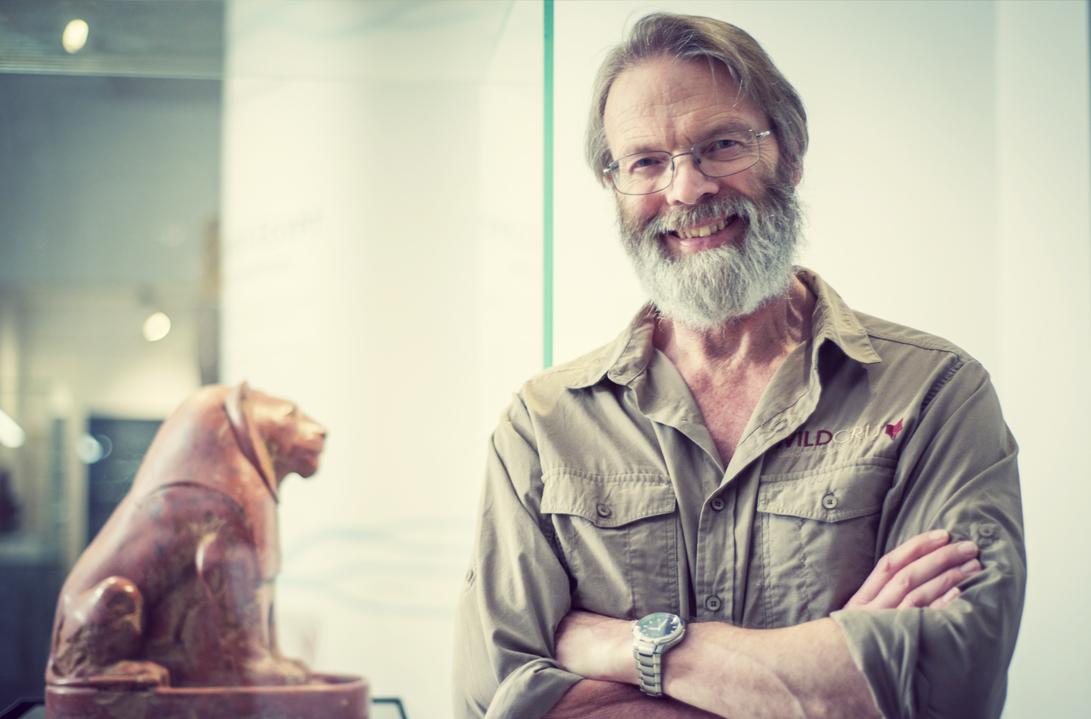
David W. Macdonald
. Portrait identified by the WildCRU institutional profile: www.wildcru.org/members/professor-david-macdonald/ .Matthias Asher is a researcher credited with field studies of the social organization of Cavia aperea. The original 2004 paper names him in full and records his University of Münster affiliation. It investigated one low-density population in southeastern Brazil over six months.[ref]
Social System and Spatial Organization of Wild Guinea Pigs (Cavia aperea) in a Natural Low Density Population by M. R. Asher and others. Original printed page 788, full byline, affiliation and Abstract
The study combined animal radiotelemetry for locations, direct observations for interactions and DNA profiling for genetic relationships. These methods distinguish three questions that need not have identical answers: which animals use the same area, which interact socially and which are related through reproduction. The observed small groups contained one male and one or two females, with largely stable home ranges during the study.[ref]
A constructed habitat-use example explains why availability matters. Suppose dense cover occupies twenty of one hundred hectares but contains eighty of one hundred location fixes. The remaining eighty hectares contain twenty fixes. The observed fix densities are and per hectare, a sixteenfold ratio. This compares location use with area available, rather than simply reporting that eighty percent of fixes were in cover.
Interpreting that ratio as a biological preference requires comparable sampling opportunities and a suitable definition of available habitat. Repeated fixes from one animal are also different evidence from independent observations of many animals. The toy numbers are not the paper's data.
Asher and collaborators' contribution connected spacing and social relationships with environmental context, including vegetation and predation. Its conclusions describe the studied population and conditions rather than establishing one invariant social organization for the whole species.
T. E. Patt is the published name of a microbiologist credited with the original description of Methylobacterium and its type species, Methylobacterium organophilum. The 1976 paper, written with collaborators, gives Patt's initials and a University of Wisconsin bacteriology affiliation; these identify the scientific contribution without requiring an inferred full name.[ref]
Methylobacterium, a New Genus of Facultatively Methylotrophic Bacteria by T. E. Patt and others. Published byline, affiliation and Abstract
The description combined several kinds of evidence, including pink colonies, rod-shaped cells, cellular ultrastructure, DNA base composition and growth on different carbon sources. This is more informative for taxonomy than classifying an isolate solely by colony color. The proposed type species was distinguished by the range of organic substrates it could use, linking the naming decision to measured metabolism.[ref]
Methylobacterium, a New Genus of Facultatively Methylotrophic Bacteria by T. E. Patt and others. Abstract: morphology, substrate use and type strain
A simple conceptual comparison shows why growth conditions matter. Imagine two isolates with equally pink colonies: isolate A can grow with either a one-carbon substrate or a tested substrate containing carbon–carbon bonds, whereas isolate B grows only with the first. Color alone cannot distinguish those metabolic capabilities. Conversely, failure to grow in one culture medium does not establish inability to use its carbon source if another required nutrient is absent. A meaningful comparison needs suitable controls and must separate substrate use from general failure of the bacterial culture.
Patt's paper is historical evidence for a particular classification and set of observations. Its description of methane-related properties should not be extended automatically to every species currently placed in Methylobacterium. A type strain provides a reference for a name; it does not imply that every strain in the genus shares every phenotype under every condition.
Virginia Alonso Roldán is an ecologist whose research includes the measurement of wild-animal populations. In a 2015 study of Dolichotis patagonum, she and collaborators evaluated a two-step monitoring design: first locate communal warrens, then use continuously recording video to count associated adults. The paper credits her with study design, fieldwork, analysis and writing.[ref]
Sources of Variation in a Two-Step Monitoring Protocol for Species Clustered in Conspicuous Points: Dolichotis patagonum as a Case Study by Virginia Alonso Roldán and others. Abstract, Methods and Author Contributions; VAR denotes Virginia Alonso Roldán
The scientific difficulty is that an observed count combines animal abundance with the observation process. The study distinguished finding a warren, deciding whether it was active, and detecting the animals using it. Its field checks combined transect searches with an intensive second search, while video observations tested how observation duration affected counts. Abandoned warrens were an important source of error.[ref]
Sources of Variation in a Two-Step Monitoring Protocol for Species Clustered in Conspicuous Points: Dolichotis patagonum as a Case Study by Virginia Alonso Roldán and others. Methods: warren detectability and active warrens; Discussion: false-positive bias
For an invented illustration, suppose active warrens each have associated adults. If the detection probability for an active warren is and the conditional detection probability for each adult at a found warren is , the expected observed total isalthough the actual total is . Correcting only the video count gives , still missing animals associated with undetected warrens. Conversely, treating abandoned warrens as active could overestimate abundance. This simplified calculation assumes identical detection rates, distinct adult memberships and no double counting; it illustrates the observation problem rather than reproducing the study's estimator or data. Repeated, independently checked observations help distinguish a change in animal numbers from a change in detection probability.

Virginia Alonso Roldán
. Named photograph by Kiara Worth, IISD Earth Negotiations Bulletin, 17 December 2024. Original caption and credit.Ola Alessa is a microbiologist credited with comparative genomics and phenotype analysis of Methylobacterium species. The 2021 research article credits Alessa with study design, experiments, data analysis and manuscript preparation, alongside collaborators in the respective roles.[ref]
Comprehensive Comparative Genomics and Phenotyping of Methylobacterium Species by Ola Alessa and others. Published byline and Author contributions: OA
An important part of the study was checking which organism a supposedly informative genome actually represented. The authors sequenced the Methylobacterium organophilum type strain NBRC15689 because a previously available assembly labelled DSM760 did not adequately represent the intended taxon. This is a provenance problem, not merely an issue of obtaining more DNA sequencing reads: a high-quality assembly associated with the wrong strain label cannot answer the intended species-level question.[ref]
Comprehensive Comparative Genomics and Phenotyping of Methylobacterium Species by Ola Alessa and others. Materials and Methods, Genome Sequencing: organophilum strain identity and new NBRC15689 sequence
An original arithmetic example also shows why comparison criteria must be explicit. Suppose two consistently annotated genomes each contain distinct genes under a chosen matching rule, with shared. The fraction of each genome's gene set shared with the other is . Their Jaccard index instead isThe two answers summarize different denominators; neither is a DNA sequence identity percentage. Missing or split annotations could change the counts even without a corresponding biological gain or loss of genes.
Comparing genome annotation with measured phenotypes therefore tests a different relationship from comparing two sequence files. A predicted gene suggests a possible function; its presence does not by itself show that the function is expressed under a particular condition. The study's combination of comparative genomics and observed traits illustrates why strain identity, consistent annotation and functional evidence belong to the same chain of interpretation.
Charles W. Scouten is a technical author whose account of microtomy explains the mechanical role of knife orientation. His manufacturer-hosted article separates an ideal infinitely thin cutting plane from the real blade's finite knife wedge angle and final bevel. It explains how a blade face that fails to clear the specimen can press against the freshly cut surface instead of moving freely past it.[ref]
Knife Angle in Microtomy by Charles W. Scouten. Named byline; Ideal versus compromise and Consequences of too shallow an angle
The central distinction is between the blade's geometry and its orientation in the apparatus. A knife wedge angle belongs to the blade, whereas knife clearance angle depends on how it is presented to the cut surface. A holder reading must therefore be interpreted using the relevant instrument and bevel conventions; two quantities informally called the knife angle need not be interchangeable.[ref]
Knife Angle in Microtomy by Charles W. Scouten. Figure 1 and discussion of the specimen-side bevel and final bevel
For an original symmetric-wedge example, let be the orientation of the blade bisector relative to the cut plane and let the included wedge angle be . The specimen-side face then has ideal clearanceWith and , this gives . Keeping the same bisector orientation but replacing the wedge by one with gives : in this ideal model the trailing face intersects the nominal specimen half-space. These are chosen geometries, not recommended cutting settings or a claim about the scale on a particular commercial holder.
The example illustrates the practical value of Scouten's explanation. A change in apparent cutting behavior could result from the altered face orientation even if the operator retains the same holder reading. Comparing section compression or surface damage therefore requires recording both the relevant blade geometry and its orientation, rather than treating the displayed angle as a complete description of the cut.
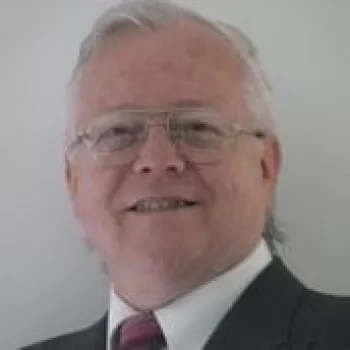
Nevin D. Young is a geneticist whose research uses genomics to investigate communication between plants and microbes. His institutional profile emphasizes legumes, Medicago truncatula and the evolution of nitrogen fixation in association with bacteria.[ref]
Nevin D. Young research profile at the University of Minnesota. Areas of Interest; named profile and portrait
Young was first author of the 2011 draft Medicago truncatula genome report. The work combined sequence assembly with comparative genomics, including duplicated genomic regions and comparisons involving genes expressed strongly in root nodules. Such observations connect genome history with biological specialization, while a duplicated region by itself does not establish the function of every gene it contains.[ref]
The Medicago genome provides insight into the evolution of rhizobial symbioses by Nevin D. Young and others. Abstract and Figures 1–3: draft genome, whole-genome duplication and nodule-enhanced gene comparisons
An original example illustrates why synteny can preserve evidence of whole-genome duplication despite later gene losses. Begin with four neighboring genes,
A B C D. After duplication, suppose one descendant region retains A1 B1 D1, while the other retains A2 C2 D2. Both have lost a different gene, yet the retained A and D copies, their order and corresponding neighboring regions can still support a shared duplication history. Requiring two perfectly identical present-day gene lists would miss that relationship.There is a second inference to keep separate. If
B1 is strongly expressed in a root nodule, that observation concerns present gene expression; the duplicate arrangement concerns ancestry. Neither alone establishes that duplication caused a particular symbiotic function. Comparative sequence evidence and functional tests contribute different parts of that argument. A genome assembly supplies a framework in which those questions can be posed more precisely, rather than a complete explanation of how every gene operates.
Mélodie Duval is a microbiologist whose work examines bacterial RNA and biological translation. She is first author of a 2013 study of Escherichia coli ribosomal protein S1 and structured messenger RNA.[ref]
The study compared S1-depleted and reconstituted 30S ribosomal subunits, using toeprinting to distinguish RNA attachment from positioning in a 30S initiation complex. This connects a molecular perturbation with a specific functional readout.[ref]
Escherichia coli Ribosomal Protein S1 Unfolds Structured mRNAs Onto the Ribosome for Active Translation Initiation by Mélodie Duval and others. Figures5 andS5, depleted/reconstituted subunits and domain variants
An Institut Pasteur profile records her molecular-biology doctorate at Strasbourg in 2015 and a postdoctoral fellowship at Pasteur during 2016–2018. Those are dated biographical facts; the profile does not establish a present institutional appointment.[ref]
For Mélodie Duval bacteria have a future by Institut Pasteur. Key dates and At the Institut Pasteur, profile published2018 and updated2019

Mélodie Duval. The institutional profile identifies this portrait; credit: Institut Pasteur. For Mélodie Duval bacteria have a future by Institut Pasteur.
S. Yaemsiri is first author of a 2010 study measuring human nail growth with N. Hou, M. M. Slining and K. He. Twenty-two young adults marked their nails and recorded mark position and elapsed time. The reported mean rates were 3.47 millimetres per month for fingernails and 1.62 for toenails.[ref]
Growth rate of human fingernails and toenails in healthy American young adults by S. Yaemsiri and others. Primary byline; Abstract, Methods and Results
The study links an accessible physical measurement with interpretation of a slowly growing biological sample.An original example illustrates the measured quantity. A mark that moves from 1.0 to 7.0 millimetres from the reference fold over 60 days has average growth rateExpressing that result as 3.00 millimetres per month additionally chooses a 30-day month. Reporting the elapsed days avoids silently mixing calendar and fixed-duration units.
The measured displacement describes advance of a nail mark over an interval; it is not an instantaneous measurement of every cell's production rate. In a longitudinal study, consistent landmarks and repeated measurements help define what changed. Extrapolating from a group mean to the exact age of an individual clipping would require assumptions about that individual's growth history.
For a purely illustrative constant-rate comparison, a 10-millimetre travel distance takes months at the reported fingernail mean and months at the toenail mean. These calculated times are not individual predictions. The work's value is to make the time axis of biological sampling measurable rather than implicit.
Pinned article: Introduction to the OurBigBook Project
Welcome to the OurBigBook Project! Our goal is to create the perfect publishing platform for STEM subjects, and get university-level students to write the best free STEM tutorials ever.
Everyone is welcome to create an account and play with the site: ourbigbook.com/go/register. We belive that students themselves can write amazing tutorials, but teachers are welcome too. You can write about anything you want, it doesn't have to be STEM or even educational. Silly test content is very welcome and you won't be penalized in any way. Just keep it legal!
Intro to OurBigBook
. Source. We have two killer features:
- topics: topics group articles by different users with the same title, e.g. here is the topic for the "Fundamental Theorem of Calculus" ourbigbook.com/go/topic/fundamental-theorem-of-calculusArticles of different users are sorted by upvote within each article page. This feature is a bit like:
- a Wikipedia where each user can have their own version of each article
- a Q&A website like Stack Overflow, where multiple people can give their views on a given topic, and the best ones are sorted by upvote. Except you don't need to wait for someone to ask first, and any topic goes, no matter how narrow or broad
This feature makes it possible for readers to find better explanations of any topic created by other writers. And it allows writers to create an explanation in a place that readers might actually find it.
Figure 1. Screenshot of the "Derivative" topic page. View it live at: ourbigbook.com/go/topic/derivativeVideo 2. OurBigBook Web topics demo. Source. - local editing: you can store all your personal knowledge base content locally in a plaintext markup format that can be edited locally and published either:This way you can be sure that even if OurBigBook.com were to go down one day (which we have no plans to do as it is quite cheap to host!), your content will still be perfectly readable as a static site.
- to OurBigBook.com to get awesome multi-user features like topics and likes
- as HTML files to a static website, which you can host yourself for free on many external providers like GitHub Pages, and remain in full control

Figure 2. You can publish local OurBigBook lightweight markup files to either OurBigBook.com or as a static website.
Figure 3. Visual Studio Code extension installation.
Figure 5. . You can also edit articles on the Web editor without installing anything locally. Video 3. Edit locally and publish demo. Source. This shows editing OurBigBook Markup and publishing it using the Visual Studio Code extension. 
- Infinitely deep tables of contents:


All our software is open source and hosted at: github.com/ourbigbook/ourbigbook
Further documentation can be found at: docs.ourbigbook.com
Feel free to reach our to us for any help or suggestions: docs.ourbigbook.com/#contact