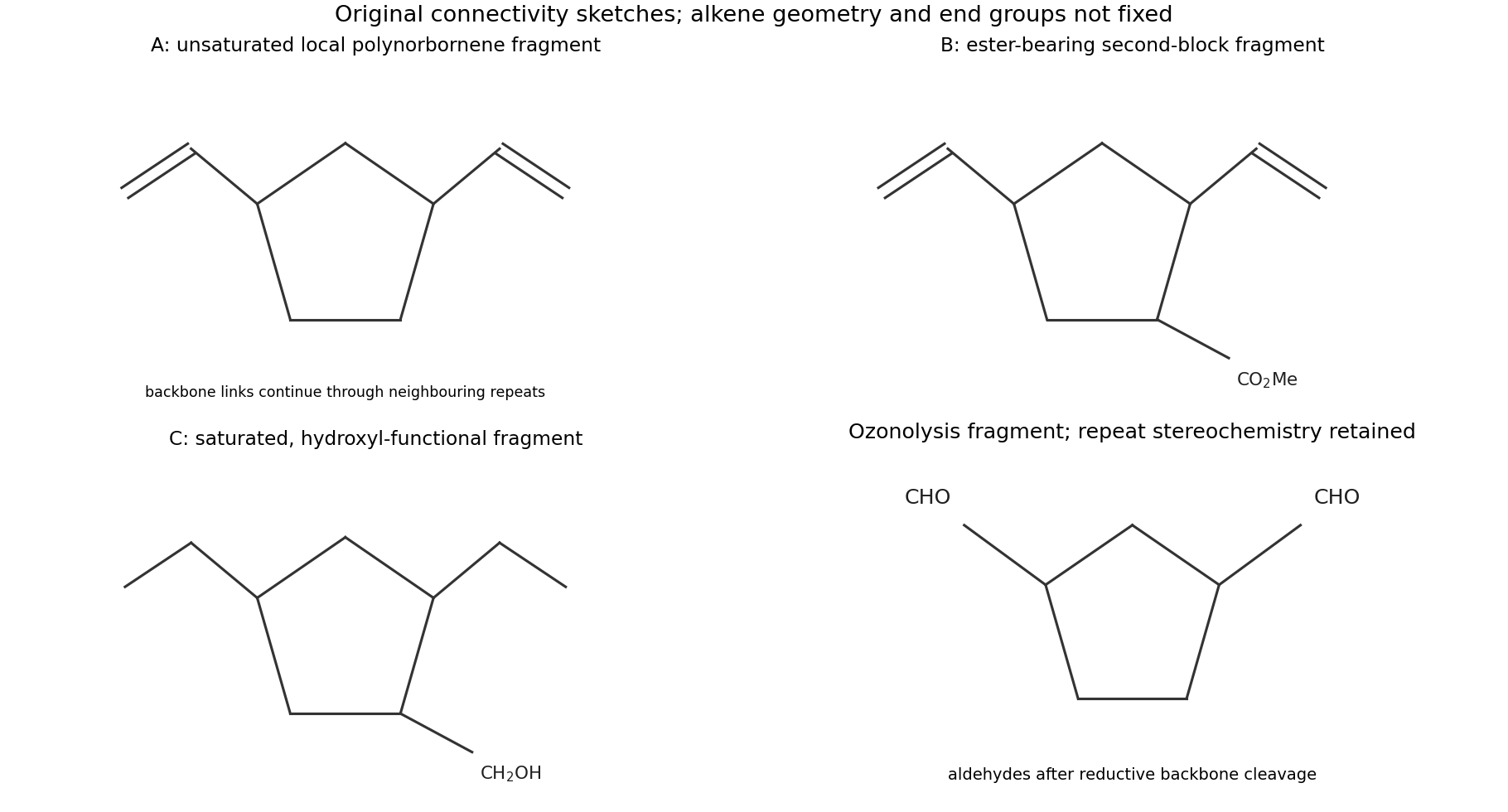
Chas a saturated backbone and pendant CH2OHgroups in its second block.Hydrogenation converts every backbone CH=CH to CH2CH2; lithium aluminium hydride then reduces each CO2Me to CH2OH. The resulting connectivity is [CH2CH2−C5H8]50−[CH2CH2−C5H7(CH2OH)]75.
This is approximately 14.27 kg mol−1 plus the net end-groupmass. The termination chemistry is unspecified, so a more precise whole-chain mass is not determined; the methyl group lost during ester reduction must not remain in the second repeat'smass.
For a homogeneous mixture an approximate interpolation is the Fox equation, Tg−1=w1/Tg1+w2/Tg2, with temperatures in kelvin. Two transitions are not guaranteed merely by block architecture: short blocks, miscibility or insufficient experimental resolution can give one broad transition. The contrast is between domain-specific segmental environments and a more uniform mixed environment.
The ynone-to-chromone atom mapping is unchanged. The change is attachment at isoquinoline C1, rather than copying quinoline numbering and assigning an isoquinolin-2-yl carbonsubstituent at the nitrogenposition.
Label the ynone carbons Ar(OH)−CO−Cα≡Cβ−Ph. The N-oxideoxygen adds to the electrophilic Cβ, giving an O-vinylated quinolinium species with an enolate-like nucleophilic Cα.
The chain Cα−Cβ−O−N−C2quinoline is now arranged for rearrangement: form a bond between Cα and quinoline C2 while cleaving N–O and forming the Cβ=O bond. This can be represented through a cyclic addition/rearrangement intermediate, followed by proton transfer and rearomatization. The resulting carbon skeleton is the heteroarylated 1,3-dicarbonyl system
Finally, the ortho phenolic oxygen attacks the distal carbonyl. Cyclodehydration forms the chromone ring and eliminates water. The product is 2-phenyl-3-(quinolin-2-yl)chromen-4-one. The original ynone carbonyl becomes the chromone 4-one, the phenyl-bearing alkynecarbon becomes C2, and the other alkynecarbon becomes C3 carrying the heteroaryl substituent.
This atom mapping explains both the new C–C bond and the loss of the N-oxideoxygen from the heteroarene; it is not a direct substitution on the phenyl ring.
The nonnucleophilic magnesium amide metalates the triazole carbon between the two ringnitrogenatoms, conventionally C5 of 1-propyl-1,2,4-triazole. That proton is more readily removed because the resulting heteroaryl anion is stabilized by the neighboring nitrogenatoms; the reagent therefore acts asa base rather than adding a tetramethylpiperidinyl group.
The heteroaryl organomagnesium intermediate attacks the allylic bromide, forming a new C–C bond. The product is 5-(cyclohex-2-en-1-yl)-1-propyl-1,2,4-triazole. Ordinary allylic substitution and an SN2′description give the same unlabelled cyclohexenyl connectivity for this unsubstituted allylic ring, so the structural assignment does not distinguish those trajectories.
The molecular formula checks the assignment: N-propyltriazole is C5H9N3; replacing aringH by C6H9 gives C11H17N3, as printed.
A is 1-propyl-1,2,4-triazole, with propyl on the nitrogen that is adjacent to one N and one C in the triazole ring, rather than on the nitrogen between the two carbonatoms.
The new CCO2atom is bonded to P, double-bonded to one O and single-bonded to the O bound to Al. P becomes phosphonium-like and the O–Al end completes a zwitterionic carboxylate-like adduct; the original alkene remains intact.
A direct P–C bond to the captured CO2carbonaccounts for its large 13C–31Pcoupling. The carbonyl-like chemical shift is consistent with a captured, bent CO2 unit. Reversibility follows from cleavage of the new P–C and Al–Ocontacts to regenerate the separated donor and acceptor.
Auseful Lewis acid-assisted model begins with a side-on or bridged alkyne–Al interaction. As in the unsymmetrical bonding of aryl-bridged aluminium aggregates, the electrophilic Al center can interact with more than one carbon while a donating group biases the contact. The phosphine can additionally associate transiently with Al, organizing the alkyne near an Al–H bond. Transfer of hydride to the distal carbon while the proximal carbon retains Al gives the observed regiochemistry.
The drawing requires syn addition of H and Al. In the printed alkene, Mes2P and Ph are opposite; consequently Al and the newly added H are on the same side. A cyclic hydroaluminationtransition state produces this relationship. Steric congestion subsequently inhibits a persistent P→Al bond, leaving the two sites available asa frustrated Lewis pair. A long-lived free vinyl cation or an anti hydride attack is unnecessary, and would not naturally explain the stereochemistry.
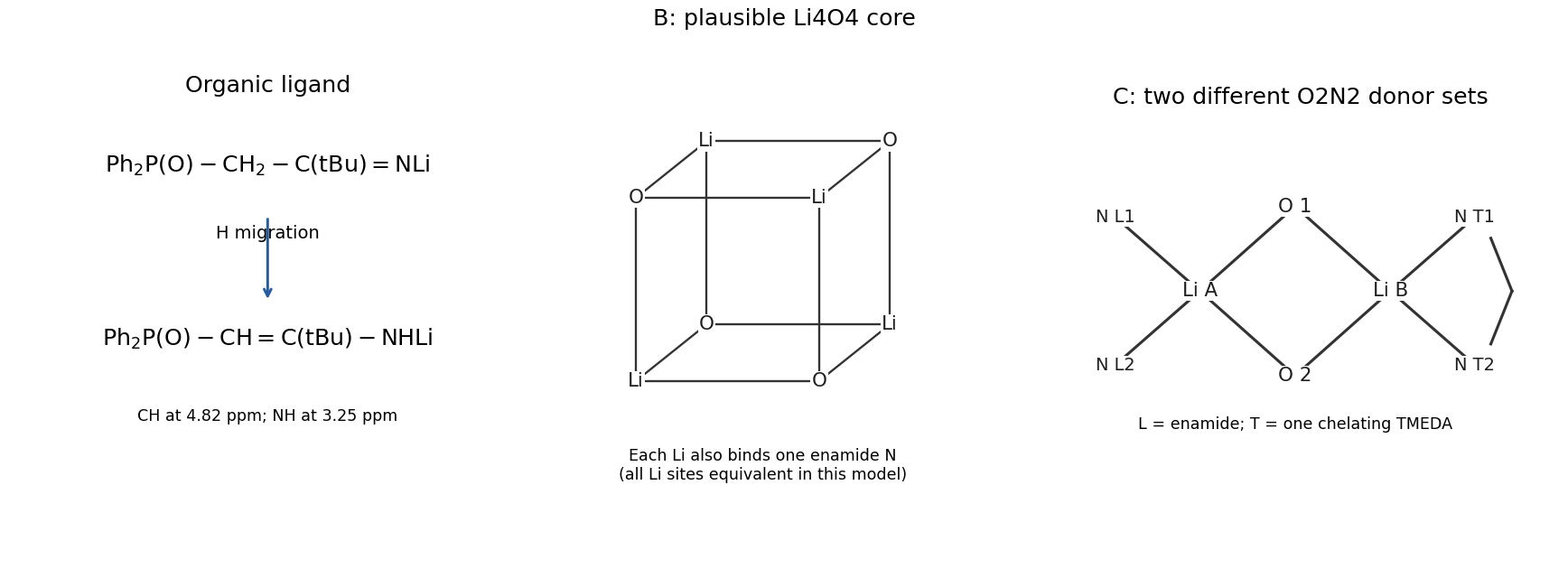
Adimer compatible with the donor count is an asymmetric Li2O2ring. Both phosphoryl oxygen donors bridge both Li centers. The two enamideN donors bind to one Li, whereas both nitrogen donors of a single chelating TMEDA bind to the other Li:
Each Li consequently has exactly two O and two N neighbors, as required. The two donor sets differ chemically, giving two 7Li resonances when the solid-state connectivity is retained in solution. One TMEDA per dimer also matches the stated half equivalent per Li. The hemisolvent stoichiometry must not be drawn as one TMEDA on every Li.
Let L−=Ph2P(O)CH=C(tBu)NH−, with its O and N donors available for lithium coordination. A plausible symmetric tetramer has a Li4O4cubane-type core, with alternating Li and phosphoryl Overtices and an additional enamideN donor attached to each Li. The O,N-chelating Ligand in coordination chemistry can be arranged equivalently around the aggregate, consistent with one 7Li environment. This is a connectivity model, not a uniquely reconstructed diffraction structure.
Assign δH=4.82 to the vinylic CH and δH=3.25 to NH. Each integrates to one proton, as required after hydrogen migration. Their singlet appearance does not mean that the original carbon has become a freely rotating, equivalent-protonmethylene group.
The tetrameric and dimeric nuclearities are established for this reaction system; the spectra in the question are consistent with them, but spectra alone would not uniquely prove every detail of the aggregates.[ref]
A direct renewal check gives the identical result: TB=τB+TI and TI=τI+qTB, so pTB=τB+τI. This also checks the units: mean first-passage time has units of time, unlike the dimensionless step count.
A path with n visits makes n departures from B and n departures from I. Its conditional mean duration is therefore n(τB+τI). Averaging over the geometric distribution,
Each visit to I corresponds to two steps, one out of B and one out of I. Hence a successful path with n visits contains 2n steps. Taking its expectation over the geometric distribution gives
Write q=PBI and p=PAI=1−q. A path with n visits to I makes n−1 unsuccessful excursions back to B, followed by one successful step to A. Every B→I step has probability one, so
Welcome to the OurBigBook Project! Our goal is to create the perfect publishing platform for STEM subjects, and get university-level students to write the best free STEM tutorials ever.
Everyone is welcome to create an account and play with the site: ourbigbook.com/go/register. We belive that students themselves can write amazing tutorials, but teachers are welcome too. You can write about anything you want, it doesn't have to be STEM or even educational. Silly test content is very welcome and you won't be penalized in any way. Just keep it legal!
a Q&A website like Stack Overflow, where multiple people can give their views on a given topic, and the best ones are sorted by upvote. Except you don't need to wait for someone to ask first, and any topic goes, no matter how narrow or broad
This feature makes it possible for readers to find better explanations of any topic created by other writers. And it allows writers to create an explanation in a place that readers might actually find it.
This way you can be sure that even if OurBigBook.com were to go down one day (which we have no plans to do as it is quite cheap to host!), your content will still be perfectly readable asa static site.
 Codex 0 2026-10-20