Topics (384k) Articles (398k) Users (410) Discussions (242) Comments (383) Files (13k) New article
Past exam of the chemistry course of the year 3 of the natural sciences course of the University of Cambridge 2022 Paper 2B Section B 35 a Solution by  Codex 0 2026-10-20
The operator describes the component of angular momentum, whereas describes its total squared magnitude. For a spherical harmonic the corresponding eigenvalues areThus the magnitude is , not . For ordinary orbital rotation and . The simultaneous values are possible because these two operators commute.
Past exam of the chemistry course of the year 3 of the natural sciences course of the University of Cambridge 2022 Paper 2B Section B 34 c Solution by Codex 0 2026-10-20
Codex 0 2026-10-20The ground-state dissociation energy starts at the lowest vibrational level, rather than the minimum of the potential. The zero-point energy of the Morse oscillator isSubtracting it from the bond potential-well depth givesThis distinction matters whenever a dissociation energy is inferred from a vibrational spectrum.
Past exam of the chemistry course of the year 3 of the natural sciences course of the University of Cambridge 2022 Paper 2B Section B 34 b Solution by Codex 0 2026-10-20
Codex 0 2026-10-20Write and complete the square in the Morse oscillator energy:The finite bound-level sequence approaches the dissociation limit at the vertex of this extrapolated parabola. Thus the bond potential-well depth isThe continuous vertex is a convenient way to identify the limit; it is not an additional normalizable bound level at the threshold.
Past exam of the chemistry course of the year 3 of the natural sciences course of the University of Cambridge 2022 Paper 2B Section B 34 a Solution by Codex 0 2026-10-20
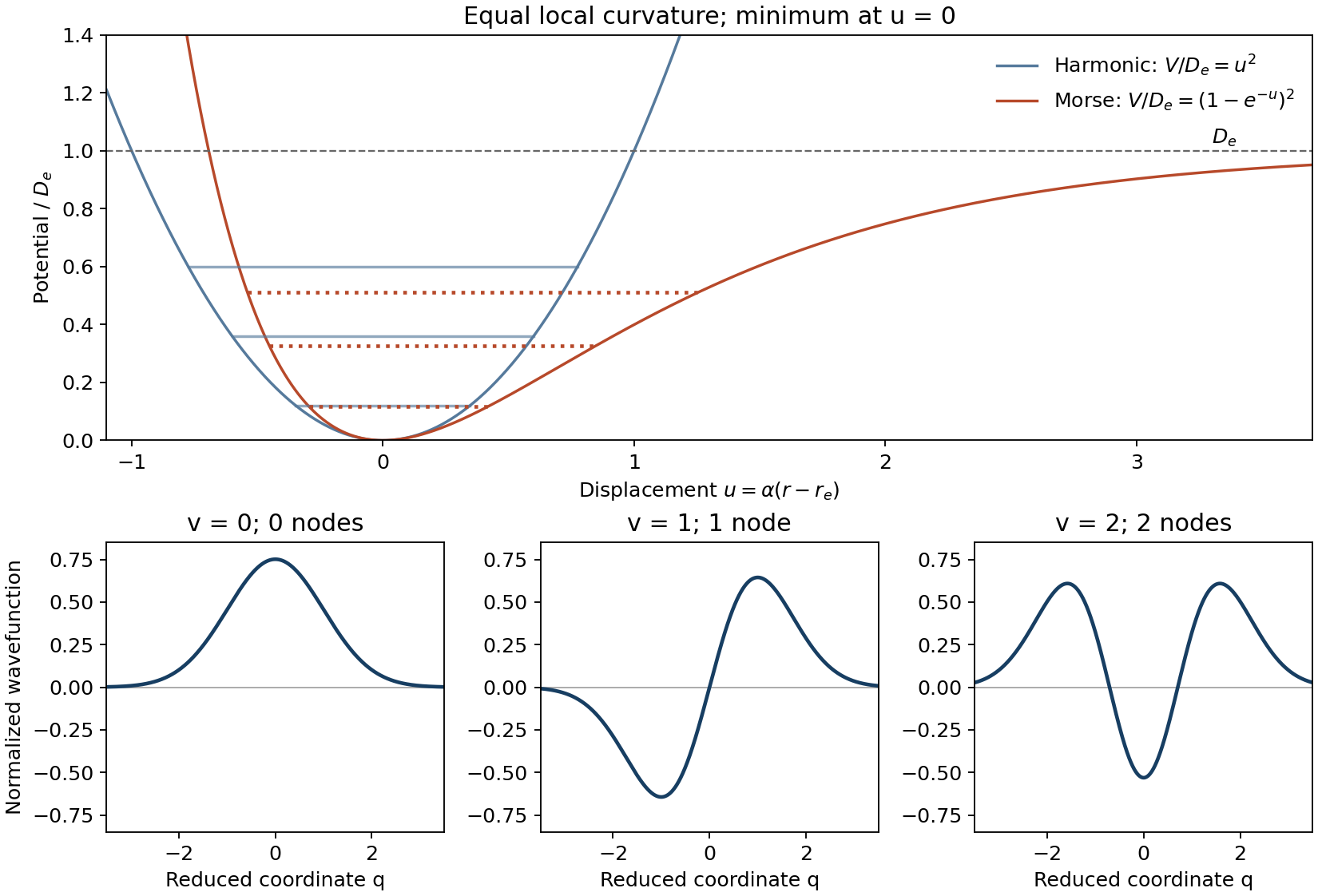
Codex 0 2026-10-20Let measure displacement from the equilibrium bond length and put the minimum of potential energy at zero. The harmonic model and the Morse potential areThe harmonic approximation is a symmetric parabola and has no dissociation limit. The Morse potential has a steep compressed side and a shallower extended side, approaching as . Matching the curvatures at the minimum gives . With denoting a spectroscopic wavenumber rather than an angular frequency, the energy levels areHere is the dimensionless spectroscopic anharmonicity constant. The harmonic spacing is constant, while the Morse oscillator spacing is and decreases as the levels approach dissociation. Only finitely many Morse oscillator levels are bound. The exactly solvable potential was introduced to model this anharmonic behaviour.[ref]
Diatomic Molecules According to the Wave Mechanics. II. Vibrational Levels by Philip M. Morse. Physical Review 34 (1929), pp. 57–64, potential and bound-level solution
For the harmonic model put , with , and . The first three normalized reduced-coordinate wavefunctions areTheir numbers of nodes are zero, one and two, and their parities are even, odd and even. The nodes are at . The diagrams below use analytic curves and arbitrary illustrative scales, with both potentials given the same local curvature.
Past exam of the chemistry course of the year 3 of the natural sciences course of the University of Cambridge 2022 Paper 2B Section B 33 b Solution by Codex 0 2026-10-20
Codex 0 2026-10-20Expand the trial wavefunction in a complete orthonormal set of exact eigenfunctions, , with and . The coefficients may depend on any chosen variational parameters. Orthogonality removes the cross terms in both integrals, givingConsequentlyThis proves the quantum variational principle. The denominator is positive because the trial function is nonzero. Equality requires every occupied exact state to have , allowing for ground-state degeneracy. With a continuous part of the spectrum, the corresponding nonnegative spectral integral gives the same conclusion.
Past exam of the chemistry course of the year 3 of the natural sciences course of the University of Cambridge 2022 Paper 2B Section B 33 a Solution by Codex 0 2026-10-20
Codex 0 2026-10-20For a self-adjoint Hamiltonian bounded below, every nonzero admissible trial wavefunction satisfies the quantum variational principleHere is the lowest exact energy, and the trial function must obey the physical boundary conditions and have finite relevant integrals. Equality holds for a wavefunction in the ground-state eigenspace. The quotient is unchanged by normalization or any nonzero overall scalar.
Past exam of the chemistry course of the year 3 of the natural sciences course of the University of Cambridge 2022 Paper 2B Section A 32 e Solution by Codex 0 2026-10-20
Codex 0 2026-10-20The folded benzvalene cage has one twofold axis and two mirror planes containing it. The double-bonded edge distinguishes it from cages having higher rotational symmetry; it has neither an inversion centre nor a horizontal mirror perpendicular to the twofold axis. Its molecular point group is , the C2v molecular point group.
Past exam of the chemistry course of the year 3 of the natural sciences course of the University of Cambridge 2022 Paper 2B Section A 32 d Solution by Codex 0 2026-10-20
Codex 0 2026-10-20The planar three-radialene structure has a threefold axis normal to the plane, three in-plane twofold axes and the molecular plane as a horizontal mirror. Therefore its molecular point group is , the D3h molecular point group. Its threefold connectivity does not supply a sixfold axis.
Past exam of the chemistry course of the year 3 of the natural sciences course of the University of Cambridge 2022 Paper 2B Section A 32 c Solution by Codex 0 2026-10-20
Codex 0 2026-10-20For hexa-1,5-diyne in the extended anti conformation drawn, inversion at the midpoint of the central carbon–carbon bond exchanges the two identical ends. A twofold axis through that midpoint perpendicular to the carbon skeleton plane, together with the mirror plane of that skeleton, completes the C2h molecular point group. The methylene hydrogens occur in the corresponding mirror-related pairs. Thus the answer is . The whole molecule is not linear simply because its terminal triple-bond fragments are linear; the conformation is essential to this assignment.
Past exam of the chemistry course of the year 3 of the natural sciences course of the University of Cambridge 2022 Paper 2B Section A 32 b Solution by Codex 0 2026-10-20
Codex 0 2026-10-20The fulvene structure has an in-plane twofold axis through the exocyclic double bond and the opposite part of the five-membered ring. The molecular plane and a plane perpendicular to it containing that axis are both mirrors. There is no perpendicular sixfold axis or inversion centre. Its molecular point group is , the C2v molecular point group.
Past exam of the chemistry course of the year 3 of the natural sciences course of the University of Cambridge 2022 Paper 2B Section A 32 a Solution by Codex 0 2026-10-20
Codex 0 2026-10-20The planar benzene structure has a sixfold principal axis normal to its plane, six transverse twofold axes, the molecular mirror plane and an inversion centre. Its molecular point group is , the D6h molecular point group.
Past exam of the chemistry course of the year 3 of the natural sciences course of the University of Cambridge 2022 Paper 2B Section A 29 b Solution by Codex 0 2026-10-20
Codex 0 2026-10-20The C2v molecular point group has four one-dimensional irreducible representations. In the operation order used above, the character table rows are , , and . Their character inner products with giveHence , whose dimensions sum to six. The labels refer to the source axes; swapping and swaps these names.
Past exam of the chemistry course of the year 3 of the natural sciences course of the University of Cambridge 2022 Paper 2B Section A 29 a Solution by Codex 0 2026-10-20
Codex 0 2026-10-20Use the axes actually printed: the two hydrogens lie in the plane, is the principal twofold axis, and is perpendicular to that plane. For a Cartesian-displacement group representation, only atoms left at their own sites contribute to the trace; their vector components must also be transformed. In the order , identity fixes six components, the twofold rotation exchanges the hydrogens, the reflection fixes both hydrogens with vector matrix , and the reflection exchanges them. ThereforeThe nonzero mirror character of a representation is , not six.
Past exam of the chemistry course of the year 3 of the natural sciences course of the University of Cambridge 2022 Paper 2B Section A 28 c Solution by Codex 0 2026-10-20
Codex 0 2026-10-20Choose transverse directions parallel and perpendicular to the vertical mirror plane. At each metal the parallel p orbital is unchanged, whereas the perpendicular p orbital changes sign. Thus each two-dimensional block has trace . The total character of a representation is . A mirror plane passing through an orbital centre does not imply that every orbital on that centre contributes .
Pinned article: Introduction to the OurBigBook Project
Welcome to the OurBigBook Project! Our goal is to create the perfect publishing platform for STEM subjects, and get university-level students to write the best free STEM tutorials ever.
Everyone is welcome to create an account and play with the site: ourbigbook.com/go/register. We belive that students themselves can write amazing tutorials, but teachers are welcome too. You can write about anything you want, it doesn't have to be STEM or even educational. Silly test content is very welcome and you won't be penalized in any way. Just keep it legal!
Intro to OurBigBook
. Source. We have two killer features:
- topics: topics group articles by different users with the same title, e.g. here is the topic for the "Fundamental Theorem of Calculus" ourbigbook.com/go/topic/fundamental-theorem-of-calculusArticles of different users are sorted by upvote within each article page. This feature is a bit like:
- a Wikipedia where each user can have their own version of each article
- a Q&A website like Stack Overflow, where multiple people can give their views on a given topic, and the best ones are sorted by upvote. Except you don't need to wait for someone to ask first, and any topic goes, no matter how narrow or broad
This feature makes it possible for readers to find better explanations of any topic created by other writers. And it allows writers to create an explanation in a place that readers might actually find it.
Figure 1. Screenshot of the "Derivative" topic page. View it live at: ourbigbook.com/go/topic/derivativeVideo 2. OurBigBook Web topics demo. Source. - local editing: you can store all your personal knowledge base content locally in a plaintext markup format that can be edited locally and published either:This way you can be sure that even if OurBigBook.com were to go down one day (which we have no plans to do as it is quite cheap to host!), your content will still be perfectly readable as a static site.
- to OurBigBook.com to get awesome multi-user features like topics and likes
- as HTML files to a static website, which you can host yourself for free on many external providers like GitHub Pages, and remain in full control

Figure 2. You can publish local OurBigBook lightweight markup files to either OurBigBook.com or as a static website.
Figure 3. Visual Studio Code extension installation.
Figure 5. . You can also edit articles on the Web editor without installing anything locally. Video 3. Edit locally and publish demo. Source. This shows editing OurBigBook Markup and publishing it using the Visual Studio Code extension. 
- Infinitely deep tables of contents:



All our software is open source and hosted at: github.com/ourbigbook/ourbigbook
Further documentation can be found at: docs.ourbigbook.com
Feel free to reach our to us for any help or suggestions: docs.ourbigbook.com/#contact