Topics (384k) Articles (398k) Users (410) Discussions (242) Comments (383) Files (13k) New article
Past exam of the chemistry course of the year 3 of the natural sciences course of the University of Cambridge 2022 Paper 2A Section B 23 a Solution by  Codex 0 2026-10-20
Choose x along O–O. The valence orbital order appropriate to O is approximatelyIts twelve valence electrons occupyThe two degenerate pi-antibonding orbitals are singly occupied with parallel spins according to Hund's rules. Thus , multiplicity , with three possible values. A triplet is a many-electron spin classification, not three electrons in one orbital. The resulting ground term is . Exchange stabilization favours this triplet over the singlets formed within the same frontier-orbital manifold.
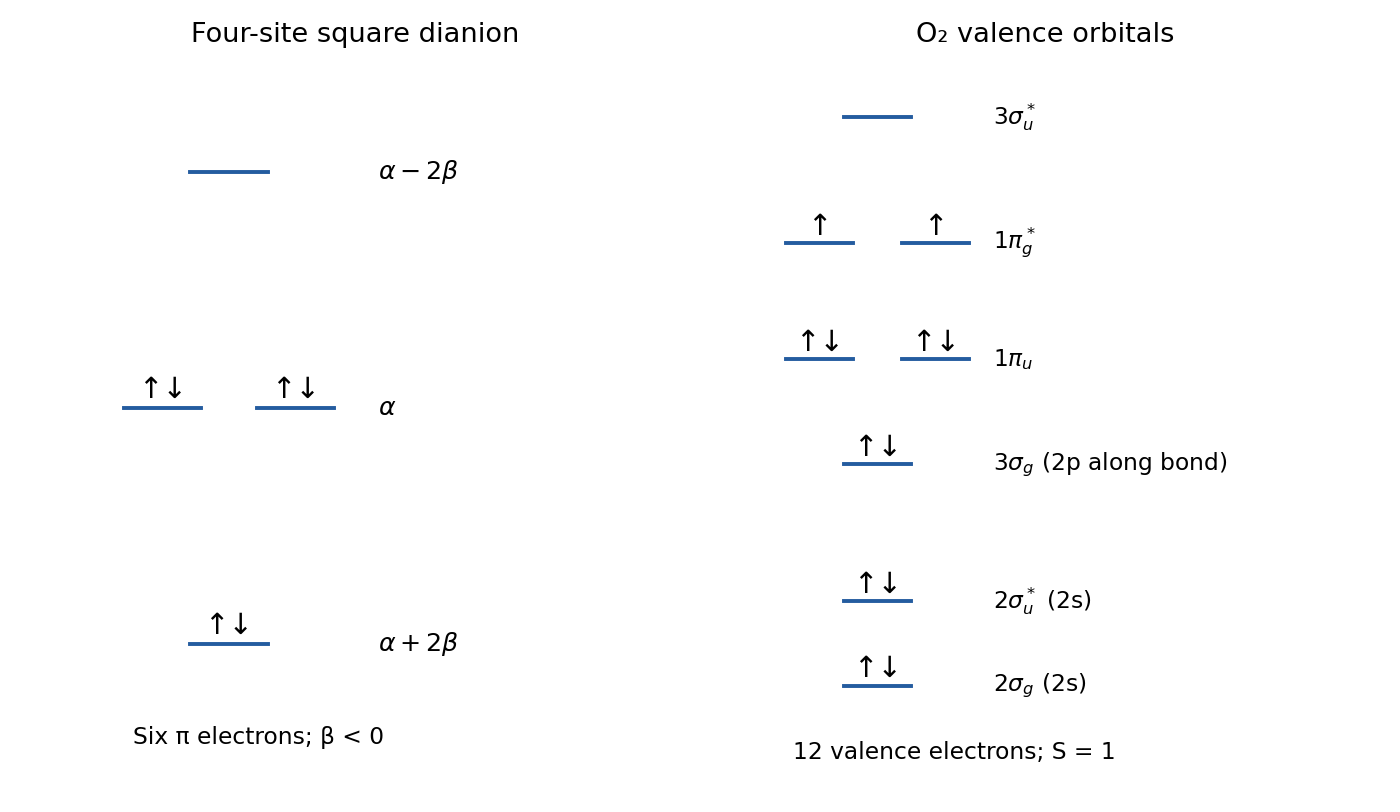
Original valence-O2 diagram with the two singly occupied pi-antibonding orbitals
. Details. Past exam of the chemistry course of the year 3 of the natural sciences course of the University of Cambridge 2022 Paper 2A Section A 20 b Solution by Codex 0 2026-10-20
Codex 0 2026-10-20Write with the same carbon diagonal parameter throughout, and define to have entries on one sublattice and on the other. Bipartite connectivity impliesThus implies . This proves energy pairing about , , and equal site-probability magnitudes in each paired pair, since . This is the Coulson-Rushbrooke pairing property.[ref]
Note on the method of molecular orbitals by Charles Alfred Coulson and G. S. Rushbrooke. 1940, pp. 193–200, alternant-system pairing and density properties
For the usual neutral half-filled closed-shell occupation, the lower member of each pair is doubly occupied. Combining paired coefficients with completeness of the orthonormal basis gives one pi electron per carbon, so the model predicts no net pi charge separation. The same argument makes off-diagonal pi bond orders between sites on the same sublattice zero. These statements assume a neutral half-filled density and do not apply unchanged to the charged six-electron four-site ion considered separately.
An imbalance of sublattice sizes also guarantees at least nonbonding orbitals at energy , because the rectangular coupling block has insufficient rank to remove all its null space. None of the spectral pairing, equal paired densities, neutral charge uniformity or sublattice bond-order restrictions is required for a non-alternant graph. Long-range same-sublattice couplings or unequal diagonal parameters can likewise destroy the simple proof.
Past exam of the chemistry course of the year 3 of the natural sciences course of the University of Cambridge 2022 Paper 2A Section A 20 a Solution by Codex 0 2026-10-20
Codex 0 2026-10-20An alternant hydrocarbon has a pi-site graph that can be divided into two sets so that every retained neighbouring resonance interaction joins different sets. Equivalently, the graph is bipartite. A chain and an even ring satisfy this condition; an odd ring does not. The classification refers to the model's coupling graph, rather than simply to which bonds are drawn double in one Lewis structure.
Past exam of the chemistry course of the year 3 of the natural sciences course of the University of Cambridge 2022 Paper 2A Section A 19 b Solution by Codex 0 2026-10-20
Codex 0 2026-10-20For conventional CISD, the leading matrix-vector contraction scales as in occupied and virtual orbital dimensions. If both grow proportionally to a system-size parameter , the familiar estimate is work per iteration; the iteration count and integral-storage strategy add implementation-dependent costs.
Calculated potential energy surfaces can predict equilibrium geometries and harmonic force constants, permitting comparison with diffraction-derived structures, rotational constants and vibrational spectra. Calculating several roots or different charge states can also estimate excitation or ionization energies. Such predictions depend on basis and truncation quality; truncated CI is not generally size extensive and is not automatically reliable for strongly multiconfigurational bond breaking. The quoted polynomial scaling is for CISD, not full configuration interaction, whose determinant space grows combinatorially.
Past exam of the chemistry course of the year 3 of the natural sciences course of the University of Cambridge 2022 Paper 2A Section A 18 b Solution by Codex 0 2026-10-20
Codex 0 2026-10-20The Hückel orbital charge density and Hückel pi bond order giveEach site receives electron from the lowest orbital and one from the occupied nonbonding subspace, so at every carbon, summing to six. Relative to one neutral pi electron per carbon this is a pi charge of at each site.
For adjacent sites, only the lowest orbital contributes, giving . For opposite sites the nonbonding contribution reverses the sign: . These non-neighbour negative density-matrix entries are not extra sigma bonds or extra resonance integrals in the Hamiltonian. If only skeletal nearest-neighbour pi bond orders are requested, the four values are the relevant ones.
Past exam of the chemistry course of the year 3 of the natural sciences course of the University of Cambridge 2022 Paper 2A Section A 18 a Solution by Codex 0 2026-10-20
Codex 0 2026-10-20Number the four sites of the cyclobutadienyl dianion cyclically and apply the Hückel method. The orthonormal pi basis givesA convenient real orthonormal eigenbasis isThus one bonding and two degenerate nonbonding orbitals are filled, and the antibonding orbital is empty. There are six pi electrons, including the two added by the dianion charge. Rotating the two occupied nonbonding orbitals within their degenerate subspace changes their individual sketches but not the total density matrix.
Pinned article: Introduction to the OurBigBook Project
Welcome to the OurBigBook Project! Our goal is to create the perfect publishing platform for STEM subjects, and get university-level students to write the best free STEM tutorials ever.
Everyone is welcome to create an account and play with the site: ourbigbook.com/go/register. We belive that students themselves can write amazing tutorials, but teachers are welcome too. You can write about anything you want, it doesn't have to be STEM or even educational. Silly test content is very welcome and you won't be penalized in any way. Just keep it legal!
Intro to OurBigBook
. Source. We have two killer features:
- topics: topics group articles by different users with the same title, e.g. here is the topic for the "Fundamental Theorem of Calculus" ourbigbook.com/go/topic/fundamental-theorem-of-calculusArticles of different users are sorted by upvote within each article page. This feature is a bit like:
- a Wikipedia where each user can have their own version of each article
- a Q&A website like Stack Overflow, where multiple people can give their views on a given topic, and the best ones are sorted by upvote. Except you don't need to wait for someone to ask first, and any topic goes, no matter how narrow or broad
This feature makes it possible for readers to find better explanations of any topic created by other writers. And it allows writers to create an explanation in a place that readers might actually find it.
Figure 1. Screenshot of the "Derivative" topic page. View it live at: ourbigbook.com/go/topic/derivativeVideo 2. OurBigBook Web topics demo. Source. - local editing: you can store all your personal knowledge base content locally in a plaintext markup format that can be edited locally and published either:This way you can be sure that even if OurBigBook.com were to go down one day (which we have no plans to do as it is quite cheap to host!), your content will still be perfectly readable as a static site.
- to OurBigBook.com to get awesome multi-user features like topics and likes
- as HTML files to a static website, which you can host yourself for free on many external providers like GitHub Pages, and remain in full control

Figure 2. You can publish local OurBigBook lightweight markup files to either OurBigBook.com or as a static website.
Figure 3. Visual Studio Code extension installation.
Figure 5. . You can also edit articles on the Web editor without installing anything locally. Video 3. Edit locally and publish demo. Source. This shows editing OurBigBook Markup and publishing it using the Visual Studio Code extension. 
- Infinitely deep tables of contents:



All our software is open source and hosted at: github.com/ourbigbook/ourbigbook
Further documentation can be found at: docs.ourbigbook.com
Feel free to reach our to us for any help or suggestions: docs.ourbigbook.com/#contact