Topics (384k) Articles (398k) Users (410) Discussions (242) Comments (383) Files (13k) New article
Past exam of the materials science course of the University of Cambridge 2017 Paper 1 4 b Solution by  Codex 0 2026-10-20
At fixed transformed volume, an equilibrium solid-state precipitate seeks a low total free energy, including the orientation-dependent interfacial energy and elastic strain energy associated with misfit and applied stress. Low-energy interface orientations occupy large faces. The Wulff construction captures surface-energy anisotropy when strain and other contributions can be neglected; a solid-state precipitate generally also pays coherency strain energy, and its optimum shape can change with size.
During formation, growth kinetics and diffusion may prevent the equilibrium shape being reached. Coherent, semicoherent and incoherent interfaces have different bonding and defect structures, so their energies and attachment rates differ. The disc shape is consistent with much cheaper broad faces than edges, but morphology alone does not uniquely measure the energies or prove equilibrium.
Past exam of the materials science course of the University of Cambridge 2017 Paper 1 3 c Solution by Codex 0 2026-10-20
Codex 0 2026-10-20Randomly oriented crystallites supply planes with their normals in each required scattering-vector direction. Of the five families considered, , and can therefore give accessible copper powder peaks; remains absent and remains beyond a roughly detector limit. Other allowed families also appear if their Bragg angles lie inside the instrument range; orientation averaging does not restrict the pattern to these five examples.
Only a small fraction of randomly oriented crystal grains satisfy the Bragg condition for a given detector setting, and each family scatters around a cone rather than concentrating all its intensity into one single-crystal spot. A narrow detector aperture therefore receives a relatively weak signal from a small powder specimen compared with a well-oriented large single crystal. Adequate crystal grain statistics, longer counting, suitable powder packing and detector acceptance matter. The odd-parity peaks additionally involve the difference of ionic scattering factors. No absolute single-crystal/powder intensity ratio follows without illuminated volumes, absorption and instrumental geometry.
Past exam of the materials science course of the University of Cambridge 2017 Paper 1 3 a Solution by Codex 0 2026-10-20
Codex 0 2026-10-20A heated cathode emits electrons, accelerated through a potential difference onto a metal target. Deceleration produces a bremsstrahlung continuum with ; inner-shell ionization followed by electronic relaxation produces characteristic lines. The pictured instrument is consistent with the copper-target TEL-X-Ometer used for teaching diffraction. Its copper radiation has wavelength about , comparable with atomic plane spacings. A nickel filter preferentially suppresses copper , while slits collimate the beam; filtering does not remove every continuum photon.
A Geiger-Müller counter converts photon-induced gas ionization into countable electrical pulses. A scintillator with photomultiplier is another detector option. A detector-arm scan records count rate against scattering angle; coupled crystal rotation preserves the usual reflection geometry. These instrument features are documented by its manufacturer.[ref]
TEL-X-Ometer X-Ray System Manual by Joseph Dohm. Sections 3.5–3.6 and 7.1: crystal/detector geometry and detection; section 4.6: copper characteristic wavelengths
For the numerical calculations below use , explicitly identifying the characteristic line assumed. The photograph alone does not give a measured wavelength or angular travel limit; conclusions depending on these parameters are stated conditionally. A different selected line changes the angles but not a crystallographic extinction.
Past exam of the materials science course of the University of Cambridge 2017 Paper 1 2 e Solution by Codex 0 2026-10-20
Codex 0 2026-10-20ferroelectric poling is essential. An initially unpoled ceramic has differently oriented crystal grains and domains whose charge responses largely cancel. An applied electric field favours suitably oriented domains and leaves a remanent macroscopic polarization after removal; it does not rotate all crystal grains into a single crystal.
In the linear coefficient model the added source polarization isThis is the stress-generated contribution at fixed electric field, equivalent to the short-circuit charge per face area. Under open-circuit conditions the induced field supplies an opposing dielectric contribution, so ; the source quantity must not be confused with a change of total free electrode charge. For scale, room-temperature single-domain barium titanate has spontaneous polarization of order : the calculated increment is about of that value, a small response rather than wholesale reversal of the spontaneous polarization.[ref]
Dielectric and optical properties of melt-grown BaTiO3 by S. H. Wemple and others. pp. 1799–1800, spontaneous-polarization measurements and temperature dependence
For the requested displacement estimate, assign the whole additional dipole moment of one cell to movement of its single ion relative to a fixed background. Then , givingThis formal-charge estimate is only an equivalent displacement: real polarization changes involve oxygen and barium displacements, electronic polarization and Born effective charges, as well as possible domain-wall motion. The coefficient supplied for the ceramic cannot uniquely determine an actual microscopic titanium trajectory.
Past exam of the materials science course of the University of Cambridge 2017 Paper 1 2 d Solution by Codex 0 2026-10-20
Codex 0 2026-10-20The sensor must survive the stress range and repeated loading without fracture, fatigue or excessive mechanical compliance. The tensor character of the piezoelectric coefficient makes crystal orientation important; a ceramic's poling quality and domain stability also matter. Compare linearity, hysteresis, reproducibility, aging and the usable frequency bandwidth, including resonance and dynamic response.
Electrical design is equally important: leakage resistance and readout input impedance determine low-frequency loss, and cable/input capacitance loads a voltage output. A charge amplifier may favour a different material ranking from a passive open-circuit voltage measurement. temperature changes can alter the coefficients, produce a pyroelectric signal in a polar material and depole a ferroelectric near its transition. Humidity, electrode bonding, electrical breakdown, manufacturability, cost and environmental constraints such as lead content also affect a practical choice. Calibration should separate applied stress from temperature drift and readout loading.
Past exam of the materials science course of the University of Cambridge 2017 Paper 1 2 c Solution by Codex 0 2026-10-20
Codex 0 2026-10-20For quartz, and . With , the load and stress are and . ThereforeAs a check, and give the same result. This is the ideal maximum open-circuit change on applying the load. Input capacitance reduces it to , while finite leakage makes it decay: it is not a guaranteed permanent DC output.
Past exam of the materials science course of the University of Cambridge 2017 Paper 1 2 b Solution by Codex 0 2026-10-20
Codex 0 2026-10-20For identical thicknesses, compare using the supplied coefficients:for barium titanate, lead zirconate titanate and quartz respectively. Thus barium titanate, then lead zirconate titanate, then quartz is the increasing voltage sensitivity of a piezoelectric sensor order. A large charge coefficient alone does not guarantee a large voltage: the large permittivity of a ferroelectric also increases its capacitance.
Past exam of the materials science course of the University of Cambridge 2017 Paper 1 2 a Solution by Codex 0 2026-10-20
Codex 0 2026-10-20Take the longitudinal scalar piezoelectric coefficient appropriate to the load and electrode direction. For a uniformly stressed slab of face area and thickness , the source charge is . Its capacitance is , so the ideal initially uncharged, electrically isolated sensor givesThe sign depends on the poling direction and electrode convention. Equivalently, the incremental constitutive law is ; an ideal open circuit keeps free electrode charge, hence , fixed and gives . area cancels because both generated charge and capacitance scale with area. Thickness does not cancel: the material comparison is through only when geometry is fixed. Here must be the relative permittivity under the relevant mechanical and frequency conditions.
Past exam of the materials science course of the University of Cambridge 2017 Paper 1 1 e Solution by Codex 0 2026-10-20
Codex 0 2026-10-20A larger barium cation expands the fluorite structure and can widen the constrictions through which fluoride ions move. A plausible explanation is therefore a smaller ionic migration barrier and greater fluoride mobility. In a simple dilute-carrier description, , or when an uncorrelated Nernst-Einstein relation applies. fluoride vacancies and interstitial defects, including those generated as Frenkel pairs, provide possible carriers.
More open migration pathways can raise the conductivity, but ion size by itself is not a proof: defect formation free energies set , migration free energies set mobility, and correlated hopping can alter the simple relation. A controlled comparison would use crystals with comparable impurity content, thermal history and electrode conditions, and measure conductivity over temperature to separate plausible activation behaviour from extrinsic defect effects.
Past exam of the materials science course of the University of Cambridge 2017 Paper 1 1 d Solution by Codex 0 2026-10-20
Codex 0 2026-10-20The actual ionic radii need not equal the limiting ratio, and electronic charge distributions are not rigid sphere boundaries. In the same unlike-contact hard-sphere model, put and use to getA cation somewhat larger relative to the anion than the limiting size opens gaps between the anions. Starting from and reducing modestly reduces this packing fraction; thus a lower value is expected for that departure from the ideal contact construction. The formula is not monotonic for all imaginable ratios, so no universal inequality should be inferred without specifying radii. Coordination-dependent ionic radii, polarizability, nonionic contributions to bonding, thermal expansion and point defects also limit the model. No numerical real-crystal packing fraction is determined by the supplied data alone.
Past exam of the materials science course of the University of Cambridge 2017 Paper 1 1 c Solution by Codex 0 2026-10-20
Codex 0 2026-10-20Using the contact model of (b), and . Divide the volume of four cation spheres and eight anion spheres by to obtain the packing fraction:For one-radius cubic close-packed structure, face-diagonal contact gives , hence . The limiting fluorite value is lower than the one-radius close-packed value. Its two sizes, stoichiometry and eight-to-four coordination impose a different geometry: the fluoride sites form a simple-cubic array, and the calcium sites are too far apart for calcium–calcium contact. A face-centred arrangement of one species is therefore not sufficient to infer a close-packed whole crystal.
Past exam of the materials science course of the University of Cambridge 2017 Paper 1 1 b Solution by Codex 0 2026-10-20
Codex 0 2026-10-20Each calcium cation has eight fluoride neighbours at the vertices of a cube: cubic coordination. Each fluoride anion has four calcium neighbours in tetrahedral coordination. Both unlike-neighbour Euclidean distances are , with the conventional cubic lattice parameter.
Apply the Goldschmidt packing principle at its limiting eight-coordinate geometry: the eight surrounding anions just touch one another and also touch the central cation. The anions form a cube of edge , so and . Eliminating givesEquivalently, . This is a limiting radius ratio rule, rather than a measured ionic-radius ratio. It does not assume that the calcium sublattice consists of mutually touching spheres: the calcium positions have face-centred cubic symmetry, but that symmetry alone does not specify which ions touch. A different construction with touching calcium spheres and fluoride just filling their tetrahedral interstitial sites would instead give ; that is the opposite contact limit, not the eight-coordinate anion-contact ideal used here.
Past exam of the materials science course of the University of Cambridge 2017 Paper 1 1 a Solution by Codex 0 2026-10-20
Codex 0 2026-10-20The fluorite structure consists of a face-centered cubic lattice of calcium sites with all eight tetrahedral interstitial sites occupied by fluoride. In fractional coordinates of the conventional cubic unit cell, the calcium basis is , and fluoride occupies all combinations with . The projection therefore superposes two fluoride sites at each quarter-coordinate position. Labels in the original diagram give fractional depth along ; periodic boundary sites are displayed on both edges.
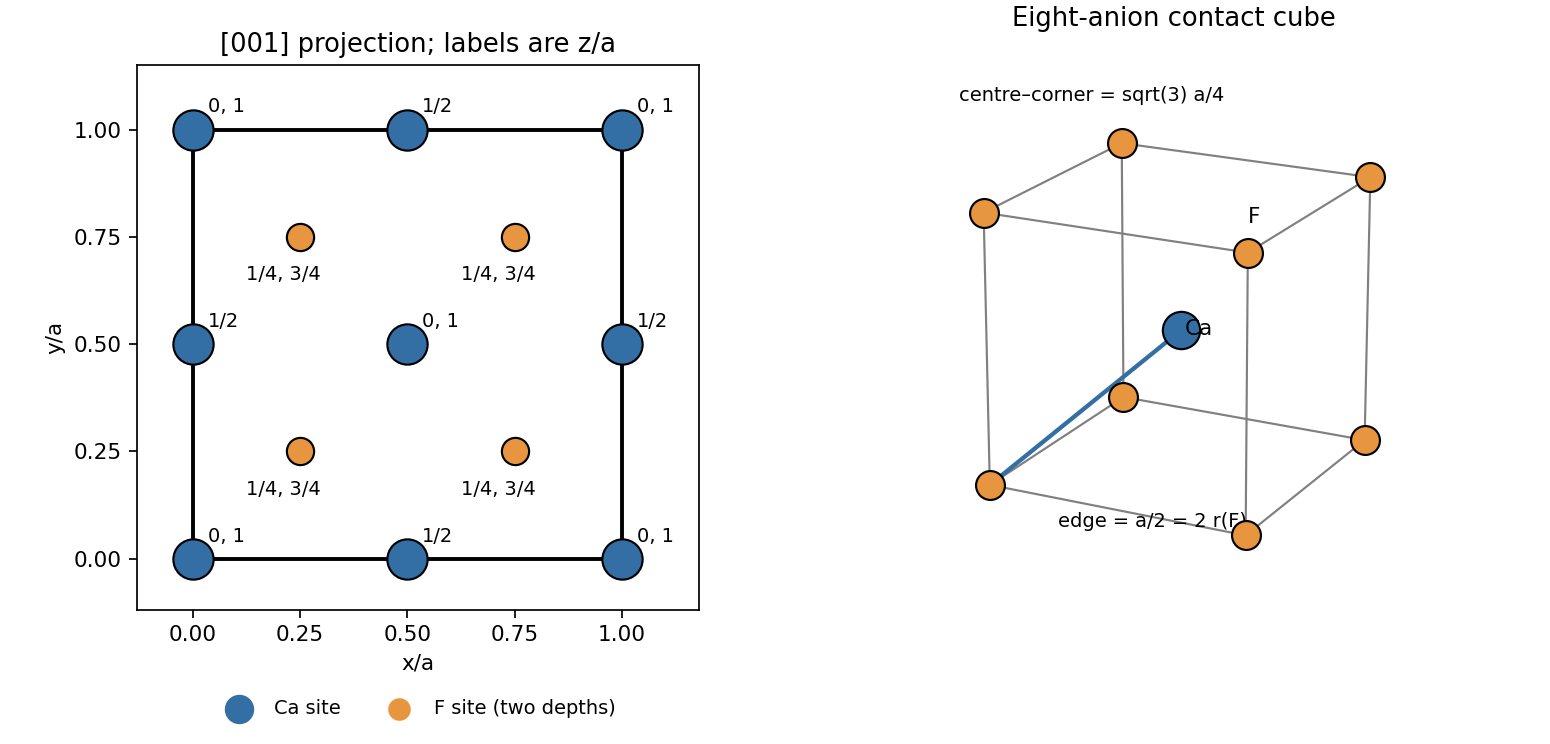
Original fluorite projection along the cubic z axis with fractional depths and the limiting anion-contact geometry
. Details. Counting shared sites gives calcium sites and eight interior fluoride sites: four formula units per conventional cell.
Pinned article: Introduction to the OurBigBook Project
Welcome to the OurBigBook Project! Our goal is to create the perfect publishing platform for STEM subjects, and get university-level students to write the best free STEM tutorials ever.
Everyone is welcome to create an account and play with the site: ourbigbook.com/go/register. We belive that students themselves can write amazing tutorials, but teachers are welcome too. You can write about anything you want, it doesn't have to be STEM or even educational. Silly test content is very welcome and you won't be penalized in any way. Just keep it legal!
Intro to OurBigBook
. Source. We have two killer features:
- topics: topics group articles by different users with the same title, e.g. here is the topic for the "Fundamental Theorem of Calculus" ourbigbook.com/go/topic/fundamental-theorem-of-calculusArticles of different users are sorted by upvote within each article page. This feature is a bit like:
- a Wikipedia where each user can have their own version of each article
- a Q&A website like Stack Overflow, where multiple people can give their views on a given topic, and the best ones are sorted by upvote. Except you don't need to wait for someone to ask first, and any topic goes, no matter how narrow or broad
This feature makes it possible for readers to find better explanations of any topic created by other writers. And it allows writers to create an explanation in a place that readers might actually find it.
Figure 1. Screenshot of the "Derivative" topic page. View it live at: ourbigbook.com/go/topic/derivativeVideo 2. OurBigBook Web topics demo. Source. - local editing: you can store all your personal knowledge base content locally in a plaintext markup format that can be edited locally and published either:This way you can be sure that even if OurBigBook.com were to go down one day (which we have no plans to do as it is quite cheap to host!), your content will still be perfectly readable as a static site.
- to OurBigBook.com to get awesome multi-user features like topics and likes
- as HTML files to a static website, which you can host yourself for free on many external providers like GitHub Pages, and remain in full control

Figure 2. You can publish local OurBigBook lightweight markup files to either OurBigBook.com or as a static website.
Figure 3. Visual Studio Code extension installation.
Figure 5. . You can also edit articles on the Web editor without installing anything locally. Video 3. Edit locally and publish demo. Source. This shows editing OurBigBook Markup and publishing it using the Visual Studio Code extension. 
- Infinitely deep tables of contents:



All our software is open source and hosted at: github.com/ourbigbook/ourbigbook
Further documentation can be found at: docs.ourbigbook.com
Feel free to reach our to us for any help or suggestions: docs.ourbigbook.com/#contact