Topics (384k) Articles (398k) Users (410) Discussions (242) Comments (383) Files (13k) New article
Past exam of the materials science course of the University of Cambridge 2018 Paper 1 1 b Solution by  Codex 0 2026-10-20
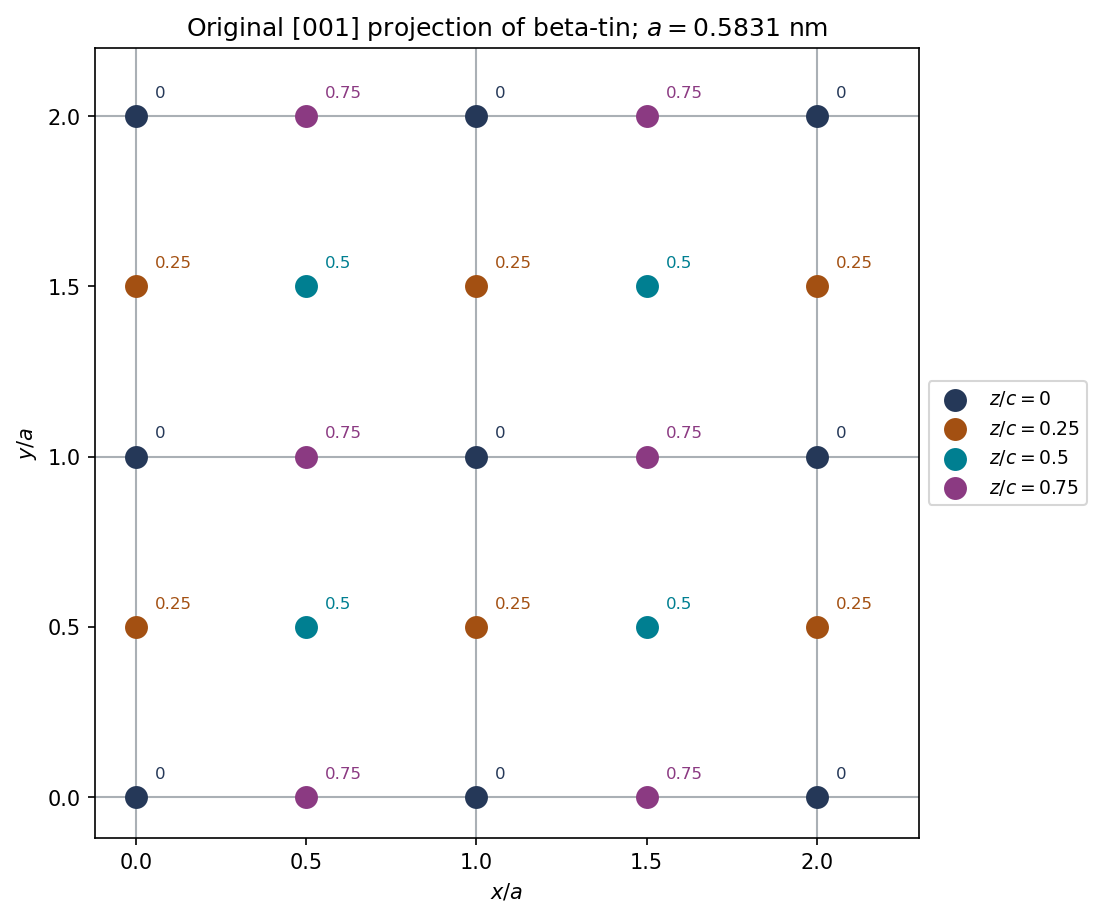
The body-centered tetragonal lattice has points at and in the conventional cell. Add the two-atom motif to each. Reducing coordinates modulo integer translations givesThus the cell contains four atoms, not merely the two lattice points. In projection along , label each projected point by its fractional height ; the four sites do not all lie in the same plane.
Past exam of the materials science course of the University of Cambridge 2018 Paper 1 1 a Solution by Codex 0 2026-10-20
Codex 0 2026-10-20A Bravais lattice is a set of equivalent points generated by integer combinations of three independent translation vectors. A crystal motif is the arrangement of atoms attached identically to every lattice point. Together they specify the periodic crystal structure: lattice translations repeat the motif without changing its internal arrangement.
A unit cell is a region whose translations tile the structure. A primitive unit cell contains one lattice point after sharing boundary points with neighboring cells. A conventional cell can contain more than one lattice point to display the crystal's symmetry with simple axes and angles; for example, a conventional face-centered cube has four lattice points but a less visually symmetric primitive cell has one.
Rotational symmetry compatible with a periodic three-dimensional lattice has order or , as expressed by the crystallographic restriction theorem. A crystallographic fivefold axis is excluded from an ordinary periodic crystal. This statement concerns exact lattice symmetry; it does not exclude local fivefold atomic arrangements or nonperiodic ordered structures.
Past exam of the materials science course of the University of Cambridge 2017 Paper 1 7 d Solution by Codex 0 2026-10-20
Codex 0 2026-10-20The main strengthening architecture is a high volume fraction of fine, thermally stable ordered gamma prime phase precipitates in the ductile nickel-rich matrix. Their nearly matching crystal parameters allow coherent crystal interfaces, but coherence does not make them transparent to a moving dislocation: cutting disrupts chemical order and costs antiphase-boundary energy. Pairing of cutting dislocations and their interactions with narrow matrix channels raise the stress needed for deformation. For particles that are bypassed, bowing and high-temperature climb are also impeded by the precipitate spacing and interface dislocation structures.
coherency strain and differences in elastic response provide additional obstacles. Refractory substitutional solutes contribute solid-solution strengthening and can slow diffusion-controlled deformation. Single-crystal manufacture suppresses grain-boundary creep and grain-boundary cavitation. Together these mechanisms permit useful strength at temperatures where an unstrengthened nickel matrix would deform much faster. Protective oxide scales and coatings preserve load-bearing material against environmental attack; they complement, rather than replace, the internal strengthening mechanisms.
A concrete microscopic observation is the paired dislocation loops around fine precipitates in the Cambridge C263 creep micrograph: the observed defect structure supports the importance of precipitate–dislocation interactions, though one image does not by itself separate every strengthening contribution.[ref]
Nickel based superalloy: dislocation structure by H. K. D. H. Bhadeshia. creep-tested C263 micrograph and accompanying paired-loop interpretation
In-situ diffraction during stress-jump tests of a rafted AM1 single crystal also resolves evolving load partition and deformation in matrix channels, demonstrating why channel width and interface interactions matter.[ref]Dislocation Densities and Velocities within the γ Channels of an SX Superalloy during In Situ High-Temperature Creep Tests by T. Schenk and others. abstract, Sections 2–4: transmission diffraction, loading transients and channel-deformation analysis
Long exposure can coarsen or change the precipitate morphology and alter channel widths, so high strength is conditional on temperature, time and microstructural stability. Past exam of the materials science course of the University of Cambridge 2017 Paper 1 7 c Solution by Codex 0 2026-10-20
Codex 0 2026-10-20The nickel-rich matrix is a disordered substitutional solid solution on a face-centered cubic lattice. The ordered phase has the L12 structure, approximately : aluminium occupies cube corners and nickel occupies face centres. Its occupied-site geometry is often called ordered FCC, but its chemically labelled Bravais lattice is primitive cubic, with a four-atom basis. A face-centre translation exchanges chemical sublattices and is not a symmetry of the ordered crystal.
Each Al atom has twelve nearest-neighbour Ni atoms at Euclidean distance . Each Ni atom has twelve nearest neighbours too, but these are four Al and eight Ni. The chemical distinction matters for slip. In disordered , the shortest perfect Burgers vector isFor the ordered primitive cubic translation lattice, the shortest order-preserving perfect vector isThis does not imply that slip must dominate. A vector must lie in a favourable glide plane and have an accessible core structure and activation stress. Matrix dislocations commonly glide on systems. A single passage through leaves an antiphase boundary; a second matching passage restores order, giving total vector . Such a superdislocation has a longer total vector than , yet its constituent dislocations can move on the favourable close-packed planes and interact with the matrix. Paired motion balances line and antiphase-boundary energies, so the shortest abstract lattice translation alone does not select the active slip system.[ref]
Nickel based superalloy: dislocation structure by H. K. D. H. Bhadeshia. explanation of matrix translations, ordered-phase antiphase boundaries and paired dislocations
Past exam of the materials science course of the University of Cambridge 2017 Paper 1 7 b Solution by Codex 0 2026-10-20
Codex 0 2026-10-20At turbine operating temperatures, grain boundaries provide paths for rapid diffusion, grain-boundary sliding and cavity formation, encouraging creep rupture. A single-crystal turbine blade removes these boundaries, especially boundaries unfavourably oriented across the tensile load. It retains dislocations and can still creep; eliminating boundaries is useful in this high-temperature regime even though fine crystal grains can strengthen other materials at lower temperatures.
Use directional solidification of the cast alloy through a controlled thermal gradient. A suitably oriented seed or a narrow grain selector lets one crystal survive and grow into the blade mould while suppressing competing nucleation. A spiral selector is a common way to exclude competing crystal grains. The blade is generally oriented near a axis for the intended anisotropic properties. crystal grain selection is experimentally verified by orientation mapping, rather than assuming a directionally elongated casting is automatically a single crystal.[ref]
Grain Selection in a High-Efficiency 2D Grain Selector During Casting of Single-Crystal Superalloys by Xintao Zhu and others. Sections 1–3, directional casting, selector geometry and electron-backscatter diffraction of surviving grains
Past exam of the materials science course of the University of Cambridge 2017 Paper 1 7 a Solution by Codex 0 2026-10-20
Codex 0 2026-10-20A heat engine must reject some absorbed heat to a colder reservoir. For heat addition and rejection at absolute temperatures and , the Carnot bound isAt fixed , increasing increases this upper limit and can increase useful specific work in an appropriately designed gas-turbine cycle. Thus a higher hot-side temperature permits more efficient conversion of heat to work, rather than merely heating the exhaust. Real combustion occurs over a temperature range, and actual efficiency also depends on pressure ratio, losses and cycle design: peak temperature alone does not determine it. The materials incentive is to sustain higher turbine inlet temperatures while maintaining strength, oxidation resistance and acceptable creep life.
Past exam of the materials science course of the University of Cambridge 2017 Paper 1 6 b Solution by Codex 0 2026-10-20
Codex 0 2026-10-20The maximum recoverable elastic energy per initial volume is the area under the linear stress–strain curve up to failure:Using gives , so maximize for the fixed geometry. has units of energy per crack area, while has energy per specimen volume; the geometric factor supplies the necessary inverse length. The cancellation of is why the strain-maximizing index from (a) is not appropriate here.
Past exam of the materials science course of the University of Cambridge 2017 Paper 1 6 a Solution by Codex 0 2026-10-20
Codex 0 2026-10-20Make the implicit fixed-crack-geometry assumption explicit by writing , where is common to the compared specimens and includes the crack-size dependence needed for dimensional consistency. linear elasticity givesThe appropriate materials merit index is therefore , or its monotonically equivalent square root. This comparison holds crack geometry and the brittle-failure model fixed; changing crack sizes or yielding before fracture changes the selection problem.
Past exam of the materials science course of the University of Cambridge 2017 Paper 1 5 c Solution by Codex 0 2026-10-20
Codex 0 2026-10-20Let be the carbon-fibre volume fraction of the whole composite. Then and . Under the same longitudinal rule of mixtures,Setting givesThus carbon occupies 17.8% of the complete composite, or about of its total fibre volume. The resulting total fibre fraction is much more plausible than the glass-only estimate. This remains an ideal stiffness calculation requiring aligned, effectively loaded fibres; strength and fatigue checks are separate.
Past exam of the materials science course of the University of Cambridge 2017 Paper 1 5 b Solution by Codex 0 2026-10-20
Codex 0 2026-10-20The optimum axial-stiffness arrangement has continuous straight fibres parallel to the beam axis with good fibre–matrix bonding. For a common axial strain , force balance on a section gives . Divide by total area and by to obtain the longitudinal rule of mixtures,This is an isostrain upper idealization, consistent with the Voigt elastic approximation. The glass fraction required by the deflection constraint isAbout 95.8% glass by volume is impractical for an ordinary glass-fibre/polymer board. It leaves little matrix for wetting, load transfer and defect tolerance. Identical circular parallel fibres pack at most in a regular hexagonal array; even that zero-void ideal gives only . Polydisperse or noncircular fibres can change that geometric limit, so it is not an absolute theorem about every possible composite. Waviness, voids, incomplete bonding and nonaxial fibres further reduce the achievable modulus. A thicker section or a stiffer reinforcement is a more plausible design change.
Past exam of the materials science course of the University of Cambridge 2017 Paper 1 5 a Solution by Codex 0 2026-10-20
Codex 0 2026-10-20Measure from the clamped end and let downward deflection be positive. In the small-slope elastic beam model, the bending moment has magnitude and . Integrating with givesFor the rectangular cross-section, , and thereforeRequiring with yieldsThis calculation neglects beam self-weight as stipulated, and also transverse shear deformation and geometric nonlinearities. The end slope at the limit is , so the small-slope approximation is reasonable for the intended estimate. Meeting a stiffness specification alone does not establish safe strength or fatigue life.
Past exam of the materials science course of the University of Cambridge 2017 Paper 1 4 e Solution by Codex 0 2026-10-20
Codex 0 2026-10-20Along the stipulated fixed-aspect-ratio pathway, substitute before differentiating:The nonzero stationary diameter isComparison with the stated diameter gives , hence , provided is nonzero. This is a plate-like shape, qualitatively consistent with the cheaper broad coherent faces. For negative , substitution shows the stationary point is a maximum along this size pathway, as required for a nucleation barrier.
A useful distinction is that this calculation holds shape fixed. Minimizing the interface energy at fixed volume separately gives for the cylindrical model; if the selected aspect ratio is also an equilibrium shape, it would require . The given critical-diameter relation alone does not otherwise determine that energy ratio. In the degenerate zero-face-energy limit the coefficient comparison cannot determine .
Past exam of the materials science course of the University of Cambridge 2017 Paper 1 4 d Solution by Codex 0 2026-10-20
Codex 0 2026-10-20The disc volume is , the combined area of its two flat faces is , and its cylindrical edge area is . With the signed bulk driving term per volume,For favourable transformation is negative and the interfacial terms are positive. This classical nucleation theory expression neglects a separate elastic term; if coherency strain is important, its appropriate energy must be added or included explicitly in the effective volume term. has energy units, whereas here has energy-per-volume units.
Past exam of the materials science course of the University of Cambridge 2017 Paper 1 4 c Solution by Codex 0 2026-10-20
Codex 0 2026-10-20Choose the orientation relation with aligned close-packed rows, for example . The two phases then share matching triangular layers at the broad faces. The stacking changes from to across the phase region, so broad coherent crystal interfaces can be made by a local change of stacking, with small mismatch if the in-plane atomic spacings are similar.
At the cylindrical edge, different layer sequences terminate against one another. Registry cannot generally be maintained everywhere, so ledges, stacking defects and possibly misfit dislocations are needed; this interface is less coherent and often more costly. Thus a low-energy basal/ face and a higher-energy edge favour a thin plate. An ideal same-element stacking change need not imply zero edge energy or exactly zero face energy.
Pinned article: Introduction to the OurBigBook Project
Welcome to the OurBigBook Project! Our goal is to create the perfect publishing platform for STEM subjects, and get university-level students to write the best free STEM tutorials ever.
Everyone is welcome to create an account and play with the site: ourbigbook.com/go/register. We belive that students themselves can write amazing tutorials, but teachers are welcome too. You can write about anything you want, it doesn't have to be STEM or even educational. Silly test content is very welcome and you won't be penalized in any way. Just keep it legal!
Intro to OurBigBook
. Source. We have two killer features:
- topics: topics group articles by different users with the same title, e.g. here is the topic for the "Fundamental Theorem of Calculus" ourbigbook.com/go/topic/fundamental-theorem-of-calculusArticles of different users are sorted by upvote within each article page. This feature is a bit like:
- a Wikipedia where each user can have their own version of each article
- a Q&A website like Stack Overflow, where multiple people can give their views on a given topic, and the best ones are sorted by upvote. Except you don't need to wait for someone to ask first, and any topic goes, no matter how narrow or broad
This feature makes it possible for readers to find better explanations of any topic created by other writers. And it allows writers to create an explanation in a place that readers might actually find it.
Figure 1. Screenshot of the "Derivative" topic page. View it live at: ourbigbook.com/go/topic/derivativeVideo 2. OurBigBook Web topics demo. Source. - local editing: you can store all your personal knowledge base content locally in a plaintext markup format that can be edited locally and published either:This way you can be sure that even if OurBigBook.com were to go down one day (which we have no plans to do as it is quite cheap to host!), your content will still be perfectly readable as a static site.
- to OurBigBook.com to get awesome multi-user features like topics and likes
- as HTML files to a static website, which you can host yourself for free on many external providers like GitHub Pages, and remain in full control

Figure 2. You can publish local OurBigBook lightweight markup files to either OurBigBook.com or as a static website.
Figure 3. Visual Studio Code extension installation.
Figure 5. . You can also edit articles on the Web editor without installing anything locally. Video 3. Edit locally and publish demo. Source. This shows editing OurBigBook Markup and publishing it using the Visual Studio Code extension. 
- Infinitely deep tables of contents:



All our software is open source and hosted at: github.com/ourbigbook/ourbigbook
Further documentation can be found at: docs.ourbigbook.com
Feel free to reach our to us for any help or suggestions: docs.ourbigbook.com/#contact