Topics (384k) Articles (398k) Users (410) Discussions (242) Comments (383) Files (13k) New article
Past exam of the chemistry B course of the University of Cambridge 2022 Paper 1 B2 b Solution by  Codex 0 2026-10-20
Number the cyclopentenone carbonyl carbon , its alkene carbons and with OR at , and its saturated carbons and . The ester alkene has alpha carbon , bearing Me and CO2Et, and beta carbon , bearing the protected carbon substituent. lithium diisopropylamide generates the ordinary ketone enolate at the saturated alpha carbon . The acetonide is retained.
The carbon end of this enolate attacks ester beta carbon Y. Its pi system shifts through X onto the ester oxygen, forming the first new bond and an ester enolate at X. That enolate now attacks the original cyclopentenone beta carbon intramolecularly, giving the second new bond . The original enone electrons move onto its ketone oxygen, and protonation of the final ketone enolate completes the product. The OR substituent is retained at the new bridgehead; it need not leave in either Michael addition.
The atom map provides a useful structural check. Between bridgeheads and , the three paths are , , and . Their numbers of internal atoms are 2, 1 and 2, establishing the norbornane skeleton. Both original carbonyls survive and both initial alkenes are consumed. The two successive conjugate additions give this atom map without requiring a concerted cycloaddition.
Past exam of the chemistry B course of the University of Cambridge 2022 Paper 1 B2 a Solution by Codex 0 2026-10-20
Codex 0 2026-10-20The five-carbon unit is initially an open chain, not a completed carbocycle. Label it , with phenyl-bearing , carbonyl , amide-substituted , and the two ethylthio groups on . Its double bonds are initially and . Let be the nitro-bearing carbon of nitroethane; its methyl remains a substituent throughout.
DBU removes an alpha proton from nitroethane to give a nitronate. carbon attack at the Michael acceptor forms , with electron redistribution through onto the carbonyl oxygen. proton transfer restores the ketone. Removing the remaining X–H proton gives another carbon-nucleophilic nitronate. It attacks the other conjugated end, , intramolecularly, closing the six-membered circuit . Addition to the ketene dithioacetal and ethylthiolate elimination restore the bond, leaving one SEt group at .
base-assisted loss of the proton at , with C–NO2 cleavage at X, creates and expels nitrite. Enolization at supplies the third aromatic double bond and the phenolic OH. proton transfers to the leaving anions complete the acid–base balance. nitroethane supplies the new ring carbon X and its methyl substituent; its nitro group is eliminated. Aromatization, rather than a separate oxidation of an intact six-membered starting ring, provides the final driving force. This is a proposed stepwise nitroalkane benzannulation; related DBU-promoted tandem Michael addition/cyclization/aromatization has direct primary precedent.[ref]
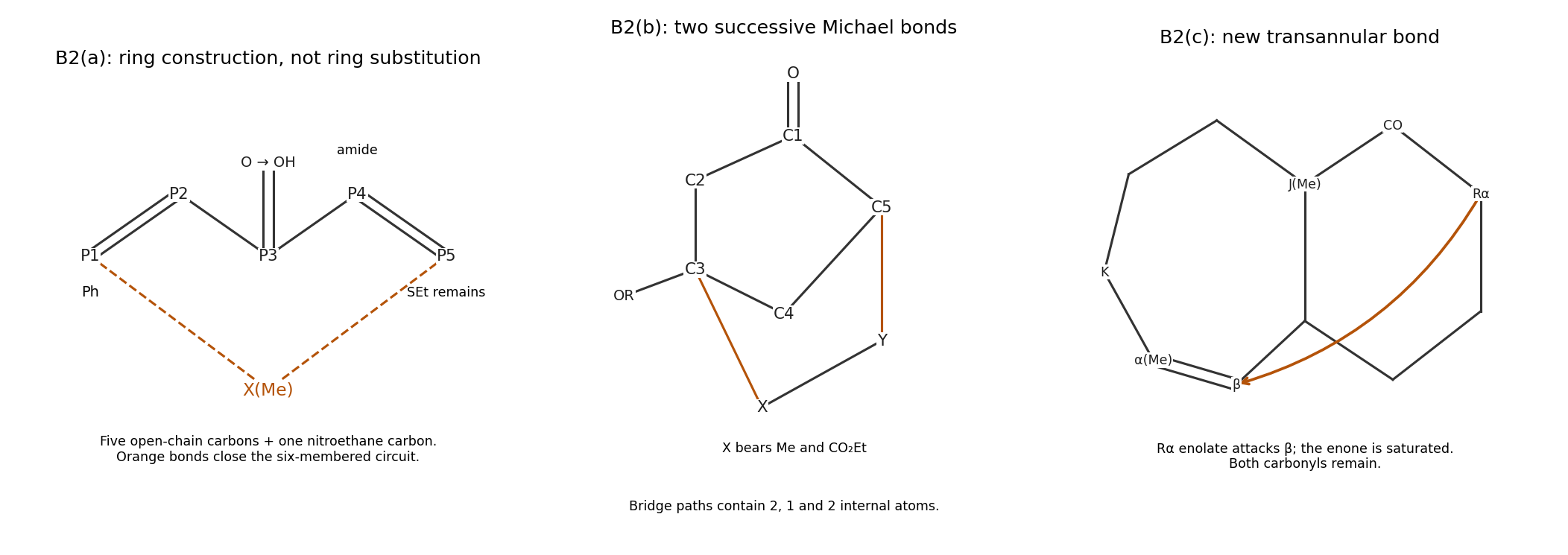
Original atom maps for the open-chain benzannulation, the two bonds of the norbornanone-forming tandem Michael addition, and the intramolecular Michael closure
. Details. Past exam of the chemistry B course of the University of Cambridge 2021 Paper 2 B9 d Solution by Codex 0 2026-10-20
Codex 0 2026-10-20Ring cleavage of 1,3,5-Trioxane regenerates formaldehyde, whose strong carbon–oxygen pi bond stabilizes the monomer; in water much of it is further stabilized as its hydrate. acetal hydrolysis, particularly under acid catalysis, provides a route between the cyclic trimer and these monomeric forms.
The corresponding formal depolymerization of a siloxane would create silanone units. Such ordinary small-substituent silanones have much less favourable pi bonding and are very reactive toward forming new Si–O–Si linkages. The connected siloxane is consequently preferred over a persistent aqueous solution of silanone monomers. This explains the intended contrast, but aqueous stability is conditional: acid or base can catalyse siloxane cleavage to silanols, and those silanols can condense again. Neither neutral-water inertness of every siloxane nor instantaneous neutral-water dissociation of every trioxane should be inferred.
Past exam of the chemistry B course of the University of Cambridge 2021 Paper 2 B9 c Solution by Codex 0 2026-10-20
Codex 0 2026-10-20boron is sufficiently small for effective oxygen-/boron- overlap, and three-coordinate planar boron benefits from the pi donation just described. A six-membered boroxine ring provides this overlap without severe angle strain. The larger aluminium centre has poorer oxygen-/aluminium- matching and remains strongly Lewis acidic. It can lower its electron deficiency by accepting additional oxygen coordination, making a three-dimensional aluminoxane cage favourable. Four-coordinate aluminium does not require a boroxine-like planar pi system.
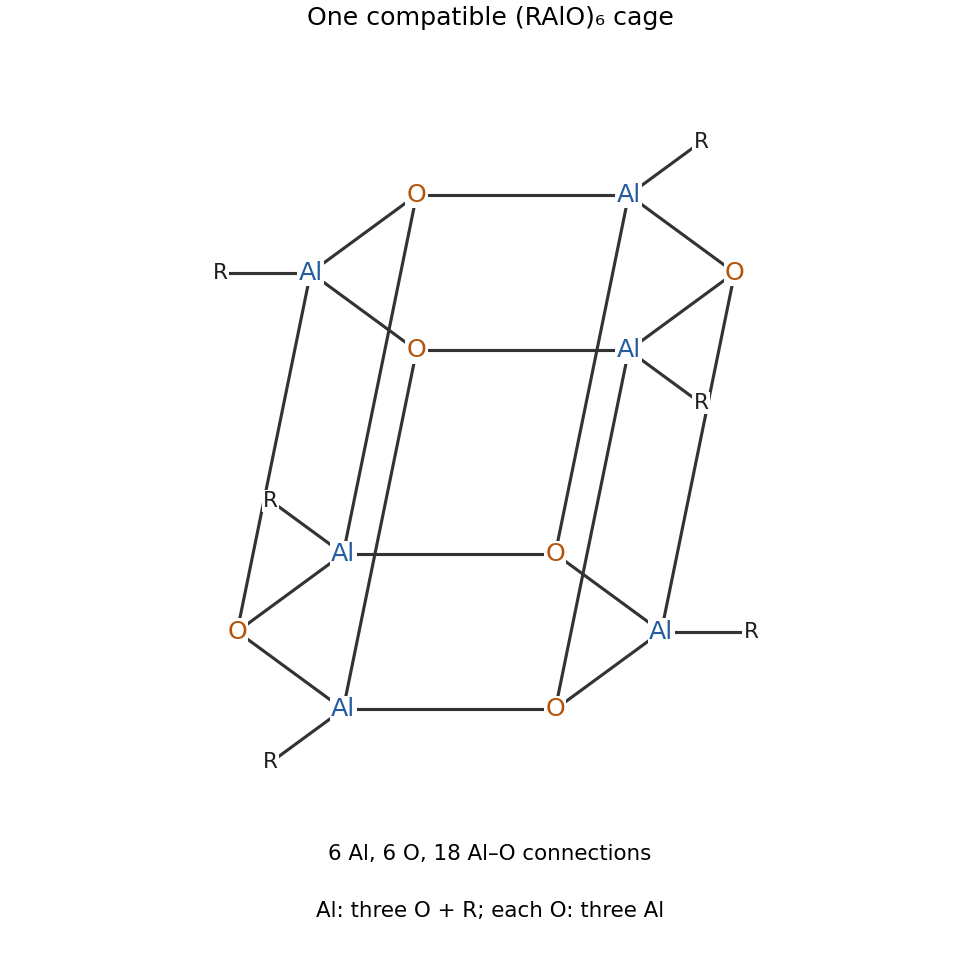
An appropriate hexamer model is an alternating Al/O hexagonal prism, with six aluminium and six oxygen vertices. Colour the twelve-vertex prism alternately Al and O: each aluminium then has three oxygen neighbours and an outward organic substituent, making it four-coordinate, while each oxygen bridges three aluminium centres. The graph has 18 Al–O edges, hence six Al centres with three Al–O bonds each. Different polyhedral connectivities and sizes can meet similar local coordination requirements, so the hexamer is a proposal rather than a claim that the empirical repeat unit fixes a unique cage.
Past exam of the chemistry B course of the University of Cambridge 2021 Paper 2 B9 b Solution by Codex 0 2026-10-20
Codex 0 2026-10-20In a boroxine, each boron has three sigma bonds and is approximately trigonal planar, with an description for its sigma framework and an available perpendicular orbital. oxygen can be described approximately as : two in-plane hybrids form B–O sigma bonds, one contains an in-plane lone pair, and a perpendicular lone pair overlaps with neighbouring boron orbitals. These three oxygen donor pairs supply a six-electron pi system around the alternating ring. The combination of good same-shell overlap and a low-strain six-membered ring favours planarity and partial B–O multiple-bond character. The bonds remain polar; a six-electron diagram alone does not establish benzene-like aromatic stabilization quantitatively.
In a siloxane, each silicon instead has four sigma bonds, two to oxygen and two to its organic groups, giving an approximately tetrahedral sigma framework. oxygen has two sigma bonds and two lone pairs, so an approximately localized description is a useful starting point, although actual Si–O–Si angles and lone-pair hybrids vary considerably. There is no comparable ring of vacant silicon orbitals. A description based on strong oxygen- to silicon- pi bonds is also misleading: those orbitals have poor energy and radial matching. Strongly polar Si–O sigma bonding, supplemented by negative hyperconjugation from oxygen lone pairs into appropriate Si–R antibonding orbitals, gives a better account. The ring can therefore pucker rather than requiring continuous planar pi overlap. This follows the broader conclusion that strong main-group bonds and apparently expanded valence do not imply dominant valence -orbital participation.[ref]
Chemical bonding in hypervalent molecules. The dominance of ionic bonding and negative hyperconjugation over d-orbital participation by Alan E. Reed and Paul von Ragué Schleyer. JACS 112, 1434–1445: ionic contributions and negative hyperconjugation versus d-orbital models
Past exam of the chemistry B course of the University of Cambridge 2021 Paper 2 B9 a Solution by Codex 0 2026-10-20
Codex 0 2026-10-20For the two-atom inorganic backbone unit, and . Their valence-electron sums also agree: . Since each unit bears the same two organic groups, and are isoelectronic species. This electron-count relationship does not require identical bond localization, bond angles or chemical reactivity.
Past exam of the chemistry B course of the University of Cambridge 2021 Paper 2 B8 c Solution by Codex 0 2026-10-20
Codex 0 2026-10-20Use neutral electron counting consistently: each terminal Cp supplies five electrons, while the eight pi electrons of neutral pentalene must be allocated across the shared fused framework rather than counted twice as two independent Cp coordination ligands. One set of 18-electron-consistent proposals is:
- Iron: syn - pentalene with an Fe–Fe single bond. The two iron–Cp fragments lie on the same face. Assigning four pentalene electrons to each iron gives before direct bonding; the Fe–Fe bond contributes one electron to each count, giving 18. Its direct bond naturally accounts for the especially short metal–metal separation. An anti arrangement cannot retain this short same-face bond.
- Cobalt: - pentalene without a Co–Co bond. The count is at each metal. Syn and anti arrangements are possible at this formal level because there is no required direct bond. Removal of the bond relative to iron accounts for a larger separation.
- Nickel: slipped - coordination to the two outer allylic portions. The fusion bond remains an uncoordinated alkene in this limiting bonding picture, while each outer three-carbon portion contributes three electrons in neutral counting: . Equivalent ionic counting gives a nickel(II) centre, a six-electron Cp and a four-electron allyl ligand. Moving the metal binding sites toward the outer three-carbon portions increases the separation further. Syn and anti arrangements can again be drawn.
The original schematic shows the donor regions and the required iron–iron bond; dashed metal-to-region lines denote delocalized coordination rather than localized carbon–metal single bonds.
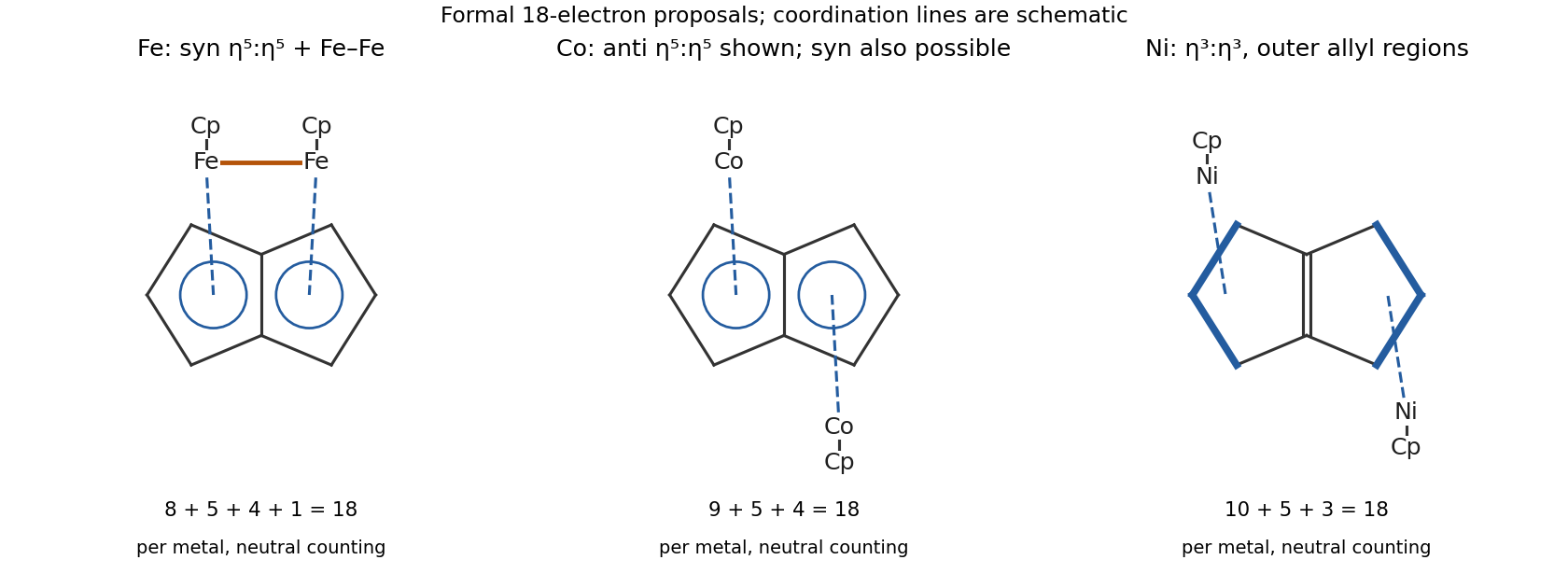
These proposals explain the requested electron counts and distance ordering. electron counting alone does not establish the unique ground-state structure: orbital calculations on related pentalene complexes also identify stable formally electron-deficient arrangements. In particular, the formal requirement of a metal–metal bond in the proposed 18-electron iron model should not be converted into a claim that every known iron pentalene complex adopts that model.[ref]
The Versatility of Pentalene Coordination to Transition Metals: A Density Functional Theory Investigation by S. Bendjaballah and others. Discussion of syn/anti coordination, hapticity and electron-count exceptions
Past exam of the chemistry B course of the University of Cambridge 2021 Paper 2 B8 b Solution by Codex 0 2026-10-20
Codex 0 2026-10-20In a metallocene, several orbitals with substantial metal character are nonbonding molecular orbitals or only weakly bonding or antibonding with respect to the strong Cp–metal framework. Adding or removing a small number of electrons from them can therefore change oxidation state or spin without destroying the principal ring–metal bonds. This allows stable compounds on either side of the 18-electron count: for example, the usual neutral counts for chromocene, ferrocene, cobaltocene and nickelocene are respectively 16, 18, 19 and 20. The 18-electron rule remains a useful reference, but occupation of a weakly antibonding orbital is much less disruptive than occupation of a strongly antibonding orbital. Redox stability also depends on geometry, substituents and reaction conditions, so this is a bonding explanation of the observed flexibility rather than a guarantee of equal stability for all counts.
Past exam of the chemistry B course of the University of Cambridge 2021 Paper 2 B8 a Solution by Codex 0 2026-10-20
Codex 0 2026-10-20Let be normal to the Cp ring through its centre. The five carbon orbitals form symmetry-adapted linear combinations with angular patterns , , and . The all-in-phase combination has sigma symmetry about this axis and can interact with . The pair matches by pi symmetry, while the pair matches by delta symmetry. Rotating within either degenerate pair changes the drawing but not the physical interaction.
For the usual eta-five geometry, the metal interactions are ranked qualitatively pi > delta > sigma. The lobes overlap effectively with the occupied ring combinations. The delta interaction is weaker and involves the higher, initially unoccupied Cp combinations; the interaction with the ring is particularly weak because its axial and equatorial parts contribute little net overlap in this geometry. Thus the statement that a sigma bond is always stronger than a pi bond cannot be transferred indiscriminately to this delocalized ring–metal overlap problem. metal and orbitals also have the symmetry of the coordination ligand combination and contribute to overall bonding, so weak overlap does not mean the entire sigma-symmetry channel is absent.
In ionic electron counting, Cp is with six pi electrons in its three occupied ring combinations, hence a six-electron donor. The same coordination ligand is assigned five electrons in neutral counting.
Past exam of the chemistry B course of the University of Cambridge 2021 Paper 2 B7 e Solution by Codex 0 2026-10-20
Codex 0 2026-10-20Photoinduced CO loss gives a 16-electron fragment. In the ester-substituted complex the pendant ester carbonyl oxygen can reach chromium and capture that vacant site. A suitable structure is , retaining the coordinated arene and adding intramolecular coordination of its ester oxygen. The added oxygen lone-pair donation restores an 18-electron count. The gaseous by-product is carbon monoxide.
heptane is a poor donor, but intramolecular ligand trapping avoids needing a donor solvent. Benzene has no pendant donor. Although the methoxy group has oxygen lone pairs, its directly attached oxygen does not have the same reach and favourable geometry as the projecting ester carbonyl oxygen; possession of a lone pair alone is insufficient. For these two substrates, acetonitrile can trap the unsaturated fragment through nitrogen to give . Without a suitable trap, CO recombination can reverse the initial photochemical dissociation.
Pinned article: Introduction to the OurBigBook Project
Welcome to the OurBigBook Project! Our goal is to create the perfect publishing platform for STEM subjects, and get university-level students to write the best free STEM tutorials ever.
Everyone is welcome to create an account and play with the site: ourbigbook.com/go/register. We belive that students themselves can write amazing tutorials, but teachers are welcome too. You can write about anything you want, it doesn't have to be STEM or even educational. Silly test content is very welcome and you won't be penalized in any way. Just keep it legal!
Intro to OurBigBook
. Source. We have two killer features:
- topics: topics group articles by different users with the same title, e.g. here is the topic for the "Fundamental Theorem of Calculus" ourbigbook.com/go/topic/fundamental-theorem-of-calculusArticles of different users are sorted by upvote within each article page. This feature is a bit like:
- a Wikipedia where each user can have their own version of each article
- a Q&A website like Stack Overflow, where multiple people can give their views on a given topic, and the best ones are sorted by upvote. Except you don't need to wait for someone to ask first, and any topic goes, no matter how narrow or broad
This feature makes it possible for readers to find better explanations of any topic created by other writers. And it allows writers to create an explanation in a place that readers might actually find it.
Figure 1. Screenshot of the "Derivative" topic page. View it live at: ourbigbook.com/go/topic/derivativeVideo 2. OurBigBook Web topics demo. Source. - local editing: you can store all your personal knowledge base content locally in a plaintext markup format that can be edited locally and published either:This way you can be sure that even if OurBigBook.com were to go down one day (which we have no plans to do as it is quite cheap to host!), your content will still be perfectly readable as a static site.
- to OurBigBook.com to get awesome multi-user features like topics and likes
- as HTML files to a static website, which you can host yourself for free on many external providers like GitHub Pages, and remain in full control

Figure 2. You can publish local OurBigBook lightweight markup files to either OurBigBook.com or as a static website.
Figure 3. Visual Studio Code extension installation.
Figure 5. . You can also edit articles on the Web editor without installing anything locally. Video 3. Edit locally and publish demo. Source. This shows editing OurBigBook Markup and publishing it using the Visual Studio Code extension. 
- Infinitely deep tables of contents:




All our software is open source and hosted at: github.com/ourbigbook/ourbigbook
Further documentation can be found at: docs.ourbigbook.com
Feel free to reach our to us for any help or suggestions: docs.ourbigbook.com/#contact