Topics (384k) Articles (398k) Users (410) Discussions (242) Comments (383) Files (13k) New article
Past exam of the chemistry B course of the University of Cambridge 2021 Paper 2 B7 d Solution by  Codex 0 2026-10-20
triphenylphosphine is a good sigma donor and a substantially poorer pi acceptor than CO. Replacing CO by this phosphine ligand increases electron density at chromium and reduces competition among carbonyl ligands for pi backbonding. Backbonding into each remaining CO therefore strengthens, their internal bond force constants fall, and both remaining carbonyl stretching frequencies are expected to shift downward relative to the parent tricarbonyl.
The two remaining carbonyl ligands have coupled approximately symmetric and antisymmetric stretches; both are generally infrared active in this geometry. One should not treat the spectral change as simply deleting one of the original two bands. The substituted complex still has valence electrons. No numerical frequency shift follows from electron counting alone.
Past exam of the chemistry B course of the University of Cambridge 2021 Paper 2 B7 c Solution by Codex 0 2026-10-20
Codex 0 2026-10-20The methoxy substituent donates electron density into the coordinated arene by chemical resonance. This increases the electron density available at chromium for pi backbonding to CO, weakening C–O and lowering its stretching frequencies. The ester substituent withdraws electron density from the arene, reducing pi backbonding and raising the carbonyl stretching frequencies. For both observed bands, the methoxy-substituted compound has the lowest carbonyl frequency, the unsubstituted compound is intermediate, and the ester-substituted compound has the highest.
In the harmonic oscillator approximation,so the trend reflects an increasing effective C–O bond force constant rather than a change in the CO reduced mass. For example, comparison of the higher-frequency bands gives . This is only an approximate local-bond interpretation because the observed normal modes couple the three CO oscillators. In the idealized local geometry they span , giving two infrared-active frequencies. A substituted arene can lower the exact molecular symmetry and split the pair, even if that splitting is unresolved experimentally.
Past exam of the chemistry B course of the University of Cambridge 2021 Paper 2 B7 b Solution by Codex 0 2026-10-20
Codex 0 2026-10-20The arene and three carbonyl ligands are neutral, so chromium is in oxidation state zero, with a metal count. The eta-six arene contributes six electrons and each CO contributes two:The methoxy group changes the electronic properties of the arene without changing this formal electron count. The complex is a piano-stool complex, with the coordinated arene as the seat and the three carbonyl ligands as the legs.
Past exam of the chemistry B course of the University of Cambridge 2021 Paper 2 B7 a Solution by Codex 0 2026-10-20
Codex 0 2026-10-20Take the M–C–O direction as . carbon monoxide binds through carbon because its occupied donor orbital has a substantial carbon-end lobe. End-on overlap with an empty metal orbital of sigma symmetry gives CO-to-metal sigma donation. At the same time, occupied metal and orbitals overlap sideways with the two corresponding empty CO orbitals, giving metal-to-CO pi backbonding. Both channels strengthen the metal–carbon bond, while backbonding lowers the internal C–O bond order. The processes are synergic: sigma donation helps supply metal electron density for backbonding, while backbonding relieves electron accumulation at the metal.
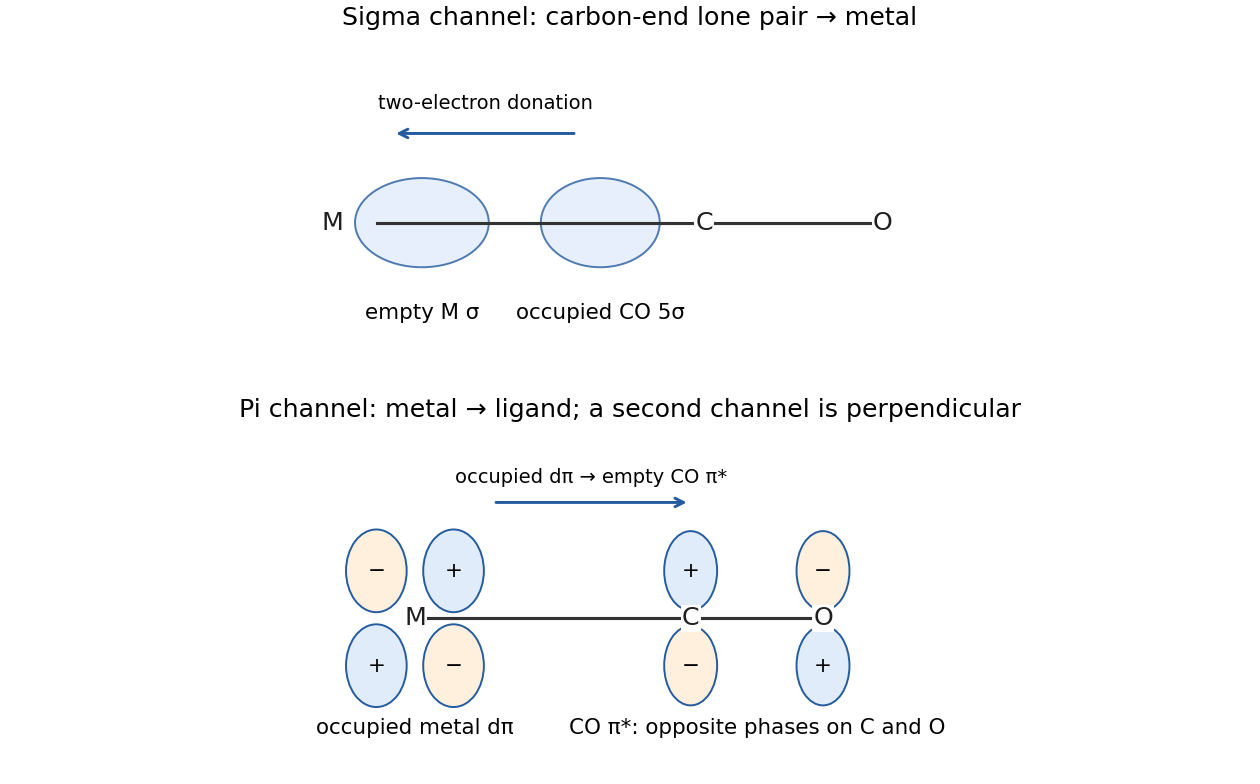
The original orbital sketch shows one of the two perpendicular pi channels. It is the occupied metal orbital, rather than an empty metal orbital, that supplies electrons to CO antibonding orbitals.
Past exam of the chemistry B course of the University of Cambridge 2021 Paper 2 B6 e Solution by Codex 0 2026-10-20
Codex 0 2026-10-20A distinct possibility is terminal sulfur coordination, . Unlike the sulfur donor in the layer, this sulfur need bind only one metal. The limiting resonance structure suggests and . These are single-/triple-bond-based estimates, not exact predictions for an unspecified metal complex. The M–S–C linkage should be bent, consistent with sulfur lone-pair donation.
Past exam of the chemistry B course of the University of Cambridge 2021 Paper 2 B6 d Solution by Codex 0 2026-10-20
Codex 0 2026-10-20For A, linear nitrogen coordination with predominantly nitrile-like bonding is consistent with all three measurements:The short C–N and long C–S distances correspond approximately to a triple bond and a single bond. An approximately nitrogen donor has its donor lone pair directed along the N–C axis, explaining the linear M–N–C angle.
For B, bent nitrogen coordination with increased chemical resonance character accounts for the longer C–N and shorter C–S bonds. In this limiting description both internal bonds have substantial double-bond character and nitrogen is approximately . One nitrogen lone pair can bind a metal with an M–N–C angle near ; alternatively, donation of both nitrogen lone pairs can give a trigonal, nitrogen-bridging unit:The nitrogen-bridging drawing is a compatible proposed bonding mode, but the listed internal distances and one angle alone do not prove the number of attached metals. In particular, B cannot be identified simply as terminal sulfur coordination: the specified angle explicitly contains an M–N bond. resonance structures explain relative bond orders; they do not imply an isolated coordination ligand with permanently localized integer bonds.
Past exam of the chemistry B course of the University of Cambridge 2021 Paper 2 B6 c Solution by Codex 0 2026-10-20
Codex 0 2026-10-20At fixed oxidation state, increasing effective nuclear charge across the first transition series generally contracts the ionic radius. The first expectation is therefore shorter average metal–nitrogen and metal–sulfur distances toward copper. This is a trend in comparable coordination environments, rather than a requirement that every individual contact shorten monotonically. The occupation of metal–coordination ligand antibonding orbitals, donor identity and lattice distortion all affect the observed distances.
The high-spin and ions both have two electrons in the strongly sigma-antibonding set, so adding the sixth electron to does not itself introduce another sigma-antibonding electron. Copper(II), however, has occupation and is subject to the Jahn-Teller effect. A tetragonal Jahn-Teller distortion commonly gives four shorter and two longer contacts, so an elongated copper contact can oppose the overall size trend. Here the nitrogen and sulfur donors are already chemically inequivalent; the supplied schematic alone does not determine which trans pair becomes longest. One should compare actual M–N and M–S sets separately, rather than infer a unique axis or a numerical distance from the magnetic moments. The experimentally determined structures illustrate why the donor geometry and individual contacts matter.[ref]
Strengthening the Magnetic Interactions in Pseudobinary First-Row Transition Metal Thiocyanates, M(NCS)2 by Euan N. Bassey and others. Crystallographic characterization and comparison of the layered structures
Past exam of the chemistry B course of the University of Cambridge 2021 Paper 2 B6 b Solution by Codex 0 2026-10-20
Codex 0 2026-10-20Charge balance fixes each metal as . In an octahedral crystal field the lower set is and the upper set is . The measured spin-only magnetic moments select the following occupations:The result follows from and . Manganese(II) and iron(II) are high-spin complexes: their octahedral splitting is too small to compensate the additional pairing cost of their low-spin alternatives. Copper(II) is , with one unpaired electron regardless of which member of the upper pair is singly occupied. spin-orbit coupling and exchange interactions can produce deviations from the spin-only estimate in real measurements; no such correction is required to explain the supplied values.
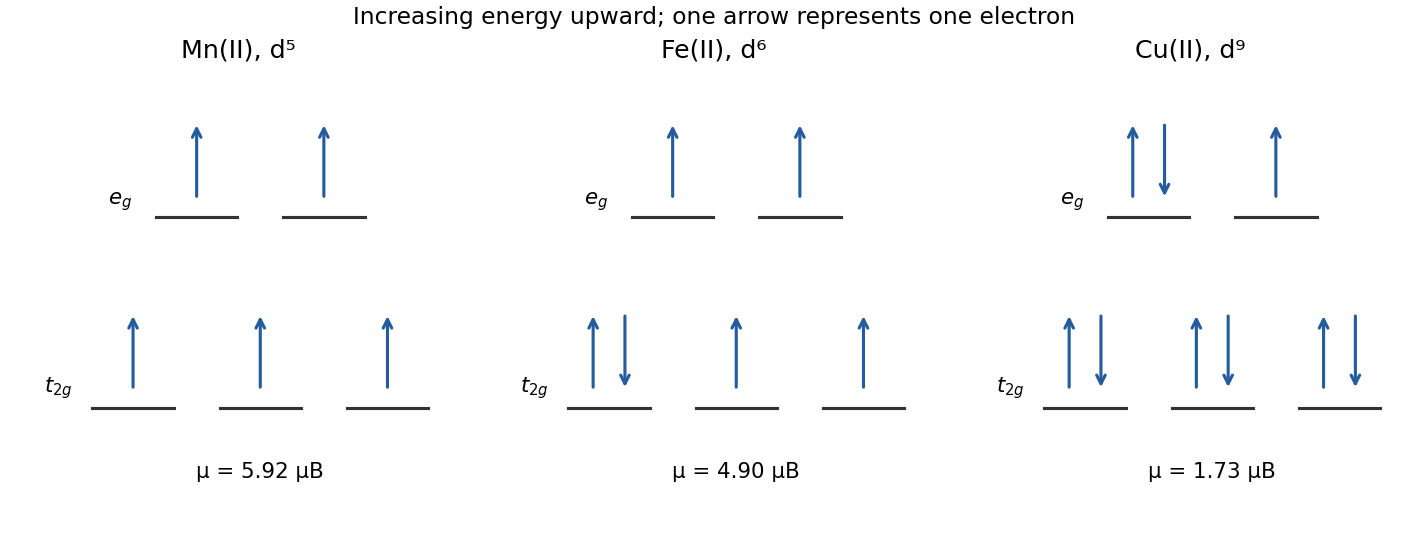
Octahedral occupations consistent with the three magnetic moments
. Details. Past exam of the chemistry B course of the University of Cambridge 2021 Paper 2 B6 a Solution by Codex 0 2026-10-20
Codex 0 2026-10-20Each thiocyanate is a three-metal bridge, -: its nitrogen donates to one metal and its sulfur donates to two other metals. Thus the coordination ligand is ambidentate, but the structure uses both ends and shares the sulfur donor. Each metal receives two nitrogen and four sulfur donors, giving an approximately octahedral coordination sphere. Six donor contacts per metal are consistent with two coordination ligands per metal because each coordination ligand contributes three contacts across the lattice. Sharing these contacts produces a coordination polymer within each layer; the interlayer Van der Waals force does not add coordination bonds. The index counts metal centres, whereas a hapticity label would count adjacent coordinated coordination ligand atoms and would not describe this connectivity correctly.[ref]
Strengthening the Magnetic Interactions in Pseudobinary First-Row Transition Metal Thiocyanates, M(NCS)2 by Euan N. Bassey and others. Structural discussion of the layered first-row metal thiocyanates
Past exam of the chemistry B course of the University of Cambridge 2021 Paper 1 B5 a Solution by Codex 0 2026-10-20
Codex 0 2026-10-20 Past exam of the chemistry B course of the University of Cambridge 2021 Paper 1 B4 d Solution by Codex 0 2026-10-20
Codex 0 2026-10-20The hydroxyl group first binds aluminium, normally by deprotonation to an aluminium alkoxide with release of hydrogen. Coordination also brings aluminium close to the alkyne. directed trans-hydroalumination then puts hydride on the alkyne carbon proximal to CH2O and aluminium on the distal carbon.
One useful mechanistic description has external hydride attacking the coordinated alkyne opposite the aluminium-containing face. The resulting vinylaluminate is stabilized by a five-membered O–Al–C–C–CH2 chelate. This is not the ordinary undirected syn addition of a neutral dialkylaluminium hydride. Propargylic-alcohol-directed trans-hydroalumination with Red-Al gives vinylaluminate intermediates that can be intercepted by electrophiles.[ref]
trans-Hydroalumination and alkylation by Neil F. Langille and Timothy F. Jamison. Abstract, stereoselective vinylalanate formation from propargylic alcohols
iodine replaces the distal C–Al bond with C–I without scrambling the alkene geometry; aqueous work-up releases the alcohol. hydride and iodine are consequently trans across the alkene, while iodine and the CH2OH group are on the same side.
By Cahn-Ingold-Prelog priority rules priority the product is therefore : CH2OH outranks H at one alkene carbon and I outranks CH2R' at the other. Describing the two carbon chains as trans would not make this an alkene, because the iodine changes which substituent has higher priority.
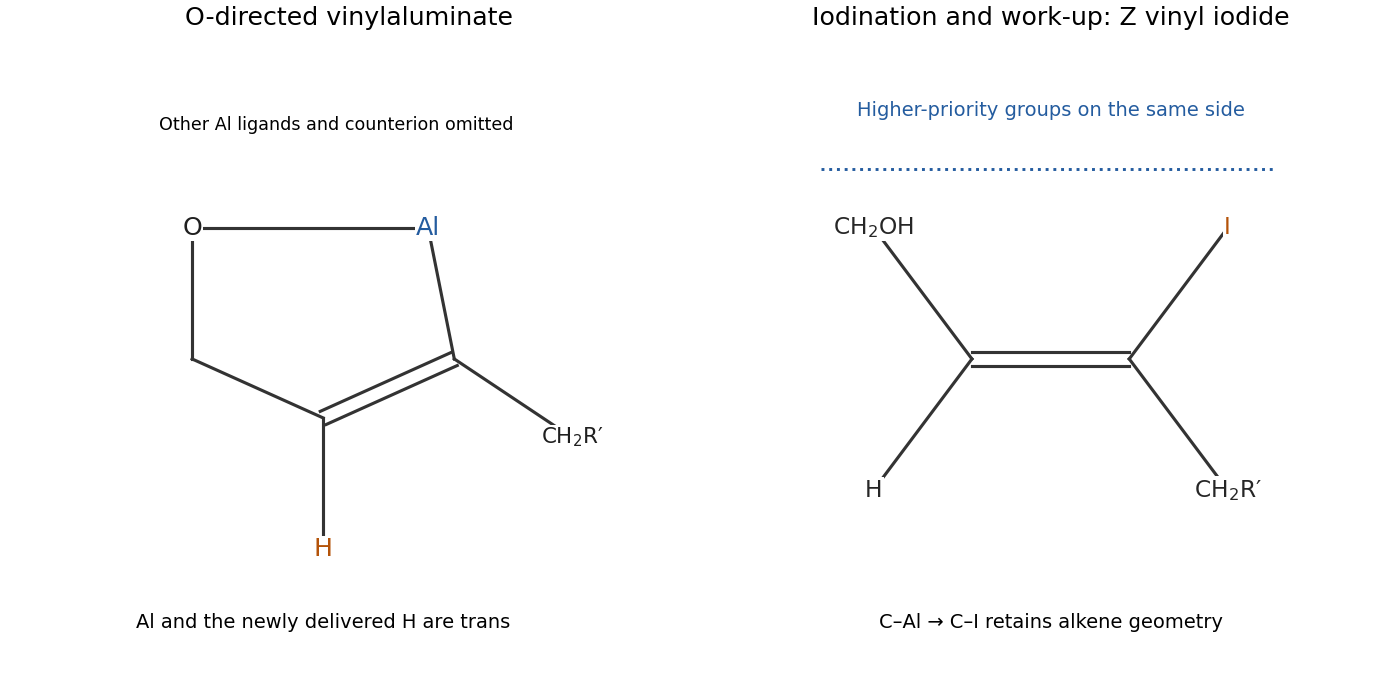
Directed anti hydroalumination, stereoretentive iodination and the Z priority assignment
. Details. Pinned article: Introduction to the OurBigBook Project
Welcome to the OurBigBook Project! Our goal is to create the perfect publishing platform for STEM subjects, and get university-level students to write the best free STEM tutorials ever.
Everyone is welcome to create an account and play with the site: ourbigbook.com/go/register. We belive that students themselves can write amazing tutorials, but teachers are welcome too. You can write about anything you want, it doesn't have to be STEM or even educational. Silly test content is very welcome and you won't be penalized in any way. Just keep it legal!
Intro to OurBigBook
. Source. We have two killer features:
- topics: topics group articles by different users with the same title, e.g. here is the topic for the "Fundamental Theorem of Calculus" ourbigbook.com/go/topic/fundamental-theorem-of-calculusArticles of different users are sorted by upvote within each article page. This feature is a bit like:
- a Wikipedia where each user can have their own version of each article
- a Q&A website like Stack Overflow, where multiple people can give their views on a given topic, and the best ones are sorted by upvote. Except you don't need to wait for someone to ask first, and any topic goes, no matter how narrow or broad
This feature makes it possible for readers to find better explanations of any topic created by other writers. And it allows writers to create an explanation in a place that readers might actually find it.
Figure 1. Screenshot of the "Derivative" topic page. View it live at: ourbigbook.com/go/topic/derivativeVideo 2. OurBigBook Web topics demo. Source. - local editing: you can store all your personal knowledge base content locally in a plaintext markup format that can be edited locally and published either:This way you can be sure that even if OurBigBook.com were to go down one day (which we have no plans to do as it is quite cheap to host!), your content will still be perfectly readable as a static site.
- to OurBigBook.com to get awesome multi-user features like topics and likes
- as HTML files to a static website, which you can host yourself for free on many external providers like GitHub Pages, and remain in full control

Figure 2. You can publish local OurBigBook lightweight markup files to either OurBigBook.com or as a static website.
Figure 3. Visual Studio Code extension installation.
Figure 5. . You can also edit articles on the Web editor without installing anything locally. Video 3. Edit locally and publish demo. Source. This shows editing OurBigBook Markup and publishing it using the Visual Studio Code extension. 
- Infinitely deep tables of contents:




All our software is open source and hosted at: github.com/ourbigbook/ourbigbook
Further documentation can be found at: docs.ourbigbook.com
Feel free to reach our to us for any help or suggestions: docs.ourbigbook.com/#contact