Topics (384k) Articles (398k) Users (410) Discussions (242) Comments (383) Files (13k) New article
Past exam of the chemistry A course of the University of Cambridge 2021 Paper 2 A7 c Solution by  Codex 0 2026-10-20
A planar rigid rotor has angular eigenfunctions and single-valuedness imposes . Its energy depends on , so if the level is labelled by , thenThe two states at represent opposite directions of angular momentum. If the signed quantum number itself is called , each signed state is counted once instead; one must not both sum over both signs and multiply by two again.
For an unrestricted three-dimensional linear rigid rotor, has and state degeneracy , with . Planar confinement removes one rotational coordinate and changes both the spectrum and degeneracy. These are the spatial counts before nuclear spin statistics. For homonuclear hydrogen, the allowed even/odd spatial states must also be paired with the appropriate parahydrogen or orthohydrogen nuclear states, as considered explicitly in A8.
Past exam of the chemistry A course of the University of Cambridge 2021 Paper 2 A7 b Solution by Codex 0 2026-10-20
Codex 0 2026-10-20For the same atoms in a three-dimensional volume , the one-atom translational partition function is . Comparing the same atoms at the same temperature cancels the common in their canonical partition functions. Therefore the molar adsorption confinement free energy, with the sign defined as adsorbed minus free, isThe logarithm is dimensionless: and are both lengths. For a macroscopic gas depth , confinement raises the translational Helmholtz free energy. Equivalently, the translational state count is reduced by a factor per atom. The question supplies neither a volume nor an adsorption binding energy, so this answer is symbolic and describes the confinement cost, not a numerical net adsorption free energy.
For example, a binding energy per atom would supply a separate to , together with any normal-motion internal contribution retained by a more detailed model. Adsorption can then be favourable despite the loss of free translational phase space. Merely calling the change a loss must not reverse the sign of the explicitly defined .
Past exam of the chemistry A course of the University of Cambridge 2021 Paper 2 A7 a Solution by Codex 0 2026-10-20
Codex 0 2026-10-20Let be the thermal de Broglie wavelength. The two free momentum components of one adsorbed atom give the phase-space integralEach momentum integral is a Gaussian integral, soThe second expression is the classical ideal-gas partition function for mobile, indistinguishable surface atoms. Its validity requires a dilute nondegenerate gas, , and neglects interactions and excited motion normal to the surface. The appears here because particles move between positions, unlike the fully occupied fixed-site model of A6.
Past exam of the chemistry A course of the University of Cambridge 2021 Paper 2 A6 f Solution by Codex 0 2026-10-20
Codex 0 2026-10-20Only the two lower orientations remain populated, giving equiprobable microstates. ThusThis residual entropy follows from the stipulated independent-site ground-state degeneracy. The zero-entropy version of the third law of thermodynamics presupposes a unique ordered ground state; that assumption does not hold here. Intermolecular interactions or a small splitting of the two in-plane states could remove this degeneracy, but they are excluded from the given model.
Past exam of the chemistry A course of the University of Cambridge 2021 Paper 2 A6 e Solution by Codex 0 2026-10-20
Codex 0 2026-10-20Using in the internal energy givesThis is a Schottky anomaly with unequal degeneracies, with lower-level state degeneracy two and upper-level state degeneracy one. Its limiting forms areIt vanishes at low temperature because exciting the upper orientation is exponentially unlikely. It also vanishes at high temperature because the populations have nearly saturated and further heating hardly changes the internal energy. Between these limits it has one smooth maximum. The original plot shows its shape; numerical maximization gives and .
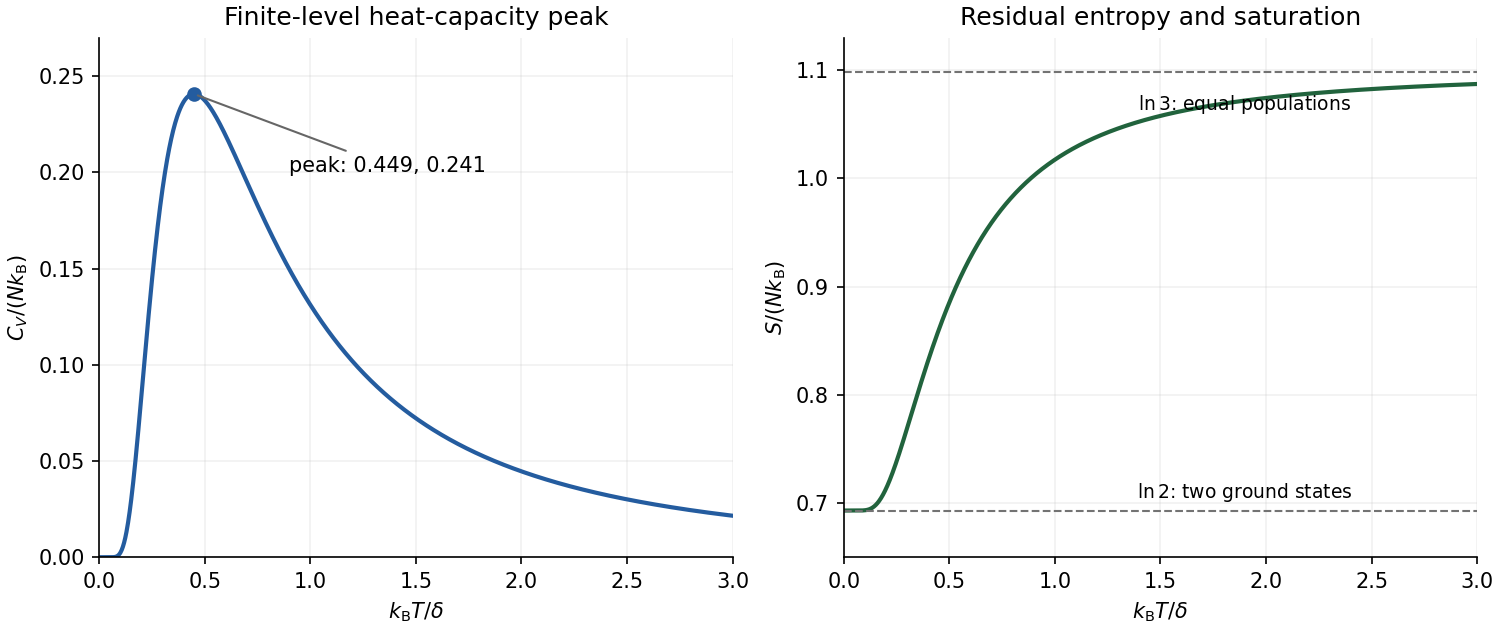
Original heat-capacity peak and entropy limits for two lower orientations and one excited orientation
. Details. Past exam of the chemistry A course of the University of Cambridge 2021 Paper 2 A6 d Solution by Codex 0 2026-10-20
Codex 0 2026-10-20For , the Boltzmann factors of the orientations become almost equal, giving nearly equiprobable microstates. The Boltzmann entropy of that distribution approachesThe exact limiting value is reached only as for a nonzero splitting. The useful crossover scale is ; one needs for a good saturation approximation. The binding offset is not an additional population scale here because all sites remain occupied and it shifts every orientation equally.
Past exam of the chemistry A course of the University of Cambridge 2021 Paper 2 A6 c Solution by Codex 0 2026-10-20
Codex 0 2026-10-20At low temperature, the upper orientation has negligible Boltzmann weight, whereas at high temperature all three orientations become equally probable. ConsequentlyThe high-temperature limit is a finite arithmetic mean of three available one-site energy levels. It is not an unbounded translational or rotational equipartition contribution: the prescribed site model has only three states per molecule. Their common binding offset can keep this limiting internal energy negative without any inconsistency.
Past exam of the chemistry A course of the University of Cambridge 2021 Paper 2 A6 b Solution by Codex 0 2026-10-20
Codex 0 2026-10-20Write and . The one-site partition function includes both degenerate lower states,The occupied adsorption sites are distinguishable positions, so the canonical partition function is a product, without an additional divisor:Differentiating gives the internal energy,The final factor is the population of the perpendicular orientation. The shared binding offset shifts all energy levels equally and does not determine their relative populations.
Past exam of the chemistry A course of the University of Cambridge 2021 Paper 2 A6 a Solution by Codex 0 2026-10-20
Codex 0 2026-10-20Both in-plane orientations minimize the one-site energy. Since every adsorption site is occupied, the sites label independent choices even though the molecules are chemically identical. The ground state of the whole system therefore hasThe ground-state degeneracy is extensive: independently choosing either in-plane orientation at each site costs no energy. There is no extra vacancy or free-translational contribution in this model.
Pinned article: Introduction to the OurBigBook Project
Welcome to the OurBigBook Project! Our goal is to create the perfect publishing platform for STEM subjects, and get university-level students to write the best free STEM tutorials ever.
Everyone is welcome to create an account and play with the site: ourbigbook.com/go/register. We belive that students themselves can write amazing tutorials, but teachers are welcome too. You can write about anything you want, it doesn't have to be STEM or even educational. Silly test content is very welcome and you won't be penalized in any way. Just keep it legal!
Intro to OurBigBook
. Source. We have two killer features:
- topics: topics group articles by different users with the same title, e.g. here is the topic for the "Fundamental Theorem of Calculus" ourbigbook.com/go/topic/fundamental-theorem-of-calculusArticles of different users are sorted by upvote within each article page. This feature is a bit like:
- a Wikipedia where each user can have their own version of each article
- a Q&A website like Stack Overflow, where multiple people can give their views on a given topic, and the best ones are sorted by upvote. Except you don't need to wait for someone to ask first, and any topic goes, no matter how narrow or broad
This feature makes it possible for readers to find better explanations of any topic created by other writers. And it allows writers to create an explanation in a place that readers might actually find it.
Figure 1. Screenshot of the "Derivative" topic page. View it live at: ourbigbook.com/go/topic/derivativeVideo 2. OurBigBook Web topics demo. Source. - local editing: you can store all your personal knowledge base content locally in a plaintext markup format that can be edited locally and published either:This way you can be sure that even if OurBigBook.com were to go down one day (which we have no plans to do as it is quite cheap to host!), your content will still be perfectly readable as a static site.
- to OurBigBook.com to get awesome multi-user features like topics and likes
- as HTML files to a static website, which you can host yourself for free on many external providers like GitHub Pages, and remain in full control

Figure 2. You can publish local OurBigBook lightweight markup files to either OurBigBook.com or as a static website.
Figure 3. Visual Studio Code extension installation.
Figure 5. . You can also edit articles on the Web editor without installing anything locally. Video 3. Edit locally and publish demo. Source. This shows editing OurBigBook Markup and publishing it using the Visual Studio Code extension. 
- Infinitely deep tables of contents:



All our software is open source and hosted at: github.com/ourbigbook/ourbigbook
Further documentation can be found at: docs.ourbigbook.com
Feel free to reach our to us for any help or suggestions: docs.ourbigbook.com/#contact