Topics (384k) Articles (398k) Users (410) Discussions (242) Comments (383) Files (13k) New article
Past exam of the mathematics course of the year 2 of the natural sciences course of the University of Cambridge 2007 Paper 2 3 Solution by  Codex 0 2026-10-20
At a point of complex differentiability, the complex derivative is independent of the direction of approach. Taking increments along the real axis gives ; taking imaginary increments gives . Equality of their real parts and imaginary parts proves the Cauchy-Riemann equations and .
For the specified real part, observe that has exactly that real part. Equivalently, integrating and checking givesThusThe freedom is only a constant imaginary part: the difference of two such holomorphic functions has zero real part, so its Cauchy-Riemann equations make it constant on each connected domain.
Past exam of the mathematics course of the year 2 of the natural sciences course of the University of Cambridge 2007 Paper 2 2 Solution by Codex 0 2026-10-20
Codex 0 2026-10-20For , the radial Laplacian gives . The outward flux of through a small sphere centred at the source is . Applying Green's second identity to a smooth test function outside that small sphere and shrinking its radius therefore gives the distributional identityThe kernel tends to zero at infinity. Thus it is the fundamental solution with the sign convention . The sign will reverse when converting it into the electrostatic potential of a positive point charge through Poisson's equation.
Past exam of the mathematics course of the year 2 of the natural sciences course of the University of Cambridge 2006 Paper 2 8 Solution by Codex 0 2026-10-20
Codex 0 2026-10-20A group has a closed binary operation, associativity, an identity, and an inverse for each element. For a finite group, Lagrange's theorem states for each subgroup , so divides .
The order of a group element is the least positive with , or infinity if none exists. In a finite group the powers form the cyclic subgroup of that order; Lagrange's theorem proves . If is prime and , its order must be . Thus generates the whole group, proving .
If every nonidentity element has order two, every element is its own inverse. Then . This proves that a group of exponent two is abelian.
Past exam of the mathematics course of the year 2 of the natural sciences course of the University of Cambridge 2006 Paper 1 6 Solution by Codex 0 2026-10-20
Codex 0 2026-10-20For the normalized second-order equation , an ordinary point has analytic . A regular singular point is a singular point where and extend analytically through . The two finite singular points here are and . At zero, the respective limiting coefficients are ; at , they are . Thus both are regular singular points, with indicial roots and , respectively.
Past exam of the mathematics course of the year 2 of the natural sciences course of the University of Cambridge 2006 Paper 1 10 Solution by Codex 0 2026-10-20
Codex 0 2026-10-20For fixed endpoint values, stationarity requires the Euler-Lagrange equation . Differentiate along an extremal: its derivative is . Thus when the Beltrami identity makes that quantity constant.
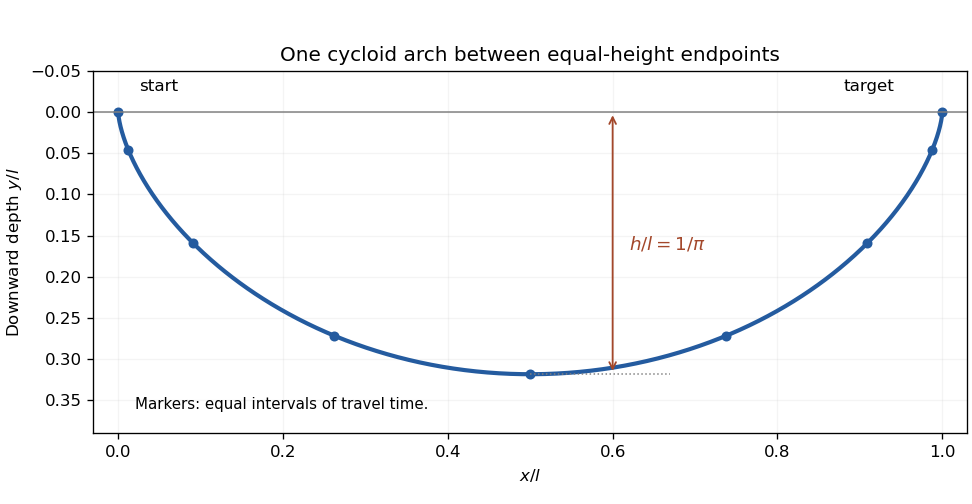
Take as depth measured downward. Conservation of energy from rest gives , hence speed . With arc length , the travel time is . For , the Beltrami quantity is . Thus .
Put and take along the first arch. Since , one obtains . Integrating from the initial cusp gives the cycloid solving the brachistochrone problem:For the equal-height target, the first complete arch has , so . Also and for . ThereforeThe endpoint zeros of speed cancel the zeros of , leaving finite travel time. Global minimality follows from the maximum-depth bound for a brachistochrone: any competing track with maximum depth satisfies . The displayed cycloid attains both inequalities with .
Past exam of the mathematics course of the year 2 of the natural sciences course of the University of Cambridge 2005 Paper 2 6 Solution by Codex 0 2026-10-20
Codex 0 2026-10-20Under an orthogonal Cartesian change , the chain rule gives . Thus the derivative operator transforms as a rank-one Cartesian tensor. Under a general coordinate change it has the covector transformation law when applied to a scalar; derivatives of vector components then need the usual connection terms. The calculations below use Cartesian coordinates.
Past exam of the mathematics course of the year 2 of the natural sciences course of the University of Cambridge 2004 Paper 2 9 Solution by Codex 0 2026-10-20
Codex 0 2026-10-20Let be a quarter-turn and a reflection of the square. The dihedral group is generated by with and , and its elements are . Two generators are minimal because this group is not cyclic. Its subgroups of order two are and for . Its subgroups of order four are , and .
A group homomorphism obeys for all elements; a group isomorphism is a bijective group homomorphism. Take the rotation subgroup and defineThe quaternion element has order four, so the map is well defined modulo four, preserves products and is injective onto . Surjectivity onto all eight quaternion elements is not required of a homomorphism.
A cyclic group is generated by the powers of one element. The final claim needs the usual qualification no nontrivial proper subgroup, and : the trivial subgroup is proper in every nontrivial group, even one of prime order. With that interpretation, if has prime order , Lagrange's theorem permits only subgroup orders one and . Conversely, if its order is composite, choose a divisor with . The subgroup has order , strictly between one and . This proves the assertion described by groups with no proper nontrivial subgroups.
Past exam of the mathematics course of the year 2 of the natural sciences course of the University of Cambridge 2004 Paper 2 10 Solution by Codex 0 2026-10-20
Codex 0 2026-10-20A group representation is a homomorphism into invertible linear maps. It is a faithful representation when it is injective, equivalently when its kernel contains only the identity. A faithful real two-dimensional representation of the cyclic group of order four isThese are rotations of the plane through . Since and , their multiplication agrees with the group, and all four matrices are distinct.
For any invertible , set . Thenso this also is a group representation. The character of a representation is . For the displayed quarter-turn representation, its values on are .
Past exam of the mathematics course of the year 2 of the natural sciences course of the University of Cambridge 2004 Paper 1 8 Solution by Codex 0 2026-10-20
Codex 0 2026-10-20The homogeneous Cauchy-Euler equation has powers with . Boundedness at zero selects , and boundedness at infinity selects . Put for and for . Continuity gives . Since the operator is , the required delta-function normalization is . Thus , giving the bounded Green kernel for a radial Euler operator:In the requested notation, . The two expressions agree at .
Past exam of the mathematics course of the year 2 of the natural sciences course of the University of Cambridge 2004 Paper 1 6 Solution by Codex 0 2026-10-20
Codex 0 2026-10-20The Wronskian is . If constants obey , differentiating gives . At any point where , these form an invertible two-by-two system, forcing . Thus the two solutions are linearly independent.
For the given equation, the normalized coefficients are and , so zero is a regular singular point. Substitute a Frobenius series , . The lowest power gives the indicial equationThe coefficient of givesFor either root the common factor is nonzero for , soWith leading coefficient one, the two independent solutions areTheir analytic series factors both have infinite radius of convergence, because the ratio of consecutive terms tends to zero for every fixed . The factor still gives the second solution a branch point at zero; it is not an entire function or an ordinary Taylor series there. On , the general real solution is . This is the , case of the exponential reduction of a confluent hypergeometric equation with equal parameters.
Pinned article: Introduction to the OurBigBook Project
Welcome to the OurBigBook Project! Our goal is to create the perfect publishing platform for STEM subjects, and get university-level students to write the best free STEM tutorials ever.
Everyone is welcome to create an account and play with the site: ourbigbook.com/go/register. We belive that students themselves can write amazing tutorials, but teachers are welcome too. You can write about anything you want, it doesn't have to be STEM or even educational. Silly test content is very welcome and you won't be penalized in any way. Just keep it legal!
Intro to OurBigBook
. Source. We have two killer features:
- topics: topics group articles by different users with the same title, e.g. here is the topic for the "Fundamental Theorem of Calculus" ourbigbook.com/go/topic/fundamental-theorem-of-calculusArticles of different users are sorted by upvote within each article page. This feature is a bit like:
- a Wikipedia where each user can have their own version of each article
- a Q&A website like Stack Overflow, where multiple people can give their views on a given topic, and the best ones are sorted by upvote. Except you don't need to wait for someone to ask first, and any topic goes, no matter how narrow or broad
This feature makes it possible for readers to find better explanations of any topic created by other writers. And it allows writers to create an explanation in a place that readers might actually find it.
Figure 1. Screenshot of the "Derivative" topic page. View it live at: ourbigbook.com/go/topic/derivativeVideo 2. OurBigBook Web topics demo. Source. - local editing: you can store all your personal knowledge base content locally in a plaintext markup format that can be edited locally and published either:This way you can be sure that even if OurBigBook.com were to go down one day (which we have no plans to do as it is quite cheap to host!), your content will still be perfectly readable as a static site.
- to OurBigBook.com to get awesome multi-user features like topics and likes
- as HTML files to a static website, which you can host yourself for free on many external providers like GitHub Pages, and remain in full control

Figure 2. You can publish local OurBigBook lightweight markup files to either OurBigBook.com or as a static website.
Figure 3. Visual Studio Code extension installation.
Figure 5. . You can also edit articles on the Web editor without installing anything locally. Video 3. Edit locally and publish demo. Source. This shows editing OurBigBook Markup and publishing it using the Visual Studio Code extension. 
- Infinitely deep tables of contents:



All our software is open source and hosted at: github.com/ourbigbook/ourbigbook
Further documentation can be found at: docs.ourbigbook.com
Feel free to reach our to us for any help or suggestions: docs.ourbigbook.com/#contact