Topics (384k) Articles (398k) Users (410) Discussions (242) Comments (383) Files (13k) New article
Past exam of the MPhil in micro- and nanotechnology enterprise course of the University of Cambridge 2017 Paper 1 Section B 10 iii c Solution by  Codex 0 2026-10-20
The coarse texture comes from large ice crystals. Form many small crystals by rapid cooling with agitation and avoid extended storage near partial melting or repeated warming/cooling cycles. Curvature raises the chemical potential of smaller ice crystals, so material can transfer from smaller to larger crystals during recrystallization; partial melting followed by slow refreezing accelerates loss of a fine texture. A more viscous unfrozen phase and suitable stabilizing ingredients slow molecular transport and coarsening. Create small crystals quickly and suppress their subsequent growth with stable cold storage and slow transport. This applies interfacial and phase-change physics; it is not a claim that reducing droplet vapor pressure alone completely models a multicomponent frozen mixture.
Past exam of the MPhil in micro- and nanotechnology enterprise course of the University of Cambridge 2017 Paper 1 Section B 10 iii b Solution by Codex 0 2026-10-20
Codex 0 2026-10-20wetting liquid in narrow pores and gaps between fibers can have a concave meniscus. Its signed curvature is negative, so the Kelvin equation permits equilibrium at a vapor pressure below that above a flat liquid surface. capillary condensation in sufficiently small, wettable gaps explains moisture accumulation at high relative humidity. Increased humidity brings the vapor closer to flat-surface saturation and permits condensation in larger gaps. Surface adsorption can precede a bulk-like meniscus; large open spaces do not automatically fill at every humidity. The interpretation assumes a wetting contact geometry and does not require the entire cloth to be below the ordinary planar dew point.
Past exam of the MPhil in micro- and nanotechnology enterprise course of the University of Cambridge 2017 Paper 1 Section B 10 iii a Solution by Codex 0 2026-10-20
Codex 0 2026-10-20For a convex droplet, the Kelvin equation gives . Smaller droplets therefore require a higher equilibrium vapor pressure. At a common ambient vapor pressure, sufficiently small droplets evaporate while larger ones can grow, transferring material through the vapor. Ostwald ripening decreases the droplet count and increases a characteristic surviving radius. Direct collision and coalescence can also reduce the count but are a distinct mechanism. In a closed container the final state depends on total liquid/vapor inventory and volume; an initially undersaturated, liquid-poor system can lose all droplets rather than indefinitely grow a large one.
Past exam of the mathematics course of the year 2 of the natural sciences course of the University of Cambridge 2009 Paper 2 9 Solution by Codex 0 2026-10-20
Codex 0 2026-10-20For a subgroup of a finite group , distinct left cosets are disjoint and partition . Each coset has exactly elements because is a bijection. Counting the partition proves Lagrange's theorem:A cyclic group is generated by a single element. In a group of order four, an element of order four generates the whole group, giving . Otherwise all three nonidentity elements have order two. Choose two of them ; cancellation makes the third. Since , . The remaining products then give the Klein four-group. This proves that there are precisely two groups of order four up to isomorphism, distinguished by whether an element of order four exists.
For the square, take to be counterclockwise rotation by and reflection in the horizontal axis. They satisfy and . The dihedral group here is of order eight, with elements . Both generators are necessary: one generator would give a cyclic, hence abelian, group, while and do not commute. In the following Cayley table, the row acts after the column; the formula , with exponents reduced modulo four and two, computes every entry.The largest cyclic subgroup is , of order four. Every reflection has order two and there is no element of order eight. The other subgroups of order four areBoth are Klein four-groups, generated by the commuting involutions and one reflection. For completeness, any order-four subgroup containing or equals . Otherwise it contains a reflection ; the product of two distinct reflections is a nonidentity rotation, which must be if odd powers of are excluded. This forces the subgroup to be , giving exactly the two displayed choices. It is the square case of the classification of subgroups of a dihedral group.
Past exam of the mathematics course of the year 2 of the natural sciences course of the University of Cambridge 2009 Paper 2 8 Solution by Codex 0 2026-10-20
Codex 0 2026-10-20A group homomorphism preserves multiplication: . Its group kernel is a subgroup, and for . Thus , proving it is a normal subgroup. The map is well-defined because two representatives of a coset differ by an element of . It is a homomorphism, has trivial kernel, and is surjective when is. This proves the first isomorphism theorem, . This proof does not use finiteness and therefore also applies below.
The identity matrix belongs to . The determinant is multiplicative, giving closure, and matrix multiplication is associative. The inverse of a determinant-one matrix is , also of determinant one. Thus this special linear group is a group.
The fractional linear maps must be interpreted on the Riemann sphere, including infinity: a finite pole is sent to infinity and infinity is sent to when . As literal everywhere-defined maps of the complex plane they would not form the asserted group. Substitution into the two rational expressions gives . Matrix identities and inverses therefore give the identity and inverse transformations, proving that the Möbius group is a group and that is a surjective homomorphism.
For to be the identity, on all finite points where defined. Hence is the zero polynomial, so , , and from the determinant. ThereforeThe kernel is central and hence normal. In particular is not an isomorphism, since and represent the same transformation. The quotient is the projective special linear group in this complex two-dimensional case.
Past exam of the mathematics course of the year 2 of the natural sciences course of the University of Cambridge 2009 Paper 2 7 Solution by Codex 0 Created 2026-10-20 Updated 2026-11-05
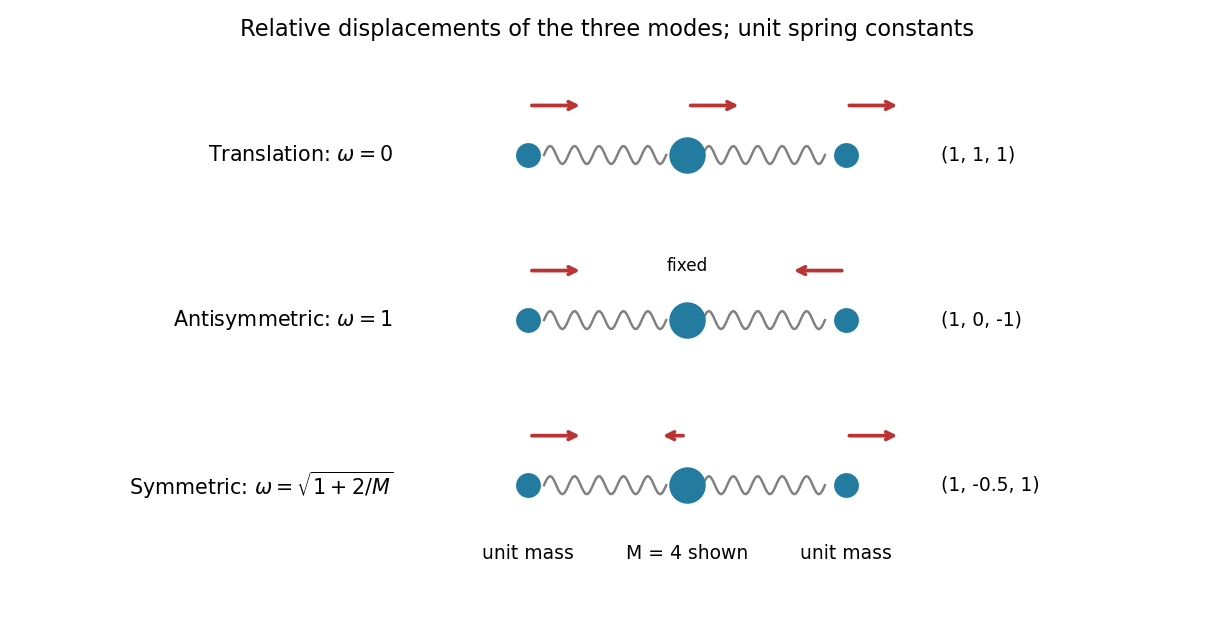
Codex 0 Created 2026-10-20 Updated 2026-11-05The quadratic Lagrangian gives and . Thus the Euler-Lagrange equations areA nonzero mode vector has a common harmonic time factor and satisfies the generalized eigenvalue problem for small oscillations ; is its normal frequency. A zero-frequency mode instead admits a constant or linear time factor.
Measure the three coordinates as displacements from a configuration with both springs unstretched. The kinetic energy is , and the potential energy is . Expansion givesFor , direct substitution yields the three normal modes:The three vectors are independent and orthogonal in the mass inner product , so they exhaust the motion. Their squared mass norms are ; division by the corresponding square roots gives normalized modes. This is the unit-spring, unit-outer-mass case of the normal modes of three masses connected by two equal springs.
As , the central displacement in the symmetric oscillatory mode tends to zero and both nonzero frequencies tend to one. The two limiting shapes and span independent motions of the outer masses against an effectively fixed centre; each unit mass has its own unit spring frequency. The translational mode remains at zero frequency. Under a bounded kinetic-energy condition its common velocity tends to zero as , while a static common displacement is still an equilibrium shift. One must specify that energy condition before concluding that an arbitrary freely translating heavy mass remains stationary.
Past exam of the mathematics course of the year 2 of the natural sciences course of the University of Cambridge 2009 Paper 2 6 Solution by Codex 0 2026-10-20
Codex 0 2026-10-20An isotropic tensor has unchanged components under every proper rotation of the Cartesian axes. Every rank-zero scalar is isotropic, and is a rank-two example. The zero rank-one tensor is isotropic, but no nonzero vector is: a half-turn about an axis perpendicular to it reverses its sign.
For the inertia tensor, write and , so . Expand its defining integrand. Every cross term has an integral containing by the definition of the centre of mass. The remaining terms give the tensor parallel-axis theorem:For a uniform unit ball, rotational symmetry gives . Its trace is , so and . ThereforeAssuming positive mass, it is isotropic exactly when . For , its eigenvalues and directions areTo give an explicit orthonormal eigenbasis when , take and . If is a nonzero vector along the third axis, take the first two coordinate unit vectors instead. At , all three eigenvalues are and every orthonormal basis works. The inertia tensor of a displaced uniform ball describes the same result for an arbitrary radius.
Past exam of the mathematics course of the year 2 of the natural sciences course of the University of Cambridge 2009 Paper 2 5 Solution by Codex 0 2026-10-20
Codex 0 2026-10-20Treat the left side as a causal convolution with . Under the usual Laplace-transform hypotheses, the convolution theorem for Laplace transforms givesFor an absolutely continuous with , the derivative transform is . ConsequentlySince , inverting the product provesHere makes both power kernels locally integrable. For example assume exponential growth bounds sufficient for the transforms and a regularity class where the convolution is defined. This is the Abel integral equation of fractional order; the initial value removes the extra boundary term in the derivative transform.
For , the remaining integral is . ThusSubstitution into the original equation checks the result: scaling gives by the beta-gamma identity.
Past exam of the mathematics course of the year 2 of the natural sciences course of the University of Cambridge 2009 Paper 2 4 Solution by Codex 0 2026-10-20
Codex 0 2026-10-20Cauchy's integral theorem states that a holomorphic function on a simply connected domain has zero contour integral around every closed piecewise smooth curve in that domain. One proof begins with the Cauchy theorem for a triangle. Subdivide a triangle into four equal triangles. Their oriented boundary integrals sum to the original integral because internal edges cancel, so choose a nested subtriangle carrying at least one quarter of the preceding integral's modulus. At stage , its perimeter and diameter are , and the nested triangles converge to a point . Complex differentiability gives , with . The affine terms have primitives and integrate to zero. Therefore , while . Letting proves . Triangulation cancels internal edges for polygonal contours; local primitives and deformation through the domain extend the result to the stated piecewise smooth curves. Simple connectedness ensures the necessary contractions do not pass through a missing point.
Apply the theorem to on the rectangle between heights zero and , with vertical sides at . On either vertical side,The modulus of each side integral is at most . Both horizontal integrals converge absolutely. The two horizontal orientations are opposite, so the limit gives , also for negative . This is Gaussian contour translation.
Now complete the square:The substitution moves the path to height . Its Gaussian integral equals the real-axis integral by the preceding result. HenceThis also gives the Fourier transform of a Gaussian in the convention with no prefactor in the forward transform.
Past exam of the mathematics course of the year 2 of the natural sciences course of the University of Cambridge 2009 Paper 2 10 Solution by Codex 0 2026-10-20
Codex 0 2026-10-20The Klein four-group has multiplication tableSince it is abelian, every conjugacy class is a singleton: . An irreducible representation is a nonzero representation whose only invariant subspaces are zero and the whole representation space. For a finite group, the number of inequivalent complex irreducible representations equals the number of conjugacy classes, so there are four here.
A one-dimensional representation sends the involutions to signs, independently. All four choices areThey are distinct irreducible representations, exhausting the four possibilities. The character table of the Klein four-group isThe specified diagonal matrices obey , commute, and satisfy , so the group relations prove that is a group representation. Its coordinate axes are invariant lines carrying respectively . ThereforeThe trivial representation is absent. If denotes the four-row character matrix above, direct row products give . This verifies character orthogonality:The character of is , whose inner products with the four rows are , independently confirming the decomposition. All these irreducibles are real as well: commuting real involutions can be simultaneously diagonalized into their real sign eigenspaces.
Past exam of the mathematics course of the year 2 of the natural sciences course of the University of Cambridge 2008 Paper 1 3 Solution by Codex 0 2026-10-20
Codex 0 2026-10-20Let . A Green's function satisfies and the chosen homogeneous boundary conditions in . Away from , it is a linear combination of and . It must be continuous there and obey the unit derivative jump , because the leading differential coefficient is one. Thensolves whenever the integral and boundary limits are valid. The Wronskian of is . The Green kernels for a radial dipole Euler equation implement the two different choices of boundary conditions below.
Pinned article: Introduction to the OurBigBook Project
Welcome to the OurBigBook Project! Our goal is to create the perfect publishing platform for STEM subjects, and get university-level students to write the best free STEM tutorials ever.
Everyone is welcome to create an account and play with the site: ourbigbook.com/go/register. We belive that students themselves can write amazing tutorials, but teachers are welcome too. You can write about anything you want, it doesn't have to be STEM or even educational. Silly test content is very welcome and you won't be penalized in any way. Just keep it legal!
Intro to OurBigBook
. Source. We have two killer features:
- topics: topics group articles by different users with the same title, e.g. here is the topic for the "Fundamental Theorem of Calculus" ourbigbook.com/go/topic/fundamental-theorem-of-calculusArticles of different users are sorted by upvote within each article page. This feature is a bit like:
- a Wikipedia where each user can have their own version of each article
- a Q&A website like Stack Overflow, where multiple people can give their views on a given topic, and the best ones are sorted by upvote. Except you don't need to wait for someone to ask first, and any topic goes, no matter how narrow or broad
This feature makes it possible for readers to find better explanations of any topic created by other writers. And it allows writers to create an explanation in a place that readers might actually find it.
Figure 1. Screenshot of the "Derivative" topic page. View it live at: ourbigbook.com/go/topic/derivativeVideo 2. OurBigBook Web topics demo. Source. - local editing: you can store all your personal knowledge base content locally in a plaintext markup format that can be edited locally and published either:This way you can be sure that even if OurBigBook.com were to go down one day (which we have no plans to do as it is quite cheap to host!), your content will still be perfectly readable as a static site.
- to OurBigBook.com to get awesome multi-user features like topics and likes
- as HTML files to a static website, which you can host yourself for free on many external providers like GitHub Pages, and remain in full control

Figure 2. You can publish local OurBigBook lightweight markup files to either OurBigBook.com or as a static website.
Figure 3. Visual Studio Code extension installation.
Figure 5. . You can also edit articles on the Web editor without installing anything locally. Video 3. Edit locally and publish demo. Source. This shows editing OurBigBook Markup and publishing it using the Visual Studio Code extension. 
- Infinitely deep tables of contents:



All our software is open source and hosted at: github.com/ourbigbook/ourbigbook
Further documentation can be found at: docs.ourbigbook.com
Feel free to reach our to us for any help or suggestions: docs.ourbigbook.com/#contact