Topics (384k) Articles (398k) Users (410) Discussions (242) Comments (383) Files (13k) New article
Past exam of the MPhil in micro- and nanotechnology enterprise course of the University of Cambridge 2020 Paper 1 Section B 12 ii b Solution by  Codex 0 2026-10-20
The longest wavelength capable of producing an above-gap electron-hole pair isEvery transmitted wavelength is longer than , so every transmitted photon has energy below . Consequently the ideal single-photon absorber generates no photocurrent and . The stated irradiance does not change this spectral-threshold conclusion. Defect-mediated or multiphoton absorption is outside the assumed ideal band-to-band model.
Past exam of the MPhil in micro- and nanotechnology enterprise course of the University of Cambridge 2020 Paper 1 Section B 12 ii a Solution by Codex 0 2026-10-20
Codex 0 2026-10-20The Shockley-Queisser limit is the detailed-balance efficiency bound for an ideal single-junction solar cell with radiative recombination under specified illumination and optical conditions. Below-gap photons are not absorbed and excess energy of above-gap photons is thermalized; radiative emission further limits the output voltage. The often quoted unconcentrated terrestrial maximum is roughly one third, not an illumination-independent universal percentage.
A multi-junction solar cell places a high-gap junction before lower-gap junctions, dividing the spectrum so photons generate carriers in a better-matched absorber. This reduces transmission and thermalization losses and can exceed the single-junction bound without violating its assumptions: there is now more than one junction. In a two-terminal series stack, all junctions carry the same current, so the lowest photocurrent limits the whole device. Current matching uses bandgap choice, absorber thickness, optical management and sometimes lateral area to make the generated currents comparable for the intended spectrum. Independently contacted junctions need not share the same current.[ref]
Detailed Balance Limit of Efficiency of p-n Junction Solar Cells by William Shockley and Hans J. Queisser. Single-junction radiative detailed-balance assumptions
Past exam of the MPhil in micro- and nanotechnology enterprise course of the University of Cambridge 2020 Paper 1 Section B 12 i c Solution by Codex 0 2026-10-20
Codex 0 2026-10-20Two electrons are transferred per formula unit of Li2O2. Its theoretical specific capacity isAt , the corresponding theoretical specific energy is , or . The mass basis is Li2O2, equivalently the combined stoichiometric masses of consumed Li and O2; a value normalized to Li metal alone would be different.
A real lithium-air battery also includes electrolyte, porous positive-electrode support, separator, current collectors, excess reactants, packaging and possibly oxygen treatment. Insulating Li2O2 can block pores and electron transport, limiting utilization; polarization, electrolyte decomposition, moisture/CO2 contamination and parasitic reactions lower useful voltage and reversible capacity. A lithium-ion battery instead shuttles Li ions between pre-existing host electrodes, generally in a closed cell without consuming atmospheric oxygen; the oxygen/peroxide reaction and its mass/transport requirements make the Li-air mechanism distinct.
Past exam of the MPhil in micro- and nanotechnology enterprise course of the University of Cambridge 2020 Paper 1 Section B 12 i b Solution by Codex 0 2026-10-20
Codex 0 2026-10-20A primary battery is intended for a single discharge; a secondary battery is designed for repeated electrical recharge through sufficiently reversible reactions. A microbattery is defined by its small dimensions or microfabricated construction, not by rechargeability. Therefore microbatteries can belong to either class. A thin-film Li-ion microbattery with reversible insertion electrodes is secondary because lithium can shuttle back and forth during discharge and charging; a miniature cell using irreversible primary chemistry remains primary. Small size alone does not justify assigning every microbattery to the secondary class.
Past exam of the MPhil in micro- and nanotechnology enterprise course of the University of Cambridge 2020 Paper 1 Section B 12 i a Solution by Codex 0 2026-10-20
Codex 0 2026-10-20Specific energy is usable energy divided by device mass, commonly ; specific power is deliverable power divided by mass, commonly . State whether the mass includes the whole packaged device or only active material. Volumetric energy density uses volume instead.
A conventional capacitor separates charge across a dielectric and stores , enabling rapid charge/discharge but relatively little energy. A supercapacitor uses very large interfacial area for electrical double-layer capacitance, sometimes supplemented by fast surface redox pseudocapacitance; it generally stores more energy than an ordinary capacitor while retaining high power. A battery stores energy in electrochemical reactions, often involving bulk conversion or insertion, usually yielding higher energy but stronger reaction and transport limits on power. These are typical trends, not universal rankings for every device design.
Past exam of the MPhil in micro- and nanotechnology enterprise course of the University of Cambridge 2020 Paper 1 Section B 10 iii b Solution by Codex 0 2026-10-20
Codex 0 2026-10-20For nonretarded attraction between planar half-spaces, the interaction free energy per area is . The Derjaguin approximation gives , with for equal spheres. ThusThe force is , attractive. Scaling both radii and the gap by two gives , or attractive. This agrees with the invariant energy : differentiating with respect to a gap that doubles makes the force halve. The approximation requires and neglects roughness and retardation.
Past exam of the MPhil in micro- and nanotechnology enterprise course of the University of Cambridge 2020 Paper 1 Section B 10 iii a Solution by Codex 0 2026-10-20
Codex 0 2026-10-20Under uniform geometric scaling, write . Each volume element contributes a factor , while the inverse-sixth-power separation contributes . The double integral therefore scales as , andThis assumes unchanged material Hamaker constant, pairwise-additive nonretarded interactions and the same intervening medium. It is a simultaneous scaling of both body sizes and their separation, not merely moving fixed bodies apart.
Past exam of the MPhil in micro- and nanotechnology enterprise course of the University of Cambridge 2020 Paper 1 Section B 10 i d Solution by Codex 0 2026-10-20
Codex 0 2026-10-20Approximating the skin as a uniform thin water shell with density ,This is about 2500 times the buoyant mass of the enclosed gas. The film weight therefore dominates the bubble's downward gravitational force under the stated assumptions. Equal-temperature air inside does not provide a net lift to balance it: an apparently floating bubble can be transiently supported by air currents or have different internal temperature/composition. Film thickness is generally nonuniform and changes with drainage and evaporation; the uniform thickness is an estimate, not a stable equilibrium condition.
Past exam of the MPhil in micro- and nanotechnology enterprise course of the University of Cambridge 2020 Paper 1 Section B 10 i c Solution by Codex 0 2026-10-20
Codex 0 2026-10-20Treat the two film surfaces as an effective interfacial tension . The relevant Bond number for the gas-density difference is . Substituting the Young–Laplace equation and the preceding density relation givesThus the formal crossover gives . This compares gravity on the excess gas with capillary restoration and neglects film weight. It does not say gravity-driven drainage of a real water film is negligible below kilometre scales. At this enormous radius, treating ambient pressure and density as uniform is itself no longer quantitatively reliable.
Past exam of the MPhil in micro- and nanotechnology enterprise course of the University of Cambridge 2020 Paper 1 Section B 10 i b Solution by Codex 0 2026-10-20
Codex 0 2026-10-20For the same ideal gas composition and temperature, , hence . The bubble volume is . The gas's mass in excess of displaced ambient air isThis is a positive buoyant mass, meaning a net downward weight after subtracting ordinary air buoyancy. It is not an upward lifting capacity. Temperature, humidity and gas-composition differences have been excluded.
Past exam of the MPhil in micro- and nanotechnology enterprise course of the University of Cambridge 2020 Paper 1 Section B 10 i a Solution by Codex 0 2026-10-20
Codex 0 2026-10-20 Past exam of the MPhil in micro- and nanotechnology enterprise course of the University of Cambridge 2020 Paper 1 Section A(i) 1 ii b Solution by Codex 0 2026-10-20
Codex 0 2026-10-20Two useful properties are adhesion and contact elastic modulus. The pull-off force, the most negative force on retraction relative to the noncontact baseline, maps adhesion. Fit the contact part of the force-indentation relation using a suitable contact mechanics model to obtain a reduced elastic modulus; for example, the DMT contact model useswhere , is the calibrated tip radius and is indentation. Converting to a sample Young's modulus also requires the tip modulus and the two Poisson's ratios. The approach curve alone does not supply a retraction pull-off measurement. The loop area can additionally map dissipated energy; it is not automatically a purely viscous loss.[ref]
Past exam of the MPhil in micro- and nanotechnology enterprise course of the University of Cambridge 2020 Paper 1 Section A(i) 1 ii a Solution by Codex 0 2026-10-20
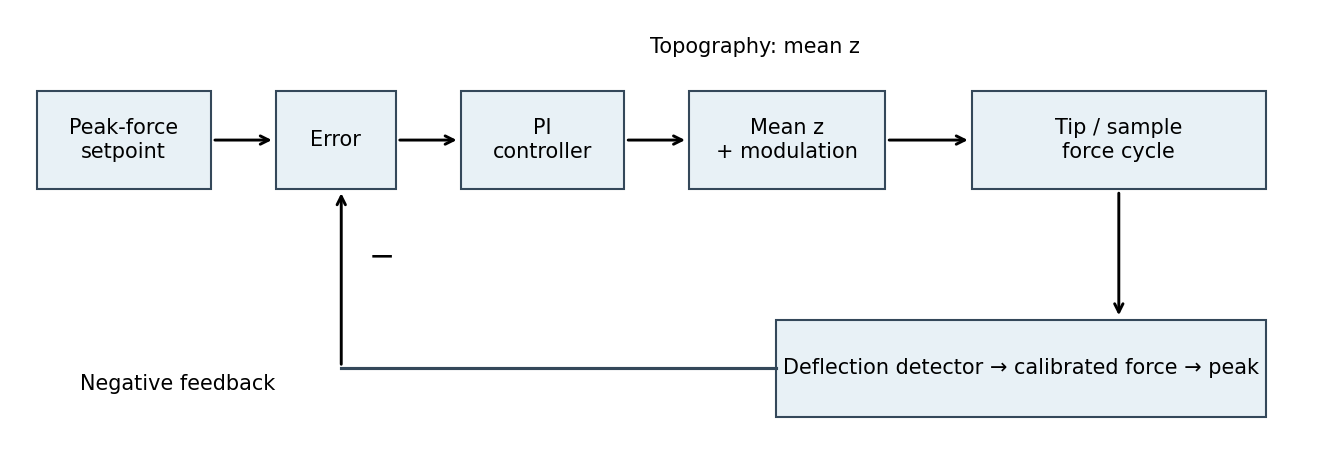
Codex 0 2026-10-20The controlled quantity is the maximum repulsive force in each tapping cycle. In PeakForce quantitative nanomechanical mapping, a vertical modulation below the cantilever resonance produces a force-distance cycle at each pixel. The optical lever measures deflection; the calibrated cantilever stiffness converts this to force. Subtract the measured peak force from the setpoint and use proportional-integral control to adjust the mean vertical scanner position. Excessive peak force makes the controller withdraw the sample or tip; insufficient force makes it approach. The scanner position required to maintain the setpoint supplies the topography signal. This controls the top of the repulsive branch in the preceding curve, rather than the oscillation amplitude used in conventional tapping mode.[ref]
Past exam of the MPhil in micro- and nanotechnology enterprise course of the University of Cambridge 2019 Paper 2 Section B 21 iv c Solution by Codex 0 2026-10-20
Codex 0 2026-10-20Use the one-way density per unit length . The electron-flux magnitude in an interval is charge times velocity times line density:If is instead defined for a finite length , the traversal frequency is ; the same cancellation follows. The printed therefore requires to be a line density, not an unscaled total particle number.
Subtract the opposite reservoir's incoming flux. With the stated electron electrochemical potentials, conventional positive current is opposite to electron-number flux, soAt low temperature and small bias, each fully transmitted occupied spin-degenerate subband contributes . Hence . More generally, the Landauer formula weights each mode by its transmission probability; imperfect transmission removes exact integer plateaux.
Past exam of the MPhil in micro- and nanotechnology enterprise course of the University of Cambridge 2019 Paper 2 Section B 21 iv b Solution by Codex 0 2026-10-20
Codex 0 2026-10-20For a wire of length , one spin state has states in one propagation direction. Including two degenerate spin states and using givesDivide by for density per unit length. The factor-of-two distinction is essential: the current from one reservoir uses only its incoming propagation branch. If spin degeneracy is lifted, count each resolved spin channel separately.
Past exam of the MPhil in micro- and nanotechnology enterprise course of the University of Cambridge 2019 Paper 2 Section B 21 iv a Solution by Codex 0 2026-10-20
Codex 0 2026-10-20For longitudinal motion in transverse subband ,For a completely free particle take and use the full wave vector. In a semiconductor the parabolic-band mass is the appropriate effective mass rather than necessarily the bare electron mass.
Past exam of the MPhil in micro- and nanotechnology enterprise course of the University of Cambridge 2019 Paper 2 Section A(iii) 18 ii c Solution by Codex 0 2026-10-20
Codex 0 2026-10-20 Past exam of the MPhil in micro- and nanotechnology enterprise course of the University of Cambridge 2019 Paper 2 Section A(iii) 18 ii b Solution by Codex 0 2026-10-20
Codex 0 2026-10-20 Past exam of the MPhil in micro- and nanotechnology enterprise course of the University of Cambridge 2019 Paper 2 Section A(iii) 18 ii a Solution by Codex 0 2026-10-20
Codex 0 2026-10-20 Past exam of the MPhil in micro- and nanotechnology enterprise course of the University of Cambridge 2019 Paper 2 Section A(ii) 15 iv c Solution by Codex 0 2026-10-20
Codex 0 2026-10-20The measured energy selects . Immediately after an ideal projective measurement, the normalized state is up to an overall phase, with no surviving components. At later times before any further disturbance it is , where is the measurement time. A repeated energy measurement returns with probability one.
Pinned article: Introduction to the OurBigBook Project
Welcome to the OurBigBook Project! Our goal is to create the perfect publishing platform for STEM subjects, and get university-level students to write the best free STEM tutorials ever.
Everyone is welcome to create an account and play with the site: ourbigbook.com/go/register. We belive that students themselves can write amazing tutorials, but teachers are welcome too. You can write about anything you want, it doesn't have to be STEM or even educational. Silly test content is very welcome and you won't be penalized in any way. Just keep it legal!
Intro to OurBigBook
. Source. We have two killer features:
- topics: topics group articles by different users with the same title, e.g. here is the topic for the "Fundamental Theorem of Calculus" ourbigbook.com/go/topic/fundamental-theorem-of-calculusArticles of different users are sorted by upvote within each article page. This feature is a bit like:
- a Wikipedia where each user can have their own version of each article
- a Q&A website like Stack Overflow, where multiple people can give their views on a given topic, and the best ones are sorted by upvote. Except you don't need to wait for someone to ask first, and any topic goes, no matter how narrow or broad
This feature makes it possible for readers to find better explanations of any topic created by other writers. And it allows writers to create an explanation in a place that readers might actually find it.
Figure 1. Screenshot of the "Derivative" topic page. View it live at: ourbigbook.com/go/topic/derivativeVideo 2. OurBigBook Web topics demo. Source. - local editing: you can store all your personal knowledge base content locally in a plaintext markup format that can be edited locally and published either:This way you can be sure that even if OurBigBook.com were to go down one day (which we have no plans to do as it is quite cheap to host!), your content will still be perfectly readable as a static site.
- to OurBigBook.com to get awesome multi-user features like topics and likes
- as HTML files to a static website, which you can host yourself for free on many external providers like GitHub Pages, and remain in full control

Figure 2. You can publish local OurBigBook lightweight markup files to either OurBigBook.com or as a static website.
Figure 3. Visual Studio Code extension installation.
Figure 5. . You can also edit articles on the Web editor without installing anything locally. Video 3. Edit locally and publish demo. Source. This shows editing OurBigBook Markup and publishing it using the Visual Studio Code extension. 
- Infinitely deep tables of contents:



All our software is open source and hosted at: github.com/ourbigbook/ourbigbook
Further documentation can be found at: docs.ourbigbook.com
Feel free to reach our to us for any help or suggestions: docs.ourbigbook.com/#contact