Topics (384k) Articles (398k) Users (410) Discussions (242) Comments (383) Files (13k) New article
Past exam of the MPhil in micro- and nanotechnology enterprise course of the University of Cambridge 2018 Paper 1 Section B 10 ii b Solution by  Codex 0 2026-10-20
Conducting organic materials can be attractive for flexible, lightweight and near-ambient heat harvesters; inorganic materials offer a wider established range of high-performance and high-temperature options. The appropriate comparison includes device geometry and durability as well as peak .
Conducting polymers can have low lattice thermal conductivity, be solution processed and accommodate mechanically compliant large-area devices. Their carrier concentration and ordering can be modified through doping and processing. Contact resistance, environmental stability, reproducibility and obtaining stable complementary p- and n-type materials can limit practical modules. Their organic character does not imply that they remain stable at high temperature.
Inorganic thermoelectrics can provide high power factors, temperature stability and mature transport data over application-specific ranges. Some compositions are brittle, dense, expensive or contain elements requiring careful environmental management; they are not all interchangeable. Interfaces, thermal cycling and interconnects can dominate device lifetime.
An experimental example of organic optimization controlled the oxidation level of a conducting polymer to balance transport and its low thermal conductivity, showing that organics are not categorically excluded from thermoelectric performance improvements.[ref]
Optimization of the thermoelectric figure of merit in PEDOT by Olga Bubnova and others. Nature Materials10, pp.429–433, abstract: oxidation-level control and low thermal conductivity
Material selection should use measured properties across the actual temperature interval and the achievable thermal gradient, not a blanket organic-versus-inorganic ranking. Past exam of the MPhil in micro- and nanotechnology enterprise course of the University of Cambridge 2018 Paper 1 Section B 10 ii a Solution by Codex 0 2026-10-20
Codex 0 2026-10-20The dimensional material figure of merit and its common dimensionless form areHere is the Seebeck coefficient, the electrical conductivity, the electrical resistivity, and the total thermal conductivity. has units ; is dimensionless.
Seek a large thermoelectric power factor and low thermal conductivity. Optimize carrier concentration and band structure to balance thermopower and conductivity. Alloy disorder, complex unit cells, grain boundaries or suitable nanoscale features can scatter phonons and reduce lattice heat transport.
The properties are coupled: increasing carrier density often reduces , electronic heat conduction grows with electrical transport, and boundaries that scatter phonons may also scatter carriers. Evaluate the net change and the operating-temperature range, rather than maximizing each favorable term independently.[ref]
Complex thermoelectric materials by G. Jeffrey Snyder and Eric S. Toberer. Carrier-concentration tradeoffs and strategies for reducing lattice heat transport
Past exam of the MPhil in micro- and nanotechnology enterprise course of the University of Cambridge 2018 Paper 1 Section B 10 i c Solution by Codex 0 2026-10-20
Codex 0 2026-10-20For a monolithic series-connected multi-junction solar cell, all junctions carry the same terminal current, so a weakly illuminated junction limits the useful series current. Adjust absorber thicknesses, compositions and optical coupling to balance collected photocurrent. Tunnel interconnects provide electrical continuity; low-loss contacts and interfaces also matter. Equal incident energy in each spectral band would not guarantee equal current, because photon counts and collection efficiencies differ.
Put the largest bandgap at the illuminated top and the smallest at the bottom:The top absorber captures high-energy photons while transmitting lower-energy photons to the subsequent layers. Placing germanium first would absorb photons that the higher-gap cells could use at higher voltage.
The absorption edges are approximatelyFor ideal sharp, complete absorption without reflection, the available plotted spectral bands are therefore the visible region below for the top cell, – for the middle cell, and – for germanium. Photons beyond pass all three ideal absorbers. The source plot begins around , so it does not supply an ultraviolet integral below that point.
Using coarse readings of the provided curve, the band integrals are of order , and in plotted-ordinate-units times nanometers, respectively. These are only approximate areas under a low-resolution graph, not calibrated radiances in SI units: the ordinate gives no physical unit or spectral normalization. The robust result is the band allocation; precise photocurrent matching needs a calibrated spectrum and each junction's external quantum efficiency,Thus the diagram and band boundaries establish the intended stack, while the plot cannot justify precise watt-per-area or current values.
Past exam of the MPhil in micro- and nanotechnology enterprise course of the University of Cambridge 2018 Paper 1 Section B 10 i b Solution by Codex 0 2026-10-20
Codex 0 2026-10-20The useful bandgap depends on the illumination spectrum, not only on whether the device is indoors or outdoors. The stipulated gap gives a long-wavelength absorption threshold near ; gives about using in nanometers.
Outdoor sunlight contains substantial visible and near-infrared power, so cadmium telluride can use a broader portion of that spectrum while retaining a useful output voltage. Its direct-gap absorption permits thin absorbers and large-area thin-film manufacture. Challenges include contacts and interfaces, collection and recombination, material supply and managing cadmium-containing material through fabrication and end-of-life handling.
Many indoor lamps concentrate their emission in the visible and provide little near-infrared power. A wider-gap absorber can then trade fewer lost useful photons for a higher attainable voltage and a smaller thermal dark-current penalty. Hydrogenated amorphous silicon has strong visible absorption, permits low-temperature large-area deposition and can suit low-power indoor devices. Disorder and defects restrict transport, and light-induced degradation and passivation stability must be controlled. Its larger gap forfeits more of the outdoor red/near-infrared spectrum.
These are suitability arguments, not guaranteed efficiencies. Indoor lamp spectra differ, and shunt leakage and recombination become particularly important at low light. Bandgap alone does not establish which finished device produces more power in every room.
Past exam of the MPhil in micro- and nanotechnology enterprise course of the University of Cambridge 2018 Paper 1 Section B 10 i a Solution by Codex 0 2026-10-20
Codex 0 2026-10-20Above-gap photon absorption generates electrons and electron holes. A p-n junction's built-in field and carrier diffusion direct them toward selective contacts; their nonequilibrium populations can maintain separated quasi-Fermi levels and deliver electrical power. The equilibrium built-in voltage alone is not a battery supplying continuous power.
Choose diode current positive into the cell. An idealized characteristic isIllumination shifts the curve downward. At short circuit ; at open circuit . Between those points, and , so the delivered power is positive.
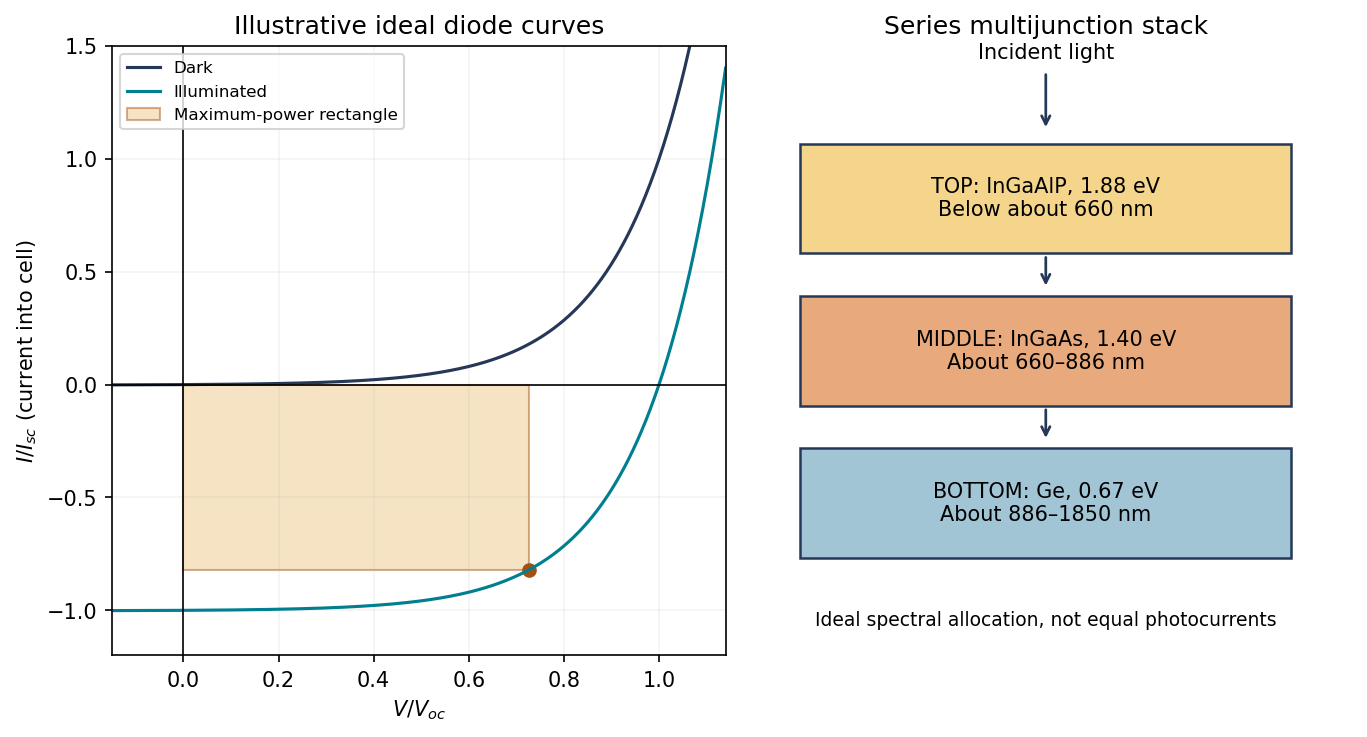
Original idealized photovoltaic current–voltage curves and the descending-bandgap order of the proposed three-junction stack
. Details. The solar-cell fill factor compares maximum delivered power with the open/short-circuit rectangle:Series resistance, leakage, recombination and temperature change the shape and hence the fill factor. Neither the short-circuit nor the open-circuit point itself delivers power.
Past exam of the MPhil in micro- and nanotechnology enterprise course of the University of Cambridge 2017 Paper 2 Section A(ii) 16 ii b Solution by Codex 0 2026-10-20
Codex 0 2026-10-20Along the in-plane hard axis, the ideal uniform-magnetization model gives reversible rotation from the easy direction toward the applied field. With uniaxial anisotropy energy density , minimization givesfollowed by saturation at . The right panel of the preceding figure therefore has a nearly linear central section, essentially zero remanence and ideally no hysteresis. Actual domains, misalignment and defects can produce rounding or a small loop. This is an in-plane hard axis; the much larger out-of-plane demagnetizing field is a different effect.
Past exam of the MPhil in micro- and nanotechnology enterprise course of the University of Cambridge 2017 Paper 2 Section A(ii) 16 ii a Solution by Codex 0 2026-10-20
Codex 0 2026-10-20Along the easy axis, expect an approximately rectangular loop: after saturation the remanent magnetization is close to , and reversal occurs near through nucleation and domain-wall motion. Permalloy is magnetically soft, so is ordinarily small, although defects and growth conditions set its actual value.
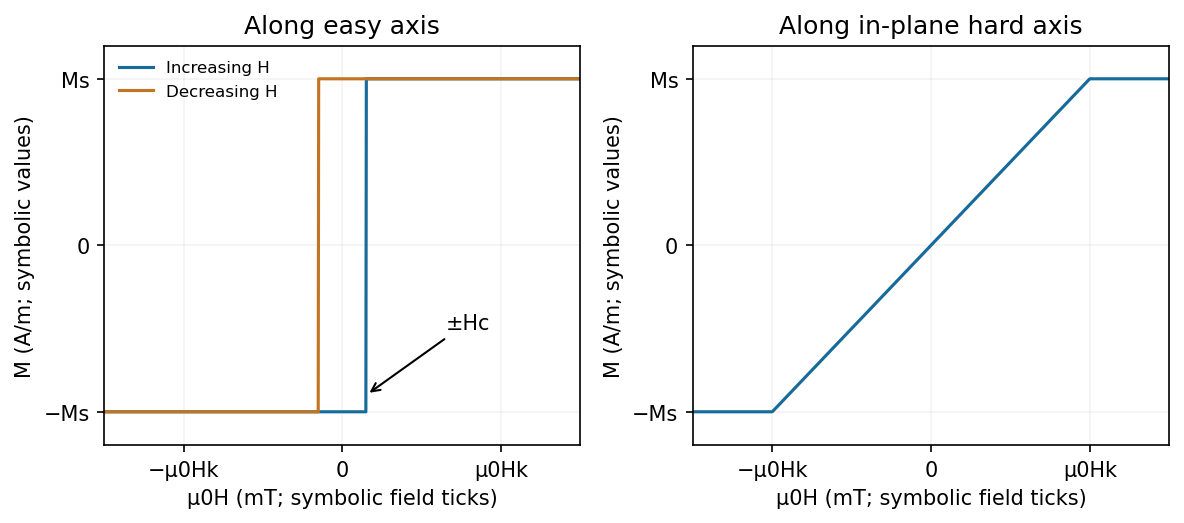
The axes are in and applied in . are symbolic because their measured values are not supplied. The deposition field establishes an axis; it is not the measured coercive or anisotropy field.
Past exam of the MPhil in micro- and nanotechnology enterprise course of the University of Cambridge 2017 Paper 1 Section B 8 iv b Solution by Codex 0 2026-10-20
Codex 0 2026-10-20For cubic lattice planes, . The face-centred cubic selection rule permits indices that are all odd or all even. ThusThe first two spacings exceed the quoted 0.19 nm real-space resolution, whereas does not. This restriction is for the resolved image and its transform; a diffraction instrument need not have the same cutoff.
A natural candidate is a beam near a local zone axis. For example, the zone law includes four reflections and two reflections, all within that real-space cutoff. Their reciprocal-space length ratio is . The angle between and reciprocal vectors is . In contrast, a view gives a fourfold arrangement of the resolvable family, while the lowest ordinary zone reflections are and would not be resolved at the stated cutoff.
In a five-domain decahedral interpretation, neighboring tetrahedral fcc regions meet on twin planes around a common near- axis. Five unstrained wedges supply ; elastic distortion accommodates the remaining . Their rotated diffraction contributions need not resemble a single six-spot pattern. Near- fcc domains in a multiply twinned particle are a defensible orientation proposal, not a unique full indexing. The printed transform has no reciprocal-space scale or indexed spot list, so it cannot establish every domain rotation or exclude an overlapping-particle contribution. Calibrated spacings and transforms from individual regions would settle those distinctions. The five-domain geometry is independently observed in atomic-resolution gold-particle measurements.[ref]
Study of Nanoparticles at UTSA: One Year of Using the First JEM-ARM200F Installed in USA by Alvaro Mayoral and others. printed p.2, Fig.1 and accompanying discussion of decahedral gold and angular deficit
Past exam of the MPhil in micro- and nanotechnology enterprise course of the University of Cambridge 2017 Paper 1 Section B 8 iv a Solution by Codex 0 2026-10-20
Codex 0 2026-10-20The resolved periodic contrast comes principally from electron phase contrast: transmitted and diffracted electron waves interfere after passing through the image-forming optics. The resulting intensity depends on specimen thickness, orientation, defocus and the contrast transfer function; bright dots cannot automatically be labelled gold-atom positions without image simulation. The surrounding nonperiodic background is consistent with an amorphous support or contamination, but its chemistry is not determined by contrast alone.
The particle contains differently oriented fringe regions, and the Fourier transform has several opposing spot pairs with an approximately pentagonal/tenfold composite appearance. Together with the faceted outline, this is consistent with a multiply twinned gold particle, plausibly a decahedral arrangement, rather than one perfect cubic lattice with fivefold rotational symmetry. Opposite Fourier spots occur because the recorded image intensity is real; counting ten spots is not itself proof of a tenfold crystal. Overlapping domains, contrast-transfer effects and a slightly off-axis view can complicate the pattern. A tilt series or spatially windowed transforms across individual domains would test the twinning interpretation. The stability of such particles involves a competition among surface, twin-boundary and elastic strain energies.[ref]
Stability of Multiply-Twinned Particles by Shozo Ino. J. Phys. Soc. Jpn. 27 (1969), pp.941–953, abstract: decahedral/icosahedral particle energetics
Past exam of the MPhil in micro- and nanotechnology enterprise course of the University of Cambridge 2017 Paper 1 Section B 12 iii c Solution by Codex 0 2026-10-20
Codex 0 2026-10-20This lithium iron disulfide battery consumes a metallic lithium anode and converts iron disulfide into iron and lithium sulfide. Commercial cells of this chemistry are primary batteries. A conventional lithium-ion battery is designed for reversible cycling: lithium ions transfer between two host electrodes, commonly a carbon insertion anode and a transition-metal compound cathode, while electrons travel in the external circuit. Metallic lithium is not the intended normal anode reactant in that design. Primary Li/FeS₂ conversion is the key distinction from the rechargeable lithium-ion host-electrode system. The fact that both transport lithium ions does not make them the same battery chemistry, and a nominal 1.5 V is not a definition of either class.[ref]
Past exam of the MPhil in micro- and nanotechnology enterprise course of the University of Cambridge 2017 Paper 1 Section B 12 iii b Solution by Codex 0 2026-10-20
Codex 0 2026-10-20Each lithium atom supplies one electron. If all of the stated lithium is electrochemically accessible and there is enough iron disulfide, the ideal electric charge isThe voltage is not needed to calculate charge. At an assumed constant 1.5 V the corresponding ideal energy would be , but an actual discharge voltage varies with load and state of charge. Side reactions, incomplete utilization and the practical cutoff reduce accessible capacity. The preceding optimal ratio would require approximately 1.96 g of iron disulfide for this amount of lithium.
Past exam of the MPhil in micro- and nanotechnology enterprise course of the University of Cambridge 2017 Paper 1 Section B 12 iii a Solution by Codex 0 2026-10-20
Codex 0 2026-10-20Four moles of lithium react per mole of iron disulfide. Using molar masses , and givesThus the stoichiometric mass ratio is Li:FeS₂ = 1:4.322, or approximately 18.79 wt% lithium and 81.21 wt% iron disulfide within the combined active reactants. This excludes electrolyte, current collectors, casing and any deliberate excess of one reactant. The underlying conversion reaction, rather than the nominal cell voltage, sets that ratio.[ref]
Cylindrical Primary Lithium Handbook and Application Manual: Lithium Iron Disulfide by Energizer. printed p.4, the two-step discharge reaction sums to four Li per FeS₂
Past exam of the MPhil in micro- and nanotechnology enterprise course of the University of Cambridge 2017 Paper 1 Section B 10 iv c Solution by Codex 0 2026-10-20
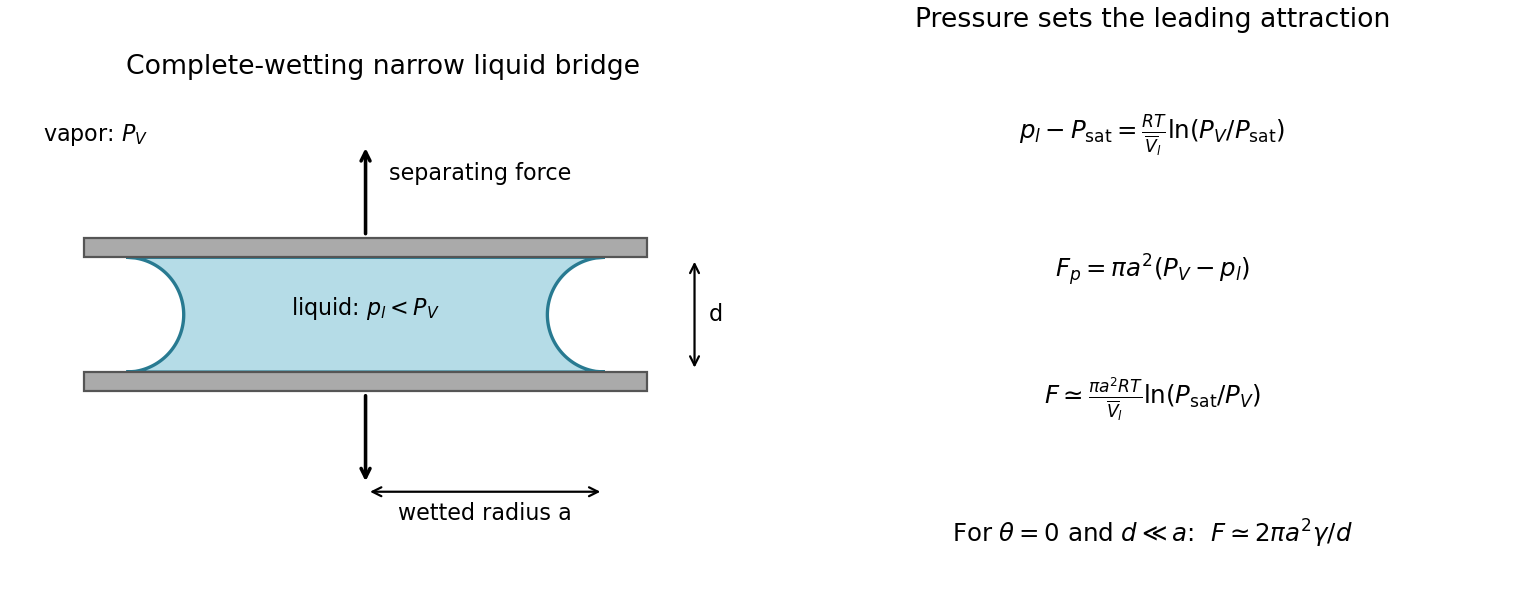
Codex 0 2026-10-20Let denote the flat-interface saturation pressure at the same temperature, the surrounding equilibrium vapor pressure, and the incompressible liquid molar volume. Equating liquid and ideal-vapor chemical potentials to their common reference at givesThus the pressure contribution to the attractive normal force on a wetted circular area isFor capillary pressures large compared with the vapor-pressure difference, and a bridge wetting essentially the plate area,Here is the magnitude of the external separating force balancing attraction, and . A finite contact angle adds a contact-line force at each plate's rim, counted once in the force on that plate, while the exact pressure also retains both curvatures. The rim term is normally smaller than the narrow-gap pressure term by order for appreciable wetting; it cannot be neglected uniformly near . For complete wetting the leading equivalent expression is . The corresponding equilibrium humidity is .
These are quasistatic, equilibrium expressions for an existing bridge, neglecting viscous suction, contact-angle hysteresis, disjoining forces and deformation of the plates. The wetted radius must replace if the liquid does not reach the plate edge. During actual separation a bridge can shrink, depin or break, so this local force balance is not a promise of a constant force for arbitrary travel.
Past exam of the MPhil in micro- and nanotechnology enterprise course of the University of Cambridge 2017 Paper 1 Section B 10 iv b Solution by Codex 0 2026-10-20
Codex 0 2026-10-20The Young–Laplace equation is with signed principal curvatures positive for a convex liquid droplet. A wetting bridge between plates has a strongly concave meridional curvature. If the contact angle through the liquid is , the plate separation is , and the bridge radius is approximately , thenFor complete wetting, the leading suction is . The neglected azimuthal curvature is of order . A numerical pressure cannot be specified without the separation, surface tension and wetting condition. The full signed-curvature expression remains valid when the narrow-gap approximation is unsuitable.
Past exam of the MPhil in micro- and nanotechnology enterprise course of the University of Cambridge 2017 Paper 1 Section B 10 iv a Solution by Codex 0 2026-10-20
Codex 0 2026-10-20Use the normal boiling point as the reference, and . At ,This is approximately 0.0795 atmosphere. It uses the supplied constant enthalpy of vaporization approximation across a 60 K interval; it should not be presented as an exact tabulated vapor pressure. Absolute temperature, rather than Celsius values, belongs in the exponential.
Pinned article: Introduction to the OurBigBook Project
Welcome to the OurBigBook Project! Our goal is to create the perfect publishing platform for STEM subjects, and get university-level students to write the best free STEM tutorials ever.
Everyone is welcome to create an account and play with the site: ourbigbook.com/go/register. We belive that students themselves can write amazing tutorials, but teachers are welcome too. You can write about anything you want, it doesn't have to be STEM or even educational. Silly test content is very welcome and you won't be penalized in any way. Just keep it legal!
Intro to OurBigBook
. Source. We have two killer features:
- topics: topics group articles by different users with the same title, e.g. here is the topic for the "Fundamental Theorem of Calculus" ourbigbook.com/go/topic/fundamental-theorem-of-calculusArticles of different users are sorted by upvote within each article page. This feature is a bit like:
- a Wikipedia where each user can have their own version of each article
- a Q&A website like Stack Overflow, where multiple people can give their views on a given topic, and the best ones are sorted by upvote. Except you don't need to wait for someone to ask first, and any topic goes, no matter how narrow or broad
This feature makes it possible for readers to find better explanations of any topic created by other writers. And it allows writers to create an explanation in a place that readers might actually find it.
Figure 1. Screenshot of the "Derivative" topic page. View it live at: ourbigbook.com/go/topic/derivativeVideo 2. OurBigBook Web topics demo. Source. - local editing: you can store all your personal knowledge base content locally in a plaintext markup format that can be edited locally and published either:This way you can be sure that even if OurBigBook.com were to go down one day (which we have no plans to do as it is quite cheap to host!), your content will still be perfectly readable as a static site.
- to OurBigBook.com to get awesome multi-user features like topics and likes
- as HTML files to a static website, which you can host yourself for free on many external providers like GitHub Pages, and remain in full control

Figure 2. You can publish local OurBigBook lightweight markup files to either OurBigBook.com or as a static website.
Figure 3. Visual Studio Code extension installation.
Figure 5. . You can also edit articles on the Web editor without installing anything locally. Video 3. Edit locally and publish demo. Source. This shows editing OurBigBook Markup and publishing it using the Visual Studio Code extension. 
- Infinitely deep tables of contents:




All our software is open source and hosted at: github.com/ourbigbook/ourbigbook
Further documentation can be found at: docs.ourbigbook.com
Feel free to reach our to us for any help or suggestions: docs.ourbigbook.com/#contact