Topics (384k) Articles (398k) Users (410) Discussions (242) Comments (383) Files (13k) New article
Past exam of the MPhil in micro- and nanotechnology enterprise course of the University of Cambridge 2021 Paper 2 Section A(iii) 18 iv Solution by  Codex 0 2026-10-20
Flocculation indicates that the attraction/kinetic balance has changed: electrolyte may screen a double-layer barrier; pH may reduce surface charge; multivalent ions can promote aggregation; added polymer can bridge particles or cause depletion force; poor solvent conditions can collapse stabilizing layers. Rapid evaporation concentrates both particles and salts and can force contacts faster than they anneal. Aggregates then sediment much faster because their effective buoyant size has grown.
Check ionic strength, pH, surface charge and the particle size distribution before and during assembly. Dialyse or reduce salt where appropriate, restore surface charge, add a nonbridging steric stabilization with a compatible solvent, and slow the concentration step. Compare untreated and deliberately salt-screened controls. Restoring repulsion after irreversible aggregation may not redisperse the particles, so prevention is preferable to assuming all settled material can be recovered.
Past exam of the MPhil in micro- and nanotechnology enterprise course of the University of Cambridge 2021 Paper 2 Section A(iii) 18 iii Solution by Codex 0 2026-10-20
Codex 0 2026-10-20Increase particle volume fraction slowly by controlled evaporation or gentle concentration until ordering becomes favourable, while preserving sufficient colloidal repulsion to prevent irreversible sticking. Hard-sphere-like monodisperse suspensions can crystallize by packing entropy; weak, reversible attractions can also favour ordered assembly if they allow defect correction. A controlled drying front or patterned surface may guide the orientation, and gentle sedimentation can create a concentration gradient that crosses the ordering range.
The practical requirement is slow structural change relative to Brownian motion, with uniform temperature, well-characterized ionic strength and a narrow size distribution. An abrupt salt addition or rapid drying can remove the repulsive barrier and trap aggregates instead of growing a crystal. Scattering or microscopy should distinguish crystalline peaks/order from merely increased turbidity.
Past exam of the MPhil in micro- and nanotechnology enterprise course of the University of Cambridge 2021 Paper 2 Section A(iii) 18 ii Solution by Codex 0 2026-10-20
Codex 0 2026-10-20A useful microscopic screening estimate compares thermal energy with the buoyant gravitational potential energy over one particle radius. Write and . The sedimentation length is , and the gravitational Peclet number isUsing and requiring givesEquivalently, combining Stokes law speed and diffusion coefficient gives . Buoyancy, not the full polystyrene density, is essential to the estimate. Taking a diameter rather than radius as the comparison length changes the numerical cutoff by an order-one factor.
There is no universal largest particle that stays uniformly suspended indefinitely. If uniformity over a vessel height is required, use , not merely . For example gives a much smaller radius, about 58 nm. Observation time, density matching, convection, particle polydispersity and shape also matter. Independent of sedimentation, electrostatic/steric barriers must prevent aggregation; low ionic strength, suitable surface chemistry and clean solvent can be as important as size.
Past exam of the MPhil in micro- and nanotechnology enterprise course of the University of Cambridge 2021 Paper 2 Section A(iii) 18 i Solution by Codex 0 2026-10-20
Codex 0 2026-10-20For this self-assembly into a colloidal crystal, four useful elements are building blocks, interactions, environment and reversible dynamics. The building blocks here are nearly monodisperse polymer spheres; their shape and size distribution constrain the accessible packing. Their interactions include excluded volume, Van der Waals forces and electrostatic or steric stabilization, which set the free energy landscape. The aqueous environment supplies temperature, viscosity, ionic strength, confinement and concentration controls. Finally, Brownian motion and rotation must let particles encounter one another and rearrange or detach from incorrect contacts. Attractions that bind every collision irreversibly favour an amorphous aggregate rather than an annealed colloidal crystal. These four categories include both thermodynamic selection and the transport/kinetic access needed to realize it.
Past exam of the MPhil in micro- and nanotechnology enterprise course of the University of Cambridge 2021 Paper 2 Section A(iii) 17 iii Solution by Codex 0 2026-10-20
Codex 0 2026-10-20 Past exam of the MPhil in micro- and nanotechnology enterprise course of the University of Cambridge 2021 Paper 2 Section A(iii) 17 ii Solution by Codex 0 2026-10-20
Codex 0 2026-10-20 Past exam of the MPhil in micro- and nanotechnology enterprise course of the University of Cambridge 2021 Paper 2 Section A(ii) 16 iii Solution by Codex 0 2026-10-20
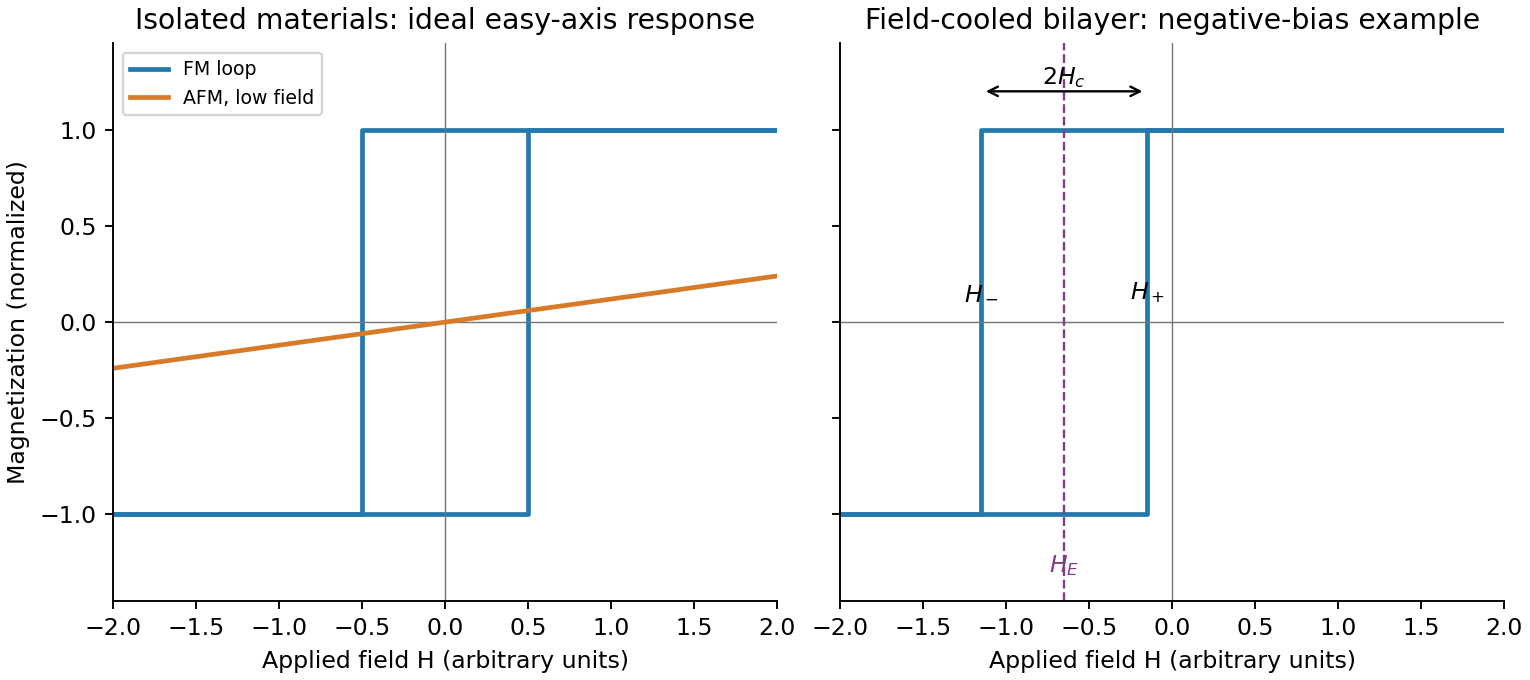
Codex 0 2026-10-20Write the descending and ascending switching fields as and . The exchange bias loop centre and magnetic coercivity half-width areWith exchange bias, a field-cooled bilayer has , often a shift opposite to the cooling field for the conventional negative-bias case shown in the diagram. The sign is not universal; it depends on interfacial coupling and preparation. A simple rigid-pinning estimate is .
Cooling farther below the blocking range usually strengthens antiferromagnetic anisotropy and suppresses thermal relaxation, so the magnitude of the shift and often the coercive width grow. Close to or above the blocking temperature the shift disappears; the blocking temperature can be below . Repeated cycling can rearrange interfacial spins and reduce the bias, and the two reversal branches can acquire different shapes. Thus increasing low-temperature asymmetry is a common tendency, not a guaranteed monotonic law for every interface.
Past exam of the MPhil in micro- and nanotechnology enterprise course of the University of Cambridge 2021 Paper 2 Section A(ii) 16 ii Solution by Codex 0 2026-10-20
Codex 0 2026-10-20Heat the bilayer into a window , apply an in-plane magnetic field sufficient to align the ferromagnet, and cool through the antiferromagnet's ordering/blocking range while retaining the field. The ferromagnet supplies a preferred interfacial spin direction as the antiferromagnet orders. Sufficient antiferromagnetic anisotropy then pins part of the interfacial spin configuration, producing unidirectional magnetic anisotropy rather than merely uniaxial magnetic anisotropy in the ferromagnet.
Measure a full major hysteresis loop after removing the cooling field, and compare with the isolated ferromagnet, a zero-field-cooled bilayer and the result of reversing the cooling-field direction. Those controls separate a true loop-centre shift from a changed coercive width, minor-loop artefacts or trapped applied field. The effect requires appropriate interfacial exchange and stable pinning; an ideally compensated or freely rotating interface need not produce a large bias. Exchange anisotropy in coupled ferromagnetic/antiferromagnetic material was demonstrated in the classic experiment below.[ref]
New Magnetic Anisotropy by W. H. Meiklejohn and C. P. Bean. Physical Review 102 (1956), pp. 1413–1414
Past exam of the MPhil in micro- and nanotechnology enterprise course of the University of Cambridge 2021 Paper 2 Section A(ii) 16 i Solution by Codex 0 2026-10-20
Codex 0 2026-10-20For an isolated easy-axis ferromagnet undergoing coherent reversal, the ideal low-temperature loop is approximately rectangular, switching between at . It has remanent Magnetization and a large response near switching. An ideal compensated antiferromagnet has essentially no remanence and a small, approximately reversible linear net Magnetization at fields far below its exchange/spin-flop scales. Strong antiferromagnetic exchange makes substantial canting costly, so its low-field magnetic susceptibility is small relative to the ferromagnet's unsaturated switching response.
This comparison does not say the ferromagnet has a larger differential slope at every field: on its saturated branches can also be small. Nor does it rule out spin-flop transitions at much larger fields, outside the sketched range. The original plot uses arbitrary normalized scales.
Past exam of the MPhil in micro- and nanotechnology enterprise course of the University of Cambridge 2021 Paper 2 Section A(ii) 15 iii Solution by Codex 0 2026-10-20
Codex 0 2026-10-20The addition energy has both charging and orbital terms,The larger diamonds indicate quantum dot shell closure after 2, 6 and 12 electrons. A two-dimensional isotropic harmonic oscillator confinement, , explains that sequence: shell has orbital states and capacity after spin degeneracy. The cumulative capacities are . Within a degenerate shell, the extra orbital term vanishes to this approximation; crossing a shell boundary costs an extra .
The gate capacitance lever arm is . Large and small gate widths differ by , so . Equivalently the tip energies differ by . Confinement anisotropy, exchange and disorder would split the ideal degeneracies; the diagram supports approximate shell symmetry rather than proving a perfectly parabolic potential.
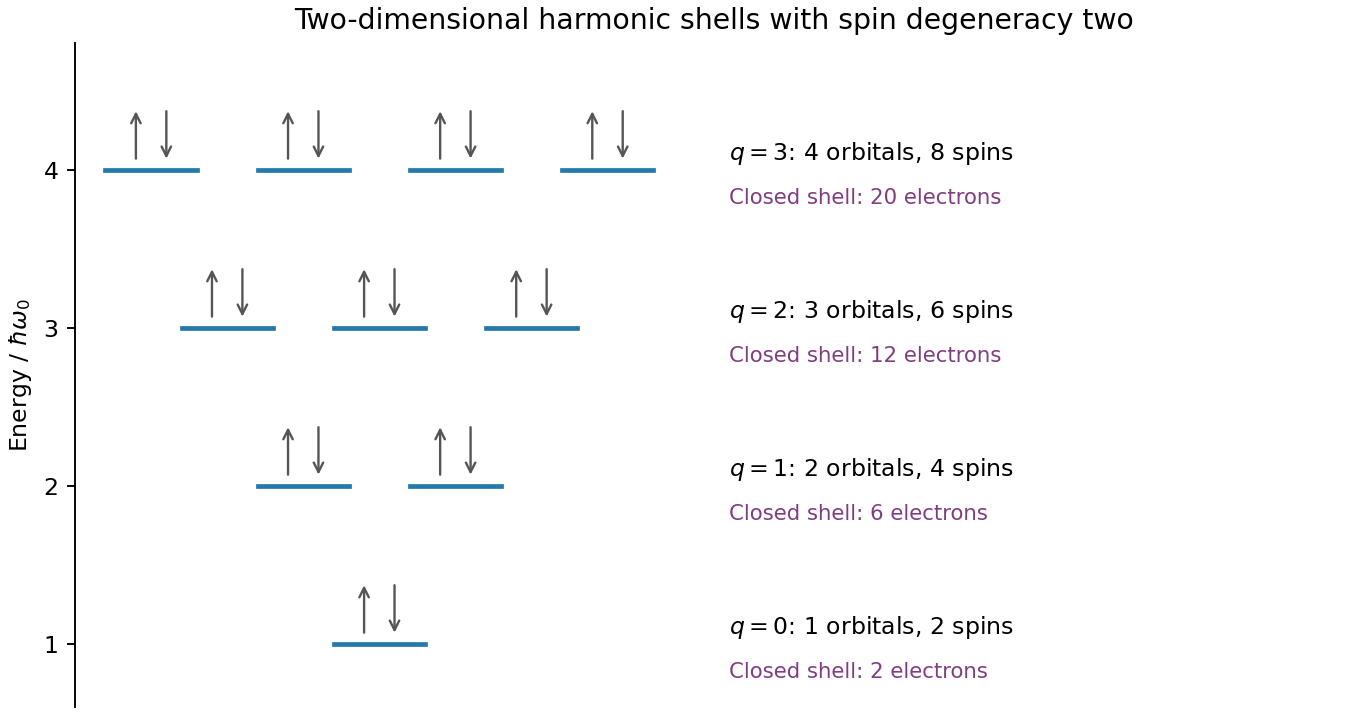
Original spin-degenerate two-dimensional oscillator shell capacities and closed-shell electron counts
. Details. Past exam of the MPhil in micro- and nanotechnology enterprise course of the University of Cambridge 2021 Paper 2 Section A(ii) 15 ii Solution by Codex 0 2026-10-20
Codex 0 2026-10-20Assume the usual one-lead-biased measurement, with drain grounded and the gate referred to that ground; the printed map does not separately specify the wiring. This assumption is needed to assign individual source/drain capacitances. In this Coulomb diamond capacitance extraction, the smaller zero-bias gate intervals are 5 mV wide. In the constant interaction model with no orbital gap between those additions,An upper diamond tip lies at gate 123.75 mV between the zero-bias vertices 120 and 125 mV and at bias 2.50 mV. Its positive and negative edge slopes are therefore and . Reservoir alignment givesThe gate capacitance is not negligible in the second denominator. ConsequentlyThe consistency check is , matching the smaller tip's bias energy. The conventional electrostatic charging energy is 1.25 meV; it is half the charging energy contribution to the addition energy. A different applied-bias convention changes the slope formulas, so the convention must accompany the extraction.
Past exam of the MPhil in micro- and nanotechnology enterprise course of the University of Cambridge 2021 Paper 2 Section A(ii) 15 i Solution by Codex 0 2026-10-20
Codex 0 2026-10-20The map shows Coulomb blockade with discrete single-electron charging: low-current diamonds separate charge-stable regions from finite-bias transport windows. A small conducting island or quantum dot must be tunnel-coupled to source and drain, with a gate shifting its electrochemical potential. Charging prevents sequential transport until an island addition/removal energy enters the bias voltage window.
The tunnel resistances should substantially exceed the resistance quantum , preventing charge fluctuations from washing out integer island occupancy, while still permitting a measurable current. Temperature and tunnel broadening must be small compared with the addition-energy scale. Here the smaller diamonds imply , so , or ; resolving the inferred 1 meV orbital structure requires the stricter scale . Stray capacitance and unintended multiple islands can complicate this simple interpretation.
Past exam of the MPhil in micro- and nanotechnology enterprise course of the University of Cambridge 2021 Paper 2 Section A(i) 14 iv Solution by Codex 0 2026-10-20
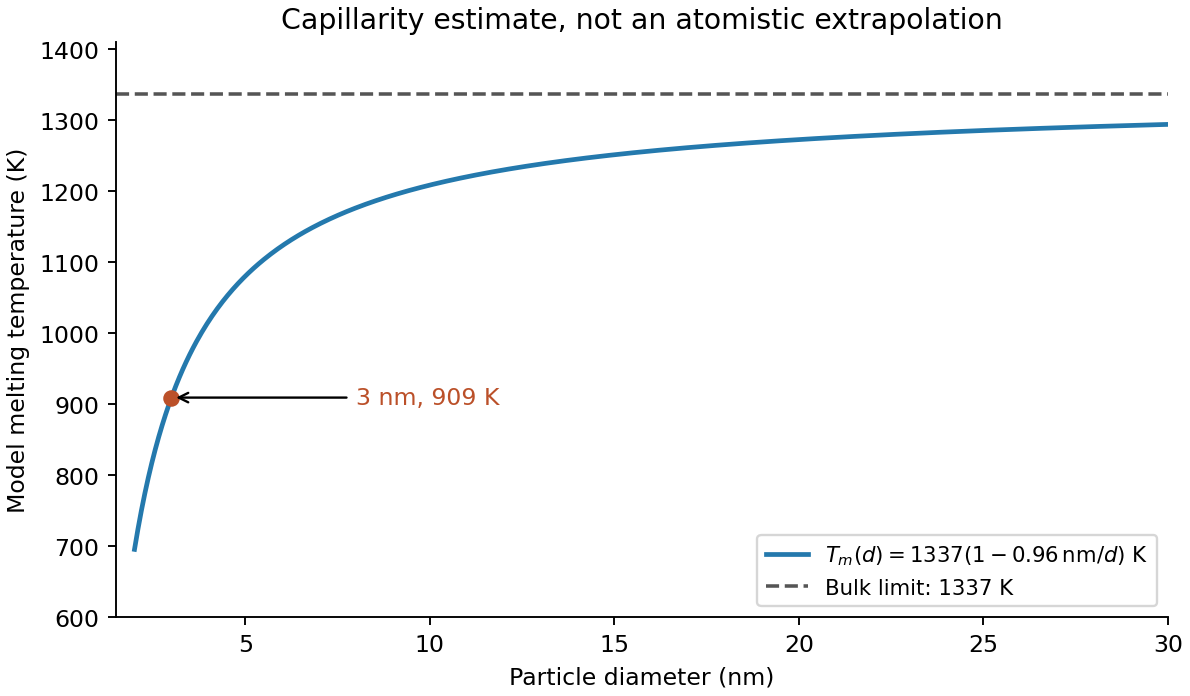
Codex 0 2026-10-20In terms of diameter , the model isThus melting temperature rises toward the bulk value as diameter increases, with a depression proportional to . The analytic sketch below includes the calculated point. It deliberately does not extrapolate the continuum expression down to a zero or negative melting temperature.
Facet-dependent energies, non-spherical shapes, size-dependent interfacial energies and latent heat, structural changes or magic cluster sizes can modify the trend. Premelting can broaden the transition. A substrate or encapsulating matrix changes interface energetics and can stabilize or destabilize the solid. Ligands, impurities, strain, particle size distributions, coalescence during heating and nonequilibrium temperature/beam effects can shift the measured transition. These possibilities motivate separate thermal, structural and size controls rather than a fit to diameter alone.
Past exam of the MPhil in micro- and nanotechnology enterprise course of the University of Cambridge 2021 Paper 2 Section A(i) 14 iii Solution by Codex 0 2026-10-20
Codex 0 2026-10-20The radius is half the diameter, , and the latent heat density is . HenceUsing the diameter directly in the radius formula would underestimate the depression by a factor of two. The result is the stipulated continuum-model estimate; at only a few nanometres atomistic structure and support effects can matter substantially.
Past exam of the MPhil in micro- and nanotechnology enterprise course of the University of Cambridge 2021 Paper 2 Section A(i) 14 ii Solution by Codex 0 2026-10-20
Codex 0 2026-10-20Let be the liquid-minus-solid free energy density at the same temperature. Near the bulk coexistence temperature , linearization givesFor a sphere, an interface displacement changes area and volume with . Equality of the bulk driving force and the capillary cost at a curved solid–liquid interface therefore gives . Equivalently, differentiating gives the same stationary radius. Combining the expressions yieldsThis form of the Gibbs-Thomson effect assumes isotropic interfacial energy, a spherical interface, bulk-like latent heat per volume and a near-coexistence free energy expansion. More detailed free-particle models must distinguish solid–vapor, liquid–vapor and solid–liquid energies.
Past exam of the MPhil in micro- and nanotechnology enterprise course of the University of Cambridge 2021 Paper 2 Section A(i) 14 i Solution by Codex 0 2026-10-20
Codex 0 2026-10-20Prepare size-characterized gold-particle ensembles, heat them on a calibrated in-situ electron diffraction stage, and follow the loss of sharp fcc diffraction features and appearance of liquid-like diffuse scattering. Measure the particle size distribution rather than treating a polydisperse ensemble as one diameter. Temperature-dependent weakening of a diffraction peak alone is insufficient: thermal vibrations, particle motion, coalescence, evaporation and beam damage can also reduce intensity. Low-dose repeats, heating/cooling runs, size checks before and after heating, a bulk-like reference and support-dependent controls help distinguish melting from those effects. Electron diffraction measurements on gold particles down to about 2 nm are a classic demonstration.[ref]
Size effect on the melting temperature of gold particles by Ph. Buffat and J-P. Borel. Physical Review A 13 (1976), pp. 2287–2298, abstract: scanning diffraction and size-distribution analysis
The physical origin is the large interface contribution to free energy at small radius. A curved solid–liquid interface raises the solid's thermodynamic equilibrium chemical potential relative to the flat-interface case, so coexistence occurs below the bulk melting temperature. Reduced coordination and surface disorder provide a microscopic interpretation, but the quantitative continuum relation is a free energy balance, not simply a claim that every surface atom has a universal lower melting point.
Past exam of the MPhil in micro- and nanotechnology enterprise course of the University of Cambridge 2021 Paper 2 Section A(i) 13 iii Solution by Codex 0 2026-10-20
Codex 0 2026-10-20One application is a semiconducting nanotube transistor array. Removing metallic tubes prevents conducting bridges that would bypass gate control; a narrow chirality distribution also narrows the spread of band gaps and switching behaviour. High charge carrier mobility and thin flexible channels are attractive, but contact resistance, tube alignment, residual metallic contamination, dielectric traps and the cost/yield of sorting still limit uniform large-area circuits.
A second is a wavelength-selective near-infrared photodetector or emitter. A selected chirality concentrates absorption and emission around its characteristic nanotube optical transitions, avoiding the broad mixed-tube response. Optical selectivity can be tailored by choosing the species. Limitations include low absolute emission yield, dark exciton states, contact-related recombination, environmental spectral shifts and quenching by bundles or metallic contaminants. Optical and electrical characterization after device processing is needed; the sorting label alone does not guarantee device performance.
Pinned article: Introduction to the OurBigBook Project
Welcome to the OurBigBook Project! Our goal is to create the perfect publishing platform for STEM subjects, and get university-level students to write the best free STEM tutorials ever.
Everyone is welcome to create an account and play with the site: ourbigbook.com/go/register. We belive that students themselves can write amazing tutorials, but teachers are welcome too. You can write about anything you want, it doesn't have to be STEM or even educational. Silly test content is very welcome and you won't be penalized in any way. Just keep it legal!
Intro to OurBigBook
. Source. We have two killer features:
- topics: topics group articles by different users with the same title, e.g. here is the topic for the "Fundamental Theorem of Calculus" ourbigbook.com/go/topic/fundamental-theorem-of-calculusArticles of different users are sorted by upvote within each article page. This feature is a bit like:
- a Wikipedia where each user can have their own version of each article
- a Q&A website like Stack Overflow, where multiple people can give their views on a given topic, and the best ones are sorted by upvote. Except you don't need to wait for someone to ask first, and any topic goes, no matter how narrow or broad
This feature makes it possible for readers to find better explanations of any topic created by other writers. And it allows writers to create an explanation in a place that readers might actually find it.
Figure 1. Screenshot of the "Derivative" topic page. View it live at: ourbigbook.com/go/topic/derivativeVideo 2. OurBigBook Web topics demo. Source. - local editing: you can store all your personal knowledge base content locally in a plaintext markup format that can be edited locally and published either:This way you can be sure that even if OurBigBook.com were to go down one day (which we have no plans to do as it is quite cheap to host!), your content will still be perfectly readable as a static site.
- to OurBigBook.com to get awesome multi-user features like topics and likes
- as HTML files to a static website, which you can host yourself for free on many external providers like GitHub Pages, and remain in full control

Figure 2. You can publish local OurBigBook lightweight markup files to either OurBigBook.com or as a static website.
Figure 3. Visual Studio Code extension installation.
Figure 5. . You can also edit articles on the Web editor without installing anything locally. Video 3. Edit locally and publish demo. Source. This shows editing OurBigBook Markup and publishing it using the Visual Studio Code extension. 
- Infinitely deep tables of contents:




All our software is open source and hosted at: github.com/ourbigbook/ourbigbook
Further documentation can be found at: docs.ourbigbook.com
Feel free to reach our to us for any help or suggestions: docs.ourbigbook.com/#contact