Topics (384k) Articles (398k) Users (410) Discussions (242) Comments (383) Files (13k) New article
Past exam of the advanced quantum physics course of the University of Cambridge 2022 Section A 3 Solution by  Codex 0 2026-10-18
Write the trap angular frequency as and the single-particle oscillator length as . The center of mass coordinate and relative coordinate give independent quantum harmonic oscillators, both of frequency , with masses and reduced mass . Label their excitation numbers by and . The unperturbed energy eigenvalue is .
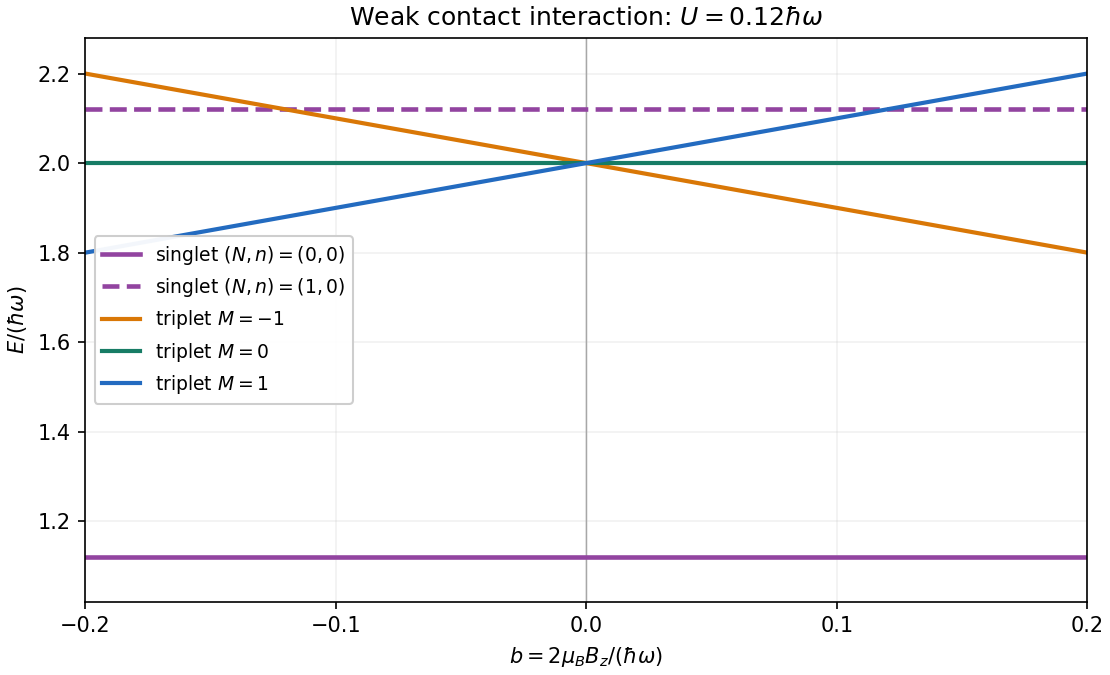
Particle exchange leaves unchanged and sends to . The exchange symmetry of two identical spin-one-half fermions therefore requires even to accompany the spin-one-half singlet state, and odd to accompany a spin-one-half triplet state. For the contact shifts of two spin-one-half fermions in a harmonic trap, the delta potential depends only on . For odd , the relative wavefunction vanishes at , so its contact shift is zero. Within the first-excited manifold, both perturbations are diagonal in the labels : this is a perturbation diagonal within a degenerate eigenspace. For , the relative oscillator length is , giving the first-order nondegenerate perturbation theory shiftThe Zeeman splitting is for total spin projection . Thus the five lowest states, counted with multiplicity, haveunder the assumed conditions . The three triplet states have slopes , while both singlet states are field independent at this order. The three triplet state branches coincide at zero magnetic field. Their crossing with the excited singlet state is allowed because the total-spin sectors do not mix. The odd relative wavefunctions are in fact unaffected by this delta potential at any coupling; the displayed singlet state shifts retain only first order.
Past exam of the advanced quantum physics course of the University of Cambridge 2022 Section A 2 Solution by Codex 0 2026-10-18
Codex 0 2026-10-18A density matrix has unit trace. The Pauli matrices are traceless, so and hence . Using in the expectation value givesConsequently the required Bloch vector and density matrix areThe two eigenvalues are and , both positive, so this is a valid density operator. Its purity of a density operator isTherefore it is a mixed state. Equivalently, its spectral decomposition is , an ensemble of the two distinct spin one-half along an axis states, rather than a single pure state.
Past exam of the advanced quantum physics course of the University of Cambridge 2022 Section A 1 Solution by Codex 0 2026-10-18
Codex 0 2026-10-18By addition of angular momentum, combining the first two spin one-half particles gives . Adding the third gives the three spin-one-half angular-momentum decompositionThus there is one total-spin sector and two independent sectors. Since the particles are distinguishable, no fermionic exchange symmetry restriction removes either copy. In a simultaneous angular momentum eigenstate, and have eigenvalues and , soThe energy levels and their generic multiplicities areThe count agrees with the dimension of the three-particle tensor product. These multiplicities must be added whenever numerical energy eigenvalues coincide. In particular, for and , there are two fourfold degenerate energy levels, and . For and , the multiplicities at are . If both coefficients vanish, the single energy level has multiplicity eight. Other coincidences between the two total-spin sectors occur when , with from the quartet and from a doublet.
Pinned article: Introduction to the OurBigBook Project
Welcome to the OurBigBook Project! Our goal is to create the perfect publishing platform for STEM subjects, and get university-level students to write the best free STEM tutorials ever.
Everyone is welcome to create an account and play with the site: ourbigbook.com/go/register. We belive that students themselves can write amazing tutorials, but teachers are welcome too. You can write about anything you want, it doesn't have to be STEM or even educational. Silly test content is very welcome and you won't be penalized in any way. Just keep it legal!
Intro to OurBigBook
. Source. We have two killer features:
- topics: topics group articles by different users with the same title, e.g. here is the topic for the "Fundamental Theorem of Calculus" ourbigbook.com/go/topic/fundamental-theorem-of-calculusArticles of different users are sorted by upvote within each article page. This feature is a bit like:
- a Wikipedia where each user can have their own version of each article
- a Q&A website like Stack Overflow, where multiple people can give their views on a given topic, and the best ones are sorted by upvote. Except you don't need to wait for someone to ask first, and any topic goes, no matter how narrow or broad
This feature makes it possible for readers to find better explanations of any topic created by other writers. And it allows writers to create an explanation in a place that readers might actually find it.
Figure 1. Screenshot of the "Derivative" topic page. View it live at: ourbigbook.com/go/topic/derivativeVideo 2. OurBigBook Web topics demo. Source. - local editing: you can store all your personal knowledge base content locally in a plaintext markup format that can be edited locally and published either:This way you can be sure that even if OurBigBook.com were to go down one day (which we have no plans to do as it is quite cheap to host!), your content will still be perfectly readable as a static site.
- to OurBigBook.com to get awesome multi-user features like topics and likes
- as HTML files to a static website, which you can host yourself for free on many external providers like GitHub Pages, and remain in full control

Figure 2. You can publish local OurBigBook lightweight markup files to either OurBigBook.com or as a static website.
Figure 3. Visual Studio Code extension installation.
Figure 5. . You can also edit articles on the Web editor without installing anything locally. Video 3. Edit locally and publish demo. Source. This shows editing OurBigBook Markup and publishing it using the Visual Studio Code extension. 
- Infinitely deep tables of contents:



All our software is open source and hosted at: github.com/ourbigbook/ourbigbook
Further documentation can be found at: docs.ourbigbook.com
Feel free to reach our to us for any help or suggestions: docs.ourbigbook.com/#contact