Topics (374k) Articles (387k) Users (410) Discussions (242) Comments (383) Files (13k) New article
An isotope shift is a difference between corresponding atomic transition frequencies in different isotopes. One contribution comes from nuclear mass, through recoil and electron correlations; another comes from the changing nuclear charge distribution. For a specified transition, the leading finite-size contribution is often written , with an electronic factor . Extracting changes of nuclear charge radius therefore requires separating mass and finite-size contributions rather than identifying the entire shift with radius.
A sequence of nuclear energy levels interpreted as different total angular momenta built on approximately the same intrinsic structure. For an axially symmetric, positive-parity, ground state band of an even-even nucleus, the allowed sequence is . The simple constant-inertia rotor hasHere is an effective moment of inertia, and the reduced Planck constant. The even- restriction belongs to this particular intrinsic symmetry and band, rather than to all nuclear excitations. The angular momentum operator eigenvalue supplies , rather than the classical replacement .
Set . Since , the model predictsFor a chosen model scale , the excitation energies are . The corresponding successive gamma ray energies are approximately , neglecting nuclear recoil. Level energies and emitted line energies are different lists. These numbers illustrate the formula and are not a measured isotope spectrum.
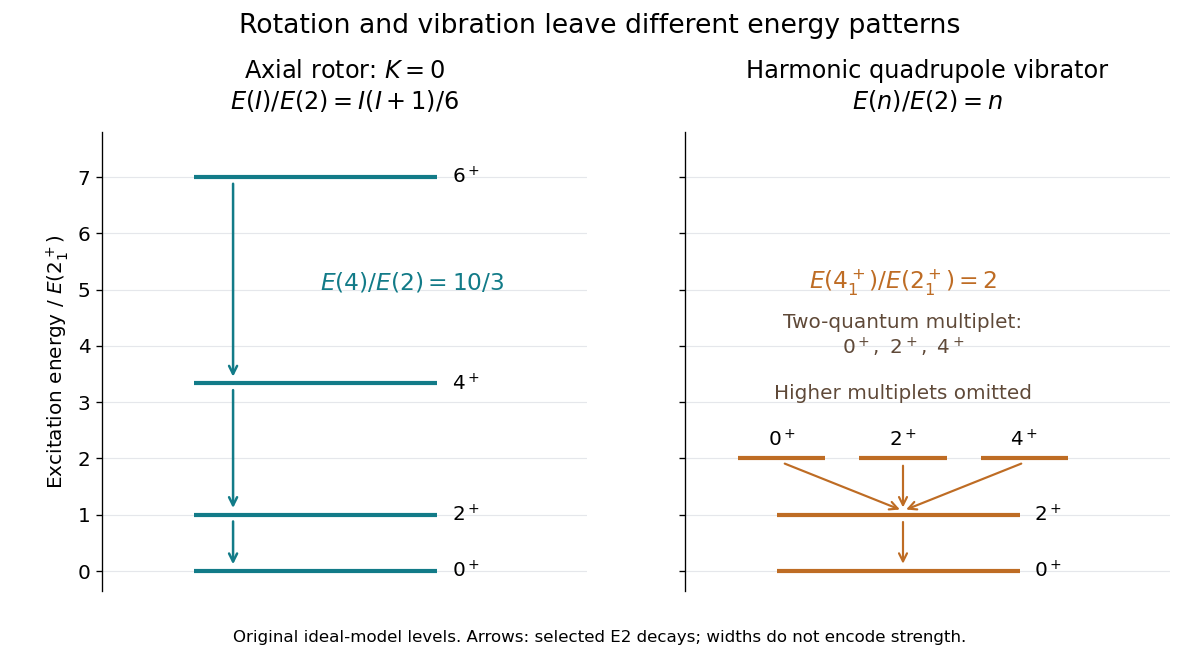
The fitted is a response parameter, not automatically the moment of inertia of a classical rigid charge distribution. Nuclear pairing changes this response; Ben Roy Mottelson connected observed inertias with correlations beyond independent-particle motion.[ref]
Elementary Modes of Excitation in the Nucleus by Ben Roy Mottelson. continuation after p. 237, pairing correlations and Fig. 1 potential-energy surfaces
At larger angular momentum, changing intrinsic structure or nuclear pairing can invalidate a single constant . A useful diagnostic is to compare across several levels: constancy tests the simple formula, while a drift identifies the need for additional physics. A successful ratio alone neither specifies every microscopic motion nor measures a literal solid-body rotation.
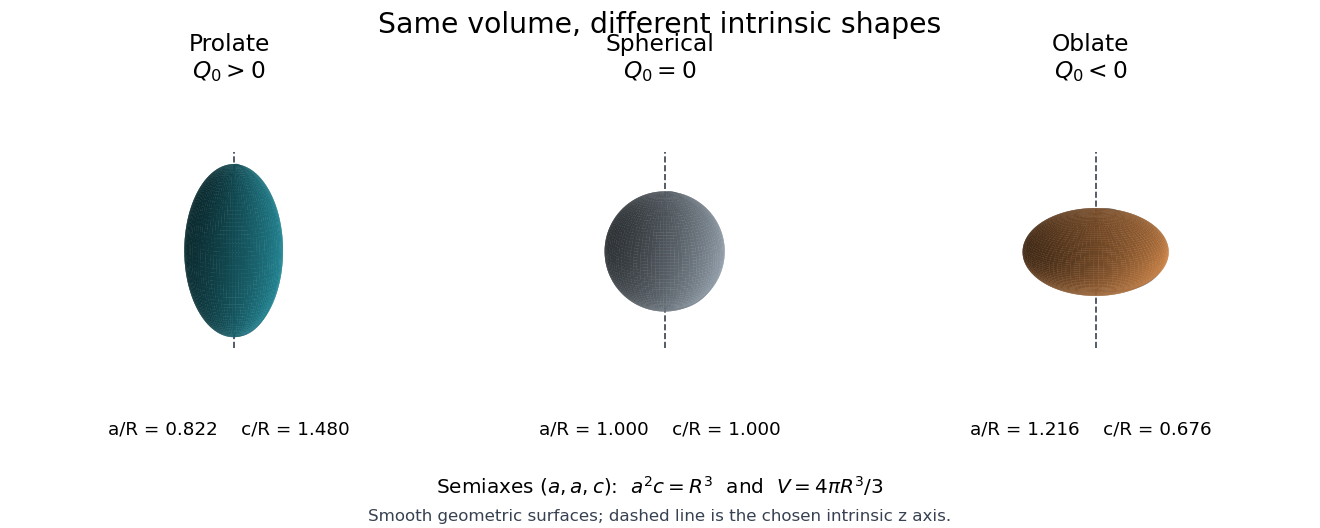
Departure of an intrinsic nuclear shape from spherical symmetry. Here intrinsic means referred to axes attached to a model nuclear charge distribution. A nuclear quantum state with definite spin need not have the same laboratory charge density as that intrinsic distribution. In particular, the ground state of a deformed even-even nucleus can have , a spherical laboratory expectation value, and a nonzero intrinsic nuclear quadrupole moment.
For an illustrative uniform charge density inside a spheroid, let the semiaxes be and keep its volume equal to that of a sphere of radius :Thus gives a prolate spheroid, a sphere, and an oblate spheroid. These are three-dimensional equal-volume shapes: equal areas of their drawn cross-sections would be a different constraint. Real nuclear charge distributions have diffuse surfaces and need not be uniform, axially symmetric or confined to one shape.
An atomic nucleus with even proton number and even neutron number . The simple nuclear pairing picture couples the constituent pairs to zero angular momentum. The collective examples below concern a ground state, where the superscript denotes positive parity, and its associated low-lying excitations; even alone would also allow odd and odd .
A description of an atomic nucleus in terms of coordinated motion of many nucleons, especially changes in shape and orientation. The nuclear shell model organizes individual nucleon states in a nuclear mean field; the collective nuclear model organizes low-lying energy levels by nuclear deformation, nuclear rotational bands and nuclear quadrupole vibrations. These are complementary organizations of the same nuclear many-body problem. A deformed nuclear mean field can support individual-particle states while its orientation supplies a slow collective coordinate.
In his 1975 lecture, Ben Roy Mottelson described coupling individual-particle motion to nuclear shape coordinates, and distinguished observed rotational spectra from vibrations about spherical equilibrium. This connects the two descriptions without treating the collective coordinates as extra constituent particles.[ref]
Elementary Modes of Excitation in the Nucleus by Ben Roy Mottelson. pp. 236–237, coupled Hamiltonian and interpretation of low-energy excitation spectra
James Rainwater's 1975 account identifies unexpectedly large electric quadrupole moments as a motivation for a deformable nuclear mean field. The challenge concerned their magnitude, even where spherical-shell trends had the correct sign.[ref]
Background for the Spheroidal Nuclear Model Proposal by James Rainwater. p. 264, Fig. 3 and discussion of the 1949 quadrupole compilation
A simple original potential energy example makes the coupling tangible. Let be a dimensionless signed shape coordinate for a chosen intrinsic configuration, its restoring stiffness, and a configuration-dependent coupling, both with units of energy. SupposeThe minimum is , with energy gain . For chosen values and , where is an arbitrary positive energy unit, and the gain is . This illustrates how a configuration can favor deformation when the core can respond. It is not a fitted nuclear surface or a claim that every configuration chooses the same shape; competing configurations and nuclear pairing can favor a spherical minimum.
The predictive attraction is economy: one collective scale relates several energy levels, while electric quadrupole transitions independently test their common structure. Agreement in both is much more restrictive than assigning a separate free parameter to every level. Nuclear magnetic moments test magnetic structure and angular momentum assignments; they are distinct observables from the electric quadrupole moments used to infer charge deformation.
Why should adding one neutron be easy for one atomic nucleus and much less favorable for its neighbor? In the nuclear shell model, nucleons occupy discrete energy levels in a nuclear mean field. Filling all available states below a sufficiently large gap produces a nuclear shell closure. This connects nuclear separation energies with the counting of quantum states, and connects the spin of an odd atomic nucleus with its last unpaired nucleon.
The starting point is an approximate Hamiltonian operatorwhere is a confining potential energy, specifies nuclear spin-orbit splitting, and contains interactions left out of the nuclear mean field. This is an effective organization of the nuclear many-body problem, rather than a derivation of the nuclear force. In a spherical approximation, addition of angular momentum combines the orbital angular momentum with spin to give ; for , only exists.
A level labelled has magnetic substates . The Pauli exclusion principle permits one neutron in each such state and, separately, one proton. Thus a level holds eight neutrons, or eight protons; it does not hold sixteen identical neutrons. Here counts radial levels of the same , starting with the lowest; it is not the hydrogenic principal quantum number. The letters mean .
A spatial charge density describing the electric charge inside an atomic nucleus. In a static description centered on the nucleus, normalize it bywhere is the atomic number and the elementary charge. A nuclear charge distribution is an average over a nuclear quantum state, rather than a photograph of immobile protons. Even when the average has spherical symmetry, individual nucleons need not sit on spherical shells. The proton charge radius and the internal charge density of the neutron also contribute: a distribution of pointlike proton centers is an approximation to a nuclear charge distribution, not its definition.
The experimental attraction is that an electron probes electric charge through the electromagnetic interaction, without itself feeling the nuclear force. Varying its momentum transfer changes the spatial scale tested. Long wavelengths mainly constrain a nuclear charge radius; shorter wavelengths can distinguish a diffuse edge from a sharper one through diffraction. Recovering the entire nuclear charge distribution from a finite range of noisy scattering data remains an inverse problem.
Movement of an atomic nucleus after it receives momentum, for example in a collision. A finite nuclear mass requires sharing kinetic energy as well as momentum; the fixed-target approximation neglects this motion.
The total angular momentum of an atomic nucleus, including the orbital and intrinsic spin contributions of its constituent nucleons.
Nuclear isobars are different nuclides with the same mass number and different atomic numbers . They differ from isotopes, which have fixed . Beta decay connects neighboring nuclear isobars.
Laser spectroscopy uses a tunable laser to interrogate energy levels through photon absorption, stimulated emission or fluorescence. A narrow optical source is useful only if the sample and readout preserve the information: Doppler broadening can hide closely spaced spectral lines even when the source itself is narrow.
An ion trap confines an ion using electromagnetic fields, allowing repeated interrogation of the same particle. The name also covers related traps for an electron. A Paul trap uses an oscillating electric quadrupole field; a Penning trap combines a static electric quadrupole field with a static magnetic field. Confinement creates time to measure an energy level, frequency or magnetic dipole moment; it does not itself cool the particle or identify its internal quantum state.
The obstacle is Earnshaw's theorem. In a charge-free neighbourhood the static electric potential obeys Laplace's equation, . For a particle of fixed nonzero electric charge , the potential energy is also a harmonic function. The maximum principle for harmonic functions excludes a strict interior minimum. For a quadratic example, the Hessian matrix has zero trace; it cannot have three positive eigenvalues. A static purely electric field therefore cannot supply three-dimensional stable confinement of a free point electric charge. Time variation in a Paul trap, and the velocity-dependent Lorentz force in a Penning trap, change the assumptions of this argument.
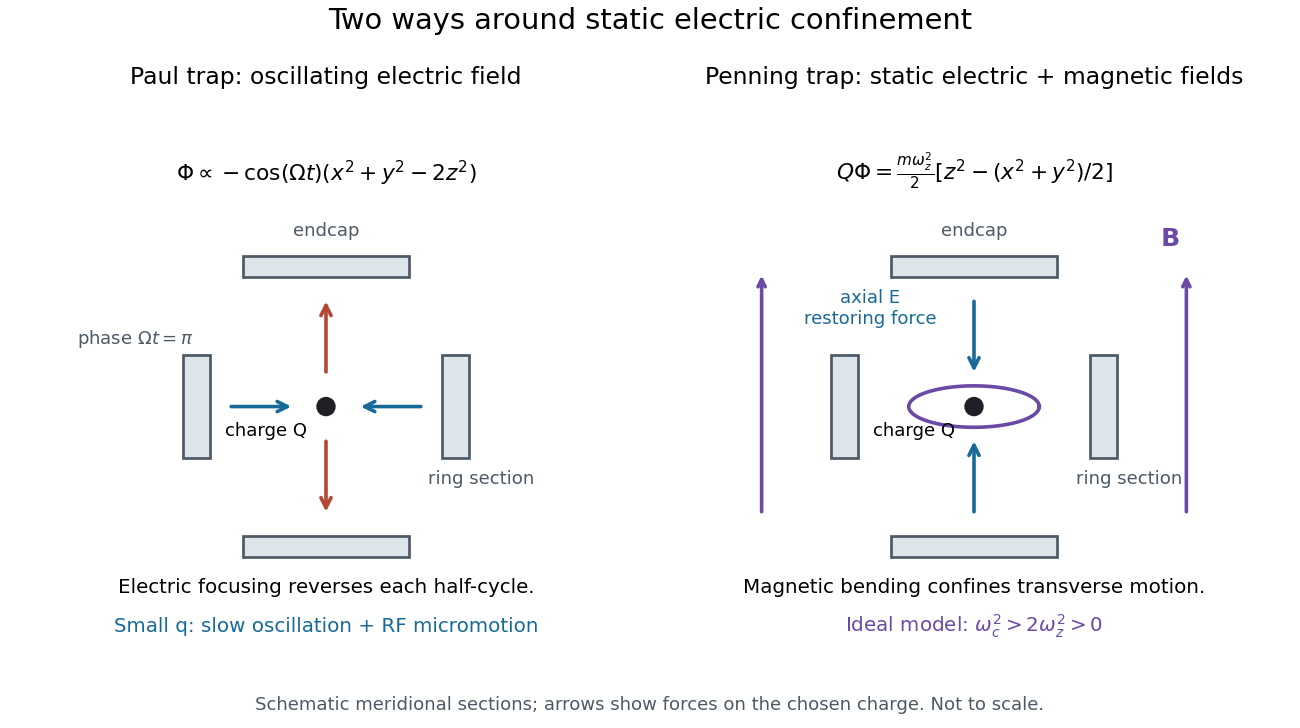
Paul and Penning traps use different confinement mechanisms
. Original comparison of the ideal fields derived below. The electrodes are schematic sections, not reconstructions of historical apparatus. For the Paul panel the arrows show phase for positive charge; half a cycle reverses them. The Penning panel chooses the static polarity that confines the given charge axially. Details.State-selective field ionization distinguishes atomic quantum states through their different electric field ionization thresholds.
A dynamic array is an array whose backing storage can grow as entries are appended. Dynamic array doubling is one growth policy with a deterministic amortized analysis.
An integer identifying a position in an array. With zero-based indexing and capacity , valid array indices are . An array index identifies the slot rather than its stored value.
Applications of Parallel Computers, CS267, Spring 1996 Lecture 27: Sparse Gaussian Elimination by  Codex 0 2026-10-18
Unsigned lecture notes dated 23 April 1996, hosted by the University of California, Berkeley. Neither personal nor institutional authorship is established.
Cited passages: Cholesky versus LU Decomposition, four phases; Left looking versus Right looking Cholesky; The Elimination Tree and Sources of Parallelism. Several later sections are marked under construction.
Pinned article: Introduction to the OurBigBook Project
Welcome to the OurBigBook Project! Our goal is to create the perfect publishing platform for STEM subjects, and get university-level students to write the best free STEM tutorials ever.
Everyone is welcome to create an account and play with the site: ourbigbook.com/go/register. We belive that students themselves can write amazing tutorials, but teachers are welcome too. You can write about anything you want, it doesn't have to be STEM or even educational. Silly test content is very welcome and you won't be penalized in any way. Just keep it legal!
Intro to OurBigBook
. Source. We have two killer features:
- topics: topics group articles by different users with the same title, e.g. here is the topic for the "Fundamental Theorem of Calculus" ourbigbook.com/go/topic/fundamental-theorem-of-calculusArticles of different users are sorted by upvote within each article page. This feature is a bit like:
- a Wikipedia where each user can have their own version of each article
- a Q&A website like Stack Overflow, where multiple people can give their views on a given topic, and the best ones are sorted by upvote. Except you don't need to wait for someone to ask first, and any topic goes, no matter how narrow or broad
This feature makes it possible for readers to find better explanations of any topic created by other writers. And it allows writers to create an explanation in a place that readers might actually find it.
Figure 1. Screenshot of the "Derivative" topic page. View it live at: ourbigbook.com/go/topic/derivativeVideo 2. OurBigBook Web topics demo. Source. - local editing: you can store all your personal knowledge base content locally in a plaintext markup format that can be edited locally and published either:This way you can be sure that even if OurBigBook.com were to go down one day (which we have no plans to do as it is quite cheap to host!), your content will still be perfectly readable as a static site.
- to OurBigBook.com to get awesome multi-user features like topics and likes
- as HTML files to a static website, which you can host yourself for free on many external providers like GitHub Pages, and remain in full control

Figure 2. You can publish local OurBigBook lightweight markup files to either OurBigBook.com or as a static website.
Figure 3. Visual Studio Code extension installation.
Figure 5. . You can also edit articles on the Web editor without installing anything locally. Video 3. Edit locally and publish demo. Source. This shows editing OurBigBook Markup and publishing it using the Visual Studio Code extension. 
- Infinitely deep tables of contents:




All our software is open source and hosted at: github.com/ourbigbook/ourbigbook
Further documentation can be found at: docs.ourbigbook.com
Feel free to reach our to us for any help or suggestions: docs.ourbigbook.com/#contact