Topics (374k) Articles (387k) Users (410) Discussions (242) Comments (383) Files (13k) New article
Cited passages: Thread-Safety; Overwrite Operation; Writing to a Full Buffer; Iterator Invalidation; Caveats. The documented overwrite-by-assignment and synchronization behavior belongs to Boost.Circular Buffer.
Transverse relaxation describes loss of ensemble transverse magnetization. It must not automatically be identified with pure dephasing. In a simple completely positive two-level relaxation model,where describes additional pure dephasing. Thus population recovery itself contributes to transverse decay. A spread of static magnetic fields can further cancel ensemble phases without the same microscopic relaxation; an observed free signal may have an effective rather than homogeneous . The simple exponential examples below assume a uniform field and a single homogeneous .
With no transverse drive, the Bloch equations giveLongitudinal nuclear spin relaxation restores the population imbalance and thus the magnetization parallel to the static magnetic field. It corresponds to population relaxation for the two-level model. Starting from , waiting recovers of , whereas waiting recovers about . This is why repeated measurements require a recovery-time decision.
Section of Biology 2e by Mary Ann Clark and others, whose whole-book authors are Mary Ann Clark, Matthew Douglas and Jung Choi. OpenStax publishes the book; no separate section author is credited. The citation panel gives whole-book publication on 28 March 2018, rather than a section revision date.
Biology 2e by Mary Ann Clark and others 8.1 Overview of Photosynthesis by  Codex 0 Created 2026-10-18 Updated 2026-10-31
Section of Biology 2e by Mary Ann Clark and others. Whole-book authors: Mary Ann Clark, Matthew Douglas and Jung Choi; no separate section byline is established. OpenStax publishes and hosts the text. The book was published on 28 March 2018; no separate section revision date is established.
Inspected locators: Basic Photosynthetic Structures, Figure 8.6; The Two Parts of Photosynthesis, Figure 8.7; citation information.
Biographical Memoirs: Volume 73 Carl David Anderson by William Hayward Pickering by Codex 0 2026-10-18
Codex 0 2026-10-18By William Hayward Pickering, credited as William H. Pickering. Memoir pp. 24–38; institutional issuer: National Academy of Sciences.
In the aqueous model here, a strong base supplies hydroxide essentially completely under the conditions considered. Strength and concentration are different properties.
In 1997, Hiroyuki Noji and colleagues attached a fluorescent actin filament to the central shaft of isolated . With ATP supplied, the marker made sustained rotations. This exposed rotation directly, but used ATP hydrolysis: there was no membrane motor producing ATP from a proton-motive force in this assay.[ref]
Direct observation of the rotation of F1-ATPase by Hiroyuki Noji and others. Noji, Yasuda, Yoshida and Kinosita Jr., Direct observation of the rotation of F1-ATPase, Nature 386 (1997), 299–302, accessible primary abstract
A subsequent primary experiment made the optical readout much faster. Purified Escherichia coli was immobilized on glass in a -deep flow cell, with a gold bead attached to . With ATP and magnesium supplied, laser illumination and dark-field microscopy recorded bead positions at or frames per second. The position trajectory resolved turns and intervening dwells. This apparatus follows a shaft-attached marker, rather than imaging the shaft's chemical atoms.[ref]
Temperature Dependence of Single Molecule Rotation of the Escherichia coli ATP Synthase F1 Sector Reveals the Importance of γ-β Subunit Interactions in the Catalytic Dwell by Mizuki Sekiya and others. Sekiya et al., 2009, Experimental Procedures: Direct Observation of gamma Subunit Rotation; Results, Figure 1
Controls addressed perturbation and chemical activity: comparison of – probes found similar rates for the two smallest sizes, supporting low drag; a separate coupled-enzyme assay followed ATP hydrolysis through NADH absorbance. But the rotational analysis excluded pauses longer than , so it characterizes continuously active intervals, not total output including long inhibited periods. It neither counts transported protons nor measures simultaneous single-molecule ATP synthesis.[ref]
Temperature Dependence of Single Molecule Rotation of the Escherichia coli ATP Synthase F1 Sector Reveals the Importance of γ-β Subunit Interactions in the Catalytic Dwell by Mizuki Sekiya and others. Sekiya et al., 2009, Experimental Procedures: Assay methods and data selection; Results: Direct Observation of Rotation Using a 60-nm Gold Bead
The experimental distinction is essential. Sustained directional marker motion tests a rotary mechanism. Demonstrating proton-driven synthesis additionally requires intact in a membrane with a controlled proton-motive force and a chemical ATP-production readout; dependence on that driving force and inhibition or respiratory uncoupling controls then test the proposed energy coupling. A rotation movie alone cannot establish the complete material and free energy ledger.
Define side as the higher proton electrochemical potential reservoir and side as the synthesis-side reservoir. For transfer at common temperature , define the positive downhill proton-motive force magnitude byHere is thermodynamic activity, is electric potential, is the molar gas constant and is the Faraday constant. Thus both a higher proton thermodynamic activity and a more positive electric potential on side contribute to the driving magnitude. This definition fixes the sign; conventions for a signed proton-motive force differ. The calculation under chemiosmosis separates these two contributions numerically.
Assume fixed reservoirs, tight mechanical energy coupling, one transported proton per subunit per revolution, and three ATP produced per revolution. Neglect leaks, slipping and membrane transport of the chemical reagents. Let be the local molar Gibbs free energy cost of ATP formation at the stipulated composition, pH and magnesium-binding convention. It is not necessarily the standard state value. Adding changes in the state function gives, per mole of complete turns,For this model net synthesis is thermodynamically favoured when . Equality is a reversible balance, not a promise of a useful reaction rate. A negative value establishes an available driving margin; it does not specify how fast the enzyme runs.
Choose , , and . These are illustrative inputs, not measurements of the preparation in the experiment below. Thenand . Per ATP, the ideal input is , leaving a driving margin of . The balance point isAt the same synthesis cycle instead has : the chosen reservoirs favour its reverse.
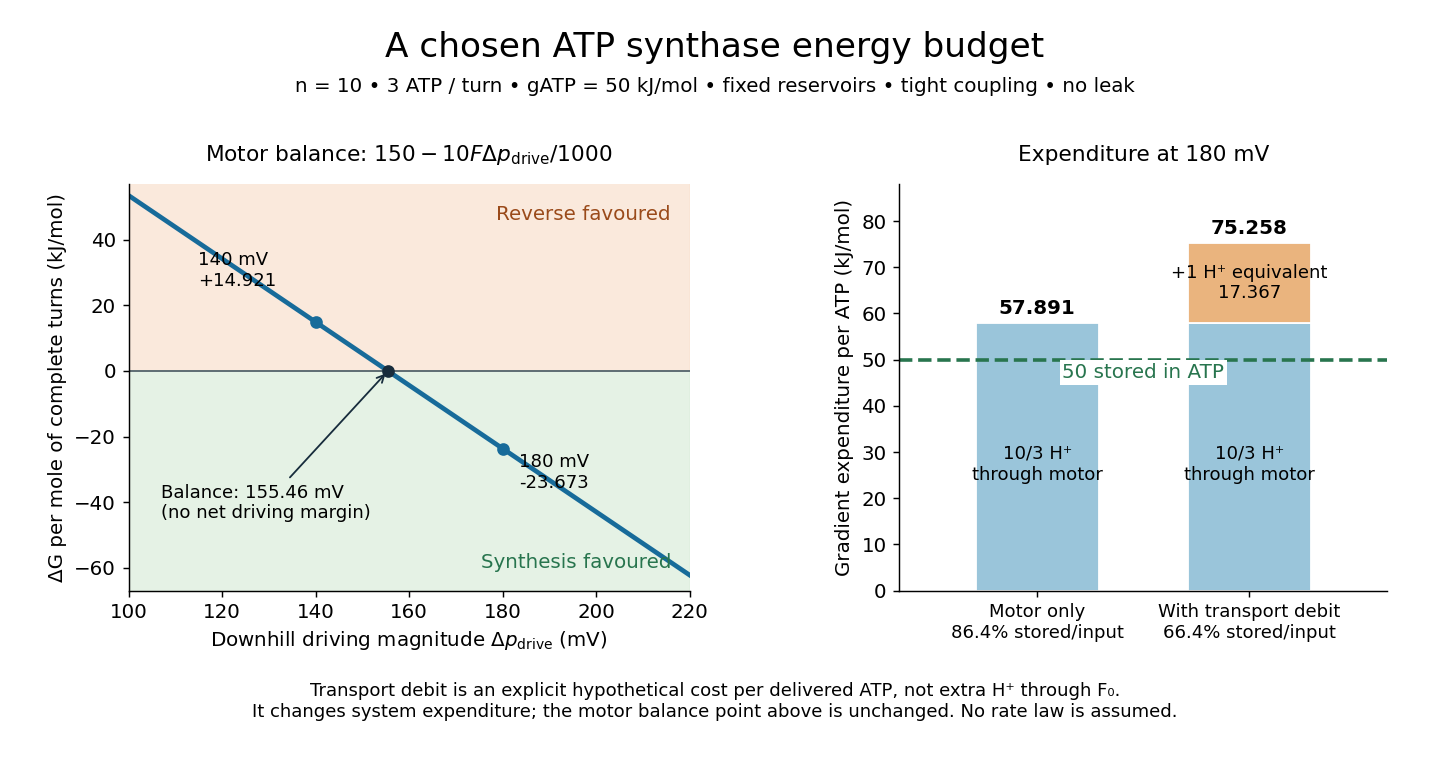
The machine is reversible: sufficient ATP hydrolysis can drive opposite rotation and pump protons uphill. Actual direction also depends on inhibition and available substrates; a weak proton-motive force need not make every intact enzyme immediately run backward. Respiratory uncoupling supplies a different failure mode: a parallel proton leak dissipates the gradient without productive shaft rotation.[ref]
Rotary catalysis of FoF1-ATP synthase by Rikiya Watanabe. Watanabe, 2013, p. 51 and Figure 2: reversal of the coupled motors
The motor budget is not the whole cost of ATP delivered outside a mitochondrion. Import of ADP and inorganic phosphate, and export of ATP, also draw on the electrochemical gradient.[ref]
The Mechanism of Oxidative Phosphorylation. Cooper, The Cell: A Molecular Approach, 2nd edition, Transport of Metabolites across the Inner Membrane, Figure 10.12
For a deliberately simplified system budget, assign these transports together one additional downhill-proton equivalent per delivered ATP, valued at the same . This is a chosen accounting convention, not a claim of one extra literal proton through , nor a universal transport stoichiometry. The total becomes equivalents and of gradient expenditure per delivered ATP at . The ratio of stored chemical free energy to that expenditure is , compared with for the motor alone. This system budget changes the resource expenditure, not the motor's balance point . Real transport terms require their own electrochemical potentials, and leaks add further cost.The membrane motor contains a rotating ring of subunits beside stationary subunit . Two offset water-accessible half-channels connect opposite membrane sides to the ring. A proton enters one half-channel and protonates a glutamic acid residue on a subunit; neutralization permits that site to enter the hydrophobic lipid bilayer. Rotation carries it around to the other half-channel, where it releases the proton. A conserved arginine in subunit helps separate the routes and promotes release. Downhill proton transfer biases rotation; this is not a freely open transmembrane pore.[ref]
Structure of a bacterial ATP synthase by Hui Guo and others. Guo, Suzuki and Rubinstein, Structure of a bacterial ATP synthase, 2019, Figure 4B–D and Proton translocation through the FO region
The central shaft transmits torque to ; a peripheral stalk prevents the catalytic head from simply co-rotating. Its three catalytic sites, within an head, cycle through different binding shapes. In the simplified binding-change picture, a loose site captures ADP and inorganic phosphate, a tight site favours bound ATP, and opening releases ATP. Rotation changes binding and release as well as chemistry.[ref]
Structure of ATP synthase under strain during catalysis by Hui Guo and John L. Rubinstein. Guo and Rubinstein, Structure of ATP synthase under strain during catalysis, 2022, Introduction and Figure 1: binding-change cycle
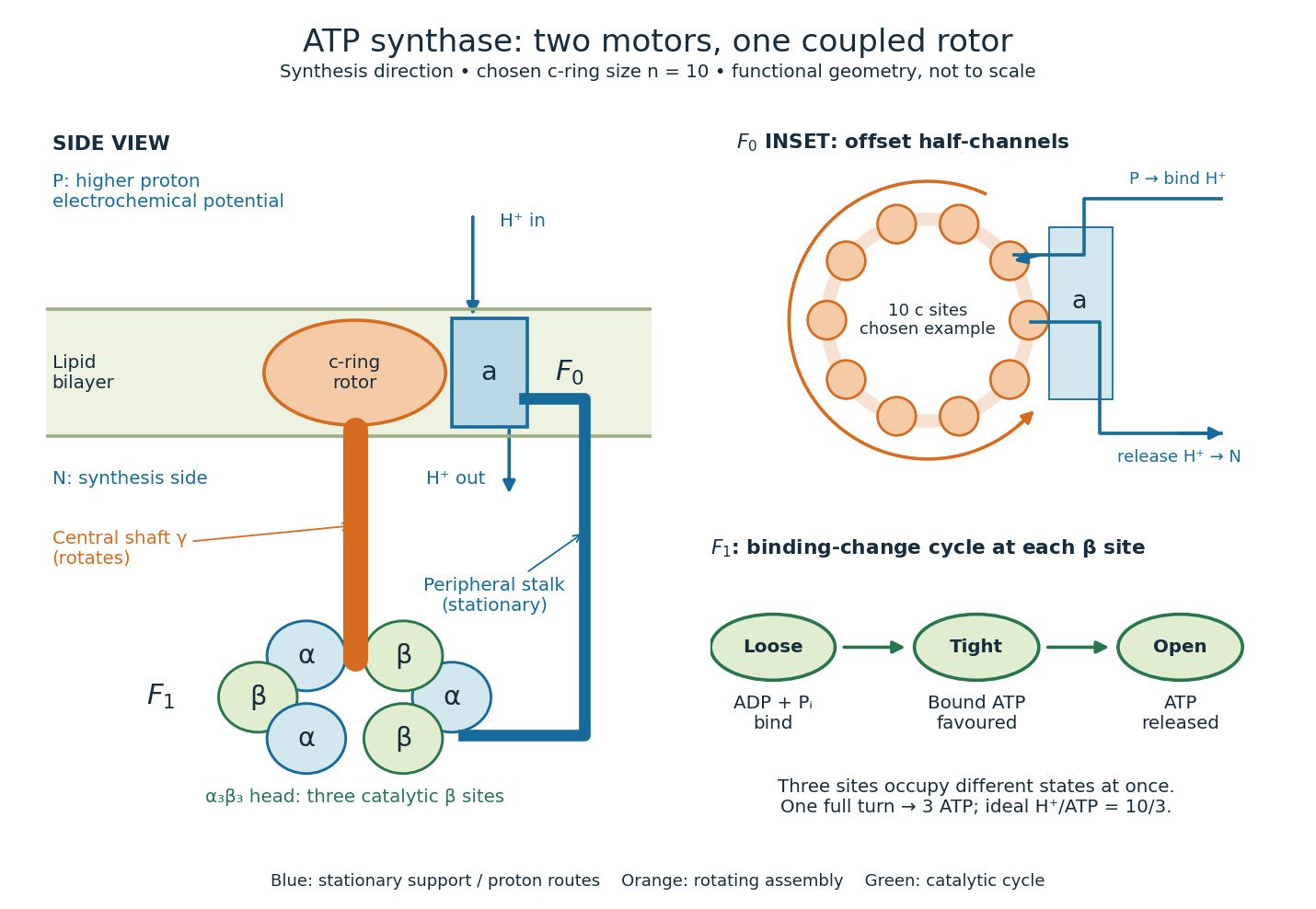
One complete, tightly coupled turn cycles each catalytic site once, producing three ATP molecules. If the ring has proton-binding subunits, the ideal motor budget is transferred protons per turn, or per ATP. Ring size varies between organisms; the worked example chooses , as in the studied bacterial systems, rather than assigning ten to every ATP synthase.[ref]
Rotary catalysis of FoF1-ATP synthase by Rikiya Watanabe. Watanabe, 2013, pp. 51–52: c-ring stoichiometry and H+/ATP ratio
For this example the ring's repeat angle is , whereas the three-site catalytic cycle repeats after . Their ratio is , not an integer. Counting complete turns avoids inventing a fixed integer proton count for every catalytic event. The schematic does not require both parts to advance simultaneously as rigid gears; elasticity allows temporary twisting while their cycles proceed.[ref]
Structure of ATP synthase under strain during catalysis by Hui Guo and John L. Rubinstein. Guo and Rubinstein, 2022, Introduction and Figure 1: symmetry mismatch and elastic coupling
Pinned article: Introduction to the OurBigBook Project
Welcome to the OurBigBook Project! Our goal is to create the perfect publishing platform for STEM subjects, and get university-level students to write the best free STEM tutorials ever.
Everyone is welcome to create an account and play with the site: ourbigbook.com/go/register. We belive that students themselves can write amazing tutorials, but teachers are welcome too. You can write about anything you want, it doesn't have to be STEM or even educational. Silly test content is very welcome and you won't be penalized in any way. Just keep it legal!
Intro to OurBigBook
. Source. We have two killer features:
- topics: topics group articles by different users with the same title, e.g. here is the topic for the "Fundamental Theorem of Calculus" ourbigbook.com/go/topic/fundamental-theorem-of-calculusArticles of different users are sorted by upvote within each article page. This feature is a bit like:
- a Wikipedia where each user can have their own version of each article
- a Q&A website like Stack Overflow, where multiple people can give their views on a given topic, and the best ones are sorted by upvote. Except you don't need to wait for someone to ask first, and any topic goes, no matter how narrow or broad
This feature makes it possible for readers to find better explanations of any topic created by other writers. And it allows writers to create an explanation in a place that readers might actually find it.
Figure 1. Screenshot of the "Derivative" topic page. View it live at: ourbigbook.com/go/topic/derivativeVideo 2. OurBigBook Web topics demo. Source. - local editing: you can store all your personal knowledge base content locally in a plaintext markup format that can be edited locally and published either:This way you can be sure that even if OurBigBook.com were to go down one day (which we have no plans to do as it is quite cheap to host!), your content will still be perfectly readable as a static site.
- to OurBigBook.com to get awesome multi-user features like topics and likes
- as HTML files to a static website, which you can host yourself for free on many external providers like GitHub Pages, and remain in full control

Figure 2. You can publish local OurBigBook lightweight markup files to either OurBigBook.com or as a static website.
Figure 3. Visual Studio Code extension installation.
Figure 5. . You can also edit articles on the Web editor without installing anything locally. Video 3. Edit locally and publish demo. Source. This shows editing OurBigBook Markup and publishing it using the Visual Studio Code extension. 
- Infinitely deep tables of contents:




All our software is open source and hosted at: github.com/ourbigbook/ourbigbook
Further documentation can be found at: docs.ourbigbook.com
Feel free to reach our to us for any help or suggestions: docs.ourbigbook.com/#contact