Topics (384k) Articles (398k) Users (410) Discussions (242) Comments (383) Files (13k) New article
Smooth endoplasmic reticulum lacks attached ribosomes. Specialized regions support lipid metabolism and processing of foreign compounds; the endoplasmic reticulum also stores and releases calcium ions. Regional specialization does not split the network into two separate organelles, nor make every smooth region perform every function.[ref]
The Endoplasmic Reticulum. Molecular Biology of the Cell, 4th edition by Bruce Alberts and others; Smooth ER Is Abundant in Some Specialized Cells, Figures 12-38A and 12-38B and calcium-storage paragraphs
Rough endoplasmic reticulum bears attached ribosomes on its cytosol surface. In a common mammalian route, protein targeting delivers a nascent chain into the ER lumen during biological translation. Other proteins enter the membrane. Free and attached ribosomes share the same basic machinery; targeting depends on their cargo.[ref]
The Endoplasmic Reticulum. Molecular Biology of the Cell, 4th edition by Bruce Alberts and others; Membrane-bound Ribosomes Define the Rough ER, Figures 12-36 and 12-37; Translocation Across the ER Membrane Does Not Always Require Ongoing Polypeptide Chain Elongation
The ER lumen is the internal aqueous compartment of the endoplasmic reticulum. A ribosome attached to its membrane sits on the cytosol side, not inside the ER lumen. This distinction separates the machinery making a protein from the compartment receiving it.[ref]
The Endoplasmic Reticulum. Molecular Biology of the Cell, 4th edition by Bruce Alberts and others; Membrane-bound Ribosomes Define the Rough ER, Figure 12-36: cytosolic ribosomes and lumenal delivery
The polarization ellipse is the curve traced by the transverse electric field of a monochromatic wave at a fixed point. Its orientation and signed ratio of minor to major semiaxis specify a pure polarization. A zero minor semiaxis gives linear polarization, and equal semiaxes give circular polarization.
Mixed Dirichlet-Neumann problem in an elliptic annulus by  Codex 0 Created 2026-10-18 Updated 2026-11-05
In elliptic coordinates , , a harmonic function in , with and period in , satisfies . Prescribe and . Expand both boundary functions in Fourier series, writing their constant terms as . For either the sine or cosine coefficient of order , separation of variables givesThe constant angular mode is . These expressions follow by solving and checking , . Their Fourier series gives the solution for sufficiently regular boundary data.
The phrase normal derivative needs care: the scale factor is , so the outward unit normal derivative on the inner ellipse is . Prescribing a physical Neumann boundary condition therefore differs from prescribing .
For uniqueness, subtract two solutions to obtain . Multiply by and use integration by parts over the periodic coordinate rectangle. The outer Dirichlet boundary condition, inner homogeneous derivative condition and periodic side cancellation give . Thus is constant, and the outer condition makes it zero.
For a point electric charge in a charge-free neighbourhood, a static electric potential obeys Laplace's equation. The maximum principle for harmonic functions excludes a strict interior minimum or maximum of that electric potential, hence a strict minimum of the charge's potential energy. A static electric field alone therefore cannot provide stable three-dimensional confinement under these assumptions.
An electric double layer consists of an interfacial electric charge and the compensating distribution of mobile ions in the adjacent chemical solution. Counterions are enriched and coions depleted near a simple charged interface. A diffuse layer is described approximately by the Poisson-Boltzmann equation; a compact specifically adsorbed layer requires additional surface chemistry. Overlap of diffuse layers can produce a screened repulsion between like-charged colloids.
The Madelung constant, named for Erwin Madelung, is a dimensionless geometrical factor in the electrostatic binding of an ionic crystal. For a neutral lattice of electric charges with nearest unlike-ion distance , Coulomb's law gives the potential energy per ion pair as . At a positive reference site, , with neighboring electric charges . Both attraction and repulsion enter this lattice sum; summing with a neutral-bulk prescription is essential. Short-range overlap repulsion and other contributions must be added before inferring a stable spacing or a thermodynamic lattice energy.
In 1932 John Douglas Cockcroft and Ernest Thomas Sinton Walton accelerated hydrogen ions from a discharge source through an evacuated tube onto lithium at . A side-facing zinc sulfide screen, viewed by microscope, showed particle scintillations. Mica stopped scattered protons; switching off or blocking the beam removed the flashes. An external screen allowed absorption-range measurements.[ref]
Experiments with High Velocity Positive Ions. II. The Disintegration of Elements by High Velocity Protons by John Douglas Cockcroft and Ernest Thomas Sinton Walton. Experiments with High Velocity Positive Ions. II. The Disintegration of Elements by High Velocity Protons, 1932, pp. 230–232, sections 2–3, Fig. 1; primary text inspected in the Scribd transcription
Magnetic deflection checked voltage calibration. Opposite screens and independent observers found excess coincidences for a thin lithium target, supporting paired alpha particle emission; geometry and screen efficiency limited detection.[ref]
Experiments with High Velocity Positive Ions. II. The Disintegration of Elements by High Velocity Protons by John Douglas Cockcroft and Ernest Thomas Sinton Walton. pp. 231, 237–238, section 4, Figs. 5–6: corrected voltage calibration, paired screens and random-coincidence comparison
John Douglas Cockcroft's 1951 lecture recalls detection at and an absorption range about , then refined alpha particle energies about each. He places the work under Ernest Rutherford's direction. The inferred nuclear reaction was lithium-7 plus a proton producing two alpha particles.[ref]
Experiments on the interaction of high-speed nucleons with atomic nuclei by John Douglas Cockcroft. Experiments on the interaction of high-speed nucleons with atomic nuclei, lecture delivered 11 December 1951, pp. 167–170, Figs. 2–4; primary text inspected in the Scribd transcription
The logic has several independent links. Beam blocking tests whether the flashes depend on bombardment. An absorber tests whether scattered beam particles could reach the screen. A particle range tests product identity and kinetic energy, while coincidences test whether two products belong to one event. These tests support a reaction interpretation jointly; counting flashes alone is not an isotope identification, and a range-to-energy conversion needs calibration. The lithium proton reaction energy below is a modern calculation, separate from those historical measurements.
A voltage multiplier made of rectifiers and capacitors that transfers electric charge from an alternating supply into a series stack of stored electric potential differences. The rectifiers allow charge transfer during selected portions of the cycle; the capacitors retain charge between transfers. The supply continually replaces charge removed by the load. Multiplication of voltage does not multiply energy: the input must supply the output power and losses.
In his 1951 lecture The Artificial Production of Fast Particles, Ernest Thomas Sinton Walton describes the fourfold multiplier's series storage capacitors and alternating transfer capacitor in Fig. 2, p. 190. This is a mechanism for producing a nearly steady accelerating potential from an alternating input.[ref]
The Artificial Production of Fast Particles by Ernest Thomas Sinton Walton. The Artificial Production of Fast Particles, lecture delivered 11 December 1951, p. 190, Fig. 2: storage and transfer capacitors; indexed primary text inspected
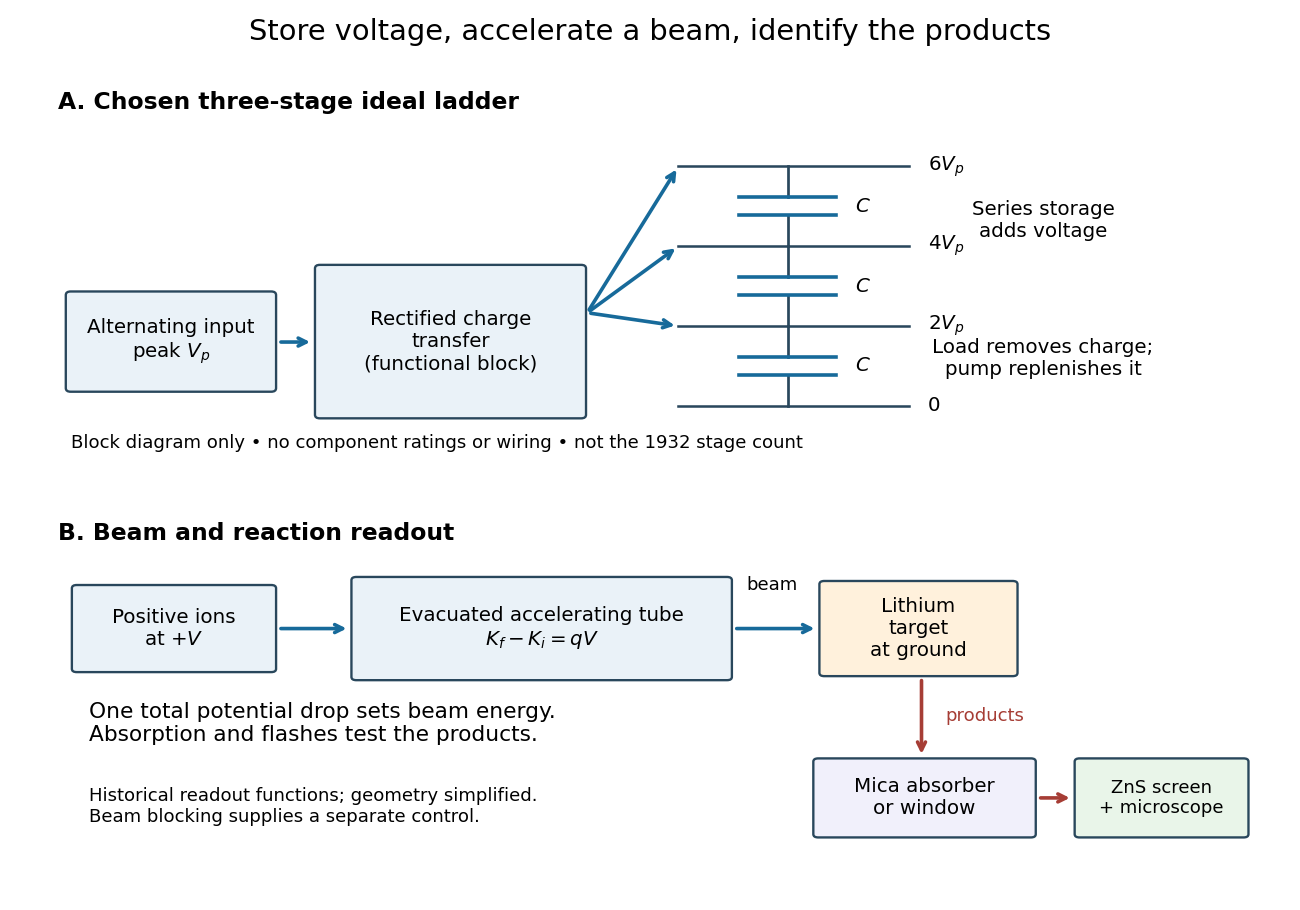
Voltage accumulation and particle acceleration are different steps
. Original functional diagram. Three ideal storage stages illustrate a chosen multiplier model; charge transfer is shown as a functional block rather than a wiring diagram. The beam crosses one total potential drop. The lower chain summarizes the lithium experiment's target and scintillation readout, not the geometry or stage count of the 1932 apparatus. Details.For a fixed electric charge , a time-independent electric potential and negligible collisions or radiation losses, conservation of energy givesHere is the signed potential drop along the trajectory. A proton starting nearly at rest at and arriving at ground gains : a chosen gives , by the definition of the electronvolt. Several intermediate electrodes can distribute that drop along a tube, but the gains telescope to the same endpoint difference. Passing through more electrodes does not multiply the available kinetic energy beyond .
This is the distinction from a cyclotron. In a static electric field, a closed trip gives zero net work. A cyclotron changes the gap electric field between successive visits, so correctly timed particles repeatedly gain kinetic energy. Its limit involves the cyclotron resonance condition and relativistic detuning of a cyclotron; a single-pass electrostatic accelerator instead requires the full accelerating electric potential difference to be sustained at once. Neither machine's beam energy by itself specifies the energy released by a nuclear reaction.
Respiratory control links mitochondrial oxygen consumption to demand for ATP. When ADP permits faster ATP synthase turnover, proton return lowers the opposing electrochemical gradient, permitting faster electron transport.[ref]
Molecular Biology of the Cell, 4th edition by Bruce Alberts and others. Chapter 14, Electron-Transport Chains and Their Proton Pumps, Respiratory Control Normally Restrains Electron Flow Through the Chain
The mitochondrial oxygen electrode assay tests this connection by changing ADP availability while observing oxygen. A slowed reaction rate alone cannot locate the cause: depleted substrate, scarce oxygen, impaired enzymes and a strong opposing electrochemical gradient can all restrict turnover. A renewed response to ADP helps distinguish these possibilities.
An electron carrier cycles between oxidation and reduction. Ubiquinone carries two electrons, while cytochrome c carries one at a time.[ref]
Biology 2e by Mary Ann Clark and others. §7.4, Q and Complex II; Complex III: mobile carriers and electron capacities
For example, transferring the two electrons supplied by one NADH requires two one-electron deliveries by cytochrome c. It does not require two permanently consumed cytochrome c molecules: an available electron carrier can unload, return and reload. Electron carriers recycle material while the net redox conversion supplies free energy.
NADH supplies two electrons to respiratory complex I, then ubiquinone, respiratory complex III, cytochrome c and cytochrome c oxidase; terminal oxygen reduction forms water. Succinate dehydrogenase, or respiratory complex II, supplies another entry to ubiquinone. Respiratory complex I, respiratory complex III and cytochrome c oxidase move protons outward; respiratory complex II does not.[ref]
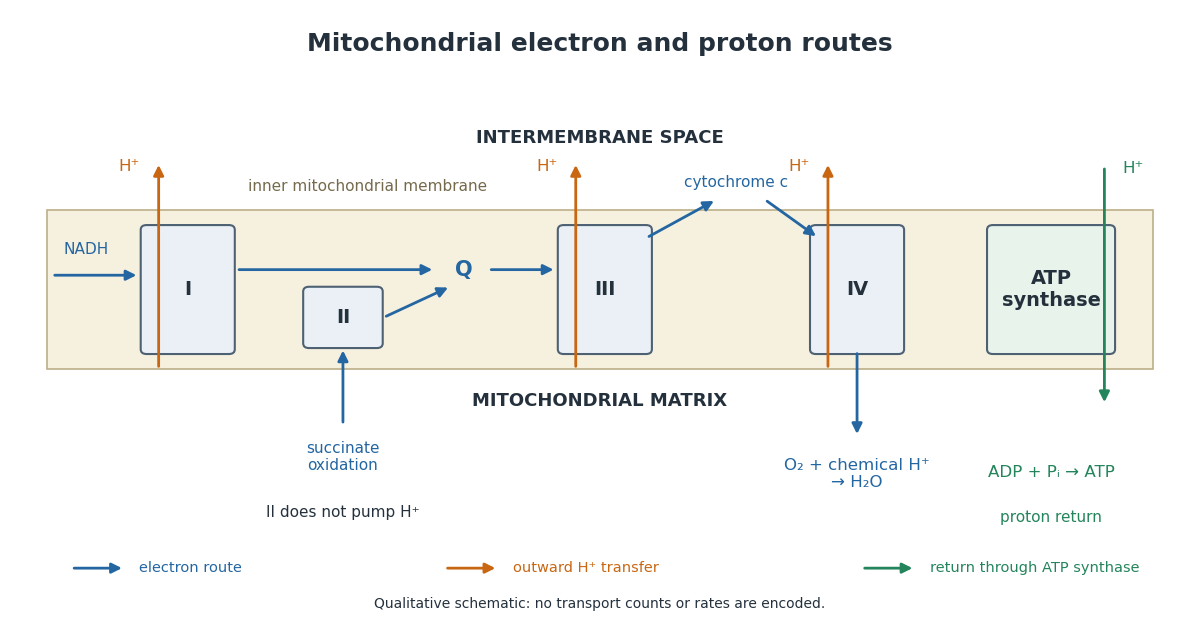
For an original electron balance, supply exactly of NADH to an ideal preparation with no other electron donor or competing electron acceptor. The donor supplies of electrons. Complete reduction of one oxygen molecule needs four electrons, so the corresponding oxygen consumption is . Adding the two formal half-reactions makes the result explicit:The cancelling electrons determine the donor-to-oxygen ratio. These chemical equations do not count transmembrane protons or determine an ATP yield. Chemical protons consumed in water formation and transported protons have different roles in the ledger.
An approximation to mean travelled path length, obtained by integrating reciprocal total electron stopping power and neglecting energy-loss fluctuations. It differs from mean forward penetration depth when electrons change direction.
Pinned article: Introduction to the OurBigBook Project
Welcome to the OurBigBook Project! Our goal is to create the perfect publishing platform for STEM subjects, and get university-level students to write the best free STEM tutorials ever.
Everyone is welcome to create an account and play with the site: ourbigbook.com/go/register. We belive that students themselves can write amazing tutorials, but teachers are welcome too. You can write about anything you want, it doesn't have to be STEM or even educational. Silly test content is very welcome and you won't be penalized in any way. Just keep it legal!
Intro to OurBigBook
. Source. We have two killer features:
- topics: topics group articles by different users with the same title, e.g. here is the topic for the "Fundamental Theorem of Calculus" ourbigbook.com/go/topic/fundamental-theorem-of-calculusArticles of different users are sorted by upvote within each article page. This feature is a bit like:
- a Wikipedia where each user can have their own version of each article
- a Q&A website like Stack Overflow, where multiple people can give their views on a given topic, and the best ones are sorted by upvote. Except you don't need to wait for someone to ask first, and any topic goes, no matter how narrow or broad
This feature makes it possible for readers to find better explanations of any topic created by other writers. And it allows writers to create an explanation in a place that readers might actually find it.
Figure 1. Screenshot of the "Derivative" topic page. View it live at: ourbigbook.com/go/topic/derivativeVideo 2. OurBigBook Web topics demo. Source. - local editing: you can store all your personal knowledge base content locally in a plaintext markup format that can be edited locally and published either:This way you can be sure that even if OurBigBook.com were to go down one day (which we have no plans to do as it is quite cheap to host!), your content will still be perfectly readable as a static site.
- to OurBigBook.com to get awesome multi-user features like topics and likes
- as HTML files to a static website, which you can host yourself for free on many external providers like GitHub Pages, and remain in full control

Figure 2. You can publish local OurBigBook lightweight markup files to either OurBigBook.com or as a static website.
Figure 3. Visual Studio Code extension installation.
Figure 5. . You can also edit articles on the Web editor without installing anything locally. Video 3. Edit locally and publish demo. Source. This shows editing OurBigBook Markup and publishing it using the Visual Studio Code extension. 
- Infinitely deep tables of contents:




All our software is open source and hosted at: github.com/ourbigbook/ourbigbook
Further documentation can be found at: docs.ourbigbook.com
Feel free to reach our to us for any help or suggestions: docs.ourbigbook.com/#contact