Topics (119k) Articles (119k) Users (287) Discussions (237) Comments (383) Files (715) New article
Git tips The key to solve conflicts: see the two conflicting diffs by  Ciro Santilli 40 Updated 2025-07-16
Ciro Santilli 40 Updated 2025-07-16The key to solve conflicts is:
You have to understand what are the two commits that touched a given line (one from master, one from features), and then combine them somehow.
In order to solve conflicts, you just have to understand what commit you are trying to move where.
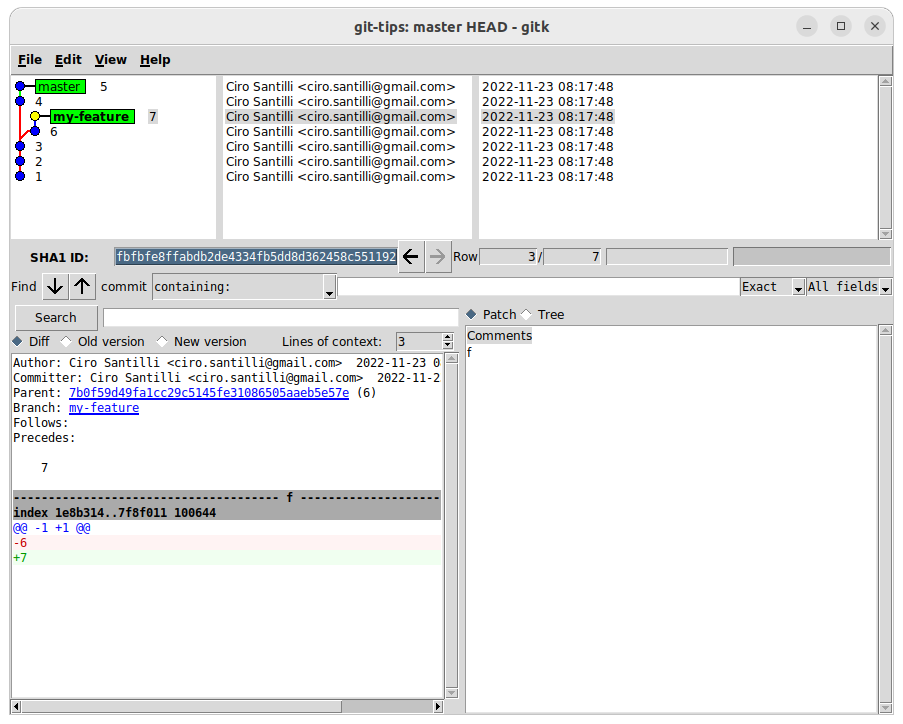
E.g. if from:we do:what happens step by step is first 6 is moved on top of 5:and then 7 is moved on top of the new 6:
5 master
|
4 7 my-feature HEAD
| |
3 6
|/
2
|
1git rebase master6on5 HEAD
|
5 master
|
4 7 my-feature
| |
3 6
| |
2-----------------+
|
17on5 HEAD
|
6on5
|
5 master
|
4 7 my-feature
| |
3 6
| |
2-----------------+
|
17on5 my-feature HEAD
|
6on5
|
5 master
|
4
|
3
|
2
|
1For the strong.
git log --abbrev-commit --decorate --graph --pretty=oneline master HEADOutput:
* b4ec057 (master) 5
* 0b37c1b 4
| * fbfbfe8 (HEAD -> my-feature) 7
| * 7b0f59d 6
|/
* 661cfab 3
* 6d748a9 2
* c5f8a2c 1
If we also add the As we can see, this removes any commit that is neither:
--simplify-by-decoration, which you very often want want on a real repository with many commits:* b4ec057 (master) 5
| * fbfbfe8 (HEAD -> my-feature) 7
|/
* c5f8a2c 1- under a branch or tag
- at the intersection of too branches or tags
- stackoverflow.com/questions/600079/how-do-i-clone-a-subdirectory-only-of-a-git-repository/52269934#52269934
- summaries:
- dupes:
- file or directory
- file
- only small files:
The Quora question: www.quora.com/Are-there-any-PhD-programs-in-training-an-AI-system-to-play-computer-games-Like-the-work-DeepMind-do-combining-Reinforcement-Learning-with-Deep-Learning-so-the-AI-can-play-Atari-games
Some mechanics:
- inter agent communication
- compute power is limited by limiting Java bytecode count execution per bot per cycle
Battlecode Final Tournament 2023
. Source. Introduction to Battlecode by MIT OpenCourseWare (2014)
Source. Bibliography:
2017. Directed by Michael Oswald. Adam Curtis vibes.
Some notable points:
- the role of the British Overseas Territories as tax havens
- the role of the City of London in setting economic policy
- the role of trusts
The porn version of Crushbridge, died in 2020.
Pinned article: Introduction to the OurBigBook Project
Welcome to the OurBigBook Project! Our goal is to create the perfect publishing platform for STEM subjects, and get university-level students to write the best free STEM tutorials ever.
Everyone is welcome to create an account and play with the site: ourbigbook.com/go/register. We belive that students themselves can write amazing tutorials, but teachers are welcome too. You can write about anything you want, it doesn't have to be STEM or even educational. Silly test content is very welcome and you won't be penalized in any way. Just keep it legal!
Intro to OurBigBook
. Source. We have two killer features:
- topics: topics group articles by different users with the same title, e.g. here is the topic for the "Fundamental Theorem of Calculus" ourbigbook.com/go/topic/fundamental-theorem-of-calculusArticles of different users are sorted by upvote within each article page. This feature is a bit like:
- a Wikipedia where each user can have their own version of each article
- a Q&A website like Stack Overflow, where multiple people can give their views on a given topic, and the best ones are sorted by upvote. Except you don't need to wait for someone to ask first, and any topic goes, no matter how narrow or broad
This feature makes it possible for readers to find better explanations of any topic created by other writers. And it allows writers to create an explanation in a place that readers might actually find it.
Figure 1. Screenshot of the "Derivative" topic page. View it live at: ourbigbook.com/go/topic/derivativeVideo 2. OurBigBook Web topics demo. Source. - local editing: you can store all your personal knowledge base content locally in a plaintext markup format that can be edited locally and published either:This way you can be sure that even if OurBigBook.com were to go down one day (which we have no plans to do as it is quite cheap to host!), your content will still be perfectly readable as a static site.
- to OurBigBook.com to get awesome multi-user features like topics and likes
- as HTML files to a static website, which you can host yourself for free on many external providers like GitHub Pages, and remain in full control

Figure 2. You can publish local OurBigBook lightweight markup files to either OurBigBook.com or as a static website.
Figure 3. Visual Studio Code extension installation.
Figure 5. . You can also edit articles on the Web editor without installing anything locally. Video 3. Edit locally and publish demo. Source. This shows editing OurBigBook Markup and publishing it using the Visual Studio Code extension. 
- Infinitely deep tables of contents:


All our software is open source and hosted at: github.com/ourbigbook/ourbigbook
Further documentation can be found at: docs.ourbigbook.com
Feel free to reach our to us for any help or suggestions: docs.ourbigbook.com/#contact