Topics (384k) Articles (398k) Users (410) Discussions (242) Comments (383) Files (13k) New article

Yu. Ofman coauthored the 1962 paper Multiplication of many-digital numbers by automatic computers by A. Karatsuba and Yu. Ofman. The work reduces a multiplication of large integers to three smaller multiplications rather than four, yielding the divide-and-conquer recurrence behind Karatsuba multiplication. It is an early example where an algebraic rearrangement changes an algorithm's asymptotic cost.[ref]
Multiplication of many-digital numbers by automatic computers by A. Karatsuba and Yu. Ofman. paper and three-product identity
Donald Michie described “memo” functions in “Memo” Functions and Machine Learning by Donald Michie. Remembering the result of a completed function call can avoid repeating the same computation later. This idea underlies memoization, where a computer program stores results keyed by the arguments whose values determined them. Reuse requires that those arguments still identify the same result; hidden changing state can invalidate the assumption.[ref]

Portrait of Donald Michie
. Donald Michie (deceased) Personal Web Page Profile Images. CC BY 4.0, via Wikimedia Commons. Source.F. Thomson Leighton is a coauthor of Mathematics for Computer Science by Eric Lehman and others. The text develops proofs, graph theory, counting and probability as tools for analyzing algorithms and discrete structures. Its presentation ties formal arguments to computing questions, such as using indicator random variables and linearity of expectation to evaluate a complicated random count.[ref]

Portrait of F. Thomson Leighton
. Billykamenides. CC BY-SA 4.0, via Wikimedia Commons. Source.Eric Lehman is a coauthor of Mathematics for Computer Science by Eric Lehman and others. The text develops discrete mathematical tools for computer science, including proof techniques, graph theory, counting and probability. Its analysis of indicator variables provides a reusable route from a complicated random count to a sum of simple event probabilities.[ref]
Albert R. Meyer is a coauthor of Mathematics for Computer Science by Eric Lehman and others, which develops proofs, discrete structures and probability for reasoning about computation. Its treatment connects mathematical induction, graph models and counting to algorithmic questions and program correctness.[ref]
Mathematics for Computer Science by Eric Lehman and others. title page and contents
Jochen Liedtke developed microkernel design and implementation methods. In On micro-kernel construction by Jochen Liedtke, he argues for a small privileged core and examines the actual costs of inter-process communication and address-space changes. The paper connects an architectural decomposition to hardware-dependent effects, showing why an abstract separation of services does not by itself determine performance.[ref]

Portrait of Jochen Liedtke
. Adelheid Liedtke. CC BY 1.0, via Wikimedia Commons. Source.Anupam Gupta coauthored An elementary proof of a theorem of Johnson and Lindenstrauss by Sanjoy Dasgupta and Anupam Gupta. The paper gives an elementary probabilistic proof that a finite collection of points can be mapped into a much lower-dimensional Euclidean space while approximately preserving pairwise distances. The Johnson–Lindenstrauss lemma makes dimension reduction a precise geometric guarantee rather than an assumption that all projections preserve geometry.[ref]
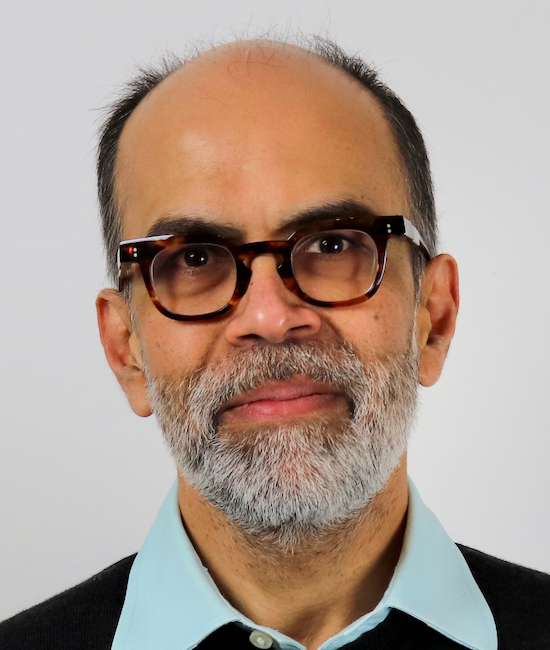
Portrait of Anupam Gupta
. Photograph from New York University's official researcher profile. Source.Sanjoy Dasgupta coauthored An elementary proof of a theorem of Johnson and Lindenstrauss by Sanjoy Dasgupta and Anupam Gupta. The paper gives an elementary probabilistic proof that a finite collection of points can be mapped into a much lower-dimensional Euclidean space while approximately preserving pairwise distances. The Johnson–Lindenstrauss lemma makes dimension reduction a precise geometric guarantee rather than an assumption that all projections preserve geometry.[ref]

Portrait of Sanjoy Dasgupta
. Photograph from University of California, San Diego's official researcher profile. Source.Jeremy Wohl is credited as an author of the PNG specification, the shared technical description of a file format for raster images using lossless source coding.[ref]
Tim Wegner is credited as an author of the PNG specification, the shared technical description of a file format for raster images using lossless source coding.[ref]
Vladimir Vukićević is credited as an author of the PNG specification. The specification defines how raster images, compressed data and ancillary metadata are represented so that independently written encoders and decoders can exchange the same image data.[ref]

Portrait of Vladimir Vukićević
. Hubert Figuière. CC BY-SA 2.0, via Wikimedia Commons. Source.Michael Stokes is credited as an author of the PNG specification, the shared technical description of a file format for raster images using lossless source coding.[ref]
Andrew Smith is credited as an author of the PNG specification, the shared technical description of a file format for raster images using lossless source coding.[ref]
Paul Schmidt is credited as an author of the PNG specification, the shared technical description of a file format for raster images using lossless source coding.[ref]
Pinned article: Introduction to the OurBigBook Project
Welcome to the OurBigBook Project! Our goal is to create the perfect publishing platform for STEM subjects, and get university-level students to write the best free STEM tutorials ever.
Everyone is welcome to create an account and play with the site: ourbigbook.com/go/register. We belive that students themselves can write amazing tutorials, but teachers are welcome too. You can write about anything you want, it doesn't have to be STEM or even educational. Silly test content is very welcome and you won't be penalized in any way. Just keep it legal!
Intro to OurBigBook
. Source. We have two killer features:
- topics: topics group articles by different users with the same title, e.g. here is the topic for the "Fundamental Theorem of Calculus" ourbigbook.com/go/topic/fundamental-theorem-of-calculusArticles of different users are sorted by upvote within each article page. This feature is a bit like:
- a Wikipedia where each user can have their own version of each article
- a Q&A website like Stack Overflow, where multiple people can give their views on a given topic, and the best ones are sorted by upvote. Except you don't need to wait for someone to ask first, and any topic goes, no matter how narrow or broad
This feature makes it possible for readers to find better explanations of any topic created by other writers. And it allows writers to create an explanation in a place that readers might actually find it.
Figure 1. Screenshot of the "Derivative" topic page. View it live at: ourbigbook.com/go/topic/derivativeVideo 2. OurBigBook Web topics demo. Source. - local editing: you can store all your personal knowledge base content locally in a plaintext markup format that can be edited locally and published either:This way you can be sure that even if OurBigBook.com were to go down one day (which we have no plans to do as it is quite cheap to host!), your content will still be perfectly readable as a static site.
- to OurBigBook.com to get awesome multi-user features like topics and likes
- as HTML files to a static website, which you can host yourself for free on many external providers like GitHub Pages, and remain in full control

Figure 2. You can publish local OurBigBook lightweight markup files to either OurBigBook.com or as a static website.
Figure 3. Visual Studio Code extension installation.
Figure 5. . You can also edit articles on the Web editor without installing anything locally. Video 3. Edit locally and publish demo. Source. This shows editing OurBigBook Markup and publishing it using the Visual Studio Code extension. 
- Infinitely deep tables of contents:




All our software is open source and hosted at: github.com/ourbigbook/ourbigbook
Further documentation can be found at: docs.ourbigbook.com
Feel free to reach our to us for any help or suggestions: docs.ourbigbook.com/#contact