Topics (384k) Articles (398k) Users (410) Discussions (242) Comments (383) Files (13k) New article

Speciation is the formation of distinct species through evolution. Detecting a difference between biological populations is a starting observation; its interpretation depends on the stated species concept and the evidence for lasting separation. Reproductive isolation is one important route to limiting gene flow in sexual reproduction.
A enzyme cofactor is a nonprotein component required for the activity of an enzyme or another protein. It can be a metal ion or an organic component; an organic helper is often called a coenzyme. A tightly bound component and a diffusible reaction partner play different roles, even when both are necessary for the overall reaction. The protein component without its required enzyme cofactor can therefore have a different activity from the complete functional assembly. [ref]
Hexokinase transfers a phosphate group from ATP to a hexose such as glucose, producing a sugar phosphate and ADP. Formation of glucose 6-phosphate is an early step in glucose metabolism and helps retain the imported carbon within the cell. Different isoforms have different kinetic and regulatory properties, so a single substrate constant is not a universal property of every hexokinase. [ref]
An active site is the region of an enzyme where a substrate binds and undergoes a chemical reaction. In a protein enzyme, it includes the amino acid residues that contact the substrate and those that directly assist catalysis. These roles can overlap: an amino acid side chain can both orient a substrate and participate in chemistry. The active site occupies only part of the folded protein; the remaining amino acid residues help establish its protein structure, stability and movement. An active site need not be a consecutive stretch of protein primary structure: protein folding can bring distant amino acid residues together. A ribozyme instead supplies an RNA active site. See Alberts et al., Molecular Biology of the Cell, Protein Function: binding sites and catalytic sites.
Binding and catalysis answer different questions. A protein binding site recognizes shape and chemistry through such interactions as hydrogen bonds, electrostatics and the hydrophobic effect. At an active site, appropriate positioning also helps a substrate reach the transition state of a chemical reaction. Some amino acid side chains transfer a proton; others participate transiently in a covalent bond. The enzyme-substrate complex is the associated enzyme and substrate, before conversion to a reaction product. Merely accumulating this complex does not establish rapid catalysis: stabilizing the bound substrate without sufficiently stabilizing the transition state can leave a large barrier. The important complementarity is chemical as well as geometric. See Geoffrey M. Cooper, The Cell, The Central Role of Enzymes as Biological Catalysts: substrate binding and transition-state stabilization.
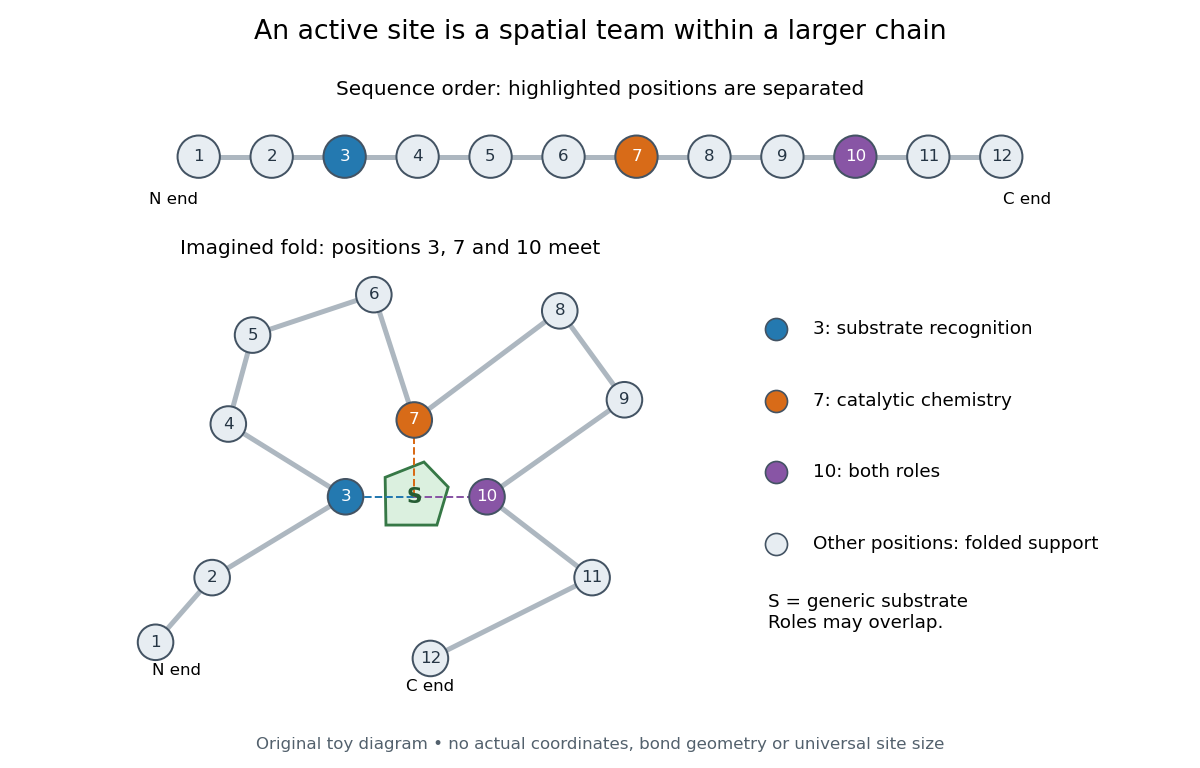
Distant amino acid residues can cooperate at an active site
. Original twelve-residue polypeptide chain cartoon, with the same order and eleven connections in both drawings. Positions 3, 7 and 10 approach a generic substrate after an imagined fold. Blue means recognition, orange means catalytic chemistry, and purple means both; these assignments are invented for explanation. Dashed contacts represent cooperation, not specified hydrogen bonds or actual atomic coordinates. The other nine positions support the imagined protein structure; three highlighted positions are not a universal active site size. Details.The cartoon makes a useful experimental distinction. Changing a contacting amino acid residue might weaken substrate binding, change the reaction rate, or do both. Changing a distant amino acid residue can also disrupt the active site by changing protein folding. Therefore a loss of activity after a mutation alone does not locate a catalytic group: compare binding, protein structure and enzyme kinetics as well. This is an interpretation guide, not a report of a particular mutation experiment.
A concrete example is hexokinase: it transfers the terminal phosphate group of ATP to the -position hydroxyl group of a sugar such as glucose. Specificity need not mean only one acceptable substrate: the hexokinase reaction class includes several possible acceptor sugars. Which are used, and at what reaction rates, depends on the particular enzyme and conditions. See Swiss Institute of Bioinformatics, ENZYME entry EC 2.7.1.1: hexokinase reaction and acceptor range.
Bennett and Steitz compared yeast hexokinase A crystallized with glucose against hexokinase B crystallized without glucose. X-rays scattered by the crystals supplied diffraction measurements from which the authors reconstructed protein structure; comparing coordinates located movement, rather than measuring a reaction rate. The glucose-containing cleft was narrower: one lobe was rotated by about relative to the other, with some protein backbone displacements reaching . This makes the active site a moving arrangement of interacting groups, rather than a permanent hole. See William S. Bennett Jr. and Thomas A. Steitz, Glucose-induced conformational change in yeast hexokinase, PNAS 75 (1978), 4848–4852.
The structural comparison has two explicit limitations: different forms of hexokinase and different crystal environments were compared, and static coordinates do not record the order of binding and movement. Closure is consistent with induced fit, but those structures alone cannot exclude conformational selection. The solution experiment under induced fit addresses whether compaction also occurs outside a crystal.
An enzyme that processes the end of precursor transfer RNA. The bacterial RNase P used in the discovery experiments contains catalytic RNA and a supporting protein; the ribozyme body gives the conditions under which its RNA component works alone. This description concerns those bacterial complexes, not every form of RNase P.
A ribozyme is an RNA molecule whose folded structure provides catalysis of a chemical reaction. A protein enzyme builds its active site from an amino acid chain; a ribozyme builds a working active site from RNA, sometimes with metal ions and associated proteins. Base pairing can help recognize a substrate, but recognition alone does not establish catalysis: the RNA must promote chemical conversion. A passive messenger RNA template being read by a ribosome is not thereby a ribozyme. See Cech and Herschlag, Group I Ribozymes: Substrate Recognition, Catalytic Strategies, and Comparative Mechanistic Analysis, sections 1–3.
The surprise is that an information-bearing polymer can also perform chemistry. Examples include the self-splicing group I intron of Tetrahymena thermophila and the catalytic RNA component of bacterial RNase P, discussed below. The ribosome supplies an everyday example: its peptide bond-forming active site is made of ribosomal RNA, although the complete machine also contains proteins. Nissen and colleagues examined structures of a large ribosome subunit with substrate analogues and found RNA contacting those analogues at the catalytic centre. This supports an RNA active site, not a claim that isolated ribosomal RNA can carry out all of biological translation. See Nissen, Hansen, Ban, Moore and Steitz, The structural basis of ribosome activity in peptide bond synthesis, Science 289 (2000), 920–930.
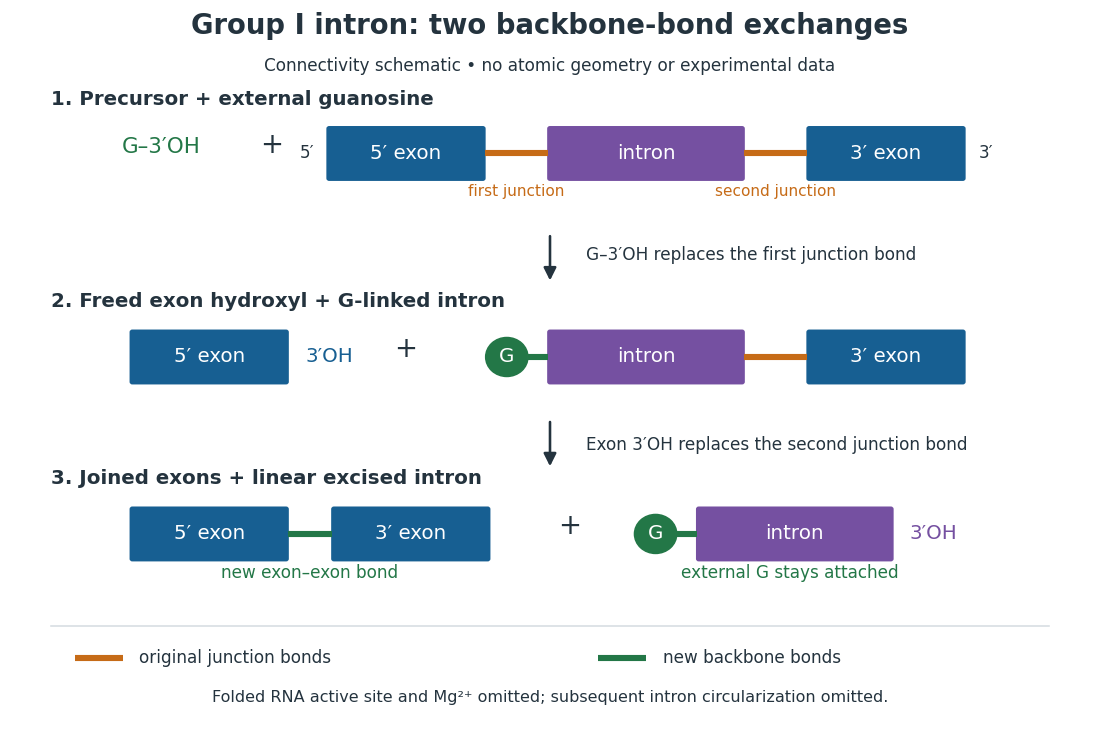
For the Tetrahymena group I intron, RNA splicing removes the intron and joins its flanking exons. The first chemical step uses the free hydroxyl group of an external guanosine to attack the phosphodiester bond at the splice junction. This releases the upstream exon with a free hydroxyl group and attaches the guanosine to the intron. That newly freed hydroxyl group then attacks the phosphodiester bond at the other splice junction, joining the exons and releasing the linear intron. Each step exchanges one backbone connection for another; it is not simply separation of base pairs. See Cech, Zaug and Grabowski, 1981: the phosphoester-transfer mechanism.
The motivating experiment began with an unexpected control. As Cech recounts, Zaug purified a ribosomal RNA precursor from Tetrahymena using a detergent and phenol extraction, then compared test tubes with and without added cell nucleus extract. Incubation in salts and nucleotides released the same amount of small intron RNA in both cases, detected by gel electrophoresis. Repetition made a missing ingredient or accidental omission less plausible. Activity also survived treatments intended to destroy proteins. Nevertheless, absence of added extract did not by itself exclude a tightly attached, resistant protein, or prove that the small RNA had been newly excised rather than released from an already processed complex. See Thomas R. Cech, 1989 Nobel lecture, pp. 655–659: the unexpected control and alternative explanations.
An independent chemical readout addressed the latter problem. Cech mixed precursor RNA with phosphorus-32-labelled guanosine bearing three phosphate groups (GTP), and used gel electrophoresis followed by exposure to X-ray film to locate the label. Label appeared in the excised intron with magnesium present; it was absent when magnesium was omitted or labelled ATP replaced the labelled guanosine reagent. This experiment is described in Cech, 1989 Nobel lecture, pp. 657–658: labelled-guanosine controls. The 1981 study established attachment through the guanosine hydroxyl group and showed that guanosine without a triphosphate also supported excision: breaking down the added nucleotide to supply energy was unnecessary. See Cech, Zaug and Grabowski, In vitro splicing of the ribosomal RNA precursor of Tetrahymena, Cell 27 (1981), 487–496: primary abstract. Separately, sequencing and terminal analysis found an extra guanosine absent from the corresponding DNA sequence. See Zaug and Cech, The intervening sequence excised from the ribosomal RNA precursor of Tetrahymena contains a 5-terminal guanosine residue not encoded by the DNA, Nucleic Acids Research 10 (1982), 2823–2838. Together, incorporation and sequence evidence support a new covalent bond, beyond a change in how RNA associates.
Kruger, Grabowski, Zaug, Sands, Gottschling and Cech's 1982 test removed dependence on a precursor purified from Tetrahymena. They cloned the intron and adjacent exons into a DNA template, made precursor RNA with purified bacterial RNA polymerase under conditions suppressing RNA splicing, and removed proteins by detergent–phenol extraction. Denaturing gel electrophoresis separated precursor species. Purified precursor was then incubated with the guanosine reagent, magnesium and salt; matched samples without this incubation supplied a precursor baseline. Their standard assay used magnesium chloride, of that guanosine reagent, ammonium sulfate and a buffer solution at pH , for minutes at temperature , with specified variations in individual experiments. Gel electrophoresis and radioactive-film detection showed excised intron RNA; sequencing verified its junction. See Kruger et al., Self-Splicing RNA, Cell 31 (1982), 147–157, figures 3–4 and Experimental Procedures.
Excision alone could leave disconnected exons. To test joining, the authors paired labelled RNA with DNA spanning the joined-exon sequence, removed exposed RNA with enzymes, and separated the protected pieces by denaturing gel electrophoresis. Spliced samples yielded protected RNA long enough to span the junction. See Kruger et al., 1982, figure 6: independent evidence for exon ligation. The experimental logic matters: an intron-sized band identifies a candidate product, while sequence and junction assays test its chemical identity.
These controls support sufficiency of the prepared RNA under the assay conditions. They do not show that every RNA self-splices, or that proteins are dispensable inside a biological cell. Many group I introns use proteins to help attain an active fold. See Cech and Herschlag, Group I Ribozymes, section 6: protein facilitation. Nor does a failed assay necessarily identify an inactive nucleotide sequence: unsuitable ions, pH, or temperature can prevent a working active site from forming.
The distinction between self-processing and repeated use became especially clear with bacterial RNase P. In 1983 Guerrier-Takada, Gardiner, Marsh, Pace and Altman separated the RNA and protein components of RNase P from two bacteria. Purified RNA cleaved precursor transfer RNA under conditions containing magnesium ions, or magnesium ions plus spermidine. The protein components alone had no catalytic activity. At – magnesium without spermidine, both components were needed. Thus the comparison demonstrated an RNA catalyst while also explaining why protein assistance could matter under other conditions. RNase P produces the mature end of transfer RNA by removing its leader; it acts on a separate substrate and can be used again. See Guerrier-Takada et al., The RNA moiety of ribonuclease P is the catalytic subunit of the enzyme, Cell 35 (1983), 849–857: primary abstract.
Self-splicing demonstrates RNA chemistry, but one precursor completing one rearrangement is not yet evidence for catalytic turnover: repeated conversion of separate substrates by a regenerated catalyst. The self-splicing precursor changes its own connectivity and incorporates external guanosine. In 1986 Zaug and Cech showed that a shortened Tetrahymena intron RNA could cleave and rejoin separate short RNA substrates in a sequence-dependent reaction. This demonstrated an RNA enzyme acting beyond its own self-processing. See Zaug and Cech, The intervening sequence RNA of Tetrahymena is an enzyme, Science 231 (1986), 470–475: primary abstract.
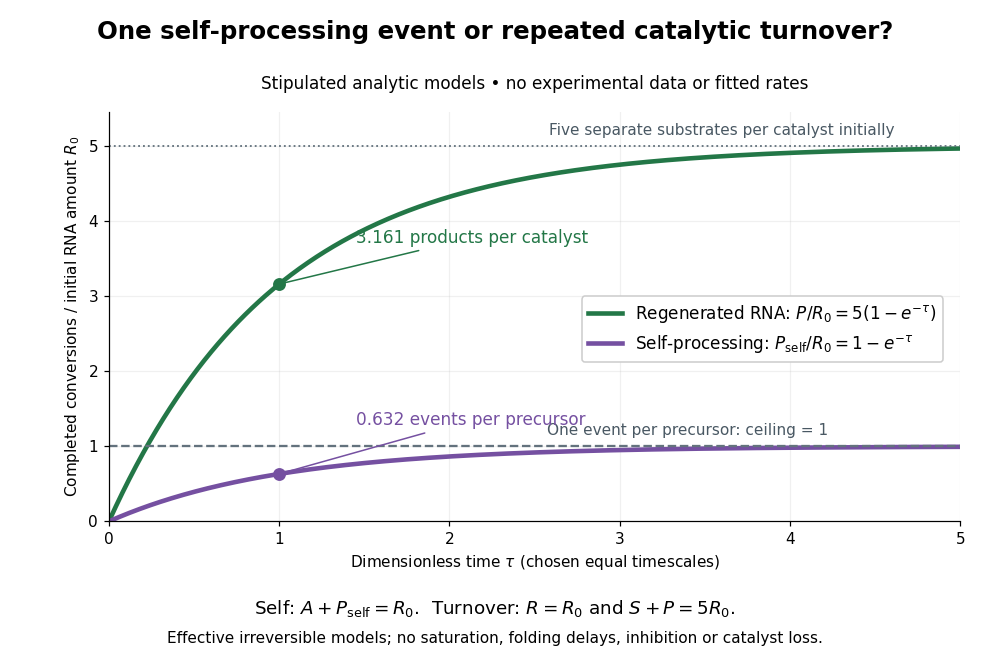
Read the second figure as a counting argument. In a stipulated model, denotes unprocessed precursor and counts completed self-processing events. Set , and . The exponential function solution gives , never exceeding one. Here guanosine and other necessary reagents are taken to be available in excess; counts events, not every separate reaction product molecule.
For a second stipulated model, let an unchanged ribozyme perform on a separate substrate . Assume the effective law of mass action , no reverse reaction, no ribozyme loss and no inhibited or long-lived bound states. Set , , and . Then and , with . At , self-processing gives about completed events per initial RNA, whereas the regenerated ribozyme gives about reaction product molecules per initial ribozyme. More than one substrate conversion per initial ribozyme, with appropriate background and identity controls, is evidence for turnover. Product accumulation below that threshold alone cannot distinguish a reusable catalyst from one-shot chemistry. These models illustrate that distinction; actual enzyme kinetics can include folding delays, binding, saturation and product release.
Glycogen phosphorylase is an enzyme involved in glycogen breakdown. Its activity is the readout in the extract-transfer experiment under second messenger; see that experiment's primary references. A change in enzyme activity need not mean production of more enzyme protein.
Phosphorylase kinase phosphorylates and activates glycogen phosphorylase, promoting glycogenolysis. Its multisubunit regulation integrates phosphorylation by protein kinase A with calcium signals through a calmodulin-containing regulatory system. In muscle, this couples a need for contraction to mobilization of stored carbohydrate. Activation of the kinase changes access to stored fuel rather than creating new glucose carbon. [ref]
Protein kinase A is a cyclic AMP-regulated serine/threonine protein kinase. Binding of cyclic AMP to regulatory subunits relieves inhibition of catalytic subunits, coupling a second messenger to substrate phosphorylation. One downstream target is phosphorylase kinase, linking a hormonal signal to glycogenolysis. Localization and regulatory-subunit composition help specify which substrates respond in a particular cell. [ref]
An adenosine 3′,5′-monophosphate-dependant protein kinase from rabbit skeletal muscle by D. A. Walsh and others. 1968, cyclic nucleotide-dependent kinase activity
Adenylyl cyclase converts ATP to cyclic AMP and diphosphate. Some membrane-associated forms respond to heterotrimeric G-protein signals, allowing receptor stimulation to change an intracellular second messenger. Production by adenylyl cyclase and breakdown by phosphodiesterases jointly determine the cyclic AMP signal. A change in messenger abundance therefore need not result solely from a change in synthesis. [ref]
Protein kinase B, also called AKT, is a serine/threonine protein kinase family involved in growth, survival and metabolism. Membrane recruitment downstream of phosphoinositide 3-kinase and activating phosphorylations regulate its activity. Its substrates include regulators of glucose handling and apoptosis, linking extracellular signals to several cellular decisions. AKT1 is one family member; findings for a particular isoform need not apply identically to every tissue or isoform. [ref]
UniProtKB by the UniProt Consortium. P31749, Function, Catalytic activity and Subunit structure
A phosphoinositide 3-kinase phosphorylates the 3-position of the inositol head group of selected membrane phosphoinositides. Class I forms generate a lipid signal that recruits proteins including protein kinase B to membranes. Different classes have different substrates and cellular roles, including signalling and membrane traffic. Producing a recruiting lipid provides a way to couple receptor activation to a localized protein assembly. [ref]
UniProtKB by the UniProt Consortium. P42336, Function, Catalytic activity and Subunit structure
A protein phosphatase is an enzyme that removes a phosphate group from a modified protein through hydrolysis. This restores a modifiable site rather than regenerating ATP by simply running protein kinase chemistry backward.
A protein kinase is an enzyme that catalyzes phosphorylation of a protein. In receptor tyrosine kinase signaling, ATP supplies the transferred phosphate group.
Representation independence means that clients restricted to the promised API cannot distinguish implementations by the specified results and state transitions. State what observations count: equal returned labels and failure statuses do not imply equal running times, allocations or physical layouts. If the API also promises a resource bound, a replacement must meet that bound too.
Replace the compact array in the bounded queue with encapsulation by a circular buffer with storage , front index and count . Its representation invariant is , , and . Its abstraction function reads the occupied slots using modular arithmetic:On successful
enqueue(x), write and increment . On successful dequeue(), return , replace by and decrement . Full and empty failures do not alter storage. peek and size have the same abstract meanings as before. Keeping a count distinguishes a full circular buffer from an empty one even when both would have the same next insertion index.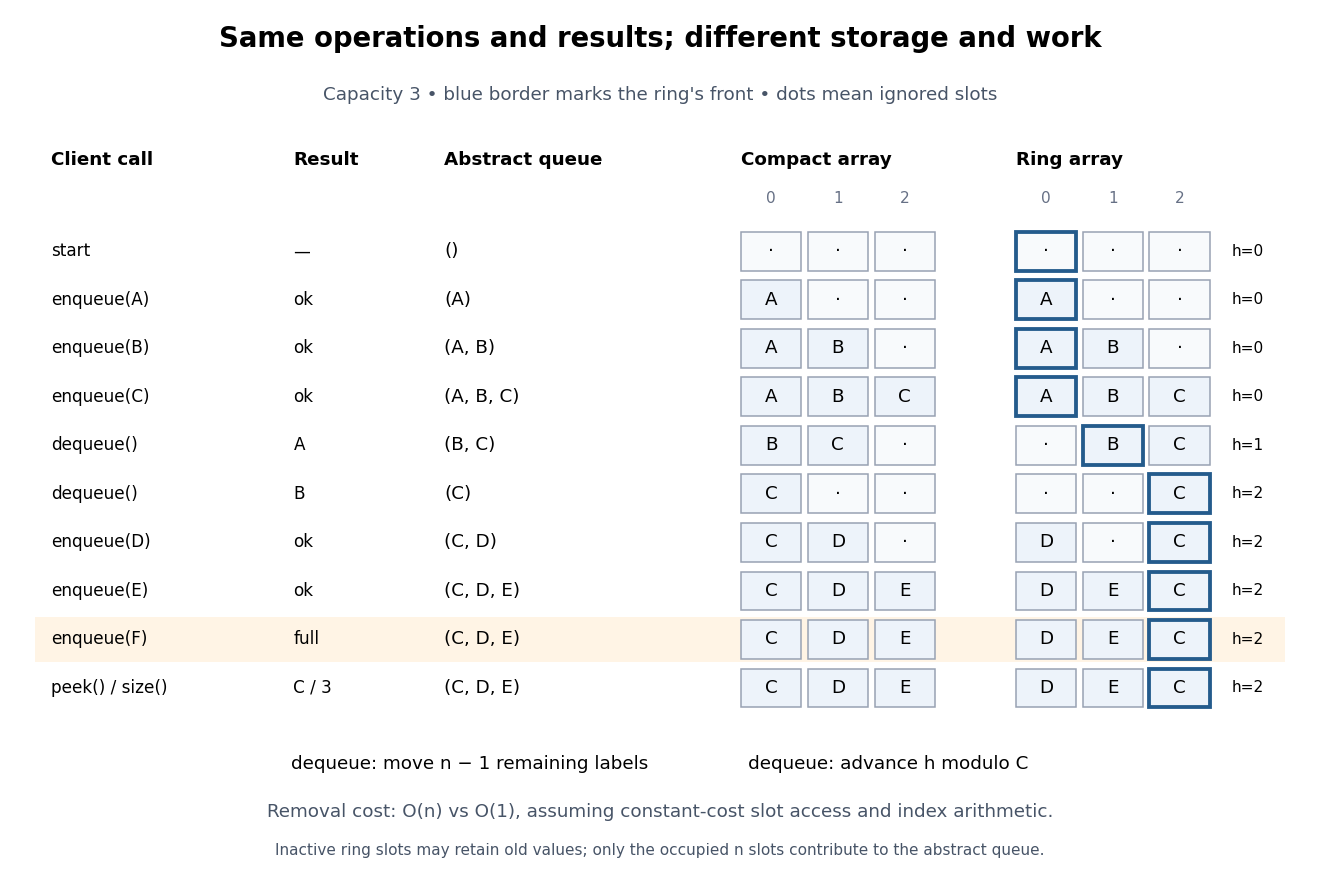
For , start empty, enqueue , dequeue twice, enqueue , try to enqueue , then
peek and size. Both implementations return from the removals, report full for , and finish with front , size three and abstract sequence . The compact array stores from index zero; the circular buffer stores with . Their abstraction functions explain why different stored entries describe the same ordered content.Under constant-cost slot access and index arithmetic, with no resizing and labels that fit in one slot, the compact array does slot moves on a successful removal: worst-case time complexity as capacity varies. The circular buffer does no slot moves and uses worst-case time complexity for all four operations. Both allocate slots initially; that construction cost is separate. These are operation-count claims in Big O notation, not measured timings. The short correctness outline checks that each implementation's abstraction function produces the specified new sequence and return value after every successful or rejected call. Repeating that check gives equal traces for clients using only this API.
Representation exposure gives outside code access that can modify storage on which the representation invariant or promised behavior depends. Returning the internal array exposes a route around the API; merely hiding the field name does not close it. Incoming shared mutable storage can create the same problem. Copies or immutable values can prevent such modification, but their costs and sharing rules belong in the design.[ref]
Reading 13: Abstraction Functions & Rep Invariants. Reading 13, Invariants, Immutability: mutable aliases through both returned values and constructor arguments
The bounded queue with encapsulation deliberately stores immutable labels. A FIFO queue of mutable objects needs a separate promise about whether changing a returned object changes stored content; protecting the queue's ordering and size does not automatically make every stored object immutable.
Consider an original FIFO queue example storing immutable labels, with fixed positive integer capacity . Its abstract state is a finite sequence , with . The API has
enqueue(x), dequeue(), peek() and size(). Successful enqueue returns ok; a full queue returns full and is unchanged. Successful dequeue returns the first label and removes it; an empty queue returns empty and is unchanged. peek returns the first label or empty without modification, and size returns . The status results are distinct from stored labels.For a compact array representation , fix and require the representation invariantThe abstraction function is . Only these first entries matter; unused slots have no abstract meaning. On successful
enqueue(x), write and then set . On successful dequeue(), save , shift the remaining entries left, and decrement . Testing the full or empty case before updating gives the specified unchanged failure state.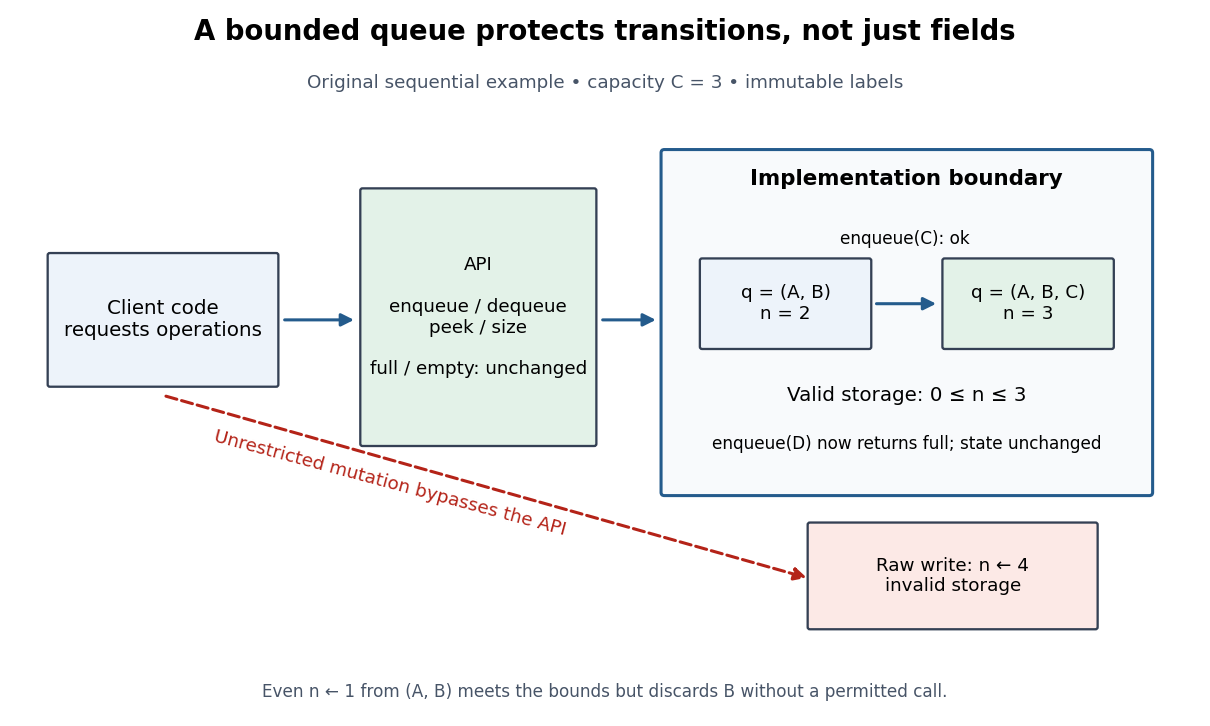
Permitted queue calls preserve valid states; an unrestricted count write bypasses the API
. Details. With and ,
enqueue(C) produces ; enqueue(D) returns full without change. A raw write violates the representation invariant. More subtly, changing the count from two to one satisfies its bounds but discards without a permitted operation. Validity of the storage state and legality of the API transition are different obligations. A setter for every storage field would surrender the useful boundary even if its name looked like an ordinary operation.An abstract data type specifies values and operations independently of their storage. A FIFO queue has ordered sequences as its abstract values; an array and a linked list can represent those same values. A representation invariant identifies valid storage states, and an abstraction function says what each valid state means.[ref]
Reading 13: Abstraction Functions & Rep Invariants. Reading 13, Rep Invariant and Abstraction Function: representation values, abstract values, AF and RI
Information hiding makes an implementation decision the responsibility of one software module, whose API lets other code work without knowing that decision. For a FIFO queue, clients need the removal order and failure behavior; they need not know the current front index in an array. This explains why encapsulation is useful beyond object-oriented programming: procedures with hidden storage can provide the same boundary.[ref]
On the Criteria To Be Used in Decomposing Systems into Modules by D. L. Parnas. Parnas, pp. 1054 and 1056, What Is Modularization? and The Criteria: responsibility assignments and hidden design decisions
In On the Criteria To Be Used in Decomposing Systems into Modules by D. L. Parnas (December 1972, pp. 1054–1056), the example applies a sorting algorithm to word rotations of input lines. One decomposition shares storage layouts among processing stages. The alternative exposes line-storage operations such as
CHAR and SETCHAR, hiding whether characters are packed four to a machine word. Changing that packing then belongs to line storage rather than every client. The paper presents a design argument using a deliberately small example, not a universal measured speedup or a claim that classes are required. It also notes that an unnecessarily specified rotation order restricts future implementations (p. 1056, Improvement in Circular Shift Module). Pinned article: Introduction to the OurBigBook Project
Welcome to the OurBigBook Project! Our goal is to create the perfect publishing platform for STEM subjects, and get university-level students to write the best free STEM tutorials ever.
Everyone is welcome to create an account and play with the site: ourbigbook.com/go/register. We belive that students themselves can write amazing tutorials, but teachers are welcome too. You can write about anything you want, it doesn't have to be STEM or even educational. Silly test content is very welcome and you won't be penalized in any way. Just keep it legal!
Intro to OurBigBook
. Source. We have two killer features:
- topics: topics group articles by different users with the same title, e.g. here is the topic for the "Fundamental Theorem of Calculus" ourbigbook.com/go/topic/fundamental-theorem-of-calculusArticles of different users are sorted by upvote within each article page. This feature is a bit like:
- a Wikipedia where each user can have their own version of each article
- a Q&A website like Stack Overflow, where multiple people can give their views on a given topic, and the best ones are sorted by upvote. Except you don't need to wait for someone to ask first, and any topic goes, no matter how narrow or broad
This feature makes it possible for readers to find better explanations of any topic created by other writers. And it allows writers to create an explanation in a place that readers might actually find it.
Figure 1. Screenshot of the "Derivative" topic page. View it live at: ourbigbook.com/go/topic/derivativeVideo 2. OurBigBook Web topics demo. Source. - local editing: you can store all your personal knowledge base content locally in a plaintext markup format that can be edited locally and published either:This way you can be sure that even if OurBigBook.com were to go down one day (which we have no plans to do as it is quite cheap to host!), your content will still be perfectly readable as a static site.
- to OurBigBook.com to get awesome multi-user features like topics and likes
- as HTML files to a static website, which you can host yourself for free on many external providers like GitHub Pages, and remain in full control

Figure 2. You can publish local OurBigBook lightweight markup files to either OurBigBook.com or as a static website.
Figure 3. Visual Studio Code extension installation.
Figure 5. . You can also edit articles on the Web editor without installing anything locally. Video 3. Edit locally and publish demo. Source. This shows editing OurBigBook Markup and publishing it using the Visual Studio Code extension. 
- Infinitely deep tables of contents:




All our software is open source and hosted at: github.com/ourbigbook/ourbigbook
Further documentation can be found at: docs.ourbigbook.com
Feel free to reach our to us for any help or suggestions: docs.ourbigbook.com/#contact