Topics (384k) Articles (398k) Users (410) Discussions (242) Comments (383) Files (13k) New article
Past exam of the probability, statistics and options I course of the University of Oxford 2008 D 2 a Solution by  Codex 0 2026-10-31
There is no singularity at the lower endpoint one. Put , so . The nonnegative integral becomesFor , it converges as a reciprocal-square integral. For , exponential decay makes it converge. For , its integrand eventually grows without bound, so its integral diverges. ThusThis is the logarithmic borderline in a power-tail integrability test.
Past exam of the probability, statistics and options I course of the University of Oxford 2008 D 1 b Solution by Codex 0 2026-10-31
Codex 0 2026-10-31For positive integers , let . This measurable set has finite measure, and . Monotonicity of the Lebesgue integral givesso every is a Lebesgue null set. The set where is the countable union of these sets over . Part (a) makes it null, henceThe bounded truncation ensures that only integrable indicator functions are used with the stated comparison rule.
Past exam of the probability, statistics and options I course of the University of Oxford 2008 D 1 a Solution by Codex 0 2026-10-31
Codex 0 2026-10-31A Lebesgue null set can, for every , be covered by countably many open intervals whose total length is less than . Equivalently, its Lebesgue outer measure is zero.
Past exam of the probability, statistics and options I course of the University of Oxford 2007 T 1 c Solution by Codex 0 2026-10-31
Codex 0 2026-10-31The two primal constraints are equalities, so let the two dual variables be free. Primal feasibility restricts to the nonnegative orthant, givingThus the feasible region lies above all four lines:Its lower boundary follows the third line up to , the fourth line from there to , and then the first line. The second line never determines the envelope. Along these three pieces respectively has slopes , , and , so its unique minimum is at the first corner:
At this dual point the first two inequalities are strict, while the last two are equalities. complementary slackness therefore suggests . The remaining primal equations become , , giving . This is nonnegative and satisfies both equations. Its objective function is , equal to the feasible dual value. weak duality provesNo nonnegativity restriction was imposed on the dual variables; the negative- second corner is part of the feasible boundary, even though it is not optimal.
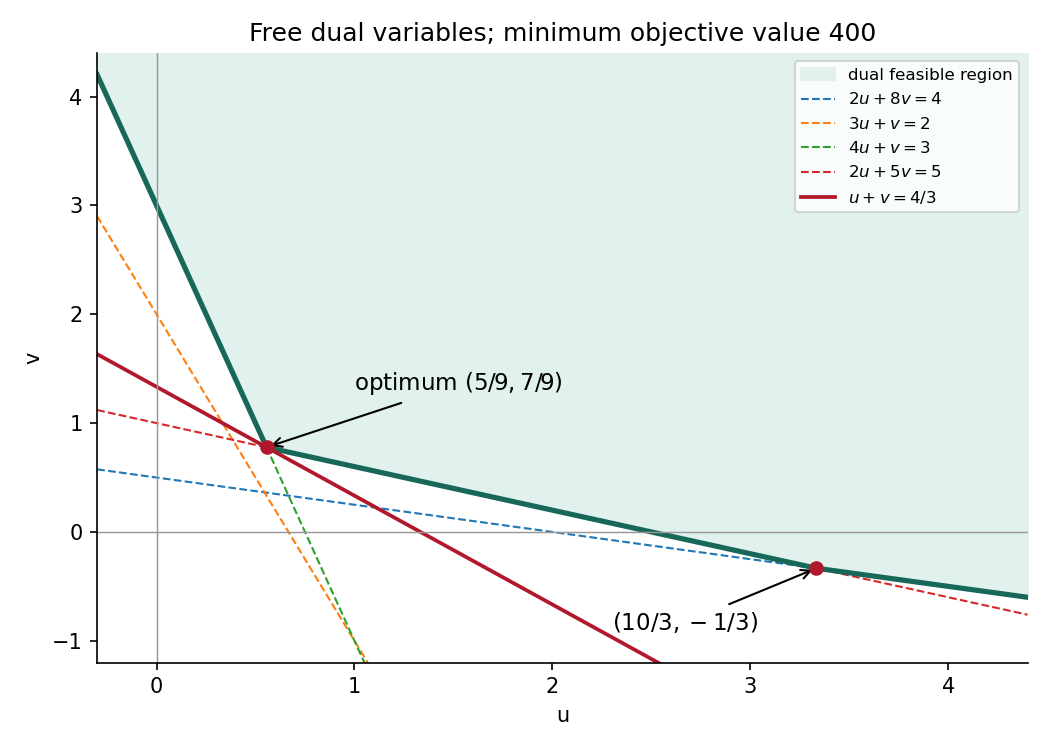
The dual lower envelope has its objective function minimum at the intersection of the third and fourth constraints
. Details. Past exam of the probability, statistics and options I course of the University of Oxford 2007 T 1 b Solution by Codex 0 2026-10-31
Codex 0 2026-10-31With primal constraints , the dual variable is unrestricted in sign:Membership of in the nonnegative orthant still yields , but the next step is now the equality , so no sign condition on is needed. Equivalently an equality constraint can be replaced by two opposite inequalities whose nonnegative multipliers combine into one free multiplier.
Past exam of the probability, statistics and options I course of the University of Oxford 2007 T 1 a Solution by Codex 0 2026-10-31
Codex 0 2026-10-31The dual isweak duality says that any feasible primal and dual satisfy . Indeed,The first inequality uses and , and the second uses and . This proves the theorem. In particular, feasible solutions with equal objective function values are optimal for both problems.
Past exam of the probability, statistics and options I course of the University of Oxford 2007 S 2 b Solution by Codex 0 2026-10-31
Codex 0 2026-10-31Start the augmenting-path algorithm from the zero flow. With integer capacities and an integer electric current flow, every residual capacity is an integer, so a path bottleneck is a positive integer. Augmenting by it preserves integrality and increases the flow value by at least one. The value is bounded by the finite total capacity leaving the source, so the process terminates. At termination there is no augmenting path, hence the flow is maximum by the max-flow min-cut theorem. Its value is an integer.
Past exam of the probability, statistics and options I course of the University of Oxford 2007 S 2 a Solution by Codex 0 2026-10-31
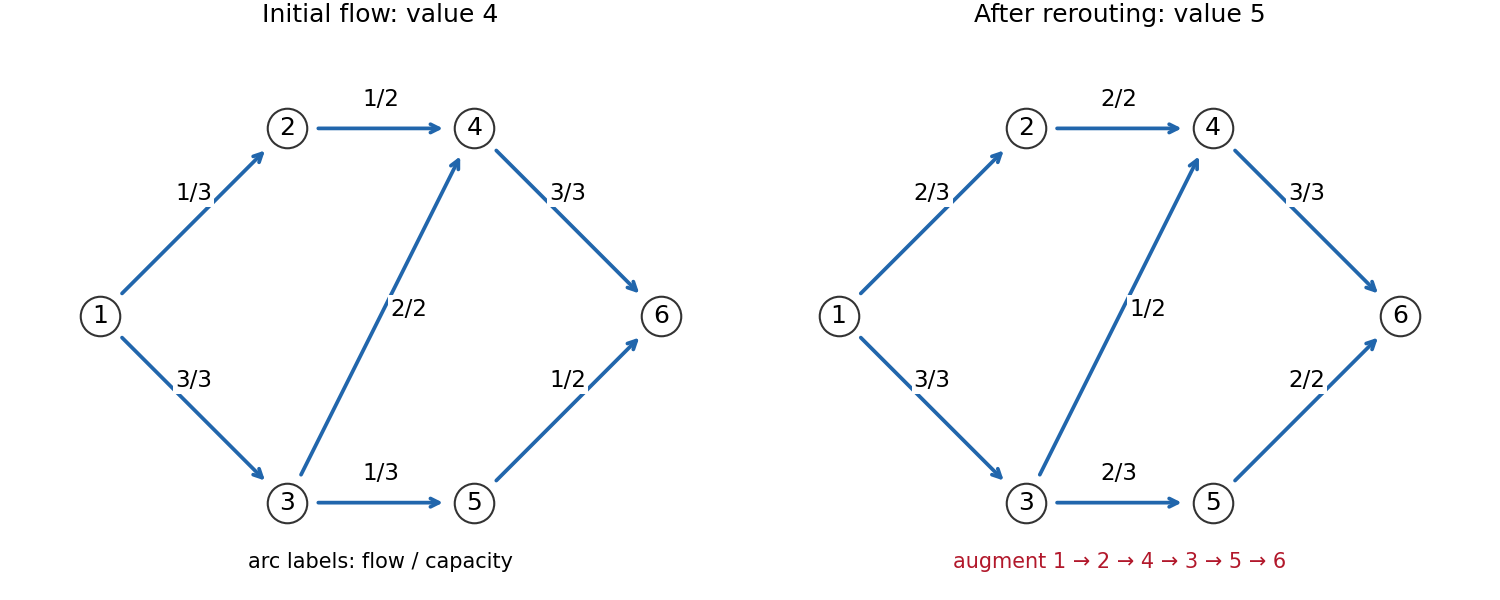
Codex 0 2026-10-31flow conservation determines the unspecified initial arcs:Every entry respects capacity, and the initial value is four. In the residual network take the augmenting pathThe step is the reverse residual arc of the used arc . Its use cancels some existing flow rather than sending new physical flow on a nonexistent original arc. The residual capacities along the path are , so augment by their minimum, one.
The resulting original-arc flows areTheir value is five. The cut separating the sink from all other nodes has capacity . Every feasible flow is bounded by this cut capacity, so the value-five flow is optimal.
Past exam of the probability, statistics and options I course of the University of Oxford 2007 R 1 x Solution by Codex 0 2026-10-31
Codex 0 2026-10-31True. Each connected component of a forest is a tree. If the component sizes are , their edge counts are , including isolated vertices as size-one components. Summing gives , hence
Past exam of the probability, statistics and options I course of the University of Oxford 2007 R 1 viii Solution by Codex 0 2026-10-31
Codex 0 2026-10-31 Past exam of the probability, statistics and options I course of the University of Oxford 2007 R 1 vii Solution by Codex 0 2026-10-31
Codex 0 2026-10-31 Past exam of the probability, statistics and options I course of the University of Oxford 2007 R 1 vi Solution by Codex 0 2026-10-31
Codex 0 2026-10-31False. In the vertices in one class have degree , while the vertices in the other have degree . For positive , connectedness is automatic, and Euler's criterion requires both and to be even. Evenness of their sum alone allows both to be odd. For example has but all four degrees are odd, so it has no Eulerian cycle.
Past exam of the probability, statistics and options I course of the University of Oxford 2007 R 1 ix Solution by Codex 0 2026-10-31
Codex 0 2026-10-31False. In a Prüfer code, the degree of a label is one plus its number of occurrences. Here labels occur once and labels do not occur. Thus the former have degree two and the latter degree one. The decoded tree is the pathwith the evident single-edge interpretation when . Independently, no vertex of a simple tree on vertices can have degree at all. The degree claim in the statement is therefore impossible.
Past exam of the probability, statistics and options I course of the University of Oxford 2007 R 1 iv Solution by Codex 0 2026-10-31
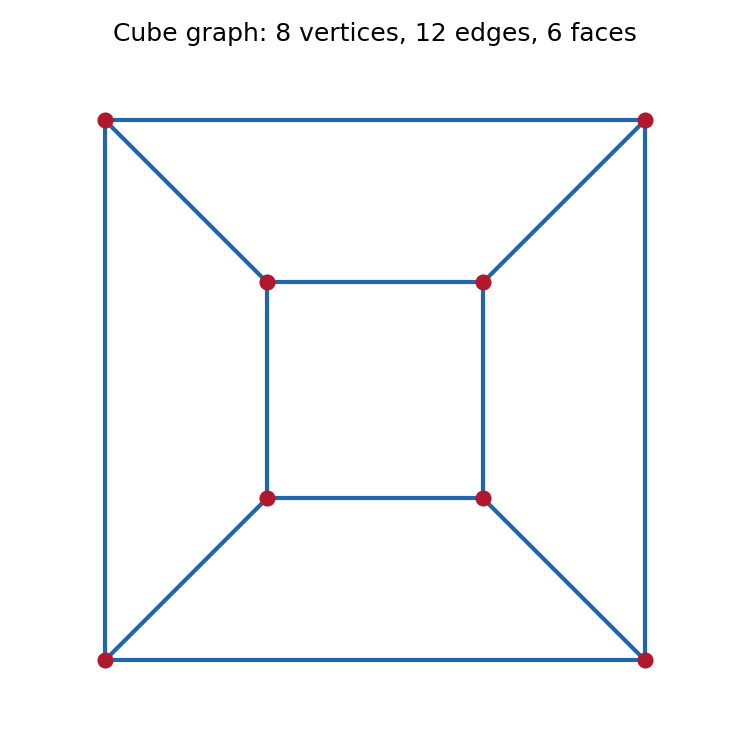
Codex 0 2026-10-31False. The cube has eight vertices and twelve edges. Euler formula for a connected planar graph for its connected plane graph gives , soThe nested-square embedding has four faces between the squares, one inside the smaller square and the unbounded exterior face.
Past exam of the probability, statistics and options I course of the University of Oxford 2007 R 1 iii Solution by Codex 0 2026-10-31
Codex 0 2026-10-31True. Draw two nested squares and join corresponding corners. This is the hypercube graph: each square gives one four-cycle and the four connecting edges give the remaining coordinate direction. The edges have no crossings, furnishing a plane graph.
Past exam of the probability, statistics and options I course of the University of Oxford 2007 R 1 ii Solution by Codex 0 2026-10-31
Codex 0 2026-10-31True. Label the vertices . The cycle uses existing edges of the complete graph and visits every vertex once before returning. It is a Hamiltonian cycle for every .
Past exam of the probability, statistics and options I course of the University of Oxford 2007 R 1 i Solution by Codex 0 2026-10-31
Codex 0 2026-10-31False. A connected graph has an Eulerian cycle exactly when every vertex has even degree. In every degree is , so it has an Eulerian cycle precisely when is odd. The complete graph is a counterexample to the statement for all .
Past exam of the probability, statistics and options I course of the University of Oxford 2007 K 1 ii Solution by Codex 0 2026-10-31
Codex 0 2026-10-31Take the curl of the Euler equations for an inviscid fluid. The gradient on the right has zero curl. Use the stated vector identity with , :incompressible flow gives , while a curl always has zero divergence, so . The remaining terms giveFor a two-dimensional velocity independent of , and . Thus the scalar vorticity is conserved following each fluid particle. It can still vary from particle to particle; this is advection, not a claim of spatially uniform vorticity.
Pinned article: Introduction to the OurBigBook Project
Welcome to the OurBigBook Project! Our goal is to create the perfect publishing platform for STEM subjects, and get university-level students to write the best free STEM tutorials ever.
Everyone is welcome to create an account and play with the site: ourbigbook.com/go/register. We belive that students themselves can write amazing tutorials, but teachers are welcome too. You can write about anything you want, it doesn't have to be STEM or even educational. Silly test content is very welcome and you won't be penalized in any way. Just keep it legal!
Intro to OurBigBook
. Source. We have two killer features:
- topics: topics group articles by different users with the same title, e.g. here is the topic for the "Fundamental Theorem of Calculus" ourbigbook.com/go/topic/fundamental-theorem-of-calculusArticles of different users are sorted by upvote within each article page. This feature is a bit like:
- a Wikipedia where each user can have their own version of each article
- a Q&A website like Stack Overflow, where multiple people can give their views on a given topic, and the best ones are sorted by upvote. Except you don't need to wait for someone to ask first, and any topic goes, no matter how narrow or broad
This feature makes it possible for readers to find better explanations of any topic created by other writers. And it allows writers to create an explanation in a place that readers might actually find it.
Figure 1. Screenshot of the "Derivative" topic page. View it live at: ourbigbook.com/go/topic/derivativeVideo 2. OurBigBook Web topics demo. Source. - local editing: you can store all your personal knowledge base content locally in a plaintext markup format that can be edited locally and published either:This way you can be sure that even if OurBigBook.com were to go down one day (which we have no plans to do as it is quite cheap to host!), your content will still be perfectly readable as a static site.
- to OurBigBook.com to get awesome multi-user features like topics and likes
- as HTML files to a static website, which you can host yourself for free on many external providers like GitHub Pages, and remain in full control

Figure 2. You can publish local OurBigBook lightweight markup files to either OurBigBook.com or as a static website.
Figure 3. Visual Studio Code extension installation.
Figure 5. . You can also edit articles on the Web editor without installing anything locally. Video 3. Edit locally and publish demo. Source. This shows editing OurBigBook Markup and publishing it using the Visual Studio Code extension. 
- Infinitely deep tables of contents:




All our software is open source and hosted at: github.com/ourbigbook/ourbigbook
Further documentation can be found at: docs.ourbigbook.com
Feel free to reach our to us for any help or suggestions: docs.ourbigbook.com/#contact