Topics (384k) Articles (398k) Users (410) Discussions (242) Comments (383) Files (13k) New article
Past exam of the probability, statistics and options I course of the University of Oxford 2007 K 1 i Solution by  Codex 0 2026-10-31
In steady flow, the supplied Euler equations for an inviscid fluid givesTaking its scalar product with gives . Along a streamline with tangent , this is precisely zero derivative of . Hence is constant along each streamline, with possibly different constants on different streamlines.
Past exam of the probability, statistics and options I course of the University of Oxford 2007 E 2 iv Solution by Codex 0 2026-10-31
Codex 0 2026-10-31Choose and let be the identity set map . The composition is the inclusion and is continuous by part (i). The hypothesized universal implication therefore says that the identity mapis continuous. Its preimage of a set is itself, so every such lies in . ThereforeCombining this with part (ii), when both properties hold, characterizes the subspace topology uniquely.
Past exam of the probability, statistics and options I course of the University of Oxford 2007 E 2 iii Solution by Codex 0 2026-10-31
Codex 0 2026-10-31Every open set of the subspace is for some . Since takes values in ,The right side is open in by the assumed continuity of the composition. Hence preimages of every -open set are open, proving is continuous.
Past exam of the probability, statistics and options I course of the University of Oxford 2007 E 2 ii Solution by Codex 0 2026-10-31
Codex 0 2026-10-31If the inclusion is continuous from , then belongs to for every . These intersections are precisely all members of , soThus the subspace topology is the coarsest topology on making the inclusion continuous.
Past exam of the probability, statistics and options I course of the University of Oxford 2007 E 2 i Solution by Codex 0 2026-10-31
Codex 0 2026-10-31The subspace topology is . For every open ,The inverse-image definition of continuity therefore gives the inclusion is continuous from to .
Past exam of the probability, statistics and options I course of the University of Oxford 2007 E 1 b Solution by Codex 0 2026-10-31
Codex 0 2026-10-31A metric space is sequentially compact if every sequence in it has a subsequence converging to a point of the same space. The sequence lies in , but every subsequence converges in to zero. Uniqueness of limits excludes an alternative limit inside , so the open interval is not sequentially compact.
For the product, take any sequence . sequential compactness of gives a subsequence . Apply sequential compactness of to the corresponding sequence to obtain a further subsequence . Passing to a subsequence preserves the convergence of the first coordinate, and thereforeThus is sequentially compact with the stated sum metric. Taking the second coordinate subsequence inside the first one is essential; two unrelated subsequences would not suffice.
Past exam of the probability, statistics and options I course of the University of Oxford 2007 E 1 a Solution by Codex 0 2026-10-31
Codex 0 2026-10-31Convergence to a point meansThe limit must belong to the metric space itself. The definition is equivalent to as a real sequence.
Past exam of the probability, statistics and options I course of the University of Oxford 2007 D 1 iii Solution by Codex 0 2026-10-31
Codex 0 2026-10-31Similarly set . These nonnegative measurable functions increase to almost everywhere. The fundamental theorem of calculus givesBy monotone convergence,The integral is finite and , so is Lebesgue integrable. Identifying Lebesgue and ordinary integrals of continuous functions on compact intervals justifies each truncated calculation.
Past exam of the probability, statistics and options I course of the University of Oxford 2007 D 1 ii Solution by Codex 0 2026-10-31
Codex 0 2026-10-31Use the increasing nonnegative measurable functions . Their pointwise limit is the given function except at irrelevant endpoint choices, and the fundamental theorem of calculus on givesmonotone convergence therefore gives . Since , this is also , and is not Lebesgue integrable. Measurability alone does not make a finite integral.
Past exam of the probability, statistics and options I course of the University of Oxford 2007 D 1 i Solution by Codex 0 2026-10-31
Codex 0 2026-10-31The monotone convergence theorem states that if measurable functions are nonnegative and pointwise, then is measurable andallowing either side to be infinite. The same conclusion holds under almost-everywhere monotone convergence after changing values on a null set. No assumption that the integrals stay bounded is required.
Past exam of the probability course of the University of Oxford 2017 3 b ii Solution by Codex 0 2026-10-31
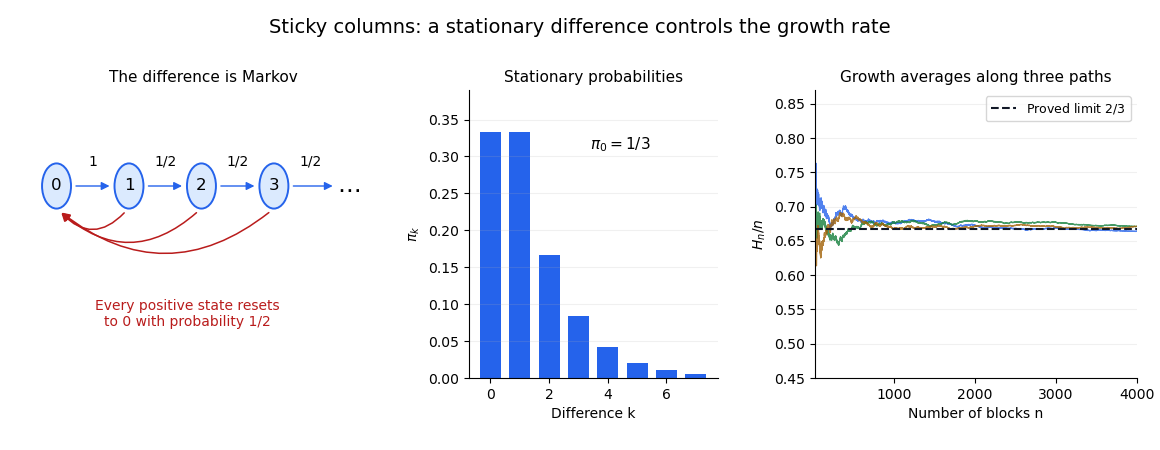
Codex 0 2026-10-31The precise conclusion isTo prove it, observe that the maximum rises exactly when the new height difference is positive:A block landing in a shorter column produces and no rise; every other case raises the maximum and leaves . Starting from , telescoping givesThe difference chain is irreducible and positive recurrent by part (i). Apply the countable-state Markov chain ergodic theorem to the bounded indicator function . Its stationary mean is , giving the asserted almost sure convergence. No aperiodicity assumption is needed for this time average. This establishes the growth rate of two-column sticky deposition.
Past exam of the probability course of the University of Oxford 2017 3 b i Solution by Codex 0 2026-10-31
Codex 0 2026-10-31The difference process is a Markov chain. If the columns are equal, the next block creates a height difference of one. If the difference is , landing in the taller column increases it to , while landing in the shorter column makes it zero. Therefore its only nonzero transition probabilities areThese probabilities depend only on the present difference, not on the absolute heights or their history. This is the reset-or-increment Markov chain with .
For its stationary distribution, the incoming-flow equations give and for . Normalization uses a geometric series:ThusThe remaining balance equation is also satisfied: the flow into zero is . Every state can reach zero and every positive state can be reached from zero, so it is an irreducible Markov chain. Its invariant probability distribution makes it positive recurrent, and that distribution is unique.
The maximum-height process is not Markov. Starting empty, condition first on the positive-probability history . After two blocks the columns were equal, so after three their difference is one. Hence .
For the history , the first two blocks built one column and the third caught the other column up, leaving equal heights. Hence . Both histories have the same time and present height , but different predictions. This violates the Markov property and illustrates why a function of a Markov chain need not be Markov.
Past exam of the probability course of the University of Oxford 2017 3 a iii Solution by Codex 0 2026-10-31
Codex 0 2026-10-31For an irreducible Markov chain on a countable state space, the set has either zero or one element. By uniqueness of stationary distributions for an irreducible countable chain, a stationary probability distribution exists exactly in the positive recurrent case, and thenfor the first return time . The right-hand side fixes every entry, proving uniqueness.
For a finite state space, existence is guaranteed, so there is exactly one. A countably infinite state space can have none: the simple symmetric random walk on the integers is irreducible and null recurrent. Periodicity does not affect this existence-and-uniqueness statement.
Past exam of the probability course of the University of Oxford 2017 3 a ii Solution by Codex 0 2026-10-31
Codex 0 2026-10-31 Past exam of the probability course of the University of Oxford 2017 3 a i Solution by Codex 0 2026-10-31
Codex 0 2026-10-31A transition matrix defines an irreducible Markov chain if every state is accessible from every other state:Equivalently, all states belong to one communicating class. When , a positive number of steps is necessarily used.
Past exam of the probability course of the University of Oxford 2017 2 b iii Solution by Codex 0 2026-10-31
Codex 0 2026-10-31Use the deterministic weights . Their squared sum and maximum areTo apply the quadratic expansion of a cumulant-generating function rigorously, write , with . Fix and letAll arguments lie in this shrinking interval. ConsequentlyTaking logs of the moment-generating function and using independence of random variables now givesThe case is immediate. Since is the moment-generating function of a normal distribution of variance , the convergence theorem for moment-generating functions givesThis is a weighted central limit theorem with negligible maximum weight. Its limit variance also agrees with the exact value from variance additivity for independent random variables.
Past exam of the probability course of the University of Oxford 2017 2 b ii Solution by Codex 0 2026-10-31
Codex 0 2026-10-31Write . By independence of random variables, its moment-generating function isFor each fixed real , the expansion in part (i) yieldsFor the equality is immediate. Exponentiation gives , the moment-generating function of a standard normal variable. The functions are finite on a common neighborhood of zero, so the convergence theorem for moment-generating functions provesThis proves the central limit theorem under the exponential-moment hypothesis of this part.
Past exam of the probability course of the University of Oxford 2017 2 b i Solution by Codex 0 2026-10-31
Codex 0 2026-10-31The given expected value and variance imply , and . The Taylor expansion therefore givesSince as , it follows thatThis is the quadratic expansion of a cumulant-generating function for a centered variable of variance one.
Past exam of the probability course of the University of Oxford 2017 2 a iv Solution by Codex 0 2026-10-31
Codex 0 2026-10-31Let be real independent and identically distributed random variables with finite expected value and variance . The central limit theorem statesEquivalently, the cumulative distribution functions of these normalized sums converge at every real point to the standard normal distribution function. The theorem itself does not require a finite moment-generating function.
Past exam of the probability course of the University of Oxford 2017 2 a iii Solution by Codex 0 2026-10-31
Codex 0 2026-10-31Integrate against the standard normal density by completing the square:Thus the moment-generating function of a standard normal variable is
Pinned article: Introduction to the OurBigBook Project
Welcome to the OurBigBook Project! Our goal is to create the perfect publishing platform for STEM subjects, and get university-level students to write the best free STEM tutorials ever.
Everyone is welcome to create an account and play with the site: ourbigbook.com/go/register. We belive that students themselves can write amazing tutorials, but teachers are welcome too. You can write about anything you want, it doesn't have to be STEM or even educational. Silly test content is very welcome and you won't be penalized in any way. Just keep it legal!
Intro to OurBigBook
. Source. We have two killer features:
- topics: topics group articles by different users with the same title, e.g. here is the topic for the "Fundamental Theorem of Calculus" ourbigbook.com/go/topic/fundamental-theorem-of-calculusArticles of different users are sorted by upvote within each article page. This feature is a bit like:
- a Wikipedia where each user can have their own version of each article
- a Q&A website like Stack Overflow, where multiple people can give their views on a given topic, and the best ones are sorted by upvote. Except you don't need to wait for someone to ask first, and any topic goes, no matter how narrow or broad
This feature makes it possible for readers to find better explanations of any topic created by other writers. And it allows writers to create an explanation in a place that readers might actually find it.
Figure 1. Screenshot of the "Derivative" topic page. View it live at: ourbigbook.com/go/topic/derivativeVideo 2. OurBigBook Web topics demo. Source. - local editing: you can store all your personal knowledge base content locally in a plaintext markup format that can be edited locally and published either:This way you can be sure that even if OurBigBook.com were to go down one day (which we have no plans to do as it is quite cheap to host!), your content will still be perfectly readable as a static site.
- to OurBigBook.com to get awesome multi-user features like topics and likes
- as HTML files to a static website, which you can host yourself for free on many external providers like GitHub Pages, and remain in full control

Figure 2. You can publish local OurBigBook lightweight markup files to either OurBigBook.com or as a static website.
Figure 3. Visual Studio Code extension installation.
Figure 5. . You can also edit articles on the Web editor without installing anything locally. Video 3. Edit locally and publish demo. Source. This shows editing OurBigBook Markup and publishing it using the Visual Studio Code extension. 
- Infinitely deep tables of contents:



All our software is open source and hosted at: github.com/ourbigbook/ourbigbook
Further documentation can be found at: docs.ourbigbook.com
Feel free to reach our to us for any help or suggestions: docs.ourbigbook.com/#contact