Topics (384k) Articles (398k) Users (410) Discussions (242) Comments (383) Files (13k) New article
Past exam of the options II course of the University of Oxford 2007 B B2 v Solution by  Codex 0 2026-10-31
In characteristic two, repeated squaring gives . There is only the root one, already in the base field. Thus . Repeated roots do not require a larger splitting field.
Past exam of the options II course of the University of Oxford 2007 B B2 iv Solution by Codex 0 2026-10-31
Codex 0 2026-10-31The cubic has no zero in , so is irreducible. Its quotient field has eight elements. Every nonzero element of that field satisfies by the order of its multiplicative group, so the polynomial splits there. It does not already split in the base field; a root of that irreducible cubic, which divides , is needed. Hence
Past exam of the options II course of the University of Oxford 2007 B B2 iii Solution by Codex 0 2026-10-31
Codex 0 2026-10-31A primitive eighth root satisfies , while and . Thus . The real elements of are rational, so it does not contain . The tower law gives
Past exam of the options II course of the University of Oxford 2007 B B2 ii Solution by Codex 0 2026-10-31
Codex 0 2026-10-31A primitive seventh root generates all seventh roots, so the splitting field is . Its minimal polynomial is the given irreducible cyclotomic polynomial . Therefore .
Past exam of the options II course of the University of Oxford 2007 B B2 i Solution by Codex 0 2026-10-31
Codex 0 2026-10-31 Past exam of the options II course of the University of Oxford 2006 N 2 ii Solution by Codex 0 2026-10-31
Codex 0 2026-10-31Independent increments give independent Poisson variables and with means and . Dividing their joint probability by yieldsThus the conditional distribution is binomial distribution with parameters .
The event means that at most events have occurred by . ConsequentlyFor , the conditional event time lies in . Integrate its survival function and substitute :The index range is implicit in the source's last assertion. For , the th event is after , and independent future increments instead give expectation ; the displayed formula does not apply.
Past exam of the options II course of the University of Oxford 2006 N 2 i Solution by Codex 0 2026-10-31
Codex 0 2026-10-31The state space is . Write . The nonzero transition probabilities areThe stationary equations give and for . Normalization gives , soThe remaining equation is satisfied, confirming stationarity.
The chain is irreducible: every positive state can jump to zero, and zero can reach every state through consecutive immigration steps. A stationary probability distribution makes it positive recurrent. Returns to zero can have lengths two and three with positive probability, so it is also aperiodic. The Markov-chain ergodic theorem now gives the almost-sure long-run time proportion for as the stationary tail:This time-average conclusion applies to the specified start at zero.
Past exam of the options II course of the University of Oxford 2006 F 2 iii Solution by Codex 0 2026-10-31
Codex 0 2026-10-31First simplify the composite: . Applying the product rule to four factors of , and the preceding inverse derivative to one factor at a time, givesThe four terms have left and right exponents . The same expression follows by composing , and in that order. Only when commutes with can it be simplified to .
Past exam of the options II course of the University of Oxford 2006 F 2 ii Solution by Codex 0 2026-10-31
Codex 0 2026-10-31For small , the matrix remains invertible and its inverse is locally bounded, for example by the convergent Neumann series when . Applying the resolvent identity twice givesThe last term is by that local bound. Hence the inverse map is differentiable, withThis verifies the differentiability and its remainder, rather than only formally differentiating the identity .
Past exam of the options II course of the University of Oxford 2006 F 2 i Solution by Codex 0 2026-10-31
Codex 0 2026-10-31The Fréchet derivative at is the linear map satisfyingIt is unique. When both derivatives exist, the chain rule is .
Past exam of the options II course of the University of Oxford 2006 E 4 ii Solution by Codex 0 2026-10-31
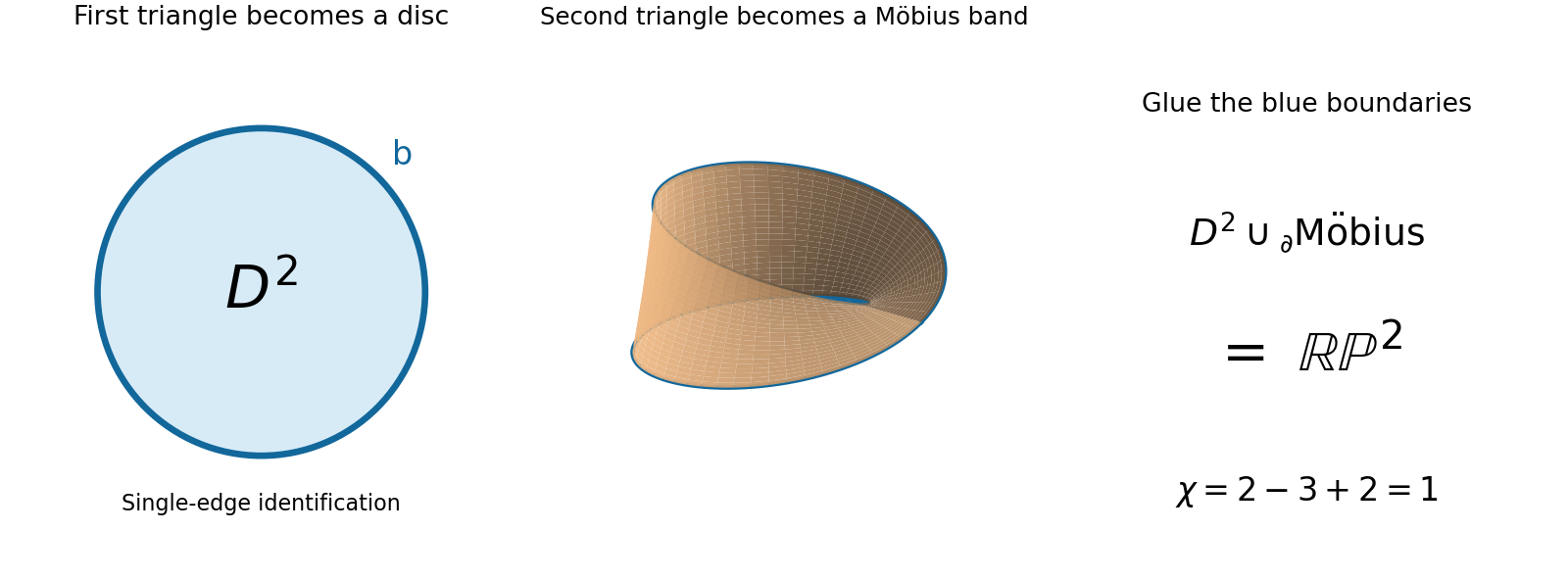
Codex 0 2026-10-31The two singly marked sides of the first triangle are glued with their endpoints at matched. A cross-section parallel to the remaining side has its two endpoints identified, becoming a circle; the apex becomes its cone point. Thus this quotient triangle is a disc, whose boundary is the doubly marked edge.
In the second triangle, the two triply marked sides run consecutively along the boundary from through to . Pairing these sides in the indicated directions introduces one reversal; its boundary word is , where is the remaining doubly marked edge. This is a Möbius band with boundary . One can obtain the usual rectangle model by cutting from the identified triple-edge seam to the midpoint of and opening the triangle.
The double markings glue the disc boundary to the boundary of that Möbius band. Capping a Möbius band by a disc givesThis description also verifies that the quotient is a closed surface, including the vertices. As a check, the vertex classes are and ; there are three edge classes and two faces. The Euler characteristic is , consistent with the projective plane. The Möbius band exhibits nonorientability directly.
Past exam of the options II course of the University of Oxford 2006 E 4 i Solution by Codex 0 2026-10-31
Codex 0 2026-10-31A quotient map is a surjection such that is open if and only if is open in . Thus the topology on is exactly the final topology induced by .
For an open continuous surjection, continuity gives one implication. For the other, if is open then is open by openness and surjectivity. Hence it is a quotient map.
If and are quotient maps, they are surjective andThis set is open exactly when is open, exactly when is open. Thus the composition is a quotient map.
For the factorization, continuity of implies continuity of . Conversely, if is continuous and is open in , then is open. The quotient property makes open. This holds for every open , so is continuous.
Past exam of the options II course of the University of Oxford 2006 D 4 b Solution by Codex 0 2026-10-31
Codex 0 2026-10-31The theorem givesIntegration by parts has zero boundary term: the sine vanishes at zero and the Gaussian tends to zero at infinity. Hence .
The same Gaussian majorant and dominated convergence give continuity at zero, where the allowed Gaussian integral gives . The differential equation implies ; continuity at zero fixes that constant. Thus
Past exam of the options II course of the University of Oxford 2006 D 4 a Solution by Codex 0 2026-10-31
Codex 0 2026-10-31We first prove the differentiation theorem. Fix and take nonzero with . The measurable difference quotientsconverge pointwise to . The mean value theorem and the assumed derivative bound give . In particular is measurable as a limit of quotients along a sequence, and its bound by proves integrability. The dominated convergence theorem, in its parameter-limit form, says that pointwise convergence with a common integrable bound permits convergence of the integrals. Applying it yieldsThe parameter-limit statement follows from the ordinary sequential theorem by applying it to every sequence of nonzero tending to zero.
For the specific function, , which is integrable by the allowed fact. It is differentiable in , withThe last majorant has integral one on , using the substitution . All three hypotheses therefore hold. The indicator of the parameter domain is one at every point under consideration and does not affect this derivative.
Past exam of the options II course of the University of Oxford 2006 B 2 iii Solution by Codex 0 2026-10-31
Codex 0 2026-10-31 Past exam of the options II course of the University of Oxford 2006 B 2 ii Solution by Codex 0 2026-10-31
Codex 0 2026-10-31Polynomial division gives a unique remainder of degree less than in every coset. Thus the classesspan the quotient as an -vector space. A linear combination of them that vanishes would be a polynomial of degree less than divisible by , so it is the zero polynomial. They are therefore linearly independent, proving
Past exam of the options II course of the University of Oxford 2006 B 2 i Solution by Codex 0 2026-10-31
Codex 0 2026-10-31An irreducible polynomial has positive degree, so its ideal is proper: otherwise would contradict degrees. Every nonzero class has a representative not divisible by . Irreducibility gives , and the Euclidean algorithm supplies polynomials with . Passing to the quotient gives . Thus the quotient is a nonzero commutative ring in which every nonzero element has an inverse, hence a field. Constants embed injectively because no nonzero constant lies in the positive-degree ideal .
Past exam of the options II course of the University of Oxford 2006 B 2 c Solution by Codex 0 2026-10-31
Codex 0 2026-10-31 Past exam of the options II course of the University of Oxford 2006 B 2 b Solution by Codex 0 2026-10-31
Codex 0 2026-10-31Let . Its odd powers are exactly the four roots, so is the splitting field. The polynomial is irreducible: after the invertible substitution , it becomes , which satisfies Eisenstein criterion at two. HenceEquivalently the field is , since , and .
Past exam of the options II course of the University of Oxford 2006 B 2 a Solution by Codex 0 2026-10-31
Codex 0 2026-10-31First address the general splitting-field request. A splitting field is an extension in which the polynomial factors into linear factors and which is generated over the base field by its roots. For a degree- polynomial, adjoin a root of an irreducible factor. The quotient construction in the preceding parts gives an extension of degree at most . Remove the resulting linear factor and repeat, now with a polynomial of degree over that extension. Induction and the tower law giveThe resulting field is generated by the roots and is a splitting field. Repeated roots or inseparability can only reduce the required degrees; separability was not used.
For the specified cubic, put and . Its splitting field is . Eisenstein criterion at two gives . This cubic field is real and therefore does not contain the nonreal , whose quadratic polynomial is . Consequently
Pinned article: Introduction to the OurBigBook Project
Welcome to the OurBigBook Project! Our goal is to create the perfect publishing platform for STEM subjects, and get university-level students to write the best free STEM tutorials ever.
Everyone is welcome to create an account and play with the site: ourbigbook.com/go/register. We belive that students themselves can write amazing tutorials, but teachers are welcome too. You can write about anything you want, it doesn't have to be STEM or even educational. Silly test content is very welcome and you won't be penalized in any way. Just keep it legal!
Intro to OurBigBook
. Source. We have two killer features:
- topics: topics group articles by different users with the same title, e.g. here is the topic for the "Fundamental Theorem of Calculus" ourbigbook.com/go/topic/fundamental-theorem-of-calculusArticles of different users are sorted by upvote within each article page. This feature is a bit like:
- a Wikipedia where each user can have their own version of each article
- a Q&A website like Stack Overflow, where multiple people can give their views on a given topic, and the best ones are sorted by upvote. Except you don't need to wait for someone to ask first, and any topic goes, no matter how narrow or broad
This feature makes it possible for readers to find better explanations of any topic created by other writers. And it allows writers to create an explanation in a place that readers might actually find it.
Figure 1. Screenshot of the "Derivative" topic page. View it live at: ourbigbook.com/go/topic/derivativeVideo 2. OurBigBook Web topics demo. Source. - local editing: you can store all your personal knowledge base content locally in a plaintext markup format that can be edited locally and published either:This way you can be sure that even if OurBigBook.com were to go down one day (which we have no plans to do as it is quite cheap to host!), your content will still be perfectly readable as a static site.
- to OurBigBook.com to get awesome multi-user features like topics and likes
- as HTML files to a static website, which you can host yourself for free on many external providers like GitHub Pages, and remain in full control

Figure 2. You can publish local OurBigBook lightweight markup files to either OurBigBook.com or as a static website.
Figure 3. Visual Studio Code extension installation.
Figure 5. . You can also edit articles on the Web editor without installing anything locally. Video 3. Edit locally and publish demo. Source. This shows editing OurBigBook Markup and publishing it using the Visual Studio Code extension. 
- Infinitely deep tables of contents:



All our software is open source and hosted at: github.com/ourbigbook/ourbigbook
Further documentation can be found at: docs.ourbigbook.com
Feel free to reach our to us for any help or suggestions: docs.ourbigbook.com/#contact