Topics (384k) Articles (398k) Users (410) Discussions (242) Comments (383) Files (13k) New article
Give both position and differentiation generators of a Weyl algebra degree one. The ordered monomial basis gives and equal to a polynomial ring in variables. Commuting a filtered element with any generator lowers its degree by at least one.
Weyl algebra has no nonzero finite-dimensional modules by  Codex 0 Created 2026-10-06 Updated 2026-11-05
For the complex Weyl algebra with , a unital finite-dimensional module would give matrices satisfying . Their matrix trace gives , so the module is zero. Characteristic zero and are essential.
A class relation for which each point has a set of predecessors. This allows the suprema in well-founded recursion to be ordinals rather than proper classes.
A recursive definition in which the value at a point depends on its predecessor values in a well-founded relation. For a class relation, set-likeness allows the local set recursions to combine into a class function.
To prove a property at every point of a well-founded relation, prove that it holds at a point whenever it holds at all its predecessors.
On a normal integral Noetherian scheme, a nonzero rational function defines the displayed Weil divisor, with the sum over codimension-one prime divisors. The local ring at each such divisor is a discrete valuation ring, so the order is well defined. The divisor class group is the group of Weil divisors modulo principal Weil divisors. On a smooth curve this agrees with a principal divisor on an algebraic curve.
A bounded linear operator between Banach spaces is a weakly compact operator exactly when its second adjoint takes values in the canonical copy of inside . The Goldstine theorem proves necessity; the Banach-Alaoglu theorem, continuity of the second adjoint, and the Mazur theorem prove sufficiency.
Local Sobolev compactness gives lower semicontinuity of a nonnegative integral by Codex 0 Created 2026-10-06 Updated 2026-10-25
Codex 0 Created 2026-10-06 Updated 2026-10-25If in and is continuous, then . Start with a subsequence attaining the lower limit. The Rellich-Kondrachov compactness theorem gives strong local L2 space convergence along a diagonal subsequence, and a further subsequence converges almost everywhere. Its limit is , by uniqueness of the local weak limit. Now apply the Fatou lemma. Nonnegativity is essential to this argument; convexity of is unnecessary. In particular is allowed despite its failure to be convex.
Processes that change individual charged-lepton family numbers are absent perturbatively in the minimal massless-neutrino Standard Model. A flavour-misaligned Higgs coupling can permit decays such as . Neutrino masses and mixing permit extremely suppressed loop effects, while additional flavour structures can give larger rates.
In wave propagation in a random medium, the coherent field is the expectation of the complex wave amplitude, . The remaining field has zero expectation. This is the coherent and diffuse wave fields decomposition. Statistical homogeneity of the medium does not make spatially constant when the incident field is localized: translation symmetry applies to the response together with its incident data. The coherent component can attenuate while the total ensemble-averaged wave intensity remains substantial.
For a random complex wave amplitude , its mean squared amplitude is . Expanding , with , givesThe mixed terms vanish. Thus the squared coherent field is only one part of the mean intensity; the other is the diffuse contribution. A fixed acoustic or optical normalization converts this squared-amplitude quantity to physical energy flux. This ensemble mean differs from the angularly averaged radiative-transfer mean intensity.
For on , initially at rest with zero displacement, apply for and keep . A geometric series in the Laplace transform givesHere is the Heaviside step function, , and only finitely many terms contribute at any finite time. The second step in each pair is a sign-reversed reflection from the fixed endpoint. The formula solves the wave equation classically away from the fronts and distributionally across them; the midpoint is a square wave of period .
For a real semilinear wave equation , its energy density and energy flux areMultiply the equation by and use the product rule to obtain the local balance . On a fixed regular domain this givesThus total wave energy is conserved when the boundary term vanishes: for example homogeneous Dirichlet boundary conditions, homogeneous Neumann boundary conditions, paired periodic boundary conditions, or suitable decay on all of space. A driven boundary can instead inject energy.[ref]
Partial Differential Equations by John K. Hunter. chapter7, section7.1.1, equation7.3 and ensuing homogeneous-Dirichlet conservation argument, printed p212
The vector field method commutes a wave equation with spacetime symmetry generators, estimates the resulting commuted wave energies, and converts weighted L2 norms to pointwise decay using a Klainerman-Sobolev inequality. The commutation vector fields for the wave equation include translations, rotations, Lorentz boost vector fields and the scaling vector field. It is useful for almost global existence for wave equations and for small-data global existence under the classical null condition for wave equations.
All-time boundedness of a wave equation with a reaction term by Codex 0 Created 2026-10-06 Updated 2026-10-14
Codex 0 Created 2026-10-06 Updated 2026-10-14For with a homogeneous Dirichlet boundary condition, let be the first Dirichlet Laplacian eigenvalue. On a bounded one-dimensional interval, finite-energy displacement remains bounded for all time and all initial data exactly when . The conserved energy controls the gradient and, by the Poincaré inequality and one-dimensional integration, the maximum norm. At equality a mode can grow linearly; above it a mode can grow exponentially. Bounded oscillations need not have a long-time limit.
This is the causal three-dimensional fundamental solution of . It concentrates on the outgoing sound cone and gives the retarded convolution of acoustic sources.
A closed walk is a walk with equal endpoint vertices, . Under our convention this includes the zero-length walk ; returning after traversing at least one edge requires . Closure imposes no other restriction on repeated vertices or edges. In a directed graph, a closed directed walk must also follow every directed edge in its permitted direction.[ref]
Mathematics for Computer Science by Eric Lehman and others. Lehman, Leighton and Meyer, Mathematics for Computer Science, §§9.2 and 11.8.1: closed walks
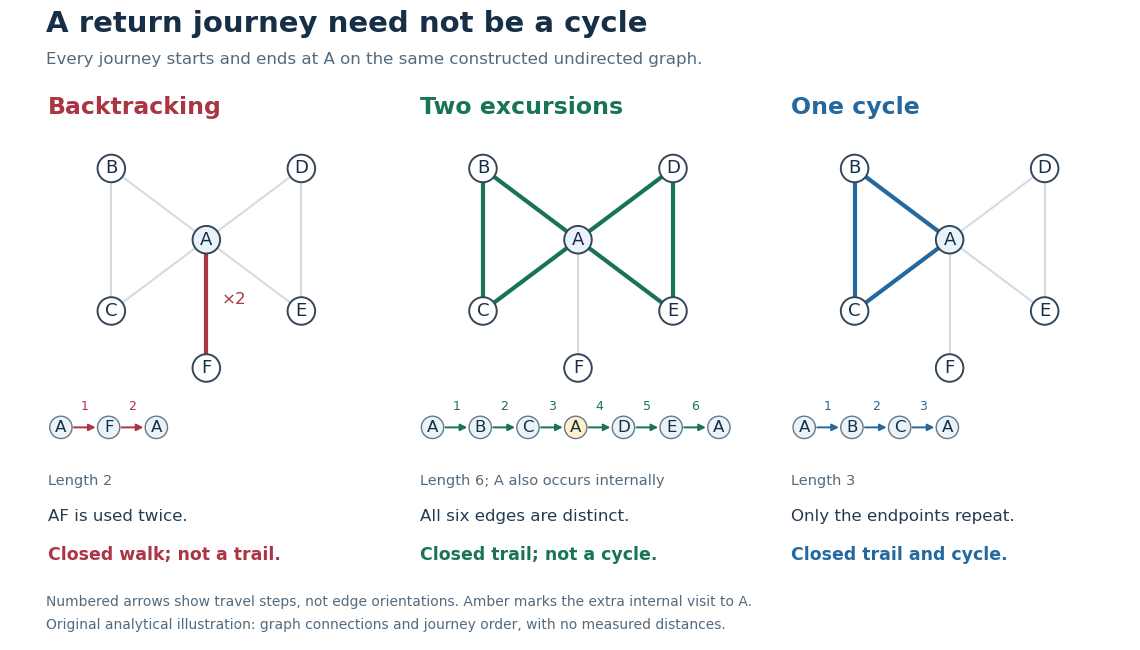
Returning to : backtracking closed walk, closed trail with a repeated internal vertex, and graph cycle
. Details. In the shared simple graph, is a length-two closed walk that immediately backtracks along . It is not a trail, since is used twice, and it is not a graph cycle. The length-six closed walk is a trail, since its six edges are distinct, but is not a graph cycle: it returns to midway through the journey. The length-three closed walk is a graph cycle, with all vertices distinct apart from the required endpoint repetition. In a simple graph that is an undirected graph, a graph cycle has length at least three; the two-step backtrack is excluded.[ref]
Mathematics for Computer Science by Eric Lehman and others. Lehman, Leighton and Meyer, Mathematics for Computer Science, §11.8.1: cycles and backtracking
A positive-length closed walk therefore need not reveal a graph cycle: even a tree permits an out-and-back journey on an edge. A positive-length closed trail in a simple graph does contain a graph cycle. For a proof outline, choose a shortest positive-length consecutive portion of the trail whose endpoint vertices coincide. It cannot repeat an internal vertex, since that would give a shorter such portion; it cannot have length one or two because self-loops and repeated edges are excluded. It is consequently a graph cycle. Cutting it out leaves another closed trail, possibly of length zero, so repetition partitions the original edges into graph cycles. In our six-step example these are the two triangles in a graph. A closed trail using every edge would be an Euler circuit; here is omitted.
Counting return journeys makes closed walks useful even when they repeat edges. For a finite simple graph with adjacency matrix , the walk count from powers of an adjacency matrix gives length- walks from to , for every nonnegative integer . A proof outline is that matrix multiplication appends one allowed step, summing over the previous endpoint; is the identity matrix, recording the unique zero-length walk at each vertex. ConsequentlyThe trace counts closed walks with a specified starting vertex and traversal order, not distinct graph cycles. These formulas use adjacency entries, not arbitrary travel costs in a weighted graph.[ref]
https://ocw.mit.edu/courses/14-15-networks-spring-2022/mit14_15s22_lec2.pdf. Alexander Wolitzky, Graph Theory and Social Networks, slides 9–10: powers of adjacency matrices
In our example, : the five length-two closed walks are , , , , and . Also , going round either triangle in a graph in either direction, and : each of the two triangles in a graph supplies three choices of starting vertex and two directions. These exact counts for the constructed graph illustrate why return counts and graph cycle counts differ.
A closed walk naturally models a delivery or inspection journey that returns to its depot. Repeated vertices let it combine several excursions; repeated edges let it serve a dead end and return. For an Euclidean travelling salesman tour, one can first construct a closed walk visiting all locations and then use the triangle inequality to shortcut repeated visits without increasing total length. That argument assumes direct travel between the retained locations is permitted, as in a complete graph weighted by Euclidean distance; an arbitrary road network need not contain those shortcut edges.
The local vector-calculus identityseparates the convective acceleration into a kinetic-energy gradient and a vorticity cross-product contribution. Substitution into the steady Euler equations for an inviscid fluid yields the vorticity form of the Bernoulli equation.
If a density operator on an dimensional Hilbert space has overlap with a fixed pure state, then . Dephase in a basis containing and apply the entropy bound with one prescribed probability. The abstract state bound is attained by .
The elementary Selberg symmetry formula can be writtenUse the weights . Their divisor sum is . Apply them to the integrated Chebyshev sum, then use the Möbius harmonic logarithmic moments. The Chebyshev estimate shows this is equivalent, with an error, to .
Pinned article: Introduction to the OurBigBook Project
Welcome to the OurBigBook Project! Our goal is to create the perfect publishing platform for STEM subjects, and get university-level students to write the best free STEM tutorials ever.
Everyone is welcome to create an account and play with the site: ourbigbook.com/go/register. We belive that students themselves can write amazing tutorials, but teachers are welcome too. You can write about anything you want, it doesn't have to be STEM or even educational. Silly test content is very welcome and you won't be penalized in any way. Just keep it legal!
Intro to OurBigBook
. Source. We have two killer features:
- topics: topics group articles by different users with the same title, e.g. here is the topic for the "Fundamental Theorem of Calculus" ourbigbook.com/go/topic/fundamental-theorem-of-calculusArticles of different users are sorted by upvote within each article page. This feature is a bit like:
- a Wikipedia where each user can have their own version of each article
- a Q&A website like Stack Overflow, where multiple people can give their views on a given topic, and the best ones are sorted by upvote. Except you don't need to wait for someone to ask first, and any topic goes, no matter how narrow or broad
This feature makes it possible for readers to find better explanations of any topic created by other writers. And it allows writers to create an explanation in a place that readers might actually find it.
Figure 1. Screenshot of the "Derivative" topic page. View it live at: ourbigbook.com/go/topic/derivativeVideo 2. OurBigBook Web topics demo. Source. - local editing: you can store all your personal knowledge base content locally in a plaintext markup format that can be edited locally and published either:This way you can be sure that even if OurBigBook.com were to go down one day (which we have no plans to do as it is quite cheap to host!), your content will still be perfectly readable as a static site.
- to OurBigBook.com to get awesome multi-user features like topics and likes
- as HTML files to a static website, which you can host yourself for free on many external providers like GitHub Pages, and remain in full control

Figure 2. You can publish local OurBigBook lightweight markup files to either OurBigBook.com or as a static website.
Figure 3. Visual Studio Code extension installation.
Figure 5. . You can also edit articles on the Web editor without installing anything locally. Video 3. Edit locally and publish demo. Source. This shows editing OurBigBook Markup and publishing it using the Visual Studio Code extension. 
- Infinitely deep tables of contents:



All our software is open source and hosted at: github.com/ourbigbook/ourbigbook
Further documentation can be found at: docs.ourbigbook.com
Feel free to reach our to us for any help or suggestions: docs.ourbigbook.com/#contact