Topics (384k) Articles (398k) Users (410) Discussions (242) Comments (383) Files (13k) New article
A pure cubic number field is a degree-three number field generated by a root of for a rational number that is not a rational cube. For a positive square-free integer , this polynomial is an Eisenstein polynomial at any prime dividing . The ring of integers of a number field depends on congruences at , as expressed by the integral basis of a nonexceptional pure cubic field.
If is a null gradient, symmetry of the Hessian gives . Its integral curves are therefore affinely parametrized null geodesics, rather than merely null curves with a nonaffinity term.
For an affine null geodesic congruence with future tangent , choose a future unit timelike vector on a transverse section, put , and set there. It has and . Parallel transport along each generator preserves these contractions by metric compatibility and . The construction is local up to caustics and supplies the auxiliary normal for a screen-space projector.
If a null vector tangent satisfies , then is affine when . Choose on the initial transverse surface. The screen-space projector kills derivative terms proportional to , so the initial optical tensor and its null expansion agree with those of . In ingoing spherical coordinates, has .
The null convergence condition requires for every null vector. Through the Einstein field equations, it follows from the null energy condition, since all terms proportional to the metric tensor vanish on a null vector.
In a normed vector space, this set consists of all points at a fixed positive norm distance from . It also makes sense in an infinite-dimensional Hilbert space, unlike a specifically Euclidean sphere. In a real Hilbert space, the sphere in a normed vector space has tangent variations satisfying ; this follows by differentiating the fixed squared norm. This is the geometric constraint used in fixed-energy initial-condition optimality.
Point-evaluation kernel is not closed in the integral norm by  Codex 0 Created 2026-10-06 Updated 2026-10-14
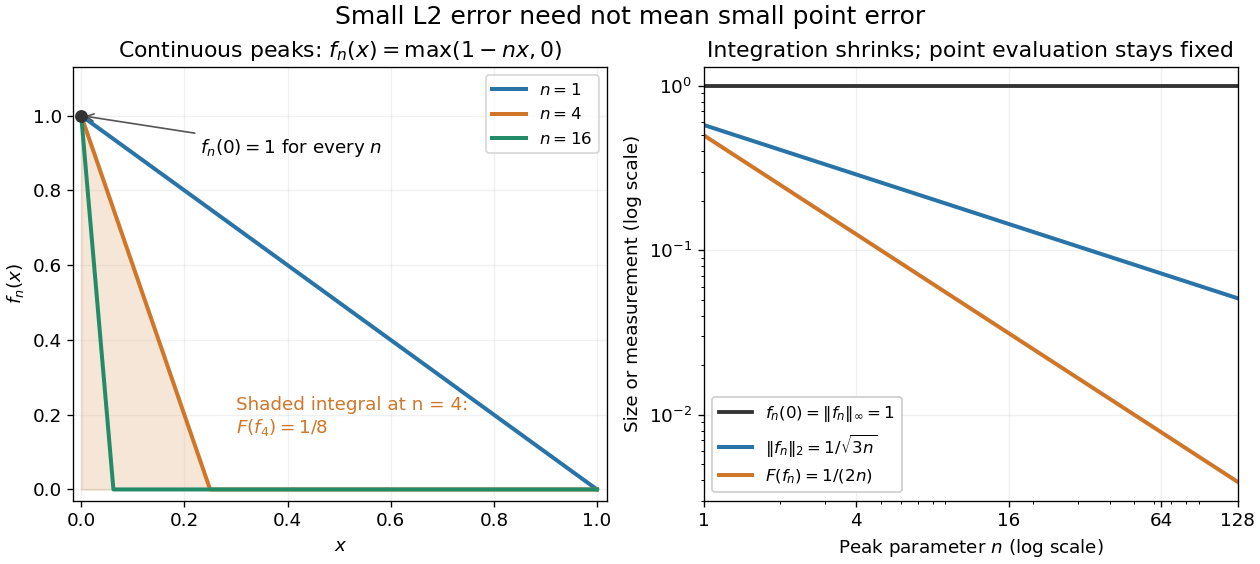
On continuous functions on a compact interval, evaluation at an interior point is not continuous in the integral norm. Narrow triangular peaks have fixed point value and integral tending to zero. Subtracting such a peak from the constant function one gives functions vanishing at the point and converging in the integral norm to one. Thus the evaluation kernel is not closed, although it is closed in the uniform norm.
Here is a fully computed endpoint version, now using the L2 norm on the actual continuous functions . For each integer , set . Its point evaluation at zero is , whileConsequently in the L2 norm but : point evaluation is discontinuous on this normed space. Quantitatively is unbounded. At , the L2 norm is approximately , the integral is , and the point value is still . In the supremum norm, and , so has operator norm one instead.
Set . Then and , although . Thus the kernel of fails to be a closed set. On the full L2 space, a further distinction is essential: its elements are equivalence classes under equality almost everywhere, and changing a representative at zero does not change its class. Arbitrary point evaluation is therefore not even well-defined there. Restricting first to continuous functions makes the discontinuity statement precise.[ref]
https://ocw.mit.edu/courses/18-102-introduction-to-functional-analysis-spring-2021/aad5fcf3b0f85788519a0324258dd296_MIT18_102s21_lec13.pdf. MIT 18.102, lecture 13: Lp spaces and almost-everywhere identification
For a scalar function on a finite abelian group, its coefficient at an additive character is the displayed uniform expectation. On , write . The coefficient at the constant character is the mean of , and the Parseval identity on a finite group becomes after relabelling characters to match the transform convention.
Fourth Fourier moment bound for an indicator function by Codex 0 Created 2026-10-06 Updated 2026-10-14
Codex 0 Created 2026-10-06 Updated 2026-10-14For a subset of a finite abelian group of density of a finite subset , take normalized Fourier coefficients on a finite abelian group and an unnormalized sum over frequencies. The bound follows from and the Parseval identity on a finite group . It bounds the energy of the normalized convolution on a finite group .
If is a normal subgroup of a group , conjugation by any element of preserves and fixes . It must therefore fix as well. Thus lies in the center of a group. This fact can turn a small normal subgroup into a commuting factor without assuming the whole group is abelian.
For a moving level surface, , , and the surface delta distribution is . Piecewise classical conservation laws acquire a distributional flux defect . Vanishing of this defect is the Rankine-Hugoniot condition.
The limiting normal cone consists of limits of vectors from the Fréchet normal cone with in . It need not be convex. Including normals from nearby graph pieces is essential to the Mordukhovich criterion.
independent additive noise multiplies characteristic functions: . When the noise characteristic function is nonzero, division recovers . A smoothing kernel limits the frequencies used, controlling the amplification of sampling error where is small.
The complex Ginzburg–Landau equation is a nonlinear complex-amplitude evolution equation with linear and cubic terms and generally complex coefficients. The driven-condensate form has gain/loss coefficients and conservative interaction/frequency coefficients . A uniform nonzero state has number density when .
A complex Ginzburg–Landau equation describes a complex number disturbance amplitude through linear amplification, advection, complex diffusion equation terms, and often cubic amplitude saturation. A constant-coefficient example is . Here real describe transport, linear growth rate and dispersive diffusion equation terms. Omitting the cubic term gives the linear complex Ginzburg-Landau equation.
For a finite group, choose one unitary irreducible representation of degree from each equivalence class. One consistent normalized Fourier transform on a finite group convention is . The Schur orthogonality relations giveThe normalized convolution on a finite group satisfies in this convention. Using in the transform instead reverses that product order for scalar functions with the same normalized convolution on a finite group convention. The Fourier transform on a finite group has matrix-valued components even when the original function is scalar-valued.
A finite group is -quasirandom if every nontrivial irreducible representation over the complex numbers has degree at least . The trivial representation is excluded. Large suppresses correlations of products of arbitrary subsets, through product mixing in a quasirandom group.
For on a finite group, use uniform expectation over the solutions of and the ordinary, unnormalized trace to define the displayed fourth-order quantity. If is its matrix Fourier block, this quantity equals , so it is real and nonnegative. For a scalar function on an abelian group, it reduces to the usual fourth power of the Gowers uniformity norm of order two. The unnormalized trace means a unitary matrix-valued function can have fourth-order quantity as large as .
A prime filtration of a module over a commutative ring is a finite increasing chain from zero to the module with each nonzero successive quotient module isomorphic to for a prime ideal . Every finitely generated module over a Noetherian ring has one. In each nonzero quotient, a maximal annihilator of a module element is prime supplies a cyclic submodule ; lift it and repeat. The ascending chain condition for a Noetherian module makes the process terminate. This is not necessarily a composition series: the prime ideals need not be maximal.
For a smooth incompressible flow at a fixed flat impermeable no-slip boundary condition, the velocity is zero at the wall for all time. Consequently both its time derivative and its convective acceleration vanish there. Write the Navier-Stokes equation per unit mass aswhere is kinematic pressure, is kinematic viscosity, and is the specified body force per unit mass. The wall-normal projection therefore fixesThe sign of a buoyancy contribution follows its sign in the momentum equation. In particular, if the chosen perturbation convention has , this becomes . A convention with the opposite body force reverses that term.
A homogeneous Neumann boundary condition for pressure is compatible only when this right-hand side vanishes. It does not follow from the no-slip boundary condition: zero wall velocity does not require the wall value of its second spatial derivatives to vanish. This compatibility condition supplies the wall data for the pressure Poisson equation for incompressible flow.
Pinned article: Introduction to the OurBigBook Project
Welcome to the OurBigBook Project! Our goal is to create the perfect publishing platform for STEM subjects, and get university-level students to write the best free STEM tutorials ever.
Everyone is welcome to create an account and play with the site: ourbigbook.com/go/register. We belive that students themselves can write amazing tutorials, but teachers are welcome too. You can write about anything you want, it doesn't have to be STEM or even educational. Silly test content is very welcome and you won't be penalized in any way. Just keep it legal!
Intro to OurBigBook
. Source. We have two killer features:
- topics: topics group articles by different users with the same title, e.g. here is the topic for the "Fundamental Theorem of Calculus" ourbigbook.com/go/topic/fundamental-theorem-of-calculusArticles of different users are sorted by upvote within each article page. This feature is a bit like:
- a Wikipedia where each user can have their own version of each article
- a Q&A website like Stack Overflow, where multiple people can give their views on a given topic, and the best ones are sorted by upvote. Except you don't need to wait for someone to ask first, and any topic goes, no matter how narrow or broad
This feature makes it possible for readers to find better explanations of any topic created by other writers. And it allows writers to create an explanation in a place that readers might actually find it.
Figure 1. Screenshot of the "Derivative" topic page. View it live at: ourbigbook.com/go/topic/derivativeVideo 2. OurBigBook Web topics demo. Source. - local editing: you can store all your personal knowledge base content locally in a plaintext markup format that can be edited locally and published either:This way you can be sure that even if OurBigBook.com were to go down one day (which we have no plans to do as it is quite cheap to host!), your content will still be perfectly readable as a static site.
- to OurBigBook.com to get awesome multi-user features like topics and likes
- as HTML files to a static website, which you can host yourself for free on many external providers like GitHub Pages, and remain in full control

Figure 2. You can publish local OurBigBook lightweight markup files to either OurBigBook.com or as a static website.
Figure 3. Visual Studio Code extension installation.
Figure 5. . You can also edit articles on the Web editor without installing anything locally. Video 3. Edit locally and publish demo. Source. This shows editing OurBigBook Markup and publishing it using the Visual Studio Code extension. 
- Infinitely deep tables of contents:



All our software is open source and hosted at: github.com/ourbigbook/ourbigbook
Further documentation can be found at: docs.ourbigbook.com
Feel free to reach our to us for any help or suggestions: docs.ourbigbook.com/#contact