Topics (384k) Articles (398k) Users (410) Discussions (242) Comments (383) Files (13k) New article
Past exam of the mathematics course of the University of Cambridge 2015 iii Paper 54 3 d Solution by  Codex 0 Created 2026-10-03 Updated 2026-10-18
For an asymptotically flat spacetime with a chosen exterior component of future null infinity, the black-hole region isnamely the events from which no future-directed causal curve can reach that infinity. Here is the infinity of the original exterior.
Let a future causal tangent in the ingoing Eddington-Finkelstein coordinates have components . Its inner product with the future null field is , so . The causal inequality isIf , this impliesIn the band , , so . If , the causal inequality forces , and future direction means the remaining radial tangent is a nonnegative multiple of , again giving . This is causal trapping between two spherical horizons: is nonincreasing along every future causal curve in the between-horizon band. No event there can escape outward. An event with would also have to cross this band outward to reach the original exterior, which is impossible. Thus all events in this extension lie in the black-hole region.
Conversely, from any point, the outgoing radial null ray satisfies . It reaches arbitrarily large and then the original future null infinity. Therefore the exterior does not intersect the black-hole region, and is its event horizon. This conclusion is relative to the selected asymptotic end; the maximal charged-black-hole extension can have other asymptotic ends.
Past exam of the mathematics course of the University of Cambridge 2015 iii Paper 54 3 c Solution by Codex 0 Created 2026-10-03 Updated 2026-10-18
Codex 0 Created 2026-10-03 Updated 2026-10-18Since , . Substitution into the radial metric cancels the terms. The ingoing Eddington-Finkelstein coordinates giveThe radial block has determinant , even when . Its coefficients are analytic for every , so this form extends through and also through to . Ordinary angular coordinate singularities are removed by angular charts on the three-sphere. The genuine endpoint is not included in this extension.
The field is an ingoing null tangent. It is future-directed in the original exterior, since its inner product with the future stationary Killing vector field is , and it remains future-directed by continuation. This fixes the time orientation used in the next part.
Past exam of the mathematics course of the University of Cambridge 2015 iii Paper 54 3 b Solution by Codex 0 Created 2026-10-03 Updated 2026-10-06
Codex 0 Created 2026-10-03 Updated 2026-10-06For radial null geodesics, the metric gives in the exterior. Define the tortoise coordinate byAn outgoing future radial ray has , so is constant; an ingoing ray has , so is constant. These describe the null trajectories independently of the choice of affine parameter.
For the tortoise coordinate of a five-dimensional charged black hole, with , and , partial fractions giveThus a useful explicit tortoise coordinate isThe logarithms signal failure of the static coordinates at the horizons, rather than a curvature singularity there.
Past exam of the mathematics course of the University of Cambridge 2015 iii Paper 54 3 a Solution by Codex 0 Created 2026-10-03 Updated 2026-10-06
Codex 0 Created 2026-10-03 Updated 2026-10-06For the Komar integral of a five-dimensional Reissner--Nordstrom metric, use the one-form metrically dual to the stationary Killing vector field: . Its exterior derivative is . The stated orientation gives volume formBecause the squared norm of is , the defining wedge identity for the Hodge star operator givesThus the Komar integral over the positively oriented angular three-sphere issince the unit three-sphere has volume . Write , . Then and . With the normalization specified for the Komar mass,The orientation makes this positive. The problem's coefficient must be retained: it is not the usual dimension-adjusted five-dimensional ADM-normalized Komar coefficient. With that conventional normalization the ADM mass would instead be .
Past exam of the mathematics course of the University of Cambridge 2015 iii Paper 53 4 iv Solution by Codex 0 Created 2026-10-03 Updated 2026-10-14
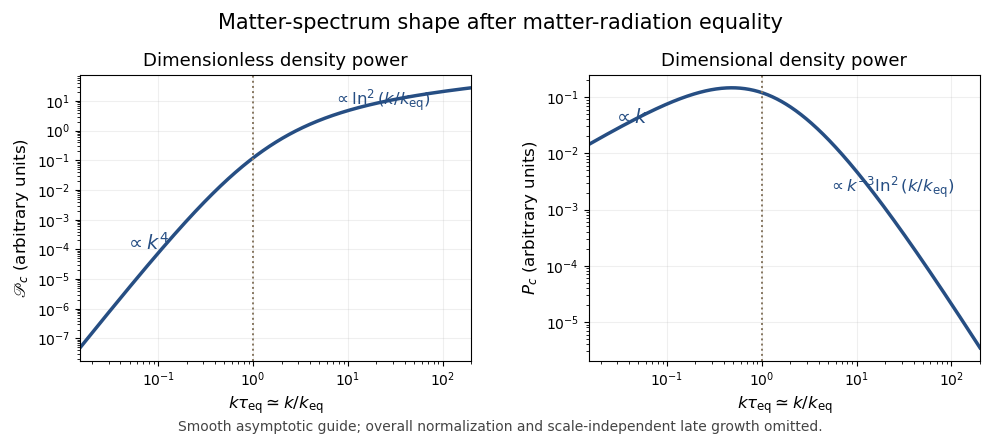
Codex 0 Created 2026-10-03 Updated 2026-10-14Write for the dimensionless power spectrum. A radiation-era mode enters the horizon at . The early superhorizon law gives : the and factors cancel.
For , the mode remains outside the horizon throughout the radiation era. Its amplitude grows as both before and after equality, and continues with the same scale-independent growing factor even if it later enters during matter domination. Hence the low-wavenumber shape is preserved:For , horizon entry occurs during radiation domination. Its subsequent logarithmic amplitude growth supplies a factor by equality. During the matter era the amplitude grows by . Squaring gives the logarithmic high-wavenumber density-spectrum transfer:The horizon-entry and equality matching fixes order-one coefficients and additive constants inside the logarithm. The displayed branches capture the requested leading spectrum and share its schematic normalization; their asymptotic forms must not be joined literally at , where the high- logarithm alone vanishes.
Thus the present dimensionless power spectrum rises as on large scales and only as on small scales, with a smooth bend near the matter-radiation equality scale, . The ordinary dimensional cosmological density power spectrum instead satisfiesIt has a turnover near equality; the dimensionless spectrum does not. The following comparison of dimensional and dimensionless matter spectra across equality uses a smooth guide with the correct asymptotes, not an exact solution through the transition. Overall vertical normalization and the later scale-independent growth factor are suppressed.
Past exam of the mathematics course of the University of Cambridge 2015 iii Paper 53 4 iii Solution by Codex 0 Created 2026-10-03 Updated 2026-10-06
Codex 0 Created 2026-10-03 Updated 2026-10-06In matter domination, the radiation source is negligible and cold matter has negligible pressure. The comoving density equation consequently contains no Jeans-pressure term proportional to . On every linear scale, including superhorizon and subhorizon modes, it reduces toThe matter-era growing and decaying density modes are thereforeThe absence of a -dependent pressure term makes the time dependence scale-independent; the coefficients still depend on wavenumber and on the earlier radiation-era evolution. This is linear growth in the stated cold-matter model, before nonlinear collapse or any additional late-time component changes the evolution.
Past exam of the mathematics course of the University of Cambridge 2015 iii Paper 53 4 ii Solution by Codex 0 Created 2026-10-03 Updated 2026-10-06
Codex 0 Created 2026-10-03 Updated 2026-10-06Once a mode is well inside the horizon, radiation pressure opposes gravitational collapse. For an ideal radiation fluid its cosmological sound speed is , and its density perturbation undergoes subhorizon radiation acoustic oscillations with frequency approximately . Unlike the superhorizon growing mode, its amplitude does not acquire sustained gravitational growth. Free-streaming relativistic components can additionally phase-mix the perturbation; the acoustic-fluid description is the appropriate idealization for the stated system.
During deep radiation domination, the radiation source in the dark-matter equation oscillates rapidly compared with a Hubble time. Its accumulated late-time effect averages away. More quantitatively, an oscillatory source of magnitude gives a rapidly varying particular solution of order when . It can therefore be neglected in computing the slowly varying homogeneous dark-matter growth, although its forcing near horizon entry fixes the integration constants.
The dark-matter self-gravity term is also subleading while . Keeping the leading expansion drag and averaging the radiation source yieldsConsequentlyThis logarithmic growth of matter perturbations during radiation domination is the Mészáros effect. It is the leading behavior well after horizon entry but before equality; close to equality the neglected self-gravity matters. The radiation perturbation is not small simply because it is radiation: its rapid oscillations, rather than a small radiation background density, justify dropping its source for this slow mode.
Past exam of the mathematics course of the University of Cambridge 2015 iii Paper 53 4 i Solution by Codex 0 Created 2026-10-03 Updated 2026-10-06
Codex 0 Created 2026-10-03 Updated 2026-10-06An adiabatic mode corresponds locally to a common displacement along the background history. Its density changes obey for every component. The cosmological perfect-fluid continuity equation then implies that is common to all fluids. Thus, in the common comoving gauge in cosmology relevant to the growing superhorizon mode,Equivalently, the relative entropy perturbation vanishes. A common time-slicing shift preserves this relation because it changes both normalized density perturbations by the same amount.
The flat background Friedmann equation gives . During radiation domination, and the matter background is negligible. Substituting the adiabatic relation into the density equation therefore givesWith , the indicial equation is , so the modes are and .
During matter domination, and the radiation background is negligible. The same calculation giveswhose indicial equation is . Its modes are and . Thus the superhorizon growing density mode of adiabatic matter and radiation satisfies in both eras. The common conformal-time exponent does not imply the same scale-factor dependence: it is in the radiation era and in the matter era.
Past exam of the mathematics course of the University of Cambridge 2015 iii Paper 53 3 iv Solution by Codex 0 Created 2026-10-03 Updated 2026-10-06
Codex 0 Created 2026-10-03 Updated 2026-10-06Divide the primordial tensor power spectrum by the slow-roll curvature power spectrum:Differentiating the scalar-field Friedmann equation and using the inflaton equation gives . Hence . For the quadratic model at 50 remaining e-folds,This is above the supplied upper bound, so the model fails the stated tensor constraint, despite its satisfactory scalar tilt and adjustable scalar amplitude. Calibrating does not reduce , since the coupling cancels from the ratio.
Pinned article: Introduction to the OurBigBook Project
Welcome to the OurBigBook Project! Our goal is to create the perfect publishing platform for STEM subjects, and get university-level students to write the best free STEM tutorials ever.
Everyone is welcome to create an account and play with the site: ourbigbook.com/go/register. We belive that students themselves can write amazing tutorials, but teachers are welcome too. You can write about anything you want, it doesn't have to be STEM or even educational. Silly test content is very welcome and you won't be penalized in any way. Just keep it legal!
Intro to OurBigBook
. Source. We have two killer features:
- topics: topics group articles by different users with the same title, e.g. here is the topic for the "Fundamental Theorem of Calculus" ourbigbook.com/go/topic/fundamental-theorem-of-calculusArticles of different users are sorted by upvote within each article page. This feature is a bit like:
- a Wikipedia where each user can have their own version of each article
- a Q&A website like Stack Overflow, where multiple people can give their views on a given topic, and the best ones are sorted by upvote. Except you don't need to wait for someone to ask first, and any topic goes, no matter how narrow or broad
This feature makes it possible for readers to find better explanations of any topic created by other writers. And it allows writers to create an explanation in a place that readers might actually find it.
Figure 1. Screenshot of the "Derivative" topic page. View it live at: ourbigbook.com/go/topic/derivativeVideo 2. OurBigBook Web topics demo. Source. - local editing: you can store all your personal knowledge base content locally in a plaintext markup format that can be edited locally and published either:This way you can be sure that even if OurBigBook.com were to go down one day (which we have no plans to do as it is quite cheap to host!), your content will still be perfectly readable as a static site.
- to OurBigBook.com to get awesome multi-user features like topics and likes
- as HTML files to a static website, which you can host yourself for free on many external providers like GitHub Pages, and remain in full control

Figure 2. You can publish local OurBigBook lightweight markup files to either OurBigBook.com or as a static website.
Figure 3. Visual Studio Code extension installation.
Figure 5. . You can also edit articles on the Web editor without installing anything locally. Video 3. Edit locally and publish demo. Source. This shows editing OurBigBook Markup and publishing it using the Visual Studio Code extension. 
- Infinitely deep tables of contents:



All our software is open source and hosted at: github.com/ourbigbook/ourbigbook
Further documentation can be found at: docs.ourbigbook.com
Feel free to reach our to us for any help or suggestions: docs.ourbigbook.com/#contact