Topics (384k) Articles (398k) Users (410) Discussions (242) Comments (383) Files (13k) New article
Past exam of the mathematics course of the University of Cambridge 2015 iii Paper 6 5 a Solution by  Codex 0 Created 2026-10-03 Updated 2026-10-06
For , the telescoping arithmetic means satisfybecause is a bounded sequence. Hence for every , and passage to the limit gives . Taking shows . The proved Hahn-Banach distance formula therefore yields a bounded linear functional on the real l-infinity sequence space withWe verify that this single linear functional also has the two remaining properties.
Past exam of the mathematics course of the University of Cambridge 2015 iii Paper 59 4 j Solution by Codex 0 Created 2026-10-03 Updated 2026-10-06
Codex 0 Created 2026-10-03 Updated 2026-10-06The hot-Jupiter radius inflation problem is that some strongly irradiated giant planets have radii much larger than standard age-, mass- and composition-dependent cooling models predict. Greater internal entropy generally means a larger radius at fixed mass. The two broad classes of explanation are retaining existing heat by delaying cooling and depositing additional energy into the deep planet.
- Enhanced atmospheric opacity slows radiative leakage and keeps the deep interior hot. Required enrichment or persistent cloud opacity must be compatible with composition and spectra; adding heavy material also tends to increase density. Insulation can preserve initial heat but cannot necessarily reinflate an already cooled planet.
- Layered convection in a giant planet uses a stabilizing composition gradient and double-diffusive layers to reduce heat transport. The needed gradient and layer structure must survive mixing, and their efficiency is model-dependent; very inefficient transport cannot simply be assumed for every planet.
- Tidal heating dissipates orbital or spin energy, often requiring maintained eccentricity or obliquity. Nearly circular, synchronized planets have little of the simplest eccentricity-tide power, so a pumping mechanism or different tidal configuration is needed to explain them.
- Ohmic heating of a giant planet dissipates wind-induced electric currents in a conducting, magnetized atmosphere and interior. It requires appropriate ionization, conductivity, magnetic field, wind speeds and sufficiently deep deposition; magnetic drag can limit the available mechanical power.
Past exam of the mathematics course of the University of Cambridge 2015 iii Paper 59 4 i Solution by Codex 0 Created 2026-10-03 Updated 2026-10-06
Codex 0 Created 2026-10-03 Updated 2026-10-06Three detection methods are exoplanet transit photometry, the radial-velocity method, and exoplanet direct imaging. Transits detect obscuration of the star; radial velocities detect stellar reflex motion; imaging separates the planet's own reflected or thermal light from the star.
Exoplanet transit photometry supports wavelength-dependent exoplanet transmission spectra, while the same orbital geometry supports exoplanet secondary eclipses and phase-resolved planetary spectra. Exoplanet direct imaging provides resolved light for atmospheric spectroscopy. Stellar radial-velocity discovery alone does not measure an atmosphere, although high-resolution follow-up can separate a moving planetary molecular spectrum through its changing Doppler effect.
- Resolvable projected separation: the angular separation is , so a wide orbit around a nearby star places the planet beyond the instrument's inner working angle, related to and the coronagraph design.
- Sufficient planet-star contrast: young, massive planets remain intrinsically hot and bright in the infrared, improving contrast against the star; starlight suppression and favorable observing wavelengths further help.
A wide orbit improves separation but weakens reflected-light illumination and lengthens the orbital period. These conditions therefore describe imaging sensitivity, not an assertion that every detection method becomes easier at large separation.
Past exam of the mathematics course of the University of Cambridge 2015 iii Paper 59 4 h Solution by Codex 0 Created 2026-10-03 Updated 2026-10-06
Codex 0 Created 2026-10-03 Updated 2026-10-06Plate tectonics is the movement and recycling of a planet's lithosphere as discrete plates over a deformable mantle. Mantle convection, the negative buoyancy of cool subducting slabs (slab pull), and gravitational sliding from elevated spreading ridges (ridge push) supply driving stresses; deformation and friction resist motion. The mantle mostly deforms by slow solid-state creep, rather than being a global liquid layer.
Its effects include subduction and recycling of crust, creation of new crust, mountain building, earthquakes and volcanism, transport of internal heat, and recycling of water and carbon. The carbonate-silicate cycle can couple volcanic CO2 supply to weathering and long-term climate.
- Mass and pressure-dependent material behavior: gravity and mantle depth affect buoyancy and convective stresses, but high-pressure changes in viscosity and density also affect whether slabs sink.
- Thermal state and heat budget: age, radiogenic heating, residual formation heat and surface temperature set convective vigor, plate thickness and the strength of the lid.
- Water and lithospheric weakening: hydration, rock rheology, fault damage and yield strength determine whether driving stresses can break and recycle the lithosphere rather than leave a stagnant lid.
Past exam of the mathematics course of the University of Cambridge 2015 iii Paper 59 4 g Solution by Codex 0 Created 2026-10-03 Updated 2026-10-06
Codex 0 Created 2026-10-03 Updated 2026-10-06For typical well-mixed structures, the dominant processes are:
- Gas giant interiors: efficient convection through most of the deep fluid envelope; radiative transfer releases the heat near the photosphere.
- Rocky interiors: slow solid-state mantle convection over geological time, with heat conduction dominant across the rigid lithosphere. A liquid core can also convect; being solid does not prevent creep-driven heat transport in the mantle.
- Weakly irradiated giant atmospheres at –: usually convection in the planetary troposphere, becoming radiative near and above the tropopause. The transition pressure and cloud or compositional effects vary between planets.
- Strongly irradiated hot Jupiter atmospheres at –: usually a stable radiative region; the deep radiative-convective boundary can lie at substantially larger pressure. Atmospheric winds also redistribute energy horizontally.
Representative temperatures must specify the level: Earth has about at the surface (about effective emission temperature); Jupiter has about near one bar (about effective temperature); hot Jupiters commonly have photospheric temperatures of order –; and the Sun's photosphere is about . Upper layers, nightsides, deep interiors and the solar corona have different temperatures. These are characteristic values, not constant temperatures throughout each atmosphere.
Past exam of the mathematics course of the University of Cambridge 2015 iii Paper 59 4 f Solution by Codex 0 Created 2026-10-03 Updated 2026-10-06
Codex 0 Created 2026-10-03 Updated 2026-10-06An ideal atmospheric biosignature gas has a strong, distinguishable spectral signature, can accumulate to a detectable abundance, and has a biologically plausible production flux. Its abiotic sources should be small or identifiable from the planet's environmental context; its lifetime must be long enough for detection but compatible with continuing replenishment. A useful diagnosis may be a disequilibrium combination of gases rather than a single molecule.
A primary metabolic byproduct comes from reactions needed for energy generation, growth or biomass synthesis. Examples include methane from methanogenesis and oxygen released by oxygenic photosynthesis. A secondary metabolic byproduct results from specialized functions such as chemical defense, signaling or stress responses; dimethyl sulfide and chloromethane are examples. Secondary products can be chemically more distinctive but are often produced in much smaller amounts.
For modern Earth, molecular oxygen (O2) and nitrous oxide (N2O) are characteristic, predominantly biologically maintained atmospheric gases: oxygenic photosynthesis maintains the former, and microbial nitrogen cycling produces much of the latter. Ozone (O3) is also a classic remote biosignature, but is made photochemically from O2 rather than being a second independent metabolic product. If O2/O3 are counted as a two-gas observational pair, they diagnose the same oxygen reservoir.
The word “unique” needs qualification: no one gas is guaranteed to be biogenic on every planet. An oxygen biosignature false positive can arise from water loss or CO2 photochemistry in suitable environments, and nonbiological N2O production is possible. The modern terrestrial source attribution does not remove the need for context when interpreting another world.
Past exam of the mathematics course of the University of Cambridge 2015 iii Paper 59 4 e Solution by Codex 0 Created 2026-10-03 Updated 2026-10-06
Codex 0 Created 2026-10-03 Updated 2026-10-06The circumstellar habitable zone is the range of orbital distances where a terrestrial planet with a specified atmospheric inventory can retain liquid water at its surface. It is a conditional climate criterion, not a guarantee of life or a requirement for every possible subsurface habitat.
Four influential factors are:
- The incident stellar energy and spectrum, including orbital distance and long-term stellar evolution.
- Atmospheric pressure and composition, greenhouse effect, Bond albedo and clouds, which set the relation between absorbed light and surface temperature.
- The water and volatile inventory, together with planetary mass and the ability to retain or replenish an atmosphere.
- Internal and surface evolution, including plate tectonics, outgassing and the carbonate-silicate cycle, which can regulate climate over geological time.
For a Sun-like present-day star and an Earth-like planet, a useful conservative range is approximately –. The inner limit depends on the adopted moist or runaway greenhouse condition, and the outer limit on the maximum greenhouse outer habitable-zone limit. More restrictive water-loss choices put the inner edge near . Empirical optimistic limits based on past Venus and Mars are about –. These are model conventions rather than exact universal boundaries.
Past exam of the mathematics course of the University of Cambridge 2015 iii Paper 59 4 d Solution by Codex 0 Created 2026-10-03 Updated 2026-10-06
Codex 0 Created 2026-10-03 Updated 2026-10-06Assume a circular orbit of radius , a spherical planet, bolometric Bond albedo , negligible internal heat, unit thermal emissivity and complete redistribution of absorbed heat over the sphere. The stellar luminosity is , and the planet absorbs the incident radiative flux through its projected cross-section:Thermal reradiation is . Equating these gives the planetary equilibrium temperatureThe planet's radius cancels. A non-black thermal emissivity divides the absorbed flux by in the fourth-power balance. For uniform dayside-only reradiation, the emitting area is and . With no local redistribution, the substellar point has , while other points depend on incidence angle. These are different temperature conventions, not contradictory formulas.
The planetary equilibrium temperature is not the surface greenhouse temperature or the internal effective temperature of a planet. If intrinsic cooling matters and both powers escape through the same emitting area, the total effective temperature obeys .
Past exam of the mathematics course of the University of Cambridge 2015 iii Paper 59 4 c Solution by Codex 0 Created 2026-10-03 Updated 2026-10-06
Codex 0 Created 2026-10-03 Updated 2026-10-06- Muted near-infrared molecular bands: exoplanet transmission spectra across approximately –, or a broader – interval, can show weak water features because an opaque exoplanet cloud deck truncates the atmospheric annulus before the gas becomes transparent in the continuum.
- A rising transit radius towards blue wavelengths: optical exoplanet transmission spectroscopy over roughly – can show a Rayleigh scattering or aerosol slope from small haze particles. Larger particles can instead give a nearly wavelength-independent, grey continuum.
- Enhanced reflected light: an optical exoplanet secondary eclipse or reflected-light planetary phase curve observation around – can indicate a large geometric albedo and wavelength-dependent reflection from bright condensate exoplanet clouds.
Cloud particles can scatter or absorb, so not every atmospheric haze makes a high-albedo planet. Weak molecular bands alone also admit low abundance or high mean molecular weight; a consistent spectral combination is stronger evidence than a single signature.
Past exam of the mathematics course of the University of Cambridge 2015 iii Paper 59 4 b Solution by Codex 0 Created 2026-10-03 Updated 2026-10-06
Codex 0 Created 2026-10-03 Updated 2026-10-06- Vertical chemical quenching: when the eddy mixing time becomes shorter than the chemical relaxation time, transported gas retains a deeper abundance rather than reaching local thermochemical equilibrium. For example, carbon monoxide–methane quenching can maintain excess carbon monoxide in cool upper giant-planet gas where equilibrium favors methane.
- Atmospheric photochemistry: ultraviolet photons dissociate molecules and drive reaction networks away from thermal equilibrium. For example, irradiation of CH4-containing gas can produce acetylene and hydrocarbon precursors of an atmospheric haze.
- Horizontal chemical quenching: winds cross a day-night temperature gradient faster than reactions can reset the composition. For example, CO-rich dayside gas can reach a cooler hot Jupiter nightside without converting most of its carbon to CH4.
These are three distinct ways to maintain disequilibrium chemistry in an exoplanet atmosphere; each compares chemistry with a different transport or irradiation process.
Past exam of the mathematics course of the University of Cambridge 2015 iii Paper 59 4 a Solution by Codex 0 Created 2026-10-03 Updated 2026-10-06
Codex 0 Created 2026-10-03 Updated 2026-10-06The usual major carbon/oxygen reservoirs in a hydrogen-rich hot Jupiter are water, carbon monoxide and methane, with their relative importance set by thermochemical equilibrium. This is not a universal ranking for every temperature and composition: nitrogen molecules or carbon dioxide can exceed a strongly depleted member of this trio.
At about one bar, the useful net reaction isThe rightward reaction is exothermic. Cooler gas favors methane and water; warming favors carbon monoxide and suppresses methane. The CO/CH4 crossover is of order and shifts with pressure, elemental inventory and metallicity; it is not a universal temperature. Water remains an important oxygen reservoir for oxygen-rich compositions but can dissociate at sufficiently high temperature.
Increasing the atmospheric metallicity of a giant planet raises the available carbon and oxygen. In a dilute, H2-dominated regime, major CO and H2O abundances roughly increase with the enrichment factor, and cool-regime CH4 does likewise. CO2 can rise faster, approximately quadratically in suitable warm regimes. At very high enrichment, the H2 fraction and mean molecular weight also change, invalidating simple linear scalings.
At high temperature and atmospheric carbon-to-oxygen ratio below unity, CO binds much of the carbon, leaving excess oxygen for H2O. As C/O approaches or exceeds one, CO consumes nearly all available oxygen and H2O is strongly depleted; excess carbon enhances CH4, hydrogen cyanide and acetylene. Cooler CH4-dominated chemistry uses less oxygen in CO and can leave more water even at the same elemental ratio. These trends are carbon partition and atmospheric water abundance, and assume equilibrium rather than vertical or horizontal quenching.
Past exam of the mathematics course of the University of Cambridge 2015 iii Paper 59 3 c Solution by Codex 0 Created 2026-10-03 Updated 2026-10-06
Codex 0 Created 2026-10-03 Updated 2026-10-06For an incompressible planetary interior of density , the enclosed mass and local gravity are and . Hydrostatic equilibrium therefore givesIntegrating inward from negligible surface pressure at yields the uniform-density planetary pressure profile:The surface gravity is . Eliminate to obtainThe units of are pressure. For a nonzero imposed surface pressure, add throughout and interpret the boxed central value as . The constant-density approximation is crucial; real centrally concentrated rocky planets need a different profile and generally a larger central pressure at the same mass and radius.
Past exam of the mathematics course of the University of Cambridge 2015 iii Paper 59 3 b Solution by Codex 0 Created 2026-10-03 Updated 2026-10-14
Codex 0 Created 2026-10-03 Updated 2026-10-14The mass-radius curve of solar-composition substellar objects reflects the transition from weak compression to pressure ionization and electron degeneracy pressure, followed by sustained hydrogen burning. A schematic joining representative object classes is:

Schematic mass-radius sequence from ice giants through gas giants and brown dwarfs to low-mass stars
. Details. The illustration is not an age-specific numerical evolutionary model. In particular, ice giants contain much more heavy material than a solar-composition giant, so a single uniform-composition equation of state does not describe the entire joined curve.
- At the low-mass, weak-compression end, a fixed-density or fixed-composition approximation gives . Ice giants such as Neptune and Uranus have substantial water/rock-rich interiors and modest H/He envelopes; changing envelope fraction changes the radius markedly. Their heat comes from retained formation energy, contraction and radiogenic heating of heavy material. Fluid interiors generally convect, while composition stratification can impede mixing; outer radiative layers release the heat.
- Ordinary gas giants reach radii of order over a broad range around Jovian masses: an effective polytrope explains the approximate segment. Increased mass compresses material enough to offset the added volume. Cooling and Kelvin-Helmholtz contraction, with additional differentiation energy such as helium settling in Saturn, supply the intrinsic luminosity. Their deep envelopes are usually convective, with radiative photospheres.
- More massive brown dwarfs become increasingly supported by electron degeneracy pressure. The cold nonrelativistic limit gives , but finite entropy and Coulomb effects flatten actual giant/brown-dwarf curves and their radii depend on age. They cool and contract; temporary deuterium fusion occurs above a composition-dependent deuterium-burning mass near . This threshold does not cause a sharp structural kink or permanent stellar luminosity. Interiors are largely convective and surface emission is radiative.
- Near the hydrogen-burning minimum mass, roughly – or – for near-solar composition, sustained fusion prevents indefinite cooling into a degenerate object. The low-mass main-sequence star branch turns upward, with approximately over the illustrative interval. Its entropy is not constant across masses, so this branch is compatible with an approximately internal profile. Hydrogen fusion through the proton–proton chain provides energy; the lowest-mass main-sequence stars are fully convective, capped by radiative atmospheres.
Planet/brown-dwarf naming conventions and deuterium burning do not define a universal discontinuity in the mass-radius relation. Composition, age and irradiation move the curves; the hydrogen-burning transition changes the long-term energy source more fundamentally.
Past exam of the mathematics course of the University of Cambridge 2015 iii Paper 59 3 a Solution by Codex 0 Created 2026-10-03 Updated 2026-10-06
Codex 0 Created 2026-10-03 Updated 2026-10-06For a fixed polytropic index and fixed equation-of-state constant , let be the first zero of the regular Lane-Emden equation solution. A finite-radius model requires such a zero; for the usual nonnegative indices this holds for . The surface radius and mass follow from and :The last equality integrates the Lane-Emden equation; define the positive Lane-Emden surface mass constant . Substituting givesThe central-density exponents cancel when the required powers are taken. Thus the polytropic mass-radius relation isIt is independent of , with and composition held fixed. For the radius is fixed; for the mass is fixed. These limiting powers need no division by a vanishing exponent.
For , the literal pressure-density power and the supplied expression for are singular. Interpret this case separately as an incompressible planetary interior with constant density. Then , or at fixed density. A weakly compressed rocky body, or a rough uniform-density approximation to Earth, is an example; realistic terrestrial planets are stratified and compressible.
For , . This describes a cold nonrelativistic degenerate electron gas of fixed composition, or a fully convective monatomic ideal gas at fixed entropy. Examples are a nonrelativistic white dwarf, a sufficiently cooled partly degenerate brown dwarf as an approximation, and an approximately fully convective low-mass star for the ideal-gas version. The fixed- scaling is . It must not be applied to an entire main-sequence stellar sequence with different entropies; the entropy dependence of a polytropic mass-radius relation explains the distinction.
Past exam of the mathematics course of the University of Cambridge 2015 iii Paper 59 2 d Solution by Codex 0 Created 2026-10-03 Updated 2026-10-06
Codex 0 Created 2026-10-03 Updated 2026-10-06An atmospheric thermal inversion is an altitude interval with . Absorption of incoming stellar radiation above the usual thermal-emitting layers can heat the upper gas faster than it cools, producing an inversion. In a semi-grey irradiated atmosphere, a large shortwave-to-infrared opacity ratio favors such high-altitude energy deposition; local infrared emitters and the intrinsic flux also matter.
In the Solar system, Earth and all four giant planets have well-known stratospheric inversions. The ozone layer absorbs ultraviolet sunlight on Earth; methane and photochemical hydrocarbons absorb solar radiation in the giant planets, with aerosols contributing. The giant planets are Jupiter, Saturn, Uranus and Neptune. This refers to their stratospheric temperature rise, not to the gradient at every atmospheric level.
For hot Jupiters, influential factors include the stellar flux and spectrum; the abundances of high-altitude absorbers such as titanium monoxide and vanadium monoxide; atmospheric metallicity of a giant planet and atmospheric carbon-to-oxygen ratio; thermal dissociation, atmospheric photochemistry and condensation; a atmospheric cold trap or atmospheric condensate rainout that removes absorbers; replenishment by vertical mixing; exoplanet clouds and atmospheric hazes; and heat redistribution by circulation. The ratio of visible heating to infrared cooling, rather than a single chemical species in isolation, determines whether an inversion persists.
Past exam of the mathematics course of the University of Cambridge 2015 iii Paper 59 2 c Solution by Codex 0 Created 2026-10-03 Updated 2026-10-06
Codex 0 Created 2026-10-03 Updated 2026-10-06In local thermodynamic equilibrium, thermal intensity samples the Planck function near an optical depth of order unity. The Eddington-Barbier relation makes this explicit: . A molecular band has greater opacity than its adjacent continuum and therefore samples a higher layer. A band in emission relative to the continuum implies that this higher layer is hotter: the line-forming region has an atmospheric thermal inversion under the assumed LTE, thermal interpretation.
The continuum is thermal radiation from an optically thick, deeper photosphere, with comparatively smooth opacity. In an H/He hot Jupiter, collision-induced absorption by H2-H2 and H2-He collisions supplies an important continuum; weak overlapping molecular lines and opaque exoplanet clouds can contribute too. It is not a separate blackbody emitter floating above the gas. A strongly isothermal layer would erase LTE molecular contrast rather than generate emission peaks.
In the emitting inversion, , whereas the dry adiabatic lapse rate has . Thereforewhich lies on the stable side of the Schwarzschild criterion. An upward-displaced parcel cools and becomes denser than the ambient hot upper gas. The region can thus carry and redistribute thermal energy by radiative transfer, not by unstable thermal convection. Winds may transport energy horizontally; stability rules out the specified buoyant vertical convection, not every possible motion.
Past exam of the mathematics course of the University of Cambridge 2015 iii Paper 59 2 b Solution by Codex 0 Created 2026-10-03 Updated 2026-10-06
Codex 0 Created 2026-10-03 Updated 2026-10-06Use a dry ideal gas of fixed composition with specific gas constant and constant specific heat capacity at constant pressure . For a fixed-mass parcel, constant and implyAlong a hydrostatic adiabat, ; hence the dry adiabatic lapse rate isFor an actual pressure-balanced parcel rising in an ambient atmosphere, instead gives . The usual lapse-rate expression is exact for a hydrostatic adiabatic column and is the local first-order result at the launch point where , as needed in a linear stability test. Treating an already much hotter parcel as an exact copy of the ambient hydrostatic column would be an extra approximation.
After a small upward displacement from temperature equilibrium, its temperature excess isAt equal pressure, warmer gas is less dense and continues to rise. Thus the Schwarzschild criterion in altitude form isThe supplied non-strict inequality includes the marginal case; strict growth requires the strict inequality. A downward displacement gives the same stability conclusion. Efficient convection normally adjusts an initially superadiabatic gradient to a nearly adiabatic one.
Deep envelopes of gas giants and ice giants commonly transport intrinsic heat by convection, as do the planetary tropospheres of many weakly irradiated atmospheres. Earth's dry troposphere provides another approximate example, with moisture changing the lapse rate. Strongly irradiated hot Jupiters can still have deep convective interiors, while their upper radiative regions need not be convective. Composition gradients can modify the homogeneous-gas criterion and inhibit overturning even in an interior.
Past exam of the mathematics course of the University of Cambridge 2015 iii Paper 59 2 a Solution by Codex 0 Created 2026-10-03 Updated 2026-10-14
Codex 0 Created 2026-10-03 Updated 2026-10-14Let increase outward and define the inward optical depth by . With constant outward internal radiative flux , radiative diffusion givesThe constant is a boundary condition; diffusion alone does not determine it. For an unirradiated grey atmosphere with the Eddington closure approximation and Eddington surface boundary condition, , soThe internal effective temperature of a planet is defined by its intrinsic cooling flux, not by its incident stellar heating. Since and , temperature decreases outward. Towards the thin upper layers, ; if the density and optical-depth gradient vanish there, . This is the upper nearly isothermal atmosphere. The diffusion approximation itself fails at small optical depth: the grey boundary closure supplies the approximate continuation. Small irradiation perturbs this intrinsic-flux solution.
Young, self-luminous gas giants at wide orbital separations can have intrinsic cooling dominate their photospheric budget. They are favorable for exoplanet direct imaging, especially in the infrared, where their own thermal radiation is easier to separate from the host light. A strongly irradiated hot Jupiter instead has a large stable outer radiative region set mainly by stellar heating; it can be nearly isothermal over a broad pressure range or develop an atmospheric thermal inversion if stellar light is absorbed sufficiently high. Inversion is not inevitable for every strongly irradiated planet. Deep convection begins below its radiative-convective boundary.
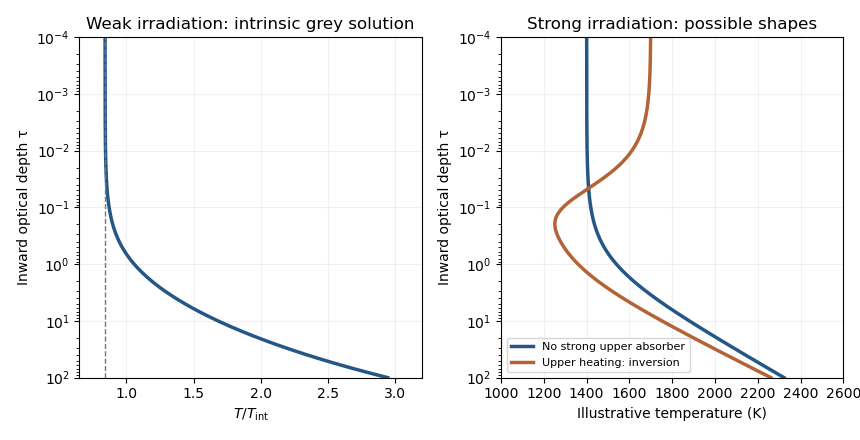
Intrinsic grey-atmosphere cooling profile compared with illustrative irradiated hot-Jupiter profiles
. Details. Pinned article: Introduction to the OurBigBook Project
Welcome to the OurBigBook Project! Our goal is to create the perfect publishing platform for STEM subjects, and get university-level students to write the best free STEM tutorials ever.
Everyone is welcome to create an account and play with the site: ourbigbook.com/go/register. We belive that students themselves can write amazing tutorials, but teachers are welcome too. You can write about anything you want, it doesn't have to be STEM or even educational. Silly test content is very welcome and you won't be penalized in any way. Just keep it legal!
Intro to OurBigBook
. Source. We have two killer features:
- topics: topics group articles by different users with the same title, e.g. here is the topic for the "Fundamental Theorem of Calculus" ourbigbook.com/go/topic/fundamental-theorem-of-calculusArticles of different users are sorted by upvote within each article page. This feature is a bit like:
- a Wikipedia where each user can have their own version of each article
- a Q&A website like Stack Overflow, where multiple people can give their views on a given topic, and the best ones are sorted by upvote. Except you don't need to wait for someone to ask first, and any topic goes, no matter how narrow or broad
This feature makes it possible for readers to find better explanations of any topic created by other writers. And it allows writers to create an explanation in a place that readers might actually find it.
Figure 1. Screenshot of the "Derivative" topic page. View it live at: ourbigbook.com/go/topic/derivativeVideo 2. OurBigBook Web topics demo. Source. - local editing: you can store all your personal knowledge base content locally in a plaintext markup format that can be edited locally and published either:This way you can be sure that even if OurBigBook.com were to go down one day (which we have no plans to do as it is quite cheap to host!), your content will still be perfectly readable as a static site.
- to OurBigBook.com to get awesome multi-user features like topics and likes
- as HTML files to a static website, which you can host yourself for free on many external providers like GitHub Pages, and remain in full control

Figure 2. You can publish local OurBigBook lightweight markup files to either OurBigBook.com or as a static website.
Figure 3. Visual Studio Code extension installation.
Figure 5. . You can also edit articles on the Web editor without installing anything locally. Video 3. Edit locally and publish demo. Source. This shows editing OurBigBook Markup and publishing it using the Visual Studio Code extension. 
- Infinitely deep tables of contents:




All our software is open source and hosted at: github.com/ourbigbook/ourbigbook
Further documentation can be found at: docs.ourbigbook.com
Feel free to reach our to us for any help or suggestions: docs.ourbigbook.com/#contact