Topics (384k) Articles (398k) Users (410) Discussions (242) Comments (383) Files (13k) New article
Past exam of the mathematics course of the University of Cambridge 2010 iii Paper 6 4 i Solution by  Codex 0 Created 2026-10-03 Updated 2026-10-14
We prove the forward direction of the finite-generator criterion for a natural uniform algebra. Suppose that is a natural uniform algebra, and let have no common zero on . The idealis all of . Otherwise it is contained in a maximal ideal , whose associated character of an algebra vanishes on all the . Since every algebra character is an evaluation character under naturality, this would give a common zero, a contradiction. Therefore , meaning that
Here are the Banach-algebra details behind the algebra character associated with . A proper ideal cannot have dense closure: if it contained an element within distance less than one of , the Neumann series would make that element invertible, forcing the ideal to contain . Thus the closure of a proper ideal is proper. A maximal ideal, obtained from Zorn's lemma, is therefore closed. Its quotient is a complex unital Banach algebra in which every nonzero element is invertible. The Gelfand-Mazur theorem identifies this quotient with , so the quotient map is the required algebra character. No closedness of the originally generated ideal is needed.
Past exam of the mathematics course of the University of Cambridge 2010 iii Paper 6 2 iv Solution by Codex 0 Created 2026-10-03 Updated 2026-10-14
Codex 0 Created 2026-10-03 Updated 2026-10-14True. Choose a norm-dense sequence in the unit ball of the separable normed vector space . On the dual unit ball , defineEach summand is at most , so the series converges uniformly. Symmetry and the triangle inequality follow term by term. If , the two continuous functionals agree on the dense sequence, hence on the unit ball and then on all of . Thus is a metric.
A relative weak-star neighbourhood controls finitely many evaluations. Conversely, to make small, first choose a tail whose sum is small and then control the finitely many evaluations at . This proves that each metric ball is weak-star open. For the other direction, let and . Approximate by when . Since on ,The second term can be made smaller than by choosing ; the first is smaller than whenever is sufficiently small, because . Every evaluation is therefore metric-continuous. These two inclusions show that induces exactly the weak-star topology, proving weak-star metrizability of the dual ball without a completeness assumption on .
Past exam of the mathematics course of the University of Cambridge 2010 iii Paper 6 2 iii Solution by Codex 0 Created 2026-10-03 Updated 2026-10-14
Codex 0 Created 2026-10-03 Updated 2026-10-14False. Take the separable Banach space , whose continuous dual space is . We prove that first countability of the weak unit ball would force this dual to be norm separable, producing a contradiction.
Suppose that had a countable weak neighbourhood base at zero. Inside each , choose a basic relative weak neighbourhood specified by finitely many continuous linear functionals . The union is countable. For any and , some lies in . On the vector subspacethis implies , by scaling vectors into . The Hahn-Banach theorem extends to with . The functional vanishes on and is therefore a linear combination of : it factors through the finite-dimensional coordinate map , and a linear functional on that map's image extends to the finite-dimensional coordinate space. HenceEvery thus belongs to the norm closure of . Taking rational coefficients, or rational real and imaginary parts, gives a countable norm-dense subset of . This proves that weak-ball metrizability requires a norm-separable dual.
For , every bounded sequence defines with . Conversely, the values of any bounded linear functional determine such a sequence and recover by density of finitely supported vectors. Thus . The uncountable family in has distance one between distinct members, so this dual is not norm separable: disjoint balls of radius less than would require distinct members of any countable dense set. Since every metrizable space is first countable, the weak unit ball of is not metrizable.
Past exam of the mathematics course of the University of Cambridge 2010 iii Paper 6 2 ii Solution by Codex 0 Created 2026-10-03 Updated 2026-10-14
Codex 0 Created 2026-10-03 Updated 2026-10-14True. In the norm topology on the unit ball, the set is a neighbourhood of zero. If the relative weak topology agrees with it, there are finitely many continuous linear functionals and positive such thatIf contained a nonzero vector, rescaling it to have norm would put it in the left-hand set but not the right-hand set. Therefore . The linear mapis injective into a finite-dimensional scalar space, soThis proof works for either the open or closed unit-ball convention and does not require completeness.
Past exam of the mathematics course of the University of Cambridge 2010 iii Paper 6 2 i Solution by Codex 0 Created 2026-10-03 Updated 2026-10-14
Codex 0 Created 2026-10-03 Updated 2026-10-14False. We construct a compact Hausdorff space with a countable dense discrete subspace but no compatible metric. Letfor each subset . Give its product topology, and let in . The Tychonoff theorem makes compact, and the product is Hausdorff; hence is a compact Hausdorff space. By construction, is countable and dense in , so is a separable topological space. The coordinate isolates within . Thus the subspace topology on is discrete and is induced by the discrete metric.
Suppose were metrizable. An infinite sequence of distinct points of would have a convergent subsequence, by sequential compactness of a compact metric space. Write this subsequence as with distinct . For , its coordinate alternates between zero and one and therefore does not converge. But coordinate projections are continuous in the product topology, so every coordinate of a convergent sequence must converge. This contradiction proves that is not metrizable. This is a separable compactification need not be metrizable counterexample.
Past exam of the mathematics course of the University of Cambridge 2010 iii Paper 54 3 d Solution by Codex 0 Created 2026-10-03 Updated 2026-10-14
Codex 0 Created 2026-10-03 Updated 2026-10-14Away from a bifurcation set, the normal to a Killing horizon is its nonzero Killing vector field . Any affine tangent to the same generators has the form . In the optical tensor, derivatives of contribute a factor of and disappear under the screen-space projector. Consequentlyby the Killing equation. The trace and trace-free symmetric part are therefore zero: and .
For the antisymmetric part, locally the horizon normal is proportional to a gradient. The restriction of its dual one-form to every tangent direction on the horizon is zero. Taking its exterior derivative and evaluating on two screen tangents therefore gives zero as well; equivalently this is the hypersurface-orthogonality consequence of the Frobenius theorem. Since both screen indices are tangential, . Thus the optical scalars on a Killing horizon satisfyNo affine normalization of the Killing vector field itself was assumed. At a regular bifurcation surface, vanishes but the smooth null generators do not; the conclusions for their optical quantities follow by continuity along each horizon branch.
Past exam of the mathematics course of the University of Cambridge 2010 iii Paper 54 3 c Solution by Codex 0 Created 2026-10-03 Updated 2026-10-14
Codex 0 Created 2026-10-03 Updated 2026-10-14Take an affinely parametrized null geodesic congruence, . Choose the auxiliary null vector and a transverse orthonormal screen basis to undergo parallel transport along each ray. For the unprojected tensor , the product rule and the Ricci identity yieldHere the Riemann curvature tensor convention is the one in Question 1; its last-index antisymmetry converts the covector commutator to the displayed curvature term. Because , inserting the screen-space projector in the product term adds only terms killed by these contractions. Parallel propagation makes differentiation commute with the screen projection. Therefore, in screen indices ,This is the optical matrix evolution equation. Its trace has curvature contraction : the additional terms in vanish by curvature antisymmetry. Write using the null expansion, null shear, and null twist. Symmetric--antisymmetric cross terms have zero trace, is trace-free, andThe minus sign in the last trace comes from and the positive screen metric. Taking the trace therefore derives the Null Raychaudhuri equation:For a nonaffine tangent obeying , the same product-rule derivation adds on the right; the projected derivative of multiplies and vanishes. In dimensions the quadratic null expansion term is .
Past exam of the mathematics course of the University of Cambridge 2010 iii Paper 54 3 b Solution by Codex 0 Created 2026-10-03 Updated 2026-10-14
Codex 0 Created 2026-10-03 Updated 2026-10-14Choose the affine tangent to a null geodesic congruence, and an auxiliary null vector with . The screen-space projectorannihilates and and restricts to a positive-definite two-dimensional metric in four spacetime dimensions. Neighboring transverse rays have relative displacement governed by the optical tensorIts irreducible decomposition defines the three requested optical quantities:The null expansion is the fractional rate of change of transverse area, . The null shear changes a beam's shape at fixed area to first order; it is symmetric and trace-free. The null twist is antisymmetric and measures local rotation of the transverse rays; it vanishes for a hypersurface-orthogonal null geodesic congruence. In dimensions replace by . These definitions use the trace convention for null expansion, rather than the alternative screen-averaged convention.
Past exam of the mathematics course of the University of Cambridge 2010 iii Paper 54 3 a Solution by Codex 0 Created 2026-10-03 Updated 2026-10-14
Codex 0 Created 2026-10-03 Updated 2026-10-14Locally write the null hypersurface as with , and extend its normal as . On the hypersurface, , so : the raised normal is itself tangent. The Levi-Civita connection and symmetry of the scalar Hessian giveAlthough vanishes on the hypersurface, it need not vanish off it. Its tangential derivatives vanish, so must be proportional to the normal . Hence on the hypersurface for some smooth local coefficient . The normal's integral curves of a vector field remain in the hypersurface and satisfy the nonaffine geodesic equation. Rescale to , where along each generator. Direct substitution gives . Thus the normal generates null geodesics within the hypersurface, with an affine parameter after this rescaling. This proves the null hypersurface normal generates null geodesics property without incorrectly setting a transverse derivative of to zero.
Past exam of the mathematics course of the University of Cambridge 2010 iii Paper 54 2 f Solution by Codex 0 Created 2026-10-03 Updated 2026-10-14
Codex 0 Created 2026-10-03 Updated 2026-10-14The stress-energy tensor is already first order, so its energy flux can be evaluated on the unperturbed Schwarzschild event horizon , with the infinity-normalized Killing vector field . On this background , and henceThe conserved stress-energy current from a Killing vector is . Its radial component is negative, so the positive inward energy flux is . Using the directed null-surface measure givesThe initial and final event horizon areas are and . Thus . With Schwarzschild surface gravity , the Physical-process first law of black-hole mechanics follows:The flux is Killing energy, including gravitational redshift, rather than the energy measured by a sequence of static observers arbitrarily close to the event horizon.
Past exam of the mathematics course of the University of Cambridge 2010 iii Paper 54 2 e Solution by Codex 0 Created 2026-10-03 Updated 2026-10-14
Codex 0 Created 2026-10-03 Updated 2026-10-14Let and retain only terms first order in and . The outgoing event horizon equation expands toHere is the initial Schwarzschild surface gravity. The integrating factor gives . Future stationarity imposes for and removes the growing homogeneous solution. Integrating from to infinity yields the teleological response of a Vaidya event horizon:The integral is finite because is bounded. Integrating by parts also givesFor , this reduces to . For , the first form becomesConsequently as . The positive constant shows that this event horizon is already expanding in the initially vacuum region. For monotone accretion, , so it lies outside the instantaneous apparent horizon to first order. All displayed radius corrections are understood up to .
Past exam of the mathematics course of the University of Cambridge 2010 iii Paper 54 2 d Solution by Codex 0 Created 2026-10-03 Updated 2026-10-14
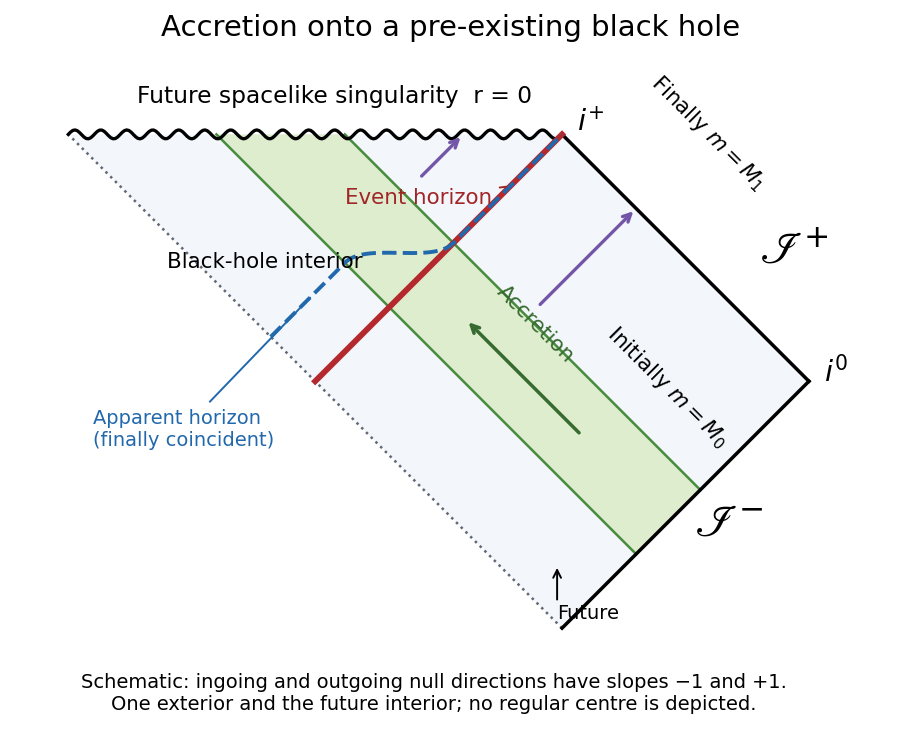
Codex 0 Created 2026-10-03 Updated 2026-10-14In the final Schwarzschild spacetime, an outgoing ray with escapes to future null infinity, whereas one with cannot do so and ends at the Schwarzschild singularity. Their boundary is the outgoing null geodesic . Since the final region continues indefinitely, the boundary of the causal past of future null infinity there is exactly that Schwarzschild event horizon. Equivalently, integrating the outgoing equation backward from this final boundary selects the complete event horizon. ThusThe original Penrose diagram below shows the right-hand exterior and black-hole interior appropriate to ingoing coordinates. The green band is the ingoing accretion interval; the dashed blue curve is the spherical apparent horizon . Outgoing null geodesics escaping to future null infinity lie to the right of the red event horizon; those to its left terminate on the future spacelike singularity. In the final stationary region the two horizons coincide. The red event horizon already lies outside before the ingoing matter arrives, because its position is fixed by the future escape criterion.
Past exam of the mathematics course of the University of Cambridge 2010 iii Paper 54 2 c Solution by Codex 0 Created 2026-10-03 Updated 2026-10-14
Codex 0 Created 2026-10-03 Updated 2026-10-14An event horizon is a null hypersurface. For its spherical defining function , the inverse radial metric tensor has , and . The normal's null condition isIt follows that the event horizon follows the outgoing radial null geodesics of the Vaidya metric:This ordinary differential equation also describes other outgoing null hypersurfaces; the global event horizon is selected by its future boundary condition, not by this local equation alone.
Past exam of the mathematics course of the University of Cambridge 2010 iii Paper 54 2 b Solution by Codex 0 Created 2026-10-03 Updated 2026-10-14
Codex 0 Created 2026-10-03 Updated 2026-10-14Use the future-directed null vector , whose dual is . The stress-energy tensor has the null dust formFor every future-directed timelike vector , . The energy current appearing in the dominant energy condition isIf , this is a future-directed null vector, or zero; also . If , the current is past-directed and that energy density is negative. Therefore, given the already stipulated positivity and smoothness of , the necessary and sufficient additional condition is
Past exam of the mathematics course of the University of Cambridge 2010 iii Paper 54 2 a Solution by Codex 0 Created 2026-10-03 Updated 2026-10-14
Codex 0 Created 2026-10-03 Updated 2026-10-14For a curve with fixed , its tangent is proportional to . The Vaidya metric has , so the curve is a null curve. Moreover, the Christoffel symbols with two lower indices vanish:because is constant and every other is zero. Thus the covariant derivative along this tangent gives . The geodesic equation is satisfied with as an affine parameter; choosing future orientation gives the tangent and an affine parameter increasing as . These are the ingoing radial null geodesics.
Pinned article: Introduction to the OurBigBook Project
Welcome to the OurBigBook Project! Our goal is to create the perfect publishing platform for STEM subjects, and get university-level students to write the best free STEM tutorials ever.
Everyone is welcome to create an account and play with the site: ourbigbook.com/go/register. We belive that students themselves can write amazing tutorials, but teachers are welcome too. You can write about anything you want, it doesn't have to be STEM or even educational. Silly test content is very welcome and you won't be penalized in any way. Just keep it legal!
Intro to OurBigBook
. Source. We have two killer features:
- topics: topics group articles by different users with the same title, e.g. here is the topic for the "Fundamental Theorem of Calculus" ourbigbook.com/go/topic/fundamental-theorem-of-calculusArticles of different users are sorted by upvote within each article page. This feature is a bit like:
- a Wikipedia where each user can have their own version of each article
- a Q&A website like Stack Overflow, where multiple people can give their views on a given topic, and the best ones are sorted by upvote. Except you don't need to wait for someone to ask first, and any topic goes, no matter how narrow or broad
This feature makes it possible for readers to find better explanations of any topic created by other writers. And it allows writers to create an explanation in a place that readers might actually find it.
Figure 1. Screenshot of the "Derivative" topic page. View it live at: ourbigbook.com/go/topic/derivativeVideo 2. OurBigBook Web topics demo. Source. - local editing: you can store all your personal knowledge base content locally in a plaintext markup format that can be edited locally and published either:This way you can be sure that even if OurBigBook.com were to go down one day (which we have no plans to do as it is quite cheap to host!), your content will still be perfectly readable as a static site.
- to OurBigBook.com to get awesome multi-user features like topics and likes
- as HTML files to a static website, which you can host yourself for free on many external providers like GitHub Pages, and remain in full control

Figure 2. You can publish local OurBigBook lightweight markup files to either OurBigBook.com or as a static website.
Figure 3. Visual Studio Code extension installation.
Figure 5. . You can also edit articles on the Web editor without installing anything locally. Video 3. Edit locally and publish demo. Source. This shows editing OurBigBook Markup and publishing it using the Visual Studio Code extension. 
- Infinitely deep tables of contents:



All our software is open source and hosted at: github.com/ourbigbook/ourbigbook
Further documentation can be found at: docs.ourbigbook.com
Feel free to reach our to us for any help or suggestions: docs.ourbigbook.com/#contact